


Phuket International Airport can be surprisingly confusing, especially when it comes to its terminals. Different websites, airlines and even locals still use older names like “Terminal 1” and “Terminal 2,” while official information now talks about an International Terminal and a Domestic Terminal. For a tired traveler arriving on a late flight or rushing to catch a domestic connection, choosing the wrong building can mean missed flights, extra stress and unexpected costs. This guide cuts through the naming confusion and explains, in practical terms, which terminal you actually need, how they connect, and what happens if you show up at the wrong one.
Get the latest updates straight to your inbox!
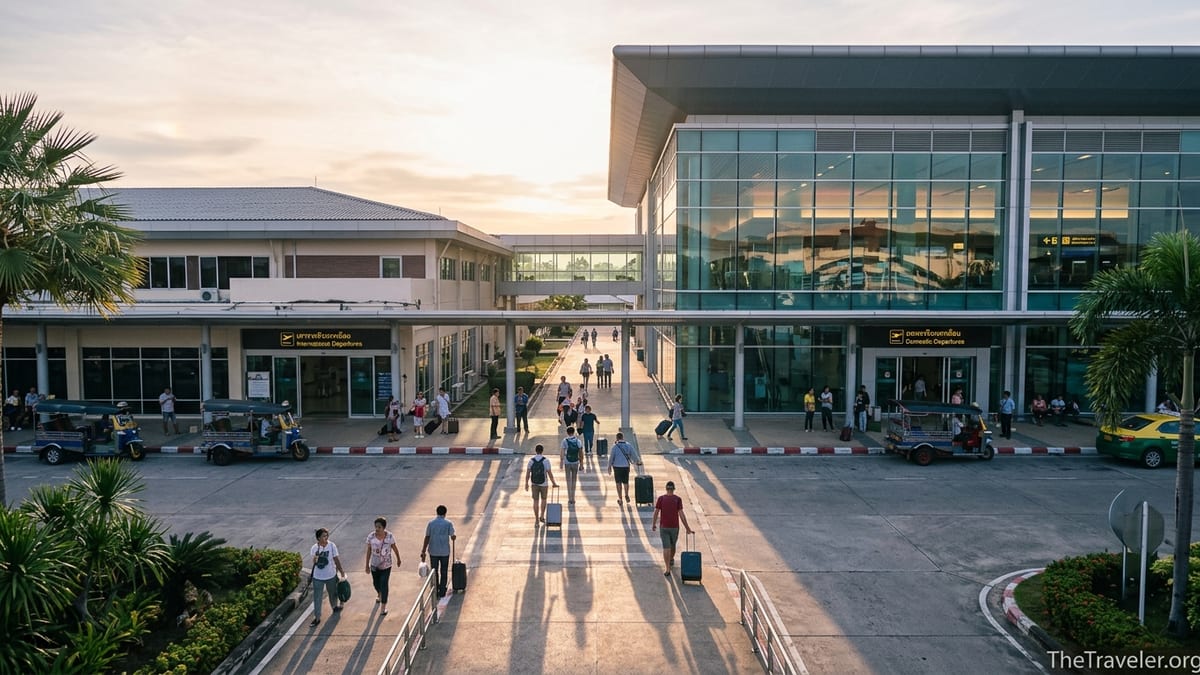
Phuket’s Terminal Confusion Explained in Plain Language
The first thing to understand about Phuket International Airport is that you will see different names for the same buildings. Officially, the airport has a large four-level International Terminal for flights to and from other countries, a smaller Domestic Terminal for flights within Thailand, and a small charter building sometimes called Terminal X, used mainly for seasonal or charter services. Many travel blogs and ticket confirmations, however, still label these as Terminal 1 and Terminal 2, which is where the confusion starts.
In practice, you can ignore most of the old terminology and focus on this simple rule: international flights use the International Terminal, domestic flights use the Domestic Terminal. If you are flying from Singapore, Dubai, Doha or Sydney directly into Phuket, you will arrive at the International Terminal. If you are flying Phuket to Bangkok, Chiang Mai, Udon Thani or Koh Samui, you will depart from the Domestic Terminal located next door, a short covered walk away.
Where Terminal 1 and Terminal 2 come in is mostly in how different sources describe the same buildings. Some current guides refer to the older domestic building as Terminal 1 and the newer international building as Terminal 2. Others reverse it and call the big international building Terminal 1 and the domestic side Terminal 2. When in doubt, ignore the number and look at whether your boarding pass, airline email or app says “International” or “Domestic” for Phuket, then follow that on the airport signs when you arrive.
To illustrate, imagine you booked a ticket from London to Phuket on Emirates, connecting to a separate Thai VietJet flight from Phuket to Bangkok. Your Emirates confirmation might list “HKT Terminal 1” for arrival, while a travel blog mentions that all international flights use “Terminal 2.” In reality, both are describing the same International Terminal. The key is that your onward flight to Bangkok departs from the Domestic Terminal next door, regardless of what number someone uses.
International vs Domestic: Which Terminal Does Your Flight Use?
For most travelers, the easiest way to decide which terminal you need is to look at where your flight is coming from or going to. If you are arriving from or departing to a country outside Thailand, you will use the International Terminal. This includes major hubs like Singapore, Kuala Lumpur, Hong Kong, Dubai, Doha, Abu Dhabi and long-haul destinations in Europe or Australia. Airlines such as Emirates, Qatar Airways, Etihad, Singapore Airlines and many charter carriers serving European holiday packages all check in and arrive at the International Terminal in Phuket.
Domestic flights, all within Thailand, use the Domestic Terminal. This is where you will find popular carriers like Thai Airways, Bangkok Airways, Thai AirAsia, Thai VietJet and Nok Air operating frequent services to Bangkok’s Suvarnabhumi and Don Mueang airports, Chiang Mai, Hat Yai, Udon Thani and smaller regional airports. If your ticket says HKT to BKK, DMK, CNX or another Thai airport code and lists the cabin as domestic, assume you will use the Domestic Terminal in Phuket.
There are a few edge cases. Some airlines operate through-checked services where you technically fly internationally but check in at domestic counters, or vice versa. For example, a passenger flying Sydney to Phuket to Bangkok entirely on Thai Airways might be checked in at the international side in Sydney, clear immigration in Phuket, then connect airside for a domestic leg. The baggage still comes out at the international reclaim in Phuket on the way in, even though the second sector is domestic. In these cases, follow the instructions on your itinerary and any stickers or tags airline staff put on your boarding pass at the origin airport.
Because airline terminal allocations can change during busy seasons, it is wise to double-check the Phuket terminal information on your airline’s website or app 24 hours before departure. If you are using a ride-hailing app or a pre-booked taxi, specify “International Terminal” or “Domestic Terminal” rather than “Terminal 1” or “Terminal 2” to avoid ending up at the wrong drop-off point.
Baggage Claim, Immigration and Customs: What Happens Where
On arrival at Phuket from an international flight, you will disembark into the International Terminal and follow signs for Immigration and Passport Control. After clearing immigration, you proceed to the baggage claim area dedicated to international arrivals. Here, luggage for overseas flights arrives on specific carousels, usually numbered separately from domestic ones. You then walk through customs, where officers may screen or briefly question passengers, especially those arriving from high-traffic tourist or shopping destinations.
If your journey continues onward within Thailand on a separate domestic ticket, you almost always need to collect your checked baggage in the International Terminal, clear customs, then walk over to the Domestic Terminal to re-check the bags. For instance, a traveler arriving from Frankfurt on a charter flight and continuing to Koh Samui on Bangkok Airways must first collect bags at the international carousel, pass through the customs channel, exit into the arrivals hall and then follow signs or walkways to the domestic departures building.
For purely domestic flights, such as Bangkok to Phuket, immigration and customs formalities are handled at your international gateway, not in Phuket. You arrive directly into the Domestic Terminal, walk to the baggage claim area for domestic flights, and exit into the public arrivals hall. If you are connecting domestically again, such as Bangkok to Phuket to Krabi on separate low-cost carriers, you will collect your luggage in the domestic reclaim, then check it in again for your next sector, just as you would at any other Thai airport.
There are special through-check procedures when you are on a single ticket that pairs an international flight with a domestic connection. In some cases, a sticker or stamp on your boarding pass indicates that your bags are checked through to your final domestic destination. You may still pass immigration in Phuket, but your luggage is routed to the correct carousel and you may collect it in a different area than passengers terminating in Phuket. Because these arrangements can vary by airline and ticket type, ask the check in staff at your origin airport to confirm exactly where you will collect your bags and whether you need to re-check them at Phuket.
Moving Between Terminals: Walking, Signage and Timing
One of the most reassuring things about Phuket International Airport is that the International and Domestic terminals are physically very close. They sit side by side along the same frontage road, separated by only a few minutes’ walk. A covered walkway links the buildings, and it is common to see passengers wheeling suitcases between them. Even if your taxi or minivan drops you at the wrong building, you can almost always walk to the other terminal without needing to re-enter security or cross any busy public roads.
From the International Terminal arrivals exit, you step outside, follow the curbside path and signage pointing to “Domestic Terminal,” and simply walk along the frontage. The stroll usually takes about 5 to 10 minutes at a normal pace, depending on how much luggage you are carrying and how crowded the sidewalks are. Inside, the second level of the international building also connects to the domestic departure level via a passage, which is useful if you are transferring airside or following airline directions for a through-checked domestic connection.
If you arrive very late at night or in heavy rain, the walk can feel longer, especially if you are traveling with children or heavy bags. In these situations, local taxi drivers and airport transfer desks may offer a short ride between terminals, but many travelers simply choose to walk under the covered sections. Give yourself adequate time. If you are connecting from an international flight to a separate low-cost domestic ticket and must clear immigration, collect baggage, walk to the Domestic Terminal and check in again, aim for at least 2.5 to 3 hours between scheduled arrival and departure.
In the other direction, if you land on a domestic flight and will later depart internationally from Phuket, you exit the Domestic Terminal arrivals hall and follow the same frontage walkway in reverse toward the International Terminal. Look for signs that say “International Departures” and “Check-in.” When using ride-hailing apps or arranging hotel pickups, confirm the exact meeting point, such as “International Terminal outside Exit 3” or “Domestic Terminal arrivals curb,” to avoid standing in the wrong building when your driver arrives.
Airline Examples: Who Uses Which Terminal in Practice
To make the terminal distinctions more concrete, it helps to map real routes and airlines to the right buildings. A typical European holidaymaker might arrive on a TUI, Condor or other charter-style flight from Germany, the UK or Scandinavia. These services use the International Terminal for both arrival and departure. Once in Phuket, the same traveler might later book a Thai AirAsia flight to Bangkok Don Mueang to connect onwards to a budget airline back to Europe. That Thai AirAsia flight operates entirely from the Domestic Terminal, with check in, security and boarding all from the domestic side.
Gulf carriers such as Emirates, Qatar Airways and Etihad operate long-haul services from Dubai, Doha and Abu Dhabi into Phuket. These routes use the International Terminal. A passenger landing on Qatar Airways from Doha and then transferring to a domestic Thai VietJet flight to Chiang Mai on a separate ticket will clear immigration and customs at Phuket’s International Terminal, walk over to the Domestic Terminal, then check in for the Chiang Mai flight at the Thai VietJet counters and proceed through domestic security.
Regional carriers like Singapore Airlines, Scoot, AirAsia (from Kuala Lumpur or Singapore), Jetstar and others also arrive and depart through the International Terminal when operating cross-border routes. In contrast, when those same brands operate flights purely within Thailand, they use the Domestic Terminal. As an example, a traveler could fly Singapore to Phuket on Scoot, arriving at the International Terminal, and later fly Phuket to Bangkok on Thai AirAsia from the Domestic Terminal, all within the same week.
Thai full-service carriers such as Thai Airways and Bangkok Airways often handle complex itineraries that combine international and domestic legs on a single ticket. In these cases, your experience at Phuket might differ from a simple point to point trip. If you fly Frankfurt to Phuket to Bangkok entirely on Thai Airways, you may check in and drop bags at the Frankfurt counter, then collect them in Phuket’s international baggage claim, clear customs and re-check in for the domestic segment, or you may follow dedicated transfer signage if Thai has arranged an airside connection. The key is to pay close attention to the instructions printed on your boarding passes and the airport staff’s directions when you land.
Wrong-Terminal Risks: What Can Go Wrong and How to Avoid It
While Phuket’s terminals are close together, getting them wrong at the wrong time can still create real problems. The most common scenario is a passenger with a tight domestic connection arriving at the International Terminal and needing to re-check bags at the Domestic Terminal. If the incoming international flight is delayed by an hour and the passenger only allowed 90 minutes between landing and the domestic departure, simply walking between buildings and queuing again at check in and security may not be possible. In peak season, domestic check in lines can stretch 20 to 30 minutes or more, and security queues may build up in the evening wave.
Another frequent issue involves taxi and transfer drivers waiting at the wrong arrivals hall. For example, a hotel might assume your flight is domestic because you arrived from Bangkok, when in fact you flew in internationally from Europe, cleared immigration in Phuket and emerged from the International Terminal. If your driver stands in the domestic arrivals hall, you might spend half an hour trying to locate each other by phone, which is especially stressful after a long overnight flight. Sharing a screenshot of your itinerary that clearly labels “International Arrivals” or explicitly stating “International Terminal” when you book your transfer helps prevent this.
There is also a less obvious risk when airlines and booking sites label Phuket terminals inconsistently. A traveler might see “Terminal 1” printed on an older e-ticket and “Terminal 2” mentioned in a blog and assume they are different buildings widely separated, like at some larger airports. In reality, both labels might refer to the same structure. This can lead to unnecessary anxiety and even premature airport runs. One way to avoid this is to disregard the number entirely and call your airline or check its app to confirm whether your flight uses the domestic or international side. If your carrier does not specify, assume that flights to and from other countries use the International Terminal and flights inside Thailand use the Domestic Terminal, then verify on the departure screens when you arrive.
Finally, there are financial consequences. Missing a separate low-cost domestic ticket because you underestimated the walk between terminals or misread which building to use often means buying a last-minute replacement fare. On popular routes like Phuket to Bangkok or Chiang Mai in high season, same-day walk up fares on low-cost airlines can easily cost significantly more than your original ticket. Building in a buffer of at least 2.5 to 3 hours for any international to domestic self-connection at Phuket, and confirming the correct terminal well in advance, is a simple way to protect both your schedule and your wallet.
Practical Tips for a Smooth Terminal Experience
To navigate Phuket’s terminals confidently, start by checking your airline’s official communication. When you receive your booking confirmation or mobile boarding pass, look for clear labels such as “International” or “Domestic” at Phuket. If the document instead shows “Terminal 1” or “Terminal 2” without explanation, visit the airline’s website or contact its support to clarify which physical building that corresponds to today. Remember that the naming has changed over time, so user forums and older travel articles may not match the current airport signage.
When planning transfers, keep the entire sequence in mind rather than each leg in isolation. For an itinerary such as Dubai to Phuket on Emirates and then Phuket to Krabi on a separate Thai AirAsia booking, factor in the need to clear immigration at Phuket, collect your luggage in the International Terminal, walk to the Domestic Terminal, re-check your bags and go through domestic security. Assuming everything runs on time, this can be comfortable in about 2.5 hours, but allowing 3 hours or more provides a buffer for delays and queues at immigration or baggage claim.
Inside the terminals, pay attention to bilingual signage. Directions are posted in both Thai and English, and icons for arrivals, departures, baggage claim, immigration and transfers are generally clear. If you are unsure, do not hesitate to ask uniformed airport staff or airline ground agents which way to go. For example, if your ticket says “Domestic Departures via International Terminal Level 2,” a staff member can confirm whether you should proceed through the international entrance and follow an internal walkway, rather than exiting to the curbside and walking outside.
For groups or families, agree on a specific meeting point if you are arriving on different flights into different terminals. A common strategy is to choose a central location, such as the arrivals area of the International Terminal near a prominent café or information counter, and have the first person to land walk from the Domestic Terminal to meet the others. This avoids everyone wandering between buildings looking for each other and simplifies shuttle or taxi pickups after you all regroup.
The Takeaway
Phuket International Airport’s shifting terminology for its terminals has created a fair amount of confusion, but the underlying structure is simple. One building handles international flights, the other handles domestic flights within Thailand, and they sit just a short walk apart. Old references to Terminal 1 and Terminal 2 often describe the same buildings under different names, which is why focusing on whether your flight is international or domestic is far more reliable than memorizing terminal numbers.
If you are flying into Thailand from abroad, you will almost certainly use the International Terminal at Phuket for both arrival and departure. Once you start or continue your journey inside the country, the Domestic Terminal next door becomes your base. Understanding how baggage claim, immigration, customs and the short walkway between the two buildings fit together will help you plan realistic connection times and coordinate with drivers, hotels and travel companions.
With a bit of advance planning and a willingness to ignore outdated labels, Phuket’s terminal layout is less intimidating than it first appears. Check your airline’s latest instructions, allow generous time for any international to domestic self-connection, and always specify “International” or “Domestic” when arranging transport. Do that, and you can treat the airport as it should be: a brief, manageable gateway to the beaches, islands and towns that brought you to Phuket in the first place.
FAQ
Q1. Which terminal do I use if my ticket just says “HKT Terminal 1”?
If your flight is international, “Terminal 1” almost certainly refers to the main International Terminal. If it is a domestic Thai flight, it will use the Domestic Terminal. When in doubt, confirm with your airline and follow the airport signs for International or Domestic rather than relying on the number.
Q2. How long does it take to walk between the International and Domestic terminals at Phuket?
The walk between the two buildings usually takes about 5 to 10 minutes at a normal pace using the covered walkway along the frontage. Allow extra time if traveling with children, large luggage or during heavy rain, and remember you still need time for check in and security at your next terminal.
Q3. I arrive internationally in Phuket and have a separate domestic ticket. Is 90 minutes enough?
Ninety minutes is risky. You must clear immigration, collect bags, walk to the Domestic Terminal, check in again and pass security. For separate tickets, aim for at least 2.5 to 3 hours between scheduled arrival and your domestic departure to reduce the chance of missing your flight.
Q4. Do I collect my baggage in the International or Domestic Terminal when connecting?
On separate tickets, you almost always collect your baggage where you first enter Thailand or finish the previous leg, which is usually the International Terminal for overseas flights. On a single ticket with through-checking, the airline may route your bags to your final destination. Always ask at your original check in desk exactly where you will pick up your luggage in Phuket.
Q5. Can I stay airside when transferring from an international flight to a domestic one at Phuket?
In most cases, you exit the secure area, clear immigration and customs, then re-check in on the domestic side. Some airlines offer specific transfer procedures on single tickets, but these are not guaranteed for all routes. Unless your airline clearly instructs you to stay airside, plan on going landside and walking between terminals.
Q6. My hotel driver is picking me up. What should I tell them about the terminal?
Tell your hotel or driver whether your flight is international or domestic and specify “International Terminal arrivals” or “Domestic Terminal arrivals” together with your flight number and arrival time. Avoid using only “Terminal 1” or “Terminal 2,” as people interpret these labels differently and it can lead to missed pickups.
Q7. Are there lounges in both terminals at Phuket Airport?
Yes, there are lounges in both the International and Domestic terminals, although the selection and standards differ. Full-service airlines often have branded lounges in their primary terminal, while independent pay in lounges may be available on both sides. Check your airline’s website or lounge membership app to see exactly which lounge you can use and which building it is in.
Q8. What happens if I go to the wrong terminal for check in?
If you arrive at the wrong building, you will need to walk to the correct one, which can cost you valuable time, especially close to check in closing. If you realize your mistake early, explain your situation to airport staff, who can point you to the quickest walkway. However, airlines are not obligated to hold the flight if you are late because you went to the wrong terminal.
Q9. Do domestic flights at Phuket have immigration or customs checks?
Purely domestic flights within Thailand do not require immigration on arrival or departure at Phuket, but your bags may still pass through standard security screening. Immigration and customs inspections apply when you are entering or leaving Thailand on international flights at the International Terminal, or when special transfer procedures require it.
Q10. How early should I arrive at Phuket Airport for international and domestic departures?
For international departures from Phuket, aim to arrive at the International Terminal about 3 hours before your flight, especially in high season. For domestic flights from the Domestic Terminal, 1.5 to 2 hours is usually sufficient. If you are unfamiliar with the airport, traveling in peak periods or moving between terminals, err on the side of arriving earlier.