


Landing at Rafael Núñez International Airport in Cartagena and heading straight to a beach hotel in La Boquilla is one of the easiest airport-to-sand transfers in Colombia. The airport sits on the same coastal strip as La Boquilla, so instead of fighting traffic across the entire city, you simply follow the shoreline north a few kilometers. With the right plan, you can be in your swimsuit and on the sand roughly 15 to 25 minutes after stepping out of arrivals.
Get the latest updates straight to your inbox!
Why La Boquilla Is the Easiest Beach Zone From the Airport
Rafael Núñez International Airport is located in the Crespo neighborhood, on Cartagena’s northern shoreline between the Caribbean Sea and the Ciénaga de la Virgen lagoon. La Boquilla begins only a short drive further up the same coastal road, which means most travelers heading for La Boquilla avoid the dense traffic and busy junctions that separate the airport from the historic center, Getsemaní, and Bocagrande. In practice this translates into shorter, more predictable journeys with fewer bottlenecks.
Distances are compact. Depending on where your hotel is, La Boquilla is typically 6 to 9 kilometers from the airport by road. In normal daytime conditions, a taxi or Uber will often cover that in 15 minutes, stretching to around 25 minutes during rush hour or heavy weekend beach traffic. By comparison, reaching popular hotels in Bocagrande or the walled city can take significantly longer, especially when cruise ships are in port or during festivals.
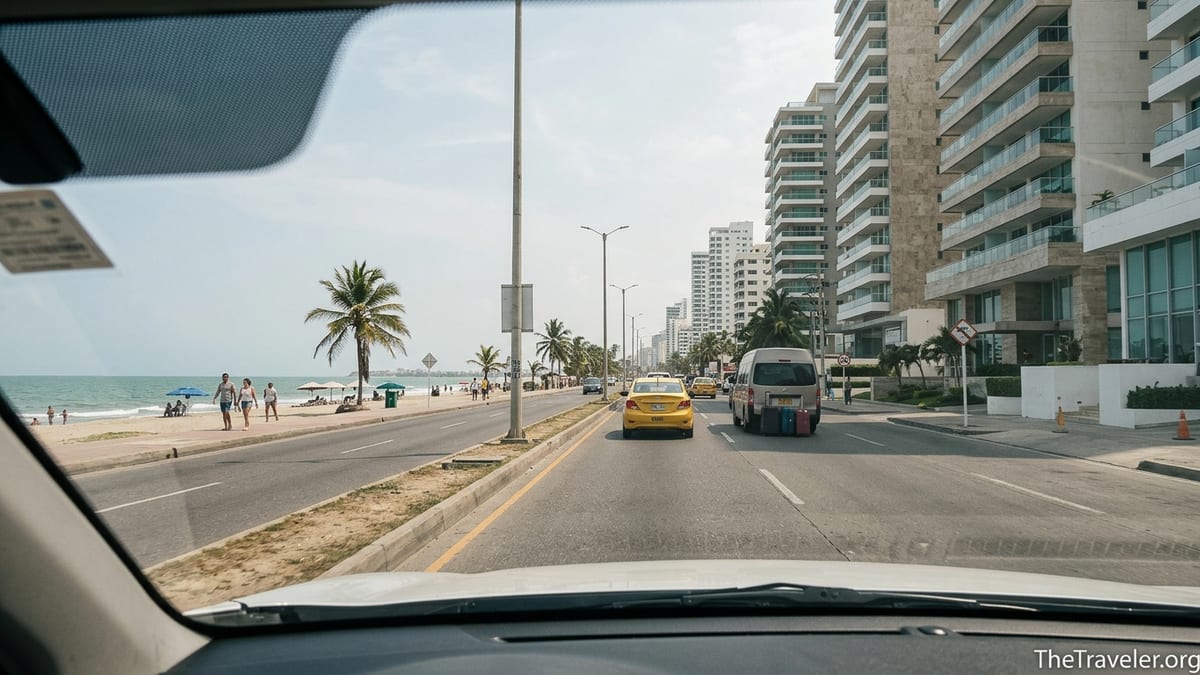
La Boquilla is also a straight shot from the terminal. Once you leave the airport grounds, the coastal highway quickly narrows into a single main axis that runs between the beachfront high-rises of the Morros and Las Américas area on one side and the lagoon and traditional fishing village on the other. You are never far from the sea, and your driver has only a small number of turns to make. For tired arrivals on late-night flights, that simplicity is a major advantage.
The beach itself is one of the main reasons travelers choose to stay here. The shoreline in La Boquilla tends to feel more relaxed than the busy, vendor-heavy beaches in Bocagrande. Many hotels sit directly on the sand or just across the road, so once your driver drops you at the lobby you are only steps away from the water. This ease of access, combined with the short transfer, makes La Boquilla a practical base for families and couples who want to front-load their trip with some quiet beach time.
Understanding the La Boquilla Beach Hotel Zones
La Boquilla stretches along the northern coast beyond the airport and includes a mix of resort-style towers, condo-hotels, and small local guesthouses. For transfers, it helps to think of the area in three overlapping zones. Closest to the airport are the large beachfront complexes around Hotel Las Américas and Sonesta Hotel Cartagena, followed by the cluster of modern Morros-branded apartment towers, and then the more traditional village core with smaller hotels and beach cabanas.
The “Las Américas / Zona Norte” segment is the most resort-like. Properties such as Hotel Las Américas Torre del Mar, Hotel Las Américas Casa de Playa, and Sonesta Hotel Cartagena offer large pools, kids’ areas, and direct beach access. Drivers at the airport are very familiar with these hotels, so you can simply say “Las Américas” or “Sonesta en La Boquilla” and most taxi dispatchers will understand the destination immediately.
Further along the same road are the Morros developments, where many visitors book apartments or condo-style suites that operate similarly to hotels. Names such as Morros Eco, Morros Ultra, Morros Epic, and Morros Vitri show up frequently on booking platforms. They line the beach side of the road with private pools, small beach clubs, and direct sand access. Drivers usually recognize the Morros towers by name, but it is helpful to have the exact tower and street number ready on your phone.
North of the big towers, the scene becomes more village-like. Here you will find smaller hotels and guesthouses, such as simple beachfront inns and locally owned hostales, along with beach shacks and seafood restaurants. The addresses may be less precise, so travelers often show a pin from a map app or a screenshot of their booking. Even in this less formal stretch, the route remains straightforward: the main road hugs the beach, and your driver drops you directly at the nearest access point or side lane to your lodging.
Taxi From Rafael Núñez Airport to La Boquilla
Official taxis are the most straightforward and widely used option from Rafael Núñez Airport to La Boquilla. Outside the arrivals area you will find a clearly marked official taxi stand with dispatch staff. Fares are regulated by the city and updated periodically, and in 2026 there is a specific tariff table for different city zones including La Boquilla. Rather than bargaining in the parking lot, you request your destination at the desk and receive a printed or written fare based on the official schedule.
For a typical ride from the airport to a hotel in the Las Américas or Morros sector of La Boquilla, recent travelers report paying in the range of around 25,000 to 35,000 Colombian pesos, which is roughly 6 to 9 US dollars at current exchange rates. Exact amounts vary with fuel adjustments and small zone differences, but the key point is that the price is fixed before you get in the cab. You pay the driver in pesos at the end of the ride, and tipping is optional; rounding up a couple of thousand pesos for good service is appreciated.
With luggage, taxis are particularly convenient. Most airport taxis are compact sedans, but there are also slightly larger vehicles in circulation. A couple with two large suitcases and hand luggage will generally fit comfortably in a standard yellow taxi. Families or groups carrying multiple large suitcases or sports equipment such as surfboards might prefer to request a larger vehicle in advance through their hotel or to consider a prebooked private transfer with guaranteed trunk space.
Traffic between the airport and La Boquilla is usually light compared with central Cartagena routes, but peak hours can slow things down. Expect around 15 minutes in off-peak periods and 20 to 25 minutes around weekday rush hours and sunny weekend mornings when locals flock to the beach. Because the route does not require crossing the city’s main congestion points, even at busy times the taxi journey to La Boquilla tends to be less stressful and more predictable than rides to Bocagrande or the historic center.
Uber and Ride-Hailing: What to Expect in 2026
Ride-hailing services such as Uber continue to operate in Cartagena in 2026, although, as in many parts of Colombia, they function within a somewhat gray regulatory framework. The Uber app lists Rafael Núñez Airport and includes instructions for pickup zones, and recent passengers report using Uber successfully between the airport and both city and beach neighborhoods. The app will show an estimated price for your ride to La Boquilla, often similar to, or slightly below, the official taxi rate for the same journey.
In practice, the availability of Uber vehicles at the airport varies by time of day and season. During busy evening arrival banks, especially when several international flights land close together, you may find multiple drivers nearby and short wait times. In quieter mid-afternoon or late-night windows, coverage can be thinner. Some travelers open both the Uber app and a local taxi app, such as one of the major Colombian ride platforms, and choose whichever shows the quickest pickup and clearest price.
When using ride-hailing at Rafael Núñez, expect your driver to suggest a slightly less visible meeting point than the front rank used by official taxis. Common practice is to walk a short distance to a nearby side street or designated pickup zone, following directions in the app. With luggage this is still manageable, as the distances are short. Payment by card through the app helps avoid currency confusion for newly arrived visitors, although keeping some pesos on hand is wise in case the driver requests a small cash supplement for tolls or airport access.
Because La Boquilla lies directly along the coastal route and is well known to local drivers, there is little risk of confusion or detours on Uber trips. You simply confirm the hotel name in the app, verify that the pin matches your actual accommodation, and then follow your route in real time. Riding apps can be a good choice for solo travelers who prefer not to handle cash immediately on arrival, or for guests returning from the city later in the evening who want door-to-door service back to their beach hotel.
Private Transfers and Hotel-arranged Transport
Many mid-range and higher-end properties in La Boquilla offer private transfers from Rafael Núñez Airport, either as part of a package or at an additional charge. Resorts such as Hotel Las Américas and Sonesta Hotel Cartagena, along with several Morros buildings that operate as condo-hotels, can arrange an air-conditioned vehicle and driver to meet you in the arrivals hall with a sign. While this typically costs more than a standard taxi, it provides certainty and can be especially attractive after long-haul or red-eye flights.
Prices for private transfers vary according to vehicle size and hotel policy, but as a rough reference, travelers in 2026 often report quotes starting in the range of 70,000 to 120,000 Colombian pesos for a private car for two to four passengers for the short trip to La Boquilla. Larger vans for families or groups with lots of luggage cost more. The advantage is that the rate is fixed in advance, often paid via card or added to your room bill, and the driver already knows your accommodation details.
Private transfers also solve potential luggage and comfort issues. If you are arriving with several large checked bags, baby gear, or sports equipment, a prebooked van gives you guaranteed space. Drivers are accustomed to handling baggage and will usually accompany you from the arrivals exit to the vehicle, load everything carefully, and help you unload at the hotel reception or apartment lobby. For parents traveling with young children, many transfer companies can provide child seats if requested ahead of time.
Some independent tour operators and local agencies in Cartagena also sell combined services such as “airport pickup plus mangrove tour” that start from La Boquilla. In these packages, you are collected at the airport, taken to your La Boquilla lodging to drop bags, and then continue on an afternoon excursion through the mangrove canals or to nearby beach restaurants. While more niche, these options underline how straightforward the airport to La Boquilla link has become in the city’s tourism infrastructure.
Travel Time, Traffic Patterns, and Luggage Tips
Under normal conditions, the drive from Rafael Núñez Airport to a beachfront hotel in La Boquilla often takes around 15 minutes. This is during typical off-peak windows such as mid-morning or mid-afternoon on weekdays. During local rush hours, roughly 7:00 to 9:00 in the morning and 4:30 to 7:00 in the evening, or on sunny weekend mid-mornings when beach traffic is highest, the journey may extend to around 20 to 25 minutes. Extremely heavy congestion is less common on this strip than in the city center because the road is more linear and has fewer intersecting arteries.
Weather can play a role. During periods of intense rain, particularly in the wetter months, drainage can be an issue on some parts of the coastal route, and puddling or localized flooding may slow traffic. Even so, the route to La Boquilla generally remains more reliable than routes that cross central Cartagena, since there are fewer alternative paths and drivers tend to know the best lines along the coast. If you are catching a return flight in the early morning, most hotels in La Boquilla recommend leaving 45 to 60 minutes before your check-in time as a comfortable buffer.
For luggage, think about both capacity and handling. Standard airport taxis in Cartagena can comfortably manage two large checked suitcases and small carry-ons. If you are a group of three or four adults each with a big bag, it may be wiser to ask your hotel to call a larger vehicle or to book a private transfer. When reserving condo-style accommodation in Morros towers, confirm whether the building has ramps and service elevators near the main entrance; most do, which makes moving suitcases from the car to the lobby and up to your unit straightforward.
On arrival, keep essentials such as passports, phones, and a change of clothes in your carry-on, rather than in checked luggage, just in case bags are delayed. Cartagena’s climate is typically hot and humid, so light fabrics and sandals near the top of your bag will be useful if your room is not yet ready when you reach the hotel. Most properties in La Boquilla offer luggage storage, allowing you to leave your bags securely at reception and head straight to the beach or pool while you wait for check-in.
Why La Boquilla Beats Crossing the Whole City After a Flight
From a logistical standpoint, the main reason La Boquilla is easier than staying across town is the simplicity of the route. Leaving the airport for the historic center or Bocagrande involves weaving through mixed commercial and residential areas, traffic lights, and crowded junctions. During peak times, it is common to encounter stop-and-go traffic that can lengthen what looks like a short distance on the map into a 30 to 45 minute or longer journey. In contrast, the road to La Boquilla largely follows the coastline in a straight line, with fewer interruptions and fewer decision points for the driver.
This simplicity pays off at the end of a long travel day. Instead of navigating urban congestion, horns, and frequent stops, you spend most of your transfer watching the Caribbean Sea on one side and the lagoon on the other. The psychological effect is notable: you feel you have already escaped into a calmer space before you even reach your hotel. Families with tired children, older travelers, and anyone arriving late in the evening particularly appreciate being able to reach their room, shower, and rest within a short time of landing.
La Boquilla’s position also works well if you plan to split your time between the beach and the city. Many visitors choose to spend the first few nights in a La Boquilla resort to decompress, then move for a couple of nights into a boutique hotel inside the walled city. Because the airport is on the same side of town as La Boquilla, that initial arrival is the least complicated segment of the trip. You only tackle city traffic later, once you are rested and more familiar with local transport options.
For departures, being on the same corridor as the airport removes much of the anxiety that can come with early morning flights. Even if there is a minor incident or extra traffic on the road, local taxis and private drivers know alternative side streets through Crespo that feed back to the airport. In practice, travelers leaving from La Boquilla rarely report major delays reaching Rafael Núñez, whereas guests leaving from denser neighborhoods sometimes build in more generous time cushions to compensate for unpredictable traffic.
Safety, Practicalities, and Choosing the Right Option for You
Overall, both the airport and the La Boquilla corridor are well traversed by tourists, locals, and workers, and daytime transfers between the two are considered routine. As always in busy Latin American cities, standard precautions apply. Keep valuables such as phones and wallets close to your body, avoid flaunting expensive jewelry, and use official taxi ranks, ride-hailing apps, or hotel-arranged drivers instead of accepting unsolicited offers in the parking lot. Traveling in pairs or groups at night is sensible, though many flights arrive after dark and guests still reach La Boquilla without incident.
In deciding among taxi, Uber, or private transfer, think about your priorities. If you want the simplest, most widely available option, the official airport taxi line is hard to beat. You step out of arrivals, queue briefly, state “La Boquilla, Hotel Las Américas” or another hotel, and receive a standard fare. If you are more cost-sensitive and already have mobile data, you might check Uber or another ride-hailing app to compare prices and pickup times. For travelers who place a premium on comfort and certainty, pre-arranged hotel transfers are worth the higher price.
It is also worth considering your schedule. For late-night arrivals when you may feel tired, or when traveling with children, knowing that a named driver will be waiting in arrivals with a sign and a larger vehicle can reduce stress significantly. Conversely, during the daytime when taxis are plentiful and traffic is light, the convenience of stepping into the first official cab is often sufficient. In all cases, having your hotel’s name and address written clearly, ideally in Spanish, and saved on your phone or printed out, makes communication with your driver smoother.
Finally, keep cash and connectivity in mind. Having at least a small amount of Colombian pesos on arrival, either withdrawn from an airport ATM or exchanged in advance, lets you pay taxis and tip porters without searching for change. A functioning local SIM card or roaming plan helps you use ride-hailing apps and map services. Once you are settled in La Boquilla, you can then explore further afield, from the mangroves behind the village to the old city, knowing that your home base is only a short and simple ride from the airport.
FAQ
Q1. How long does it usually take to get from Rafael Núñez Airport to La Boquilla?
The drive typically takes around 15 minutes in light traffic and up to about 25 minutes during peak periods or busy weekend beach hours.
Q2. How much should I expect to pay for a taxi from the airport to La Boquilla?
With the current regulated fares, most travelers pay roughly 25,000 to 35,000 Colombian pesos for a one-way official taxi to La Boquilla, depending on the exact hotel zone.
Q3. Is Uber available between the airport and La Boquilla?
Yes, Uber and similar ride-hailing apps operate in Cartagena, and many visitors successfully use them between Rafael Núñez Airport and La Boquilla, although availability can vary by time of day.
Q4. Are private transfers worth it for such a short distance?
Private transfers cost more than regular taxis but can be worth it if you arrive late, are traveling with a family or a lot of luggage, or simply want a confirmed driver waiting for you.
Q5. Can I fit large suitcases in a standard Cartagena taxi?
Two large checked bags plus carry-ons usually fit in a standard yellow taxi, but groups with multiple large suitcases may be more comfortable in a larger prebooked vehicle.
Q6. Is the route from the airport to La Boquilla safe at night?
The coastal route is well traveled, and many passengers transfer after dark. Using official taxis, ride-hailing apps, or hotel-arranged drivers is the safest and most practical choice.
Q7. How do I tell the driver exactly where in La Boquilla I am staying?
Have your hotel or apartment name, address, and a map pin saved on your phone. Drivers are familiar with major properties like Las Américas, Sonesta, and the Morros towers.
Q8. Why is La Boquilla easier to reach than Bocagrande or the walled city?
La Boquilla lies along the same coastal strip as the airport, so you follow a relatively direct shoreline road instead of crossing congested central streets and junctions.
Q9. Do La Boquilla hotels help arrange transfers back to the airport?
Yes, most hotels and condo-hotels in La Boquilla can book a reliable taxi or private car for your return, often at a fixed rate, and will advise when to leave for your flight.
Q10. Is it practical to stay in La Boquilla and still visit Cartagena’s historic center?
Yes, many travelers base themselves in La Boquilla for the beach and take taxis or ride-hailing cars 15 to 25 minutes into the walled city for sightseeing, dining, and nightlife.