


Keflavik International Airport is the main gateway to and from Iceland, and for many travelers it is both compact and efficient. At busy times, though, the departure process can feel confusing if you do not know what to expect. This guide walks you step by step from check-in to boarding, with current information on when to arrive, how security and passport control work, and where to eat, shop and claim tax-free refunds before your flight.
Get the latest updates straight to your inbox!
How early to arrive for departures from Keflavik
Keflavik is relatively small compared with many major European hubs, but it handles intense waves of traffic, especially early morning and late afternoon when transatlantic flights converge. Airport and tourism authorities generally advise arriving around 3 hours before departure for international flights, particularly if you need to check bags, return a rental car or are traveling in peak season such as June to August or over holiday periods. In quieter months like November or February, regular travelers often find that 2 to 2.5 hours is sufficient, but first-time visitors are usually more comfortable sticking with 3 hours.
Real-world experiences vary by time of day. A common pattern is that passengers arriving at the terminal around 6:00 in the morning for a 9:00 departure often clear check-in and security in under 30 minutes, then have ample time for breakfast and duty-free shopping. On the other hand, if several North America and Europe departures cluster between 9:00 and 11:00, security and passport control lines can build quickly, and a traveler arriving only 90 minutes before departure may find themselves moving directly from queue to queue with little margin for delays.
Many airlines at Keflavik open their check-in counters around 2 to 3 hours before departure. Some carriers, such as Icelandair and major European network airlines, support online check-in and bag-drop kiosks for eligible passengers, which can shorten the process. A typical scenario for a Reykjavik hotel guest is a coach transfer that leaves the city 3.5 to 4 hours before flight time, arriving at the airport roughly 2 to 2.5 hours before departure. This usually works well, but those returning rental cars should still allow an extra 20 to 30 minutes before check-in closing to handle fuel, inspection and shuttle time back to the terminal.
When deciding your own timing, consider your risk tolerance and any special circumstances. Families with small children, travelers who need assistance, those carrying sports equipment or oversize baggage, and anyone making a same-day connection from a domestic flight at Reykjavik City Airport are better off building in extra buffer. Conversely, if you are traveling with only a cabin bag, already checked in online, and departing in a quieter late evening window, you may be comfortable aiming closer to the 2-hour mark.
Check-in, baggage drop and departure flow
Departures at Keflavik operate from a single main terminal building, often referred to as the Leifur Eiríksson Air Terminal. When you enter the building from the drop-off area or shuttle bus stop, you step directly into the check-in hall. Airline counters are arranged in islands with large screens above them showing airline logos and flight numbers. For example, you might see a block of Icelandair desks handling flights to London, Copenhagen and New York, while a nearby island serves low-cost carriers such as Play or Wizz Air.
If you have checked in online and are traveling with hand luggage only, you can bypass the counter area completely and head straight toward security, following the prominent “Security check” signs. If you have bags to drop, look first for self-service kiosks used by some airlines. At busy morning peaks, it is common to see travelers print their own bag tags in a few minutes, then queue briefly at a bag-drop belt. At quieter times, traditional manned counters may be faster, especially for complex itineraries or if you need to change seats or add services.
Baggage rules vary by airline, but Keflavik staff are known for enforcing size and weight limits consistently. A common real-world scenario involves cabin suitcases slightly over the approved size for low-cost carriers; staff at the gate or check-in can insist these be checked in and charge a fee. To avoid repacking at the counter, weigh your hold bags at your hotel and keep cabin luggage within clearly published limits. Sports gear, camera tripods and outdoor equipment popular with Iceland visitors often require special handling, so ask at your airline’s information desk if you are unsure.
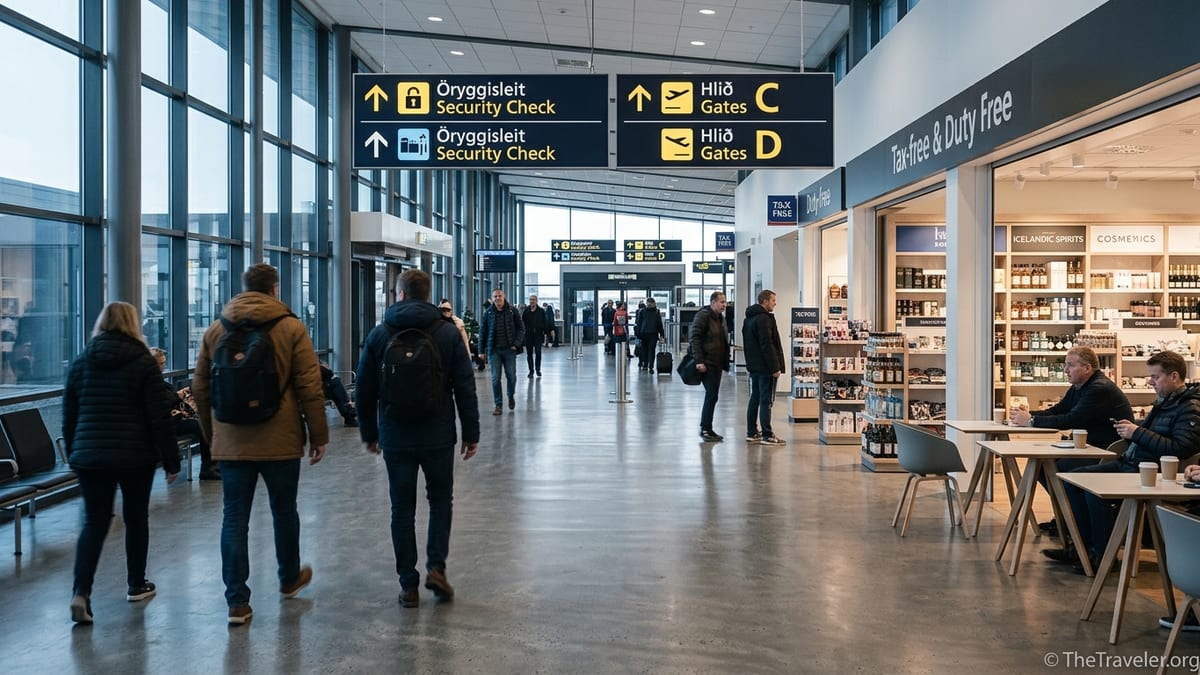
Once your boarding pass and checked bags are sorted, the flow leads you toward the single central security checkpoint. Before you join the queue, it is worth double-checking departure screens for your gate’s letter zone. Most flights to the Schengen area use C gates, while many flights to the United Kingdom, United States and Canada depart from the D gates in the non-Schengen area. Knowing your zone helps you plan how far you need to walk later and how much time to leave for passport control.
Security screening: what to expect
The security checkpoint at Keflavik is relatively compact and is designed for high throughput, with multiple lanes and clear signage. At the entrance, staff may check your boarding pass and sometimes your ID. Queues can change quickly: at 5:00 in the morning you might breeze through in under 10 minutes, but between 7:00 and 9:00 or in the late afternoon there may be a visibly snaking line. The airport provides real-time wait estimates on its information screens and online tools, which often show typical waits in the 10 to 25 minute range, though occasional surges can stretch that longer.
Rules for liquids, electronics and prohibited items broadly follow standard European practices. Liquids in hand luggage should be packed in containers of 100 milliliters or less, placed together in a transparent resealable bag of around 1 liter capacity. Travelers who forget this often end up repacking at the screening tables, discarding larger shampoo bottles or drinks bought before security. Laptops and tablets may need to be removed from bags and placed in separate trays, depending on the line and equipment in use on the day. Wearing easily removable shoes and minimizing metal accessories such as belts can speed your passage through the metal detectors or body scanners.
Iceland’s climate means many visitors wear thick coats, hiking boots and carry camera gear. Security officers are used to this and will simply ask you to place bulky outerwear, hiking boots and camera bags on the conveyor belt. For example, a traveler returning from a glacier hike with crampons attached to their backpack can expect those to be either checked in or refused through security if carried in the cabin, as they are considered sharp objects. To avoid delays, pack trekking poles, tent pegs, multi-tools and similar items into your checked baggage.
One particular rule at Keflavik to note is that liquids purchased after security but before passport control for flights to North America and other non-EU destinations may be subject to additional restrictions once you pass to the non-Schengen area. If you plan to buy alcohol or large liquid gifts in the departure duty-free, it is safer to do so after you have cleared passport control in the gate-area shop serving your flight zone, and to keep sealed security bags intact until you reach your final destination.
Passport control, gates and walking times
After security, all passengers enter a central departures area with shops and restaurants. If you are flying to a Schengen country such as Denmark, Germany or France, you usually do not pass through passport control and can walk directly to your C gate closer to boarding time. Screens throughout the hall will show your gate assignment, which often appears 1 to 2 hours before departure and may change, so it is wise to keep an eye on updates.
For flights to non-Schengen destinations such as the United Kingdom, United States and Canada, you must pass through outbound border control to reach the D gates. Lines at passport control can vary dramatically. At quieter moments, travelers report being through in under 10 minutes. During busy daytime waves when several transatlantic departures leave close together, queues can build unexpectedly and may take 30 minutes or more. Because of that variability, many regular flyers at Keflavik head toward passport control shortly after finishing security and duty-free shopping, even if boarding has not yet started.
Walking distances at Keflavik are moderate but not trivial if you have mobility issues or are traveling with young children. From the main central departures hall to some of the furthest D gates, the walk can take around 10 to 15 minutes at a relaxed pace. There are moving walkways in some sections, but at peak times corridors can feel crowded. For instance, a passenger leaving a restaurant near the center of the terminal only 20 minutes before boarding for a flight to Seattle might find themselves hurrying behind a long line at passport control and then briskly walking to the far D end.
If you need extra time or assistance, inform your airline at booking and again at check-in so that wheelchair or buggy support can be arranged. Families with strollers should be prepared to fold them at security and sometimes leave larger prams at the gate. Seating in gate areas is generally adequate outside the busiest peaks, but for popular long-haul flights it can become crowded near departure, so arriving at the gate area a little earlier allows you to settle in more comfortably.
Food, drinks and last-minute essentials
The central departures hall at Keflavik offers a mix of Icelandic and international food options. Travelers can expect cafés serving espresso drinks and pastries, casual counters offering hot dogs or burgers, and sit-down restaurants with local dishes such as lamb, fish and hearty soups. Prices are higher than in Reykjavik city but comparable with other Nordic airports. For example, a simple cappuccino and croissant might cost the equivalent of 8 to 10 euros, while a sit-down meal with a main course and soft drink may be closer to 25 to 35 euros depending on the venue.
For early-morning departures, cafés and grab-and-go outlets typically open in time for the first major wave of flights, serving breakfast sandwiches, skyr yogurt, fruit cups and bakery items. Many travelers pick up bottles of Icelandic glacier water or soft drinks after security to take on board. If you bring your own reusable bottle, there are water fountains available, though they can be busy near peak times. Vegetarian and some vegan options are available in most outlets, though the range can be limited late at night or in very early hours when fewer kitchens operate at full menu.
Beyond food and drink, there are convenience-style shops selling travel essentials such as neck pillows, earplugs, magazines, snacks, power adapters and charging cables. Tourists often make last-minute souvenir purchases here, picking up woolen hats, socks, lava-stone trinkets or small photo books of Iceland. Prices tend to be a little higher than in Reykjavik shops, but the convenience of having everything in one place after security is appealing, especially for those who spent their last hours in the city on tours rather than shopping.
If you have medications or specific dietary needs, it is safer to bring what you require from Reykjavik rather than relying on the airport selection. Pharmacies in the city are better stocked, while airport shops focus more on over-the-counter basics like pain relievers and cold remedies. Most restaurants and cafés accept major credit cards, and contactless payments are widely used, so there is rarely a need to carry large amounts of cash just to pay for food at the airport.
Shopping and tax-free at Keflavik departures
One of the main draws of Keflavik’s departures area is tax-free and duty-free shopping. Almost all retail in the international departures area is sold free of local VAT and duties for outbound passengers, which means prices on certain categories compare favorably with downtown Reykjavik. Cosmetics, skincare, fragrance, premium spirits and some branded fashion items are particularly popular, as are Icelandic design products like wool sweaters, scarves and outdoor clothing.
The primary duty-free operator at Keflavik, ÍSLAND Duty Free, runs a large store immediately after security, another shop for arriving passengers and a gate-area store in the non-Schengen D section. These stores are open 24 hours a day, which is helpful for late-night flights to North America or early-morning departures to mainland Europe. For example, a traveler on a 1:00 departure to Boston can still browse shelves of Icelandic gin, whisky, craft beers and international whisky brands, as well as confectionery gifts and skincare, long after city shops have closed.
Compared with regular Icelandic liquor stores, alcohol prices in the airport duty-free are typically significantly lower. It is common for visitors to buy a bottle of Icelandic schnapps, gin or whisky as a souvenir gift on departure rather than in town. A mid-range bottle of local gin that might cost the equivalent of 45 to 50 euros in a state liquor store can be several euros cheaper in duty-free, while multi-bottle promotions on popular international brands provide additional savings. Tobacco products, luxury cosmetics and perfumes often come in travel sets, which can also be good value compared with high-street prices in many countries.
Beyond duty-free, specialist shops in the departures hall sell Icelandic outdoor brands, books and magazines, souvenirs and clothing. You might pick up a lopapeysa wool sweater, a down jacket from an Icelandic outdoor label or an illustrated photo book of waterfalls and glaciers as a final reminder of your trip. Prices on locally made handicrafts and wool products are rarely discounted, even in the airport, but you may find slightly better selection in Reykjavik city boutiques. Use the airport stop to round out your gift list rather than as your only shopping opportunity in Iceland.
Tax refunds on Icelandic purchases
In addition to duty-free purchases made at the airport itself, many visitors to Iceland are eligible for a tax refund on goods bought in the country and exported unused. If you spent over a certain minimum amount in a single shop that participates in tax-free schemes, the retailer will have issued you a special form and attached your receipt at the time of purchase. At Keflavik on departure day, you must present these forms, along with the goods and your passport, to the tax refund service desk located in the departures area.
The exact minimum purchase amounts and refund rates can change, but as a general guide, significant refunds usually start to make sense on higher-value items such as designer clothing, outdoor gear, jewelry and art pieces rather than small souvenirs. For example, if you bought an Icelandic wool coat or a technical jacket costing several hundred euros, your refund might be enough to pay for a decent meal at the airport or cover part of your transfer back to the city next time you visit. For smaller purchases worth only a few tens of euros, the refund may be modest once service fees are deducted.
To avoid delays, fill in any personal details on your tax-free forms before you reach the desk, and keep your receipts together in a single envelope. In quieter periods, processing may take only a few minutes, but at the end of holiday weeks or on weekends there can be a short queue of fellow travelers claiming refunds. In some cases, especially for high-value goods, staff may ask to inspect the items physically to confirm that they are being exported unused, so do not pack them deep inside checked baggage; instead, keep them in your hand luggage until you have completed the refund process.
Refunds can usually be paid in cash in major currencies or credited back to your payment card. Card refunds often take several days or weeks to appear on your statement, so keep your stamped documents until you can verify that payment has been received. If you are short on time before your flight, prioritize making it through security and passport control first and only then decide whether the queue at the tax refund desk is short enough to justify waiting.
Boarding, on-time departure and practical tips
Boarding at Keflavik generally begins around 30 to 45 minutes before scheduled departure for most international flights, with longer-haul flights sometimes starting a little earlier. Gates display boarding group numbers or zones on overhead screens, and airlines with loyalty programs or premium cabins often board those passengers first. Because many gates serve buses to remote stands as well as jet bridges, you should remain close enough to hear announcements, even if you are seated away from the immediate boarding line.
Weather in Iceland can sometimes disrupt flight schedules, particularly in winter when strong winds or snow affect operations. Even so, Keflavik is well practiced at handling adverse conditions, and most delays are modest. From a passenger standpoint, the main impact of poor weather is occasionally needing to board via stairs on the tarmac or being bussed to remote stands. In such cases, wearing layers and keeping a warm jacket accessible in your hand luggage makes boarding more comfortable, especially in the early morning or late at night when temperatures drop.
If you have electronic boarding passes, keep in mind that bright terminal lighting and screen protectors can make some phone screens harder for gate scanners to read. It is a good idea to increase your screen brightness and have a backup screenshot of your boarding pass in case your airline app needs a data connection that is slow in crowded areas. Free Wi-Fi is available in the terminal, but speeds can fluctuate when many passengers are connected simultaneously.
For travelers with tight same-day connections at other airports, leaving Iceland well prepared helps reduce stress. Keep any required transit visas or entry documents for your next country accessible in a small folder or travel wallet, as airline staff at Keflavik may check them at the gate. If you are connecting onward in another Schengen country, remember that immigration checks are generally handled at your first point of entry, so your outbound flight from Keflavik to a Schengen destination usually does not involve passport control on arrival in that country.
FAQ
Q1. How early should I arrive at Keflavik Airport before my flight?
Most travelers are comfortable arriving about 3 hours before international departures, especially in summer or at busy morning and afternoon peaks. In quieter periods and if you have hand luggage only, 2 to 2.5 hours may be sufficient, but building in extra buffer is wise if you need to check bags or return a rental car.
Q2. Is 2 hours enough for Keflavik departures?
Two hours can be enough during off-peak times if you are already checked in and have only cabin baggage, but it leaves less margin for unexpected queues at security or passport control. For first-time visitors or peak-season departures, aiming for closer to 3 hours is generally safer.
Q3. How long does security usually take at Keflavik?
Security wait times often range from around 10 to 25 minutes, though they can be shorter very early in the morning or late at night and longer during busy flight waves. Queue times can change quickly, so follow airport signage and be prepared before you reach the trays to keep the process smooth.
Q4. Do I need to go through passport control when leaving Iceland?
If you are flying to a non-Schengen destination such as the United Kingdom, United States or Canada, you will go through outbound passport control to reach the D gates. For flights to Schengen countries like Denmark, Germany or France, you usually do not pass passport control when departing Iceland.
Q5. Are there good food options after security at Keflavik?
Yes, the departures area has cafés, fast and casual counters and sit-down restaurants serving both Icelandic and international dishes. You can find pastries, sandwiches, salads, hot dogs, burgers, soups and full meals, though prices are generally higher than in Reykjavik city.
Q6. Is duty-free at Keflavik cheaper than in Reykjavik?
For alcohol, many cosmetics and some branded goods, airport duty-free prices are usually lower than in city shops, especially compared with Iceland’s state liquor stores. Local handicrafts and wool products may not be substantially cheaper at the airport, but duty-free is convenient for last-minute gifts.
Q7. Can I claim tax refunds for my Iceland purchases at the airport?
Yes, if you shopped at participating stores in Iceland and received tax-free forms and receipts, you can present them, along with your goods and passport, at the tax refund desk in the departures area. Refunds are generally more worthwhile on higher-value items like outdoor gear or designer clothing.
Q8. Are the duty-free shops at Keflavik open 24 hours?
The main ÍSLAND Duty Free stores at Keflavik operate 24 hours a day, serving both arriving and departing passengers. This means you can shop for alcohol, cosmetics, confectionery and gifts even for late-night or very early-morning flights.
Q9. How far are the gates from security at Keflavik?
From the central departures hall, most C gates are only a short walk away, while some D gates in the non-Schengen area can take around 10 to 15 minutes to reach at a relaxed pace. Be sure to factor in potential lines at passport control when heading to a non-Schengen gate.
Q10. Is Keflavik Airport easy to navigate for first-time visitors?
Yes, Keflavik has a single main terminal with clear English signage and straightforward flow from check-in to security, shopping and gates. While it can be busy at peak times, most first-time travelers find it manageable if they arrive with enough time and follow the signs for their gate letter and airline.