


More news on this day
Royal Caribbean’s newest ship has been forced to cancel a scheduled port of call at short notice, according to recent coverage from cruise industry outlets and passenger reports, underscoring how even high-profile inaugural-season sailings remain vulnerable to late operational changes.
Get the latest news straight to your inbox!
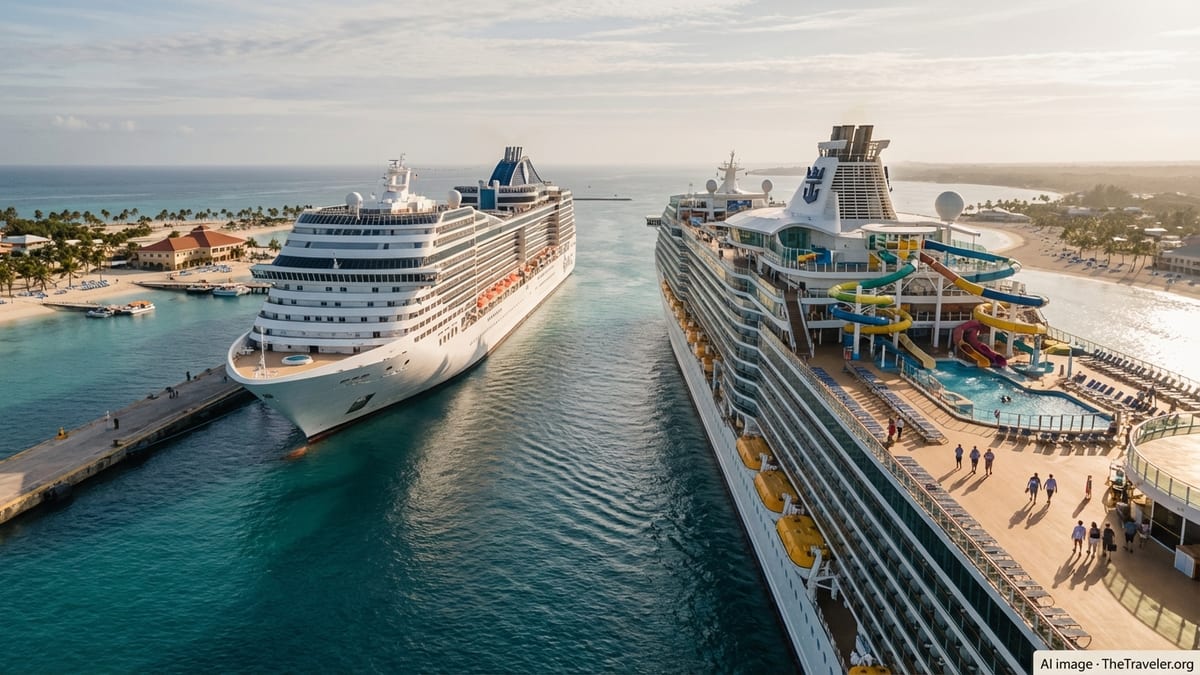
Newest Flagship Faces Early Itinerary Disruption
Publicly available information on recent Royal Caribbean deployments shows that the line’s latest generation of megaship entered service this summer with strong demand and heavy advance bookings on its debut itineraries. The vessel, which launched in 2026 as part of the company’s newest class of large-scale ships, has been marketed around marquee ports and high-intensity, port-rich schedules.
Reports emerging from cruise-focused publications and online passenger forums in recent days indicate that one of those early sailings has now undergone a significant late change, with a planned port of call removed shortly before the visit. Travelers discussing their experiences describe learning of the cancellation close to departure or after embarkation, with the affected day converted into an additional sea day or replaced by an alternative destination.
The last-minute adjustment follows a series of operational tweaks across Royal Caribbean’s fleet this season, ranging from schedule reshuffles to longer-term removal of certain destinations from future itineraries. Within that broader context, the decision to cut a port on a headline-making new ship has drawn particular attention from travelers and cruise watchers.
Industry commentators note that while itinerary changes are written into standard cruise terms, they tend to attract more scrutiny when they occur on brand-new vessels that have been heavily promoted for specific routes and ports.
Weather, Safety and Operational Factors Cited in Coverage
According to published coverage in specialist cruise media, this latest cancellation appears to be linked to a mix of operational and external factors rather than a single isolated issue. Recent reporting on Royal Caribbean’s summer deployments has highlighted the impact of strong seasonal weather systems in several regions, with some ships rerouting or delaying arrivals to avoid high winds and rough seas.
In parallel, Royal Caribbean has been adjusting its wider port strategy, particularly in the Caribbean, where publicly available statements and travel-industry reporting show an extended suspension of calls to certain destinations through at least 2027. Those longer-term changes have concentrated more traffic at remaining ports and required itinerary reshuffles across multiple ships.
Cruise-line booking conditions, which are accessible through Royal Caribbean’s own documentation, specify that management retains discretion to omit or substitute ports, change the order of calls and modify arrival and departure times when conditions warrant. Analysts observing the latest megaship cancellation point out that weather, port congestion, technical circumstances or a combination of such factors can trigger short-notice decisions to skip a stop.
While the precise balance of reasons for this particular cancellation has not been exhaustively detailed in public sources, the pattern is consistent with a season in which several large ships have faced timetable disruptions linked to storms, propulsion work and port-access constraints.
Passenger Experience: Mixed Reactions to a Lost Port Day
Reactions from travelers, as reflected in online discussion threads and social media posts, suggest a divided response to the news that Royal Caribbean’s newest ship dropped a port at the last moment. Some guests describe disappointment at losing a long-anticipated destination that formed a key part of their decision to book the sailing, particularly for itineraries built around a single marquee port or a highly marketed private-island stop.
Others take a more philosophical view, noting that the risk of last-minute itinerary changes is widely known among frequent cruisers and referenced in standard travel-insurance advice. Several passengers commenting on recent Royal Caribbean schedule shifts indicate that they were still able to enjoy the extra time on board, citing the ship’s expanded dining, entertainment and pool offerings as a partial offset to the missed port.
Travel agents and cruise bloggers following the situation point to an ongoing tension between the marketing of port-intensive cruises and the operational reality that ports can be lost on short notice. For travelers prioritizing specific destinations, some commentators recommend building flexibility into plans, such as booking fewer nonrefundable shore excursions with third-party operators or choosing itineraries with multiple high-interest ports rather than a single “must-see” stop.
Publicly shared passenger accounts from other recent Royal Caribbean sailings also describe cases where lost ports were replaced with alternative stops, sometimes to the satisfaction of guests and sometimes with criticism when the substitute was perceived as less desirable.
What the Change Reveals About Modern Megaship Itineraries
For industry observers, the late port cancellation on Royal Caribbean’s newest flagship underlines how modern megaship operations are increasingly sensitive to a web of factors that extend beyond simple route planning. Larger vessels place added demands on port infrastructure, including berth availability, tug capacity and harbor weather tolerances, and those elements can tighten the margin for maintaining scheduled calls.
The growth of private destinations and heavily curated resort-style ports has further raised expectations among guests that marquee stops will be a guaranteed highlight of a cruise. When such a port is scrapped or replaced at the last moment, the change can dominate perceptions of the entire voyage, even when onboard offerings remain robust.
Cruise analysts note that Royal Caribbean and its competitors have been investing in both shipboard attractions and destination development to balance that equation. New ships in particular are designed so that, in the event of lost ports, additional sea time still delivers a high level of activity and amenities. The latest cancellation illustrates that strategy in practice, as passengers on the affected sailing report full schedules of entertainment and dining even on the unscheduled sea day.
At the same time, the incident reinforces why cruise contracts and pre-cruise communications consistently emphasize that itineraries are subject to change. Observers suggest that, as ship sizes and deployment complexity continue to grow, occasional short-notice adjustments, including full port cancellations, are likely to remain a recurring feature of the industry.
Implications for Future Bookings and Traveler Planning
The disruption on Royal Caribbean’s newest ship arrives at a time when demand for big-ship cruising remains strong, with recent order books and capacity announcements indicating continued expansion through the end of the decade. Travel advisors commenting on this season’s changes say that, so far, there is little evidence of widespread booking hesitation tied specifically to itinerary volatility, although individual guests affected by a missed port sometimes express reluctance to rebook similar routes.
For future passengers, the episode serves as a reminder to review terms and conditions carefully when planning a cruise and to consider itinerary flexibility alongside ship features and price. Seasoned cruisers often recommend purchasing travel insurance that can address certain financial risks around disruptions, although coverage details vary widely by policy and provider.
Industry coverage of the latest cancellation also highlights the practical steps lines typically take when ports are dropped, such as processing automatic refunds for ship-run excursions and adjusting onboard programming to accommodate an extra day at sea. Travelers planning upcoming sailings on new and existing ships can expect similar measures if their itineraries are altered in response to weather, technical issues or evolving destination policies.
As Royal Caribbean’s newest vessel continues its inaugural season, cruise watchers will be monitoring whether the recent port cancellation proves to be an isolated event tied to short-term conditions or an early sign of a more fluid approach to routing in response to a changing operating environment.