


Arriving at Santiago’s Arturo Merino Benítez International Airport can be disorienting, especially when you open Uber or Cabify and are not sure where, or even if, your driver is allowed to pick you up. Local rules, two different terminals and a mix of official taxis, prebooked vans and app drivers all sharing the same forecourt create plenty of confusion for first-time visitors. This guide explains, in clear and practical terms, how Uber and Cabify pickups work at Santiago airport today, where you should meet your driver, what to watch for in the apps, and when it is easier and safer to choose an official taxi or shuttle instead.
Get the latest updates straight to your inbox!
Understanding Santiago Airport and Its Terminals
Arturo Merino Benítez International Airport, commonly referred to by its code SCL, serves as the main gateway to Chile. The airport is organized around two main passenger terminals: Terminal 1 for domestic flights and Terminal 2 for most international flights. The two terminals are connected by elevated parking structures and a central plaza, so in theory you can walk between them, but for rideshare pickups you will want to know exactly which terminal you are in before ordering a car.
International passengers arriving from North America or Europe generally come into Terminal 2, a newer building with a large arrivals hall on the lower level. Domestic flights from airlines such as LATAM and Sky Airline usually arrive into Terminal 1. If you are unsure, you can check your boarding pass or the flight information screens in the baggage hall. The exact terminal selection matters when you open Uber or Cabify, because the apps prompt you to choose a pickup zone associated with a specific terminal and door.
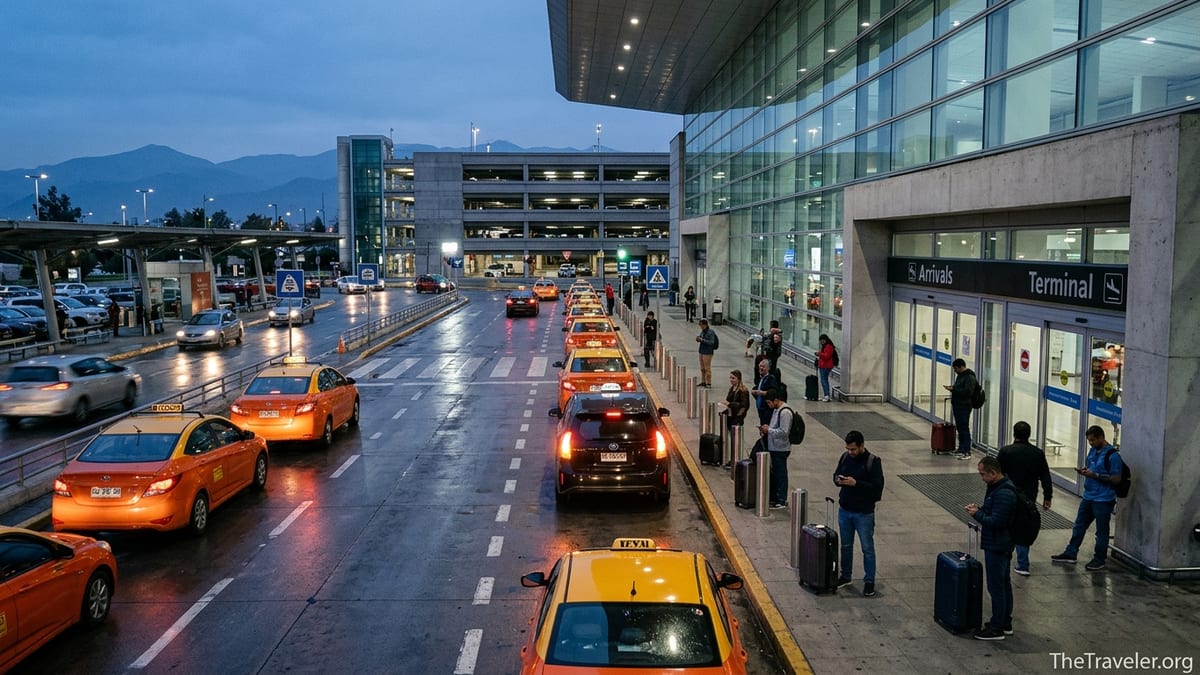
Rideshares, taxis, and airport vans all converge on the same general roadway outside arrivals, but they do not all use the curb in the same way. Official airport taxis and prebooked van services like TransVIP and Cabify’s own “Airport” or “Van” options generally use marked stands directly outside arrivals, where uniformed staff manage queues and check vouchers. Regular UberX or standard Cabify rides instead rely on meeting you at one of several designated points in nearby parking areas or at specific doors, which is where much of the first-timer confusion begins.
For planning purposes, expect it to take around 20 to 30 minutes to reach central districts such as Centro, Providencia or Las Condes in light traffic, and closer to 45 minutes or more in peak evening rush hour. That travel time, together with the time it can take to actually find your driver in the pickup zone, should factor into your decision about whether to call a rideshare or simply walk to an official taxi or van kiosk just after customs.
Where Uber and Cabify Can Pick You Up
Uber publicly confirms that its services operate at Santiago airport and provides airport-specific guidance within the app, including pickup areas associated with each terminal. In most cases, once you request a ride, the app will ask you to confirm your terminal and a meeting point such as a particular door number or parking sector. Typical meeting points include exits near doors in the arrivals level and, for some options, short walks to the multi-story car parks rather than the curb directly outside the terminal. The key is to read the on-screen instructions carefully and follow the short walking route on the map rather than staying glued to the baggage hall doors.
Cabify has gone a step further and negotiated formal arrangements at Santiago’s airport for certain categories of trips. In practice, this means there is both an in-app pickup flow and, for Cabify’s airport-specific products, staffed desks inside the arrivals area. For example, travelers coming into Terminal 2 may see signs for Cabify near or alongside desks for TransVIP and Taxi Oficial, just after customs but before exiting into the public arrivals hall. At these desks you can purchase a fixed-price trip to the city, receive a receipt and be directed either to a shared van or a dedicated car in a specific parking bay.
If you opt not to visit a desk and instead use Cabify as a regular rideshare, the experience is similar to Uber: you request a ride in the app, choose your pickup location and then walk out to meet the driver. Some drivers prefer to wait slightly away from the busiest curb to avoid congestion and police checks, so you may be instructed to cross to a parking island or meet “by the elevators” of a given parking structure. It is common, for instance, for drivers to suggest meeting near a particular pillar or level within the parking tower next to your terminal.
Because signage for rideshares is limited and changing over time, many travelers rely on a combination of the in-app map and messaging the driver through the app. If your Spanish is limited, you can still communicate with simple phrases like “Estoy en la puerta 5” or “Estoy en el estacionamiento nivel 3” and by sending a photo of a visible landmark. Build in at least five extra minutes for this back-and-forth the first time you use Uber or Cabify at SCL, especially if you arrive at a busy time in the evening.
Common App Confusion and How to Avoid It
The most frequent problem new arrivals face when using Uber or Cabify at Santiago airport is a mismatch between the pickup point they have in mind and the one the driver expects. The apps may default to a generic “Arrivals” pin that is technically inside the terminal building, while the driver is waiting on the outer roadway or in a connected parking structure. When that happens, the vehicle appears “very near” on the map but you cannot see it in real life, and the driver may start the five-minute waiting clock that leads to extra fees if you take too long to appear.
To avoid this, pay close attention to any text message from the driver as soon as your ride is accepted. A typical note from a Santiago driver might say something like, in Spanish, “Te espero en puerta 5 en el segundo carril” indicating a particular door and lane, or “Estoy en el estacionamiento, nivel 2, columna B.” If you simply stay at the first sliding door you see next to the baggage hall, you may be in the wrong place. Move outside, look for door numbers, and compare them to the instructions. In many recent traveler reports, adjusting your location by just one door or one level makes the difference between a smooth pickup and a frustrating 15-minute hunt.
Another source of confusion is the variety of product types that appear inside the apps. In Cabify, for example, you may see options labelled “Airport,” “Van,” “Van Compartida” or similar alongside standard private-ride categories. The airport-branded products are intended for journeys to or from SCL, often using licensed vans and fixed fares, while shared-van options group several passengers going into the city. Prices for shared vans can be significantly lower per person but may involve circuitous routes through multiple neighborhoods before you reach your hotel. If you have limited Spanish, lots of luggage or a tight schedule, a direct ride, whether UberX or a Cabify Airport/private van, is generally the more straightforward choice.
Payment methods can also trip people up. Most travelers prefer to pay by card saved in the app, but some drivers in Santiago still appreciate or expect tolls in cash on longer routes, or ask whether you plan to pay cash or card before starting. When leaving the airport, you should not need to carry cash for an Uber or standard Cabify ride; however, official taxis and some van companies do still quote cash fares at the counter. If you are arriving late at night and have no Chilean pesos yet, sticking with app-based rides paid by card or with a prebooked shuttle paid online avoids payment stress in the arrivals hall.
Safety, Legality and Night-time Arrivals
Both Uber and Cabify are widely used in Santiago, and many local residents rely on them for routine trips to and from the airport. Official travel advisories describe app-based rides and registered taxis as generally safe when used with normal precautions, such as confirming the vehicle details in the app and avoiding unmarked cars that approach you unsolicited in the arrivals hall. As in many large cities, opportunistic theft in crowded public areas is a bigger risk than targeted attacks on rideshare users, so keeping bags zipped and phones out of easy reach while you wait curbside is important.
Legally, rideshare services in Chile occupy a gray zone that has led to periodic enforcement campaigns and protests from taxi unions, but from the passenger perspective they continue to operate openly throughout Santiago. At the airport this can translate into occasional police checks of vehicles in the forecourt or requests that drivers use specific parking areas instead of waiting directly outside the terminal doors. If your driver asks you to walk a short distance to a designated rideshare pickup area or to meet on a higher parking level to avoid congestion, this is usually a sign of them following local rules rather than anything suspicious.
For late-night arrivals, safety considerations and convenience often favor official taxis or prearranged shuttles over standing outside trying to locate an app driver. A common pattern for travelers landing after midnight is to exit customs, walk directly to the line of official providers just before the public arrivals area, and choose between a fixed-price taxi, a private van and a shared shuttle. Typical quotes for a private taxi or van from the airport to central neighborhoods fall in a broad range roughly equivalent to 25 to 40 US dollars depending on the exact destination and provider, while a rideshare like UberX might show an estimated fare closer to the equivalent of 12 to 20 dollars at off-peak times.
When deciding, weigh the tradeoff between cost and peace of mind. An official taxi or branded shuttle purchased at a desk means someone knows your name, your destination and the license plate of the vehicle assigned to you, and you have a printed or digital receipt. With Uber or Cabify, the app provides similar traceability, but you may have to walk further in a quiet, unfamiliar area to reach the exact pickup point. Many solo travelers arriving very late choose the official taxi or a Cabify airport van for their first trip into the city, then rely on rideshare apps more heavily for daytime travel once they are oriented.
Surge Pricing, Fares and When Taxis Make More Sense
Uber and Cabify both use dynamic pricing in Santiago, which means the fare shown in the app can jump significantly during peak hours, strikes, storms or major events. On a typical weekday afternoon with moderate traffic, a standard rideshare from SCL to a central hotel in Providencia might cost the rough equivalent of 15 to 20 US dollars, but at the height of the evening rush this can climb noticeably, sometimes approaching or even exceeding the fixed rates quoted by official airport taxis. Travelers have reported that what should have been a budget-friendly ride can suddenly look much less attractive once surge multipliers kick in.
Official taxis at Santiago airport usually operate on either fixed zone-based pricing posted at their desks or on metered fares starting from a published base rate. When you exit the baggage area, you will see branded counters for Taxi Oficial, TransVIP, Cabify and sometimes other companies. Staff at these desks can quote you an approximate price in Chilean pesos to specific districts such as Bellavista, Las Condes or Vitacura. For example, a one-way trip to the Centro area might run roughly in the 25,000 to 30,000 peso range, with more distant neighborhoods priced higher. Due to currency fluctuations and occasional tariff updates, it is best to treat these numbers as ballpark figures and confirm the exact price at the counter on the day you arrive.
Because official taxi prices are relatively stable, they sometimes undercut rideshare fares during heavy surge periods. If you open Uber and see an unusually high estimate, it is worth taking a short walk to the official taxi or shuttle desks to compare. Conversely, if you land in the middle of the day when demand is lower, app-based rides can be substantially cheaper than official taxis, making Uber or Cabify an appealing choice for budget-conscious travelers comfortable navigating the pickup zones.
Shared vans booked through Cabify or companies such as TransVIP sit somewhere in between. They usually charge per person rather than per vehicle and can be excellent value for solo travelers or couples without much luggage, especially if their hotel lies along a common corridor like Alameda or Providencia. However, because vans may serve three or four drop-off points per trip, a journey that would take 25 minutes in a taxi can stretch to an hour or more as you weave through different neighborhoods. For families or groups of four or more, reserving an entire van or simply taking a taxi often works out similarly in price but saves significant time and complexity.
Terminal Differences and Walking to Better Pickup Spots
Terminal 1 and Terminal 2 at Santiago airport have slightly different physical layouts, which affects where Uber and Cabify drivers prefer to meet passengers. In Terminal 1, serving domestic flights, the arrivals roadway is older and can become congested quickly, especially during morning and evening banks of flights. Some rideshare drivers therefore ask passengers to meet on the departures level above, where it is easier to stop briefly, or in the adjacent parking tower connected by walkways. This is a familiar pattern in many airports worldwide and is generally safe, though you should avoid crossing traffic lanes outside marked pedestrian routes.
Terminal 2, the newer international terminal, has a more spacious arrivals forecourt but also sees the highest concentration of long-haul flights, creating waves of arriving passengers. Rideshare pickup points here often make use of the structured parking and clearly numbered doors at ground level. If your driver sends instructions like “salida 6, segundo carril,” look for overhead signs marking each exit and for numbered lanes on the pavement. Because Terminal 2 is newer, you may also find clearer wayfinding panels and screens indicating where to meet different transport providers, although signage specifically naming Uber or Cabify may still be limited.
Some seasoned travelers arriving into one terminal deliberately walk to the other to optimize their pickup. For instance, if you arrive domestically into Terminal 1 but your hotel is to the east and traffic outside T1 is backed up, it can sometimes be faster to walk across the central plaza and parking structures to Terminal 2 or vice versa, then request your ride there. The walk between terminals is covered and straightforward, typically taking around 10 minutes at a normal pace with carry-on luggage. This tactic can also help when surge pricing or app availability differs slightly between terminals, as occasionally one area will show more nearby drivers than the other.
Whatever your terminal, the guiding principle is to choose a pickup point that is easy to describe and safe to wait at for a few minutes. Well-lit spots near terminal doors, marked pedestrian islands and entrances to the parking structures generally meet these criteria better than isolated corners of the outer roadway. When in doubt, stay close to other travelers and visible airport security staff, and use the app to share your trip details with a trusted contact before you get into the car.
When Official Taxis or Vans Are the Easier Option
There are several scenarios in which using an official taxi or van service from Santiago airport simply makes more sense than trying to coordinate a rideshare pickup. The first is if you are traveling with a large group or heavy luggage. Families of five or six with multiple checked bags, ski equipment or bulky items will find it more convenient to book a dedicated van through a provider like Cabify Airport or TransVIP, either online in advance or at their airport desks. These vans have ample luggage space, and staff at the desk can ensure you are matched with an appropriately sized vehicle without needing multiple rideshare cars.
The second scenario is a very late arrival or a first-time visit to Chile when you do not speak Spanish and feel uncertain about navigating a busy forecourt. Stepping out of customs and seeing a row of recognizable counters, with set prices printed on boards and English-speaking staff, removes many variables. You pay once, receive a voucher or digital confirmation, and are escorted or directed to the correct lane where a branded vehicle is waiting. For instance, some travelers arriving around 2 or 3 a.m. report that they appreciated being able to pay with a credit card at a Cabify or TransVIP desk inside the terminal, then walk together with other passengers to the shared van area without worrying about finding their driver alone outside.
The third situation involves travelers with specific accessibility needs. If you require extra time to board, need a vehicle with more space to store a wheelchair, or prefer assistance from curb to check-in or from arrivals to the car, contacting an official provider in advance allows them to arrange an appropriate vehicle and, in some cases, coordinate with airport staff. While Uber and Cabify drivers may be accommodating on an individual basis, they do not guarantee accessible vehicles or trained assistance in the same way specialized airport transport companies can.
Finally, if you anticipate unreliable mobile data or a low phone battery on arrival, relying on an app-based ride can be stressful. Free Wi‑Fi at airports can be patchy, and roaming data plans sometimes fail at just the wrong moment. Booking a transfer that does not depend on you staying connected, or walking directly to a taxi counter to arrange a ride on the spot, removes this point of failure. A simple, prepaid taxi or van can be a worthwhile insurance policy after a long overnight flight.
The Takeaway
Santiago’s Arturo Merino Benítez Airport offers a full mix of ground transport options, from classic orange-and-yellow official taxis to fixed-price vans and modern rideshare services like Uber and Cabify. Each comes with its own advantages and quirks. Rideshares are usually the most economical choice in off-peak hours and give you the convenience of app-based payment and real-time tracking, but they require careful attention to pickup instructions and a few extra minutes of navigation through terminals and parking structures.
Official taxis and shuttles, on the other hand, cost more on average but excel in simplicity and predictability, particularly late at night, for larger groups or for travelers apprehensive about language barriers and local regulations. Surging app prices can occasionally erase the savings of rideshares, making the fixed fares at airport desks surprisingly competitive. Understanding how the two terminals are laid out, how pickup zones function, and what safety practices to follow will help you choose the option that best fits your budget, schedule and comfort level on the day you land.
In practical terms, if you arrive during the daytime with a charged phone, some time to spare and basic familiarity with rideshare apps, Uber or Cabify will likely serve you well from SCL to most parts of Santiago. If you land after midnight, are exhausted from a long-haul flight, or are traveling with a family and lots of bags, walking straight to an official taxi or Cabify/TransVIP desk inside the arrivals area may provide a smoother start to your stay. With realistic expectations and a little preparation, leaving Santiago airport should be a routine first step in discovering the city, not the most stressful part of your trip.
FAQ
Q1. Can I legally use Uber from Santiago’s international airport?
Yes, Uber operates openly at Arturo Merino Benítez Airport and many locals use it, although rideshare regulations in Chile are still evolving and sit in a legal gray zone. From a visitor’s standpoint, you can request a ride normally through the app and follow the airport-specific pickup instructions shown.
Q2. Where exactly do I meet my Uber or Cabify driver at SCL?
After requesting a ride, the app will prompt you to select your terminal and a door or parking area. Typical meeting points are near numbered doors on the arrivals level or in the nearby parking structures connected by walkways. Always read your driver’s messages and look for door numbers and level signs to match their instructions.
Q3. Is it safe to take rideshares late at night from Santiago airport?
Rideshares are widely used at all hours and are generally considered safe when you follow normal precautions such as confirming the license plate, car model and driver name in the app before getting in. That said, many solo travelers arriving in the very late hours prefer the simplicity of booking an official taxi or shuttle at the airport desks inside the terminal.
Q4. How much does a ride from SCL to downtown Santiago usually cost?
Prices vary with demand and destination, but a standard Uber or Cabify ride to central neighborhoods might cost roughly the equivalent of 12 to 20 US dollars in off-peak times. Official taxis and private vans bought at airport desks often fall in a higher band, roughly equivalent to 25 to 40 dollars, with shared vans costing less per person but taking longer due to multiple stops.
Q5. What should I do if I cannot find my rideshare driver?
If the vehicle appears close on the app but you do not see it, contact the driver through in-app chat or call, confirm which door or parking level you are at, and move toward clearly numbered exits or pillars they mention. If you still cannot connect after several minutes and the driver starts charging waiting time, it may be easier to cancel and switch to an official taxi or van.
Q6. Are official airport taxis in Santiago trustworthy or tourist traps?
Experiences vary, but official airport taxis that operate from branded desks just after customs are generally considered reliable. They either use meters or fixed zone-based prices that staff can explain in advance. Problems are more likely with unlicensed drivers who approach travelers directly in the arrivals hall, which you should decline in favor of official stands or app-based rides.
Q7. Should I prebook a Cabify or shuttle from SCL or just book on arrival?
Prebooking is useful if you arrive late at night, travel with a group, or need a larger vehicle such as a van. You can reserve a Cabify Airport or similar service in advance or arrange a TransVIP shuttle online. During daytime hours with normal demand, many travelers simply book on arrival, either at the airport desks or through the apps, without trouble.
Q8. Can I pay for taxis and shuttles with a foreign credit card?
Most official taxi, Cabify and shuttle desks inside the terminal accept major credit and debit cards, and rideshares like Uber and Cabify can be paid via cards stored in the app. Street taxis away from the airport are more likely to prefer cash. If you plan to pay in cash from the airport, withdraw Chilean pesos from an ATM in the arrivals hall before heading outside.
Q9. Is it better to go to Terminal 1 or Terminal 2 for cheaper or easier pickups?
Both terminals support rideshare and taxi pickups, and prices in the apps are based on your overall route rather than the specific terminal. Some travelers arriving into a very congested terminal choose to walk the 10 minutes across the central plaza to the other terminal for a calmer pickup, but this is more about convenience and traffic than about cost differences.
Q10. What is the safest option if my phone battery is almost dead when I land?
If your battery is low and you are worried about losing access to the rideshare apps or your hotel details, the safest option is usually to go straight to an official taxi or shuttle desk in the arrivals area. You can arrange and pay for your transport without relying on your phone and often ask staff to call your hotel or write down the address for the driver if needed.