


More news on this day
Heavy snow, strong winds and dangerous sea conditions caused widespread disruption across Bulgaria on 29 November 2026, with authorities urging people to avoid non-essential travel as roads, rail lines, flights and coastal shipping faced significant delays and closures.
Get the latest news straight to your inbox!
Orange and red weather alerts as storm hits land and sea
Bulgaria’s national meteorological service placed much of the country under a Code Orange alert for heavy snowfall on Sunday 29 November, while a Code Red warning for very strong winds and dangerous waves was issued along the Black Sea coast. Code Orange signals a high likelihood of disruption from severe weather, and Code Red is the highest alert level used when conditions are expected to pose a serious risk to safety and infrastructure, including maritime operations and coastal transport.
The Code Orange alert covered 16 districts, including Montana, Vratsa, Lovech, Gabrovo, Veliko Tarnovo, Dobrich, Varna, Sofia Region, Pazardzhik, Plovdiv, Stara Zagora, Smolyan, Kardzhali, Haskovo, Yambol and Burgas, with significant snowfall and strong winds forecast through early afternoon. Elsewhere in the country, a lower-level yellow warning for snow and low temperatures was in force, but forecasters still cautioned about icy surfaces and quickly changing conditions on higher ground.
Along the Black Sea, authorities warned that storm-force gusts and waves of several metres would make navigation hazardous and could affect port operations and low-lying coastal roads and promenades. Municipalities on the southern coast reported flooding of exposed seafront paths and cycle routes, including in the Sarafovo area near Burgas, where waves washed over the shore infrastructure overnight as the storm passed.
Road closures, stranded vehicles and power cuts in multiple regions
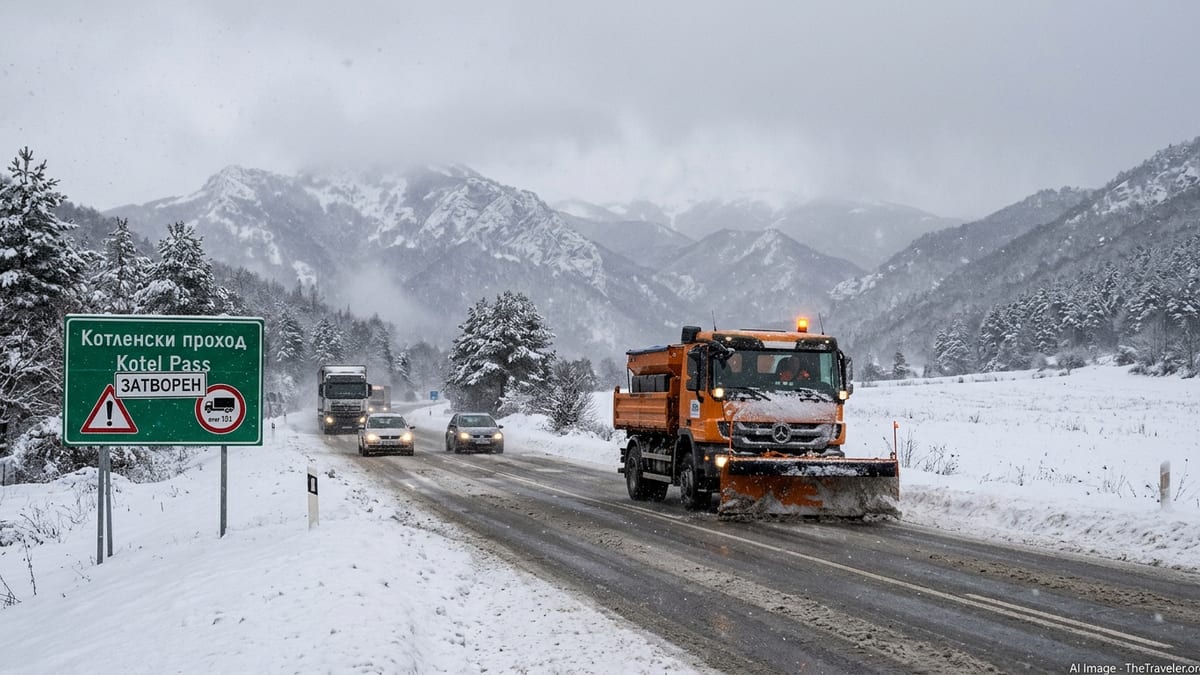
The Road Infrastructure Agency reported that more than 1,000 snow-clearing machines were deployed nationwide from the early hours of 29 November, but their work was complicated by continuing snowfall, drifting and poor visibility. By mid-morning, authorities had introduced temporary restrictions for heavy goods vehicles over 12 tonnes on multiple stretches of the national road network, especially across the Balkan and Rhodope mountain passes, where steep gradients, bends and exposed sections made conditions particularly challenging.
In eastern Bulgaria, a section of the key Burgas–Varna coastal road was closed after heavy snow and drifts reduced visibility and made it unsafe to continue ploughing alongside traffic. Local media and officials reported that traffic between Varna and Dobrich was also suspended, while movement through the Kotlenski Pass and parts of the networks in Ruse, Silistra and Shumen regions was limited or temporarily halted. Police diverted vehicles to signposted alternative routes where possible and turned others back at checkpoints when conditions deteriorated.
In the northwest, strong winds created snowdrifts on open stretches in Vratsa region, leaving some trucks stranded and temporarily blocking snowploughs. Regional authorities responded by restricting heavy lorries near known bottlenecks such as the area around Kravoder and warned that school transport and local services could be affected if drifting continued. The Road Infrastructure Agency repeated its winter guidance that motorists should travel only if necessary, use vehicles equipped with winter tyres and, where appropriate, carry snow chains, as well as sufficient fuel, warm clothing and basic supplies in case of delays.
Fallen trees and branches also caused problems. Local authorities and utilities reported that wet snow and gusty winds brought down power lines in parts of northwestern and central northern Bulgaria, leaving dozens of settlements with partial or complete power outages. Emergency and maintenance teams worked through the morning to restore supply, although access to some damaged sections was slowed by uncleared roads and blocked village approaches.
Rail passengers face delays as lines close in Iskar Gorge and central Bulgaria
Rail traffic was badly affected on 29 November as heavy snow and fallen trees forced Bulgaria’s National Railway Infrastructure Company to suspend movements on several key sections. In the early hours, traffic on the busy Sofia–Varna route was halted between Eliseyna and Mezdra in the Iskar Gorge after trees fell across the tracks and snow accumulated along cuttings and embankments. Train control records indicated that the line was closed shortly after 03:00 while crews and forestry teams were dispatched to clear the route.
One train with around 200 passengers became stranded near Eliseyna station, leading to prolonged disruption while workers removed trees and checked overhead power lines and signalling equipment. Rail managers and the national broadcaster later emphasized that passengers were not left without heating for extended periods and that people were moved to warmer areas at the station as conditions allowed, countering some early media claims of travellers being stuck for more than six hours in unheated carriages.
A separate suspension was reported between Orizovo and Svoboda on the Plovdiv–Stara Zagora line early in the morning, again attributed to snow and weather-related faults. The interruptions on these two axes caused knock-on delays across the network throughout the morning, as Bulgarian State Railways cancelled or short-turned some services and adjusted others to avoid the blocked segments. After the initial clearance, a second train experienced a technical failure in the Iskar Gorge later in the morning, leading to another pause in traffic on the Sofia–Mezdra section and requiring repair teams to move sequentially between problem sites as conditions and access allowed.
By late morning, rail infrastructure managers reported partial restoration of power and gradual resumption of movement on some closed lines, but warned that residual delays would continue until all trees were removed and signalling systems fully inspected. Passengers were advised to check service status before traveling, particularly on long-distance routes linking Sofia with Varna and Burgas and on regional lines crossing mountain areas, where snow and ice could continue to affect operations even after initial ploughing of the tracks.
Disrupted flights in Sofia and a grounded tanker off Sozopol
Air travel in and out of the Bulgarian capital was disrupted as the snowstorm swept through western Bulgaria. Sofia Airport reported difficult operating conditions on 29 November, with periods of heavy snow, gusty winds and low temperatures affecting runway clearing and aircraft de-icing. Airport authorities cautioned that some arrivals and departures might operate with delays while ground crews worked to keep runways, taxiways and aprons usable and airlines adjusted schedules to the available air traffic control slots.
Most flights were expected to run, but passengers were urged to monitor airline notifications and airport updates closely and to allow extra time for journeys to and from the airport because of poor road conditions in Sofia and the surrounding region. Travellers with tight connections were warned that missed onward flights were a possibility given the combination of weather-related delays and congestion in the terminal at peak times.
At sea, the storm contributed to a prominent maritime incident near Sozopol. The Gambian-flagged tanker Kairos, which had been anchored in Burgas Bay since December 2025, began to drift on the evening of Saturday 28 November after its anchor failed to hold in the strong wind and high seas. According to the Ministry of Transport and Communications and Bulgaria’s Maritime Administration Agency, the vessel ran aground at around 19:55 on the rocks near Cape Kolokita, approximately 100 to 150 metres from the shore southeast of Sozopol.
Initial inspections by maritime officials overnight indicated that the double-hulled tanker was firmly aground but showed no visible damage to the outer hull in the inspected sections. Authorities said there was fuel in the ship’s tanks, with some specialist sources reporting more than 500 tonnes on board, but officials and the Sozopol municipality stated on 29 November that there was no immediate evidence of leaks or danger to residents. Two crew members remained on the vessel and initially declined evacuation. The Maritime Administration announced plans to order the ship’s owner to secure and remove the tanker within a set deadline, with experts warning that freeing the Kairos could require specialized equipment and international assistance.
Urban impacts and guidance for travelers over the coming days
In Bulgaria’s cities and tourist areas, the storm produced a series of local disruptions on 28 and 29 November. Municipal authorities in Plovdiv reported collapsed festive decorations in parts of the city centre after heavy, wet snow built up on illuminated structures overnight. Although no injuries were recorded, the city received numerous calls about fallen trees and branches, prompting teams to prioritize clearing main streets, public spaces and access roads to hospitals and critical facilities.
In mountain destinations such as the area around Bansko, local roads to higher-altitude zones were temporarily closed after trees fell under the weight of the snow. Crews were dispatched to reopen the route between Bansko and the Shiligarnika area, which is important both for local residents and for businesses preparing for the winter tourism and ski season. Elsewhere, regional authorities reported evacuating or towing stranded vehicles where snowdrifts had trapped cars and buses on exposed roads, particularly on lesser-used regional links that are cleared after the main highways.
For travelers already in Bulgaria, national and local authorities recommend following official channels for frequent updates. The Road Infrastructure Agency provides round-the-clock information on closures and restrictions, while regional administrations and municipalities issue their own advisories via radio, television and social media. Motorists who cannot postpone journeys are urged to ensure their vehicles are fully prepared for winter conditions, with suitable tyres, sufficient fuel, and warm clothing, food and water on board in case of unexpected stoppages.
Rail passengers should verify whether their specific trains are running, have been rerouted or are likely to face extended delays, particularly on crossings of the Balkan Mountains and along the Sofia–Varna and Plovdiv–Stara Zagora corridors. Air travelers are advised to keep a close eye on flight status notifications and to consider allowing additional time for check-in, security and border procedures, given the potential for queues when weather delays compress departure windows. On the coast, local authorities around Sozopol have asked residents and visitors to stay away from the grounded tanker and surrounding rocks while maritime, environmental and salvage specialists complete inspections and decide on next steps. Although forecasters expect snowfall to ease in many western and central regions from the afternoon of 29 November, low temperatures and refreezing are likely to keep some roads and pavements icy into 30 November, meaning residual disruption and slower travel times can be expected even after the main storm has passed.