


More news on this day
An emergency landing by a Philippine Airlines jet at Manila’s Ninoy Aquino International Airport on 29 November led to the temporary closure of the airport’s main runway, forcing widebody diversions and multi‑hour disruptions on key long-haul routes including Dubai–Manila services operated by Philippine Airlines and Cebu Pacific.
Get the latest news straight to your inbox!
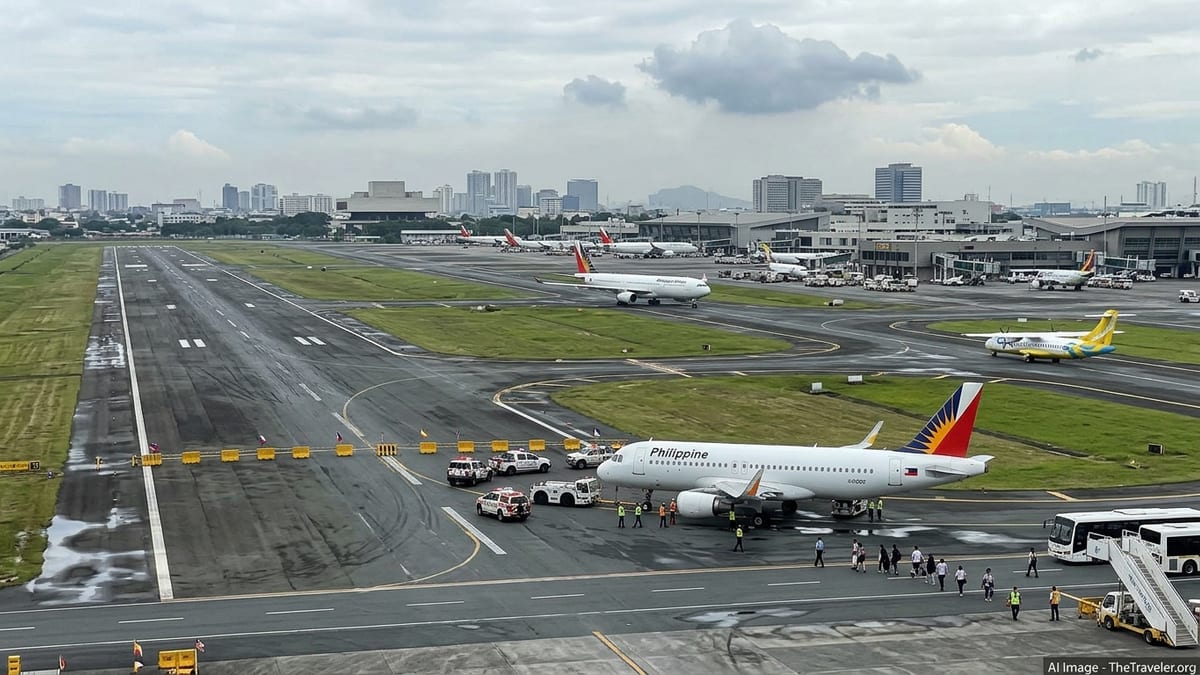
Emergency return of PR2923 shuts NAIA’s main runway
The disruption began late on Sunday morning, 29 November 2026, when Philippine Airlines domestic service PR2923, an Airbus A320 operating from Manila to Daraga in Albay province, returned to Ninoy Aquino International Airport after the crew reported a hydraulic system problem while approaching cruise. The airline and the Civil Aviation Authority of the Philippines later confirmed that the aircraft landed back at NAIA and that all passengers disembarked safely following the unscheduled arrival.
Airport and regulatory advisories state that during the landing roll several tires on the aircraft’s main landing gear were damaged, leaving the jet disabled on Runway 06/24, NAIA’s primary runway for larger aircraft. As emergency vehicles responded and engineers began assessing both the aircraft and the pavement, airport authorities ordered Runway 06/24 closed to traffic. For several hours, the only available runway for arrivals and departures was the shorter cross runway, designated 13/31, which is subject to stricter performance limits and is less suitable for heavily loaded widebody jets.
Statements from the Civil Aviation Authority and the NAIA operator indicate that air traffic controllers temporarily halted a number of departures and arrivals, then restricted movements to aircraft that could safely use Runway 13. Narrowbody domestic and regional flights were able to continue at reduced capacity, but international widebody services into and out of Manila were slowed, placed in holding patterns or diverted to other airports such as Clark while the disabled A320 remained on the main runway.
According to a late-afternoon advisory from the airport operator, runway teams eventually succeeded in towing the affected Philippine Airlines aircraft clear of the active surface after inspections and preparations. NAIA reported that Runway 06/24 reopened for departures and arrivals at approximately 17:48 local time, several hours after the initial incident, allowing a gradual resumption of normal flow. By that point, however, the lengthy interruption had already created a sizeable backlog of flights waiting for departure slots and arrival sequencing, especially on long-haul routes timed to reach Manila during the evening and overnight peaks.
Knock-on effects for Philippine Airlines’ PR658/PR659 Dubai rotation
The runway closure did not involve an international service directly, but its effects were quickly felt on Philippine Airlines’ Manila–Dubai–Manila rotation. According to the carrier’s published Northern Winter 2026/27 timetable, flight PR658 is scheduled to leave Manila for Dubai each afternoon at 13:30, arriving at Dubai International Airport at 18:45 local time, with the return sector PR659 due to depart Dubai at 20:25 and land back at NAIA at 08:40 the following morning.
On 29 November, the extended closure of Runway 06/24 compressed departure capacity at Manila through the afternoon, affecting the takeoff slot available to the A330-300 assigned to operate PR658 to Dubai. Flight-tracking data and schedules for that date indicate that the Manila–Dubai leg left later than usual, delaying the aircraft’s arrival into Dubai. Because Philippine Airlines generally uses the same widebody aircraft to operate the roundtrip pairing, the late inbound arrival into Dubai translated directly into a delayed departure for PR659 back to Manila, shifting its schedule by several hours compared with the timetable.
Real-time status feeds for PR659 on 29 November showed the Dubai departure pushed into the early hours of 30 November, roughly four hours after its 20:25 slot. The revised schedule meant passengers arrived in Manila closer to midday than the usual mid-morning, with estimates moving around as Manila air traffic control sequenced multiple delayed long-haul arrivals into the reopened runway. While not every tracking source published identical figures, the overall pattern pointed to a substantial, though not full-day, extension of travel time for passengers headed from Dubai to the Philippine capital on that date.
For many travelers on PR659, including a significant number of overseas Filipino workers and residents returning from the Gulf, the later-than-planned arrival had additional consequences. A midday landing tightens or breaks same-day connections from Manila to provincial destinations such as Cebu, Davao or Legazpi that are usually timed around a morning bank of arrivals. Some passengers would have been rebooked to later flights once capacity became available, while others with ground transport or work commitments in Metro Manila on 30 November faced schedule adjustments as the delay propagated into their onward plans.
Cebu Pacific Dubai–Manila service sees moderate delays
Cebu Pacific’s daily Dubai to Manila service, flight 5J15, also experienced disruption linked to the reduced runway capacity at NAIA, although publicly available movement data point to shorter delays than those recorded on Philippine Airlines’ Dubai flight. The low-cost carrier’s schedule for the route lists a planned 22:00 departure from Dubai International’s Terminal 1 and an 11:00 arrival in Manila the following day, reflecting a block time of about nine hours.
Flight tracking history around the weekend of 28–29 November shows that 5J15 departed Dubai behind schedule but not by the same margin as PR659. On the night of 28 November, with arrival into Manila on the morning of 29 November, the flight left Dubai more than an hour late yet was projected to land in Manila around 12:30, roughly 90 minutes beyond the timetable. Data for 29 November itself suggest that the Dubai departure remained later than the standard 22:00 slot and that the associated Manila arrival window moved accordingly, though still within what most systems classified as a moderate delay rather than an extensive disruption.
Unlike Philippine Airlines’ widebody service, which is closely tied to a specific long-haul aircraft rotation, Cebu Pacific’s operations on the Dubai route benefited from some flexibility in aircraft scheduling and ground handling, helping to limit the length of the delays. Even so, a one- to two-hour arrival shift into NAIA can be significant for budget-conscious passengers relying on tight connections to domestic flights operated from Manila or for workers planning to proceed directly from the airport to their homes or workplaces in the capital region.
Traveller reports and airline notifications over the same period indicate that some passengers on upcoming 5J15 departures received schedule-change messages reflecting revised departure times, as Cebu Pacific adjusted its operations around congestion at Manila. However, the bulk of available real-time data does not show sustained multi-hour disruptions on the Dubai–Manila sector beyond the immediate window of the 29 November runway closure and its aftermath.
Why a single disabled aircraft can disrupt long-haul schedules
The events around PR2923 underline how operational constraints at NAIA can quickly ripple across international networks when something goes wrong on a domestic sector. Manila’s airport primarily relies on two intersecting runways, with 06/24 handling most movements by larger aircraft and the shorter 13/31 generally serving smaller jets and turboprops. When an incident leaves a jet disabled on 06/24, controllers must keep that surface closed until the aircraft can be safely removed and the pavement inspected for damage and debris, sharply reducing capacity.
In these circumstances, air traffic managers tend to prioritize essential arrivals and short-haul departures that can safely use the cross runway, while widebody aircraft scheduled to depart at heavy weights for long-haul destinations face constraints. At NAIA, the performance limits of Runway 13/31, particularly in the region’s warm and often humid conditions, mean that heavily loaded widebody flights to the Middle East and beyond may not be able to depart at planned payloads or fuel levels, or at all, while the main runway remains out of service.
For the Manila–Dubai market specifically, both Philippine Airlines and Cebu Pacific typically deploy widebody aircraft such as the Airbus A330 to cover the eight- to nine-hour sector with sufficient seats and cargo capacity. When departure slots from NAIA are constrained, a flight like PR658 from Manila to Dubai may be held on the ground until controllers can sequence a safe takeoff, often after shorter domestic movements. Any such delay immediately affects the timing of the return leg, PR659, because airlines generally schedule the same airframe to operate both directions with only a modest turnaround time at Dubai International.
The knock-on impact can be compounded if the incident occurs during a busy travel period, as was the case on the final Sunday in November. Ground handling teams, immigration counters and parking stands at NAIA are already heavily utilized during peak hours, leaving limited room to compress delayed arrivals or stack departures more closely together once a runway reopens. Airlines and airport coordinators therefore have to rebuild the sequence of flights carefully, spacing traffic to avoid gridlock on taxiways and at gates, which can extend delays for services like Dubai–Manila even after the technical problem that triggered the closure has been resolved.
What Dubai–Manila passengers should check after the 29 November disruption
With NAIA’s main runway now back in service and operations gradually normalizing, passengers booked on upcoming Dubai–Manila flights are unlikely to see the kind of multi-hour delays that occurred in the immediate aftermath of the 29 November incident. However, some residual retiming of services is possible as airlines fine-tune rotations and crew schedules following the disruption, particularly on high-utilization long-haul aircraft.
Travelers scheduled to fly in the days following the runway closure should monitor their bookings through official channels maintained by their airline. Philippine Airlines provides status updates for PR658 and PR659 through its website, mobile app and customer service channels, while Cebu Pacific publishes advisories and live status information for 5J15 and associated domestic connections. These sources are more likely to reflect last-minute aircraft swaps, gate changes or minor schedule adjustments than third-party tools that rely on published timetables.
Passengers whose journeys on 29 or 30 November were significantly disrupted, including those who missed onward connections from Manila, should review the relevant conditions of carriage and contact their airline or travel agent to clarify rebooking and assistance options. Policies may vary by carrier, ticket type and the underlying cause of the delay, but in general airlines offer re-accommodation on later services where space permits and may provide meals or hotel vouchers in certain circumstances. Because this incident originated from a technical issue on a Philippine Airlines flight rather than broader airspace restrictions or severe weather, the specific support provided will depend on each carrier’s internal rules and any applicable regulations.
Looking ahead, current Northern Winter schedules for 2026/27 continue to show daily Dubai–Manila operations by both Philippine Airlines and Cebu Pacific, with no announcements to suggest that the 29 November runway closure will lead to structural changes on the route. For travelers planning itineraries that involve a connection at NAIA, the incident nonetheless serves as a reminder to allow extra buffer time between long-haul arrivals and onward domestic flights where possible, to ensure that contact details in bookings are accurate, and to check flight status on the day of travel in case of any short-notice adjustments prompted by disruptions elsewhere in the network.