


More news on this day
An emergency return by a Philippine Airlines Airbus A320 to Manila’s Ninoy Aquino International Airport on 29 November 2026 led to a multi-hour closure of the airport’s main runway, forcing widebody diversions, holding patterns and delays on key long-haul routes including the Manila–Dubai services of Philippine Airlines and Cebu Pacific.
Get the latest news straight to your inbox!
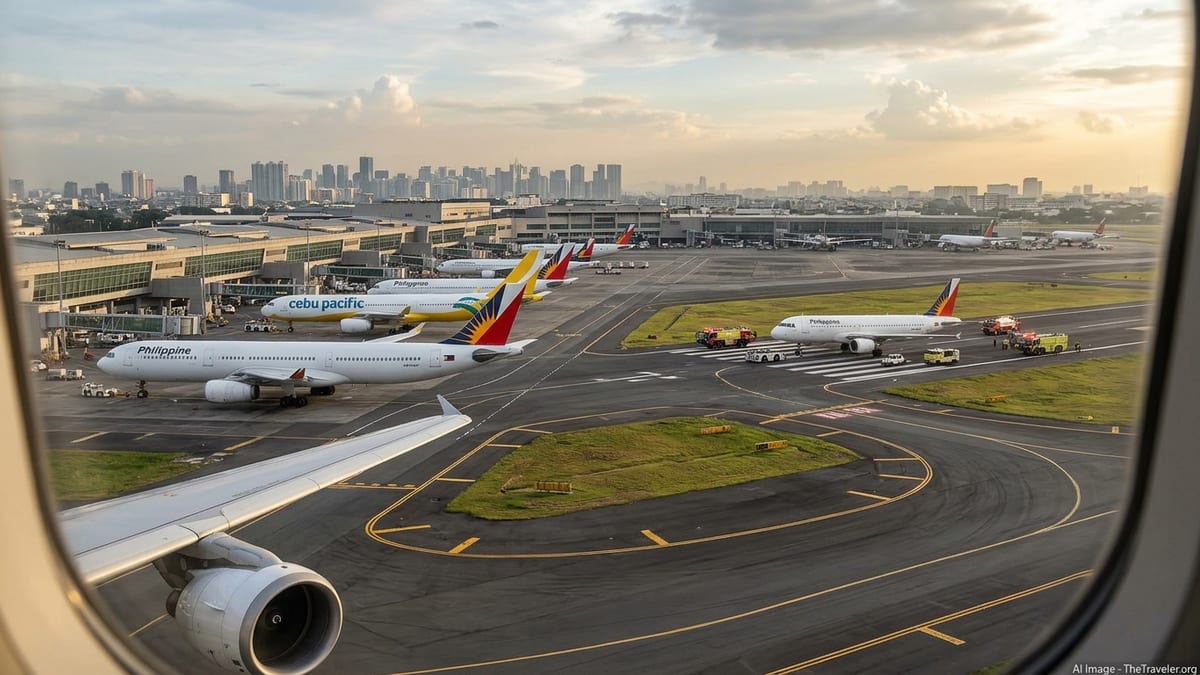
How PR2923’s emergency landing shut NAIA’s main runway
Philippine Airlines domestic flight PR2923, an Airbus A320 operating from Manila to Daraga in Albay province, declared a hydraulic system problem late on Sunday morning, 29 November 2026, and elected to return to Ninoy Aquino International Airport rather than continue to Bicol. The airline and the Civil Aviation Authority of the Philippines said the aircraft landed safely back in Manila, with no injuries reported among passengers or crew after the unscheduled arrival.
Airport and aviation authority advisories describe how the A320 became disabled on Runway 06/24, NAIA’s 3,514‑metre primary runway used by most jet operations. During the landing roll at around 11:45 local time, several tires on the main landing gear were reported to have burst, leaving the aircraft stationary on the runway while emergency vehicles responded. Crews began working shortly after midday to secure the jet, replace damaged tires and prepare it to be towed clear so engineers could inspect the pavement and remove any debris.
With the aircraft immobilised, airport operator New NAIA Infrastructure Corp and the Civil Aviation Authority ordered Runway 06/24 closed to traffic while response teams were on scene. For several hours, air traffic controllers routed movements onto the shorter intersecting runway, 13/31, which has stricter performance limits and typically handles lighter domestic and regional flights. Authorities confirmed that narrowbody jets and turboprops continued operating at reduced capacity from the cross runway, but most widebody aircraft had to hold, divert to other airports such as Clark or await the reopening of the main strip in Manila.
By mid to late afternoon, runway teams had managed to tow PR2923’s aircraft clear of the active surface. In a public advisory, NAIA reported that Runway 06/24 reopened for departures and arrivals at approximately 17:48 local time on 29 November, allowing controllers to gradually rebuild normal traffic flow. However, the extended interruption across the busy middle of the day had already generated a backlog of delayed departures and out‑of‑sequence arrivals that spilled into the evening, with long-haul flights among those most affected.
Impact on Philippine Airlines’ Manila–Dubai rotation
The incident itself involved a domestic sector, but its impact was quickly felt on Philippine Airlines’ daily Manila–Dubai–Manila rotation. According to the carrier’s published Northern Winter 2026/27 timetable, flight PR658 is scheduled to depart Manila for Dubai at 13:30, arriving at Dubai International Airport at 18:45 local time, with return flight PR659 due to leave Dubai at 20:25 and land back at NAIA at 08:40 the following day.
On 29 November, the closure of Runway 06/24 compressed Manila’s departure capacity during the afternoon window when PR658 was due to depart. Real‑time tracking and schedule data for that Sunday show that the A330‑300 assigned to PR658 pushed back and took off later than its normal mid‑afternoon slot, as controllers sequenced long‑haul departures around shorter flights using the cross runway and awaited the reopening of 06/24. The delay on the Manila–Dubai leg extended the aircraft’s arrival into Dubai, leaving less margin before the planned evening departure back to the Philippines.
Because Philippine Airlines typically operates PR658 and PR659 as a same‑aircraft rotation, the late arrival into Dubai carried through to the return sector. Flight status records for 29 November indicate that PR659’s departure from Dubai slipped into the early hours of Monday 30 November, several hours beyond its scheduled 20:25 pushback. That shift in timing meant the inbound widebody reached Manila closer to midday than the usual mid‑morning arrival, with the precise landing time influenced by how NAIA’s air traffic flow managers integrated multiple delayed long‑haul arrivals onto the newly reopened main runway.
The knock‑on effects were felt most acutely by passengers connecting beyond Manila. Many travellers on PR659 are overseas Filipino workers and residents returning from the United Arab Emirates and the wider Gulf region, often with tickets that include onward legs to cities such as Cebu, Davao, Bacolod or Legazpi. A mid‑day arrival on 30 November would have tightened or broken a number of same‑day domestic connections normally built around a morning bank of flights. In such cases, passengers were likely rebooked to later services as space allowed, while others with pre‑arranged land transport or work commitments in Metro Manila had to adjust plans as the disruption spilled over into their schedules.
Cebu Pacific’s Dubai service and other affected long‑haul flights
Cebu Pacific’s daily Dubai to Manila service, flight 5J15, also experienced delays linked to the runway disruption, although publicly available tracking logs point to more modest schedule changes compared with the Philippine Airlines widebody flight. The low‑cost carrier’s timetable lists a planned 22:00 departure from Dubai International’s Terminal 1 and an 11:00 arrival in Manila the following day for the roughly nine‑hour sector operated by an Airbus A330.
Movement history for the weekend of 28–29 November shows that 5J15’s departures around the incident were later than scheduled and arrivals into Manila shifted into the early afternoon. On the night of Saturday 28 November, for an arrival on Sunday 29 November, the flight left Dubai behind schedule and was projected to reach NAIA about an hour and a half after its planned arrival time. Data for the departure on Sunday night, 29 November, with arrival on Monday 30 November, similarly indicate a delay relative to the standard 22:00 schedule, but mostly within what tracking systems classify as a moderate rather than extensive disruption window.
Unlike Philippine Airlines’ tightly paired PR658/PR659 rotation, Cebu Pacific appears to have had slightly more flexibility in assigning aircraft and adjusting ground times on the Dubai route, which helped cap the length of the delays. Even so, an arrival one to two hours beyond the timetable can be significant for price‑sensitive passengers relying on close domestic connections from Manila or for workers planning to proceed straight from NAIA to homes and workplaces in the capital region. Travellers reported receiving schedule‑change notifications for some upcoming 5J15 departures as the airline recalibrated its operations around the congestion triggered by the runway closure.
Authorities and airline advisories also referenced delays and diversions affecting other long‑haul sectors into NAIA during the main runway outage, including services from East Asia and the wider Middle East. Widebody aircraft unable to land within fuel and performance limits on Runway 13 were held in airborne stacks or diverted temporarily to alternate fields such as Clark International Airport to await the reopening of 06/24 or a workable landing sequence in Manila.
Why a single disabled aircraft can ripple across international networks
The PR2923 incident underlines why relatively contained technical problems on a domestic flight can quickly have system‑wide effects at a single‑runway‑dependent hub. NAIA’s main runway, 06/24, handles the vast majority of jet movements into and out of the Philippine capital and is one of only two intersecting runways available. The cross runway, 13/31, is shorter and subject to more restrictive performance limitations, particularly in Manila’s warm, humid conditions, which affect aircraft takeoff weights and landing distances.
When a jet is disabled on 06/24, safety protocols require controllers to suspend movements on that surface until the aircraft is removed and ground crews can confirm that the pavement is clear of debris and undamaged. Even when 13/31 remains technically available, air traffic managers must restrict its use to aircraft types and loading scenarios that meet the required safety margins for runway length and conditions. In practice, this means prioritising essential domestic arrivals, medical or emergency movements and short‑haul departures that can operate at lower weights from the cross runway, while heavily loaded widebodies bound for long‑haul destinations are held back.
For Manila–Dubai services, both Philippine Airlines and Cebu Pacific rely on widebody aircraft such as the Airbus A330 to cover the eight to nine hour sector with sufficient passenger and cargo capacity. With 06/24 unavailable for part of the afternoon on 29 November, dispatchers and controllers had limited windows in which to release these flights at acceptable weights, or had to delay them outright until normal runway operations could resume. Any delay imposed on a departure like PR658 then flows directly into the return leg, PR659, because schedules are built on relatively tight ground times at Dubai International to maintain daily frequency with a limited long‑haul fleet.
The ripple effects are amplified when incidents occur during busy travel periods. The final Sunday of November already carries heavier traffic as travellers position for early December holidays and overseas workers arrive home. During the outage, stands, taxiways and terminal facilities at NAIA became more congested than usual as aircraft accumulated waiting for departure slots or gates. Once 06/24 reopened, operations teams had to reconstruct the departure and arrival sequence carefully, balancing the needs of delayed long‑haul flights, on‑time short‑haul services and crew duty limitations, which meant some delays persisted even after the disabled aircraft had been cleared.
What passengers on Dubai–Manila flights should do next
With Runway 06/24 now back in service and NAIA reporting that normal operations resumed from the early evening of 29 November, the most acute disruption has already passed. Available schedules and booking engines still show both Philippine Airlines and Cebu Pacific operating daily Manila–Dubai flights through the remainder of the Northern Winter 2026/27 season, and there have been no announcements indicating structural changes to the route as a result of the incident.
Travellers flying between Dubai and Manila in the days immediately after the runway closure may still encounter minor timing adjustments as airlines rebalance aircraft rotations and crew rosters. Passengers booked on Philippine Airlines should monitor flights PR658 and PR659 via the carrier’s website, mobile application or customer service channels, which are updated more frequently than third‑party timetables. Cebu Pacific customers on 5J15 and connecting domestic services are similarly advised to check live status tools and any email or SMS notifications for short‑notice departure or arrival changes.
Those who travelled on 29 or 30 November and experienced missed connections or substantial delays should review their ticket conditions and each airline’s disruption policies to understand rebooking and assistance options. Entitlements can vary depending on ticket type, the cause of the delay and any applicable local or foreign consumer regulations on the route. In general, carriers may offer re‑accommodation on the next available flights and, in some cases, provide meals or hotel vouchers where passengers are stranded overnight, although specific arrangements are handled case by case.
Looking ahead, the incident serves as a reminder for travellers planning itineraries that connect through NAIA. When possible, allowing additional buffer time between long‑haul arrivals from the Middle East and onward domestic flights within the Philippines can reduce the risk of missed connections when unexpected operational issues occur. Ensuring that contact details are up to date in airline bookings will also make it more likely that passengers receive timely notifications of any future short‑notice schedule changes related to runway constraints or other disruptions at Manila’s primary gateway.