


More news on this day
Transportation Secretary Sean P. Duffy says early federal data indicate that storms and sheer traffic volume, rather than new technology failures, have driven most U.S. flight delays so far during the 2026 Thanksgiving travel period, as airlines and airports grapple with some of the busiest skies in more than a decade.
Get the latest news straight to your inbox!
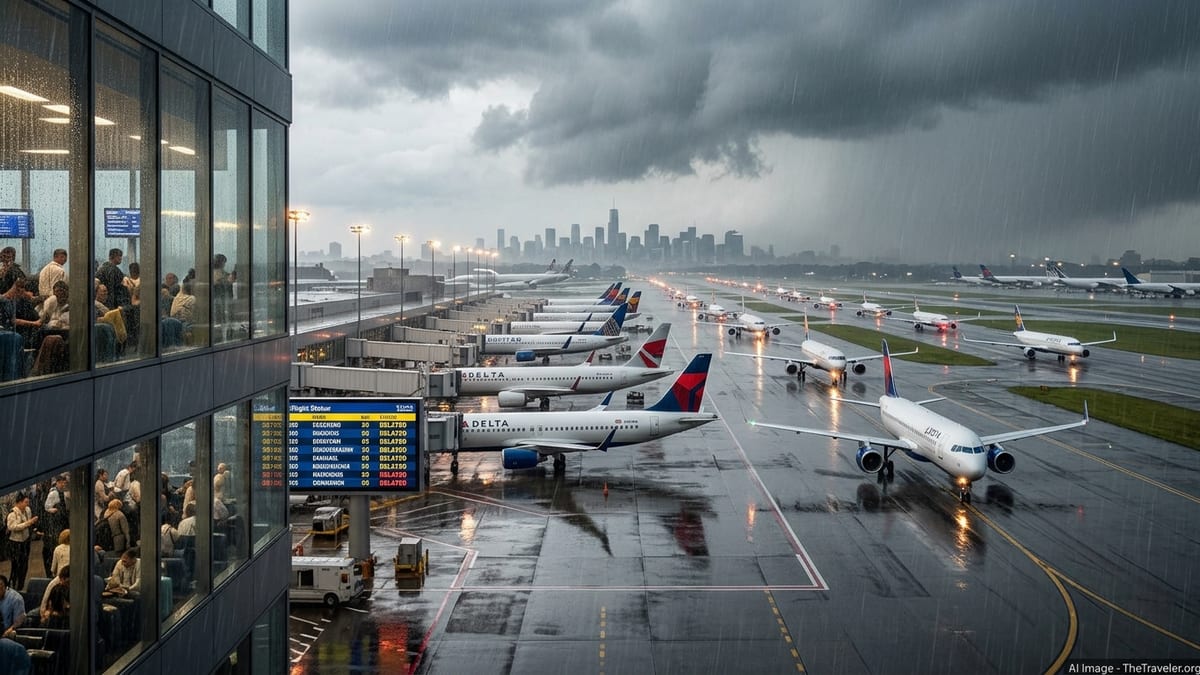
Preliminary figures point to weather and volume as main culprits
Duffy’s latest comments build on figures he first shared on social media and in interviews ahead of Thanksgiving Day on November 26, 2026. Citing preliminary operations data from the Federal Aviation Administration (FAA), he said that on Tuesday November 24, one of the week’s heaviest travel days, 50.5 percent of delays were attributed to inclement weather, with 24.1 percent linked to high traffic volume. Smaller portions were associated with air traffic control staffing and equipment issues, runway work and other causes.
Speaking again over the holiday weekend, Duffy said that from Tuesday through Friday of Thanksgiving week, bad weather accounted for about 45 percent of delay minutes, while heavy traffic was responsible for roughly 35 percent. Those broader figures have not yet been broken out flight by flight in a public database, but they align with longer term FAA statistics that typically show weather as the single largest driver of delays during peak travel periods, followed by general congestion.
The Department of Transportation (DOT) and FAA normally publish detailed cause-of-delay data several weeks after the fact. For now, officials are stressing that the mix seen so far in 2026 appears to fall within historical ranges, even as overall traffic presses up against record levels. By late in the week, private tracking service FlightAware was reporting several thousand delayed flights on some days, but with relatively modest average delays of around half an hour.
Storm systems and local outages shape where travelers feel delays
Conditions have varied sharply from airport to airport, but a sequence of storm systems and low cloud ceilings has created pockets of disruption across the country. Early in the week, San Francisco International Airport saw low clouds and reduced visibility that forced controllers to increase spacing between departures and arrivals, leading to average departure delays of around 60 minutes at times. Similar weather-related spacing measures affected other West Coast airports when marine layers and onshore flow reduced ceilings.
In Florida, thunderstorms and heavy rain slowed operations at Miami International Airport, where departures were often held 20 to 30 minutes while pilots waited for safe windows to take off. The impact there ebbed and flowed as individual storm cells moved across the region, but the cumulative effect added noticeably to national delay totals on days when weather was already challenging elsewhere.
As Thanksgiving approached, attention shifted to a strong coastal storm tracking up the Eastern Seaboard. Forecasters had warned early in the week that the system would intensify around Thanksgiving Day itself, bringing high winds, heavy rain and coastal flooding risks from parts of the Carolinas through New England. As the storm moved inland and strengthened, the FAA periodically implemented ground delay programs at major Northeast hubs, including New York area airports and Boston, to manage arrival rates safely during periods of strongest gusts and lowest cloud ceilings.
Separate from the storms, travelers also felt the effects of at least one localized technical issue layered on top of already busy operations. On Tuesday, the FAA briefly halted departures bound for Chicago O’Hare International Airport after a problem with airport surveillance equipment. Once the immediate issue was identified, the agency shifted to a ground delay program that metered flights into O’Hare while technicians worked on the affected system. The program was lifted later in the day, but some passengers experienced knock-on delays as aircraft and crews were repositioned. Officials have said that the O’Hare incident was unrelated to the nationwide ground stop earlier in the month and was confined to that airport’s systems.
Record or near-record traffic magnifies modest delays
Even relatively short setbacks are magnified when more people are traveling. In a forecast published in the week before Thanksgiving, the FAA projected nearly 418,000 flights across its nine-day Thanksgiving tracking period, the busiest holiday skies in roughly 16 years, with more than 52,000 departures scheduled on at least one peak day. The Transportation Security Administration (TSA) separately anticipated screening about 17.6 million passengers at checkpoints nationwide between Tuesday November 24 and Monday November 30, 2026.
Early checkpoint figures indicate that actual screening volumes are broadly in line with those projections, leaving airports and airlines operating at or near capacity during much of the week. That density means that when storms temporarily slow arrivals into a major hub or when a ground delay program is triggered, there is less slack in the system to absorb the disruption and more passengers are caught up in schedule changes.
Tracking services reported that at several points during the core Tuesday to Friday window, more than 2,000 flights to, from or within the United States were delayed in a single day, with a few hundred cancellations as storms crossed multiple regions. At the same time, many airports continued to report that a majority of departures were operating on time, particularly during early morning hours when weather conditions were more stable and aircraft and crews were already in position.
Duffy has emphasized that the average delay duration so far in the week has generally hovered just over 30 minutes, citing an average of about 32 minutes on Wednesday November 25. For most travelers, that has meant longer waits at the gate or on taxiways rather than wholesale cancellations or airport-wide shutdowns. Comparisons with past holiday disruptions, including the severe operational meltdown at one major U.S. carrier during Christmas 2022, suggest that this year’s Thanksgiving disruptions have so far been driven more by storms and high loads than by an internal collapse of airline scheduling systems.
Thanksgiving travel unfolds under shadow of nationwide ground stop
The backdrop to the current holiday travel period is unusually tense after the nationwide ground stop that occurred on Friday November 13, 2026. That incident saw the FAA order a halt to departures across the country for nearly five hours after a telecommunications failure disrupted communications and radar feeds at multiple air traffic control centers. According to the FAA and DOT, the problem emerged during work to upgrade communications infrastructure as part of a shift from older time-division multiplexing equipment to newer internet protocol based systems.
In public briefings and a subsequent written explanation, officials said that a new router installed at a facility in El Dorado, Arkansas began flooding older network equipment with an unusually high volume of connection attempts, which in turn destabilized communications used by controllers to guide aircraft. Out of what the agency described as an abundance of caution, the FAA implemented a rare nationwide ground stop while it worked with its network service provider to isolate the faulty equipment and restore normal operations.
The ground stop led to the cancellation of more than 12,000 flights on November 13 and caused knock-on delays into the weekend as airlines repositioned aircraft and crews. Although investigators found no evidence of a cyberattack, the episode sparked pointed questions from lawmakers and passenger advocates about the resilience of the national air traffic control system and the pace of modernization. Congressional committees have requested detailed briefings and documents, and an internal technical report from the FAA is expected in the coming weeks. Lawmakers have also signaled potential hearings focused both on the November 13 outage and on broader needs in the air traffic control infrastructure.
Against that backdrop, Duffy has been at pains to distinguish this week’s disruptions from the earlier systems failure. He has repeatedly stressed that the delays logged so far in the Thanksgiving period are far more typical of normal weather and congestion challenges and that the localized equipment issue at Chicago O’Hare was unrelated to the nationwide outage. At the same time, he has used public appearances around the holiday to argue for additional investment in FAA hardware, software and redundancy, framing the November 13 event as evidence that modernization work must accelerate even as daily operations remain safe.
What travelers should expect as the peak return days approach
The Sunday and Monday after Thanksgiving, this year November 29 and November 30, are historically among the busiest and most delay-prone travel days in the U.S. Against that pattern, and given the storms still affecting parts of the East Coast and Midwest, officials are urging passengers to treat weather and crowding as the most significant risks during the homeward rush.
The FAA is advising travelers to check their flight status repeatedly in the hours before leaving for the airport and to use airline mobile apps, text alerts or email notifications to stay informed of schedule changes. Because low visibility, wind shifts or persistent rain can trigger last-minute ground delay programs or require increased spacing between arrivals and departures, a flight that appears on time in the morning can slide later as conditions evolve. For those with tight connections, even a modest delay on the first leg can be enough to miss an onward flight when hubs are running near capacity.
Airlines and the TSA continue to recommend that passengers allow extra time at the airport, especially at major hubs and during peak morning and late afternoon banks. Travelers are being advised to arrive at least two hours before domestic departures and three hours before international flights, with additional buffer if they need to check bags, return rental cars or park in remote lots. Several large airports have already reported periods when parking garages or on-site lots have filled up, requiring drivers to divert to more distant facilities and add time to their journey to the terminal.
Duffy has said that while additional delays and localized disruptions remain possible if new storm systems develop or existing ones stall over key hubs, there is no indication at this stage that a repeat of the November 13 nationwide ground stop is likely during the remainder of the Thanksgiving period. Once the holiday rush subsides and full FAA and DOT statistics are compiled, regulators are expected to provide a more granular breakdown of delays, cancellations and their causes. That detailed dataset will allow a clearer assessment of how much of this year’s Thanksgiving disruption can ultimately be attributed to weather, traffic volume, equipment issues and other factors. In the meantime, officials say the most practical step for travelers is to plan around the two forces driving most of the problems so far: fast-changing weather conditions along several key corridors and the sheer number of people flying during one of the busiest travel weeks of the year.