


More news on this day
Preliminary data from US aviation and security agencies indicate that weather and heavy holiday crowds, rather than fresh technology failures, are driving most flight disruption over the 2026 Thanksgiving travel period, easing fears of a repeat of the November 13 nationwide ground stop that halted flights for nearly five hours and affected tens of thousands of passengers.
Get the latest news straight to your inbox!
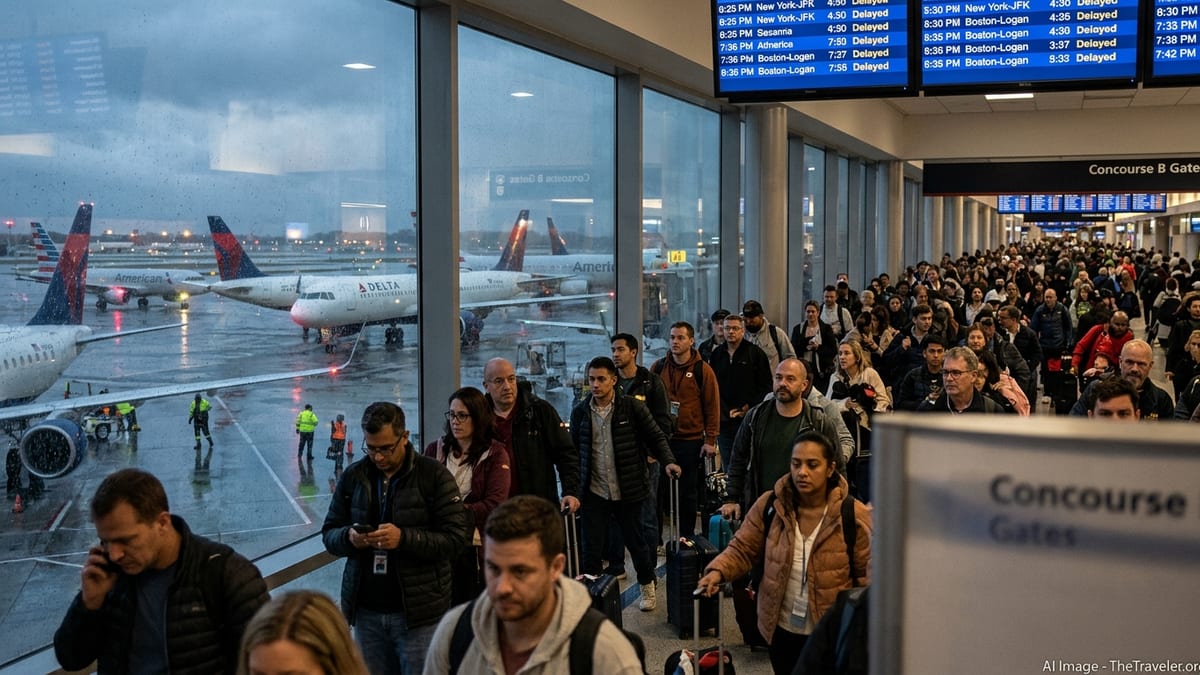
Weather-linked delays dominate early Thanksgiving week
While detailed, flight-by-flight statistics for Thanksgiving week will only appear later in the Department of Transportation’s on-time performance database, early operational summaries from the Federal Aviation Administration and airlines point to a familiar pattern: most delay minutes have been tied to ordinary weather constraints and congestion, not a new systemic technology failure. FAA traffic management advisories for Tuesday 24 November show multiple airports operating under weather-related restrictions, including low clouds and fog in the New York area and reduced arrival rates on the West Coast, with additional throughput limits attributed to volume during peak bank times.
Those operational measures have translated into what, by Thanksgiving standards, remain modest delays for many travelers. Publicly available tracking data show national average departure delays hovering a little above the 30-minute mark on the busiest days so far, with a substantial share of flights still operating on time at major hubs. Several thousand flights to, from or within the United States have run at least 15 minutes late on individual days, but cancellation totals have generally remained in the hundreds rather than the thousands, well below the scale of disruption associated with major operational meltdowns in recent holiday seasons.
The emerging picture is in line with how Thanksgiving typically behaves in federal statistics. Historical Department of Transportation data show that, outside of the Sunday and Monday after the holiday, many Thanksgiving-period days have on-time performance comparable to or slightly better than the annual average, even when storms are moving through. Analysts caution that headline delay counts can sound severe when so many travelers are concentrated into a short window, but that the underlying causes this year largely mirror those seen in other busy autumn travel periods.
Storm systems shape which airports felt the worst of it
Where passengers have run into the most difficulty has largely followed the evolving November storm track. In the run-up to Thanksgiving Day itself, low ceilings and marine layers along parts of the West Coast periodically reduced arrival and departure rates at airports such as San Francisco International and Seattle–Tacoma International. When runway acceptance rates are cut for visibility or wind reasons, controllers are required to space aircraft further apart, which quickly builds queues during already-busy morning and late-afternoon departure banks.
Farther south and east, lines of thunderstorms and heavy rain across Florida and the Gulf Coast have led to intermittent ground stops and ground delay programs at airports including Miami, Fort Lauderdale and Houston. In practice, that has meant departures held at the gate or on the tarmac for 20 to 40 minutes while convective cells passed overhead or lightning activity triggered ramp closures. Though those pauses were relatively short-lived and localized, they added meaningfully to the national tally of delay minutes once compounded with weather-related restrictions in other parts of the network.
The most disruptive single weather event of the period so far has been the coastal storm that swept up the Eastern Seaboard on Thanksgiving Day, Thursday 26 November, and into Friday. According to the National Weather Service, the system brought strong winds, heavy rain and pockets of coastal flooding from the Carolinas through New England. That combination prompted the FAA to implement repeated ground delay programs at key Northeast hubs, including New York’s LaGuardia and John F. Kennedy airports and Boston Logan, feeding into more than 2,200 delays and over 400 cancellations on Thanksgiving itself by US-bound and domestic flights, based on major tracking service tallies.
Localized issues follow earlier nationwide outage but stay contained
The backdrop to this year’s Thanksgiving travel has been heightened sensitivity to aviation technology after the rare nationwide ground stop on Friday 13 November 2026. According to public summaries from the FAA, congressional briefings and media reporting, that incident began when a contractor working for L3Harris installed a new Juniper router at a radio communications facility in El Dorado, Arkansas, as part of a broader effort to replace legacy copper-based telecommunications lines with fiber. Once activated, the router began flooding the network with frequent connection attempts that overwhelmed older equipment, with a second router at a radar facility in Amarillo, Texas contributing to the overload.
The resulting instability in communications links and radar data at multiple air traffic control centers led the FAA to order a nationwide ground stop that lasted roughly four hours and forty-five minutes, affecting traffic at 17 of the agency’s 22 en-route centers and prompting more than 17,000 flight cancellations and delays over the affected weekend. In response, Transportation Secretary Sean Duffy directed the FAA to halt similar router installations and secure the equipment that had been installed in Arkansas and Texas while investigators and outside experts conduct a technical review. Congress has also requested documentation and timelines around the upgrade program and the agency’s network monitoring.
That earlier episode has meant that even local disruptions during Thanksgiving week attracted more scrutiny than usual. Early in the holiday period, the FAA briefly imposed and then lifted a ground stop at Chicago O’Hare, citing staffing-related constraints and a transition to a formal ground delay program to manage inbound flow. Other airports reported shorter operational holds associated with localized equipment troubleshooting. Crucially for travelers, none of these issues have behaved like the November 13 outage: they were limited in geographic scope, handled with standard traffic management tools and did not cascade into nationwide stoppages of departures.
Heavy crowds test airports’ limited slack
Even with the primary causes of delay rooted in weather and expected congestion, the sheer volume of people moving through the system over the Thanksgiving window has amplified every disruption. In the days leading up to the holiday, the Transportation Security Administration projected that it would screen close to 17.6 million passengers at airport checkpoints between Tuesday 24 November and Monday 30 November. That forecast, shared publicly by the agency ahead of the holiday, positioned the 2026 travel period just below the all-time Thanksgiving record set in 2025, when daily TSA screening counts topped 3.13 million on the Sunday after the holiday.
Preliminary daily figures released by TSA indicate that 2026 volumes have broadly tracked those expectations, with multiple days exceeding 2.5 million passengers screened and some edging toward the 3 million mark. At the same time, FAA planning documents and independent schedule analyses suggest that airlines scheduled more than 50,000 flights on the busiest days of the period, including the Sunday and Monday after Thanksgiving, as carriers sought to capitalize on demand and restore normal operating patterns after the November 13 outage.
With airports and airlines operating so close to their practical capacity, even relatively short-lived weather-related throughput reductions have had outsized effects for individual passengers. Queues of aircraft have periodically formed on taxiways at hub airports when departure rates were constrained, and crowded gate areas have made it more difficult to re-accommodate travelers who misconnected due to upstream delays. Although overall cancellation rates have remained comparatively low, the lack of spare aircraft and crew has limited airlines’ flexibility to recover quickly from local disruptions, particularly late in the day when legal duty limits for flight crews become a factor.
What travelers should watch for during the Sunday–Monday return rush
The most concentrated stress on the system is occurring as travelers return from the long weekend on Sunday 29 November and Monday 30 November, historically among the most delay-prone days of the Thanksgiving period. Past Department of Transportation on-time data show that these dates often combine the highest passenger volumes with tightly banked hub schedules, leaving little margin for error when storms develop or an airport briefly reduces its arrival rate.
For this year’s return peak, forecasts from the National Weather Service and airline operations centers highlight lingering unsettled weather across parts of the East Coast and Midwest as the primary risk, rather than new technology-related problems. Low clouds, shifting winds or persistent rain can trigger last-minute ground delay programs or require controllers to increase spacing between arrivals, which in turn can push back departure slots across multiple airports connected to a major hub. Travelers whose flights are currently listed as on time are being urged by airlines and the FAA to monitor status updates closely in the hours before departure and to pay particular attention if their itineraries involve connections through New York, Chicago, Atlanta or other high-traffic nodes.
Airport and security agencies continue to recommend that domestic passengers arrive at least two hours before departure and international travelers at least three hours in advance, with extra time allowed for checked baggage, rental car returns and remote parking. Several large hubs have warned that central parking facilities could briefly reach capacity at peak times on Sunday and Monday, requiring the use of more distant lots or off-airport garages. Travelers with tight connections are being advised that even apparently modest delays on the first leg of a journey can be enough to miss a follow-on flight when hubs are running at or near their maximum sustainable throughput.
Looking beyond the immediate return rush, the FAA is expected to release a more granular breakdown in the coming weeks of delay causes during the 2026 Thanksgiving period once airlines submit their official on-time performance data. That report should clarify the precise share of disruptions attributable to weather, volume, staffing, equipment issues and other factors. In parallel, the agency plans to publish more detail on the November 13 nationwide ground stop and any changes to its modernization program or operational practices arising from that investigation. Until those documents appear, travelers and industry stakeholders are working with a high-level but consistent picture: regular holiday weather systems and heavy demand have driven most of this year’s Thanksgiving disruption, and there has been no sign to date of a repeat of the earlier system-wide technology failure.