


More news on this day
Early traffic figures from U.S. aviation agencies and tracking services indicate that weather and heavy holiday demand, rather than a repeat of this month’s high-profile technology failure, were responsible for most Thanksgiving 2026 flight disruption, leaving the air system strained but broadly functional as millions of travelers moved through U.S. airports.
Get the latest news straight to your inbox!
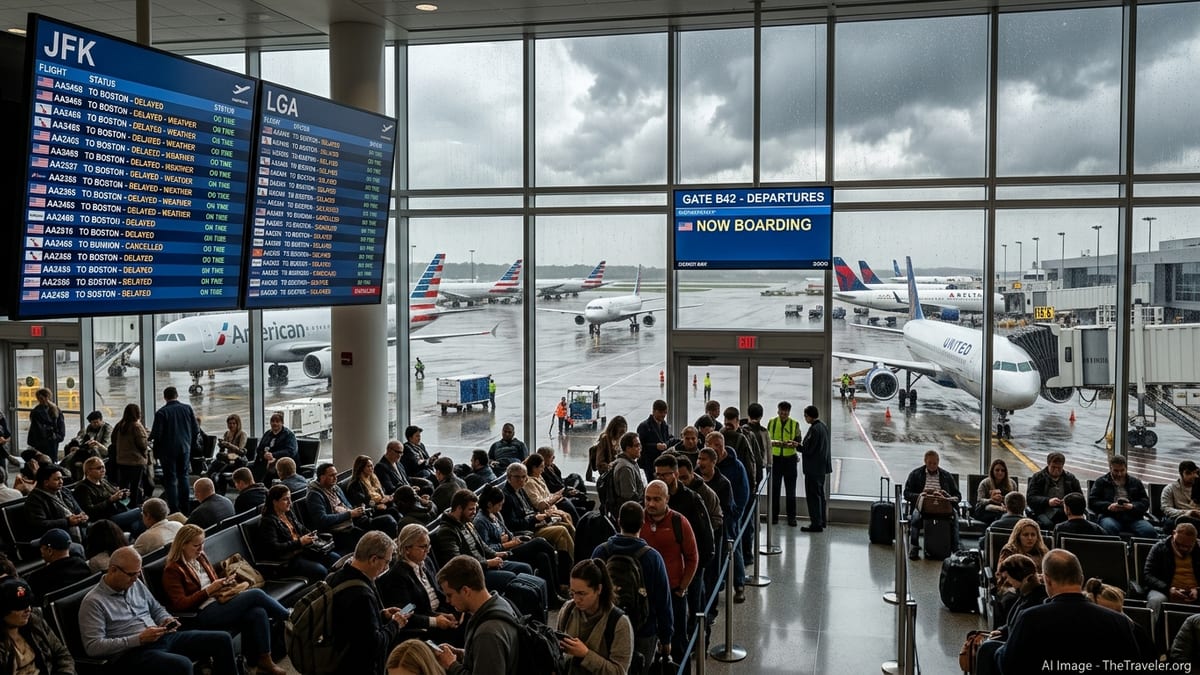
Holiday flight delays rise in line with a stormy but functioning system
Preliminary views from Federal Aviation Administration traffic logs, Transportation Security Administration checkpoint counts and commercial tracking services point to a Thanksgiving week that was very busy and frequently delayed, but without the widespread paralysis that would accompany another nationwide ground stop. Across the peak travel window from Tuesday 24 November through Monday 30 November, national average departure delays at many major airports generally sat in the 20 to 35 minute range on the busiest days, a level consistent with typical Thanksgiving performance in recent years rather than an exceptional breakdown.
Data compiled from federal feeds and real-time trackers show that on the heaviest travel days, several thousand flights to, from or within the United States arrived at least 15 minutes late, but cancellations stayed in the hundreds per day instead of climbing into the thousands. On Thanksgiving Day itself, Thursday 26 November, the flight-tracking service FlightAware counted just over 2,200 delayed flights involving U.S. destinations and more than 400 cancellations as a powerful coastal storm hit the East Coast, a profile that aligns with a difficult but still moving system.
TSA’s daily checkpoint figures confirm the intensity of demand. Publicly available counts show that Tuesday 24 November and Wednesday 25 November each saw well over 2.7 million people screened at airport security, with some industry analyses placing Thanksgiving Eve above 2.8 million, close to or slightly below last year’s pre-holiday peak. Forecasts issued before the break suggested TSA expected to screen around 17 to 17.6 million passengers between Tuesday 24 November and Monday 30 November, compared with an estimated 18.1 million over the same seven-day window in 2025, indicating near-record volumes but not a new high.
Coastal storms and regional weather shape where travelers felt it most
The pattern of disruption largely tracked the sequence of November storm systems moving across the country, rather than any broad failure of aviation technology. Along the West Coast in the first half of the week, low clouds, fog and marine layers periodically reduced arrival and departure rates at airports including San Francisco International and Seattle–Tacoma International. When visibility or crosswinds fall outside preferred operating ranges, controllers increase spacing between aircraft on approach and departure, which quickly generates queues during the already busy morning and late-afternoon peaks.
Farther south and along parts of the Gulf Coast, bands of thunderstorms and heavy rain affected operations at airports in Florida and Texas. Airports such as Miami, Fort Lauderdale and Houston Intercontinental intermittently used ground stops or formal ground delay programs as lightning and strong storm cells moved over airfields. In practice, departures were held at gates or on taxiways for 20 to 40 minutes at a time and ramp workers were pulled back from aircraft during lightning, slowing boarding and turnarounds. These local measures, repeated across several hubs, fed into a higher national tally of delays without necessarily triggering widespread cancellations.
The most significant single weather event for aviation arrived on Thanksgiving Day itself, when a coastal storm intensified along the Eastern Seaboard. National Weather Service and federal emergency briefings described strong winds, heavy rain and pockets of coastal flooding from the Carolinas through New England, conditions that led the FAA to apply repeated ground delay programs at major Northeast hubs including New York LaGuardia, John F. Kennedy and Boston Logan. As the storm moved north into Friday, arriving and departing aircraft in the region continued to face flow restrictions, with knock-on impacts on connections across the country.
November 13 ground stop casts a shadow but is not repeated
This year’s Thanksgiving travel unfolded less than three weeks after the 13 November 2026 nationwide ground stop, the longest systemwide halt to U.S. departures in roughly a quarter century and an incident that heightened concern among travelers and policymakers about the resilience of the country’s aviation infrastructure. According to public summaries from the FAA and an analytical brief from the Congressional Research Service, that episode began during an upgrade of telecommunications equipment at a radio facility in El Dorado, Arkansas, where contractor L3Harris was replacing legacy copper-based communications lines and Cisco routers with newer Juniper devices as part of a national copper-to-fiber transition.
Once brought online, one of the newly installed Juniper routers at El Dorado began flooding the FAA’s communications network with far more connection attempts than the older equipment could handle, with a second router at a radar facility near Amarillo, Texas contributing to the overload. As network links and radar data became unstable across multiple air route traffic control centers, the FAA imposed a nationwide ground stop on the afternoon of Friday 13 November while technicians worked to stabilize the system. Official accounts place the halt at about four hours and forty-five minutes and note that operations at 17 of the agency’s 22 en route centers were affected, with more than 17,000 flights canceled or delayed across the following weekend as airlines worked through the backlog.
In response, Transportation Secretary Sean Duffy ordered a temporary pause on further installations of the Juniper routers across FAA facilities while internal and external experts investigate the precise failure mode, and members of Congress requested detailed timelines and documentation of the modernization program in a formal letter. Publicly available material from those briefings indicates that several thousand routers are slated for conversion as part of the multi-year upgrade, but that the specific devices involved in El Dorado and Amarillo have been isolated for testing. That investigative backdrop meant any sign of disruption in the days before Thanksgiving drew close scrutiny from travelers and officials alike.
In the event, there was no repeat of a nationwide halt over the holiday period. Early in Thanksgiving week, the FAA did briefly impose a ground stop at Chicago O’Hare International Airport, citing staffing constraints at an air traffic facility and the need to shift to an orderly ground delay program for inbound traffic. The hold was lifted after a short period and operations moved to scheduled flow controls. Elsewhere, some airports reported short-lived local issues with equipment or procedures, but available evidence shows that all such incidents were geographically limited, were handled with standard air traffic management tools and did not cascade into a wider stoppage of departures.
Heavy demand reveals tight capacity during peak hours
Even where the underlying causes of disruption were largely routine weather and congestion, the intensity of Thanksgiving 2026 travel magnified the effect on individual passengers. Forecasts from AAA and federal transportation data suggested ahead of the holiday that more than 80 million Americans were likely to travel at least 50 miles from home by all modes between Tuesday 24 November and Monday 30 November, a figure only slightly below last year’s record and still among the busiest Thanksgiving periods on record.
On the aviation side, FAA planning materials and schedule analyses from airline and airport sources indicated that U.S. carriers had planned more than 50,000 flights on the busiest days of the Thanksgiving window, especially on the outbound peak in the middle of the week and the inbound surge expected on Sunday 29 November and Monday 30 November. Some U.S. airlines described these as among their heaviest individual operating days since before the pandemic, although definitive tallies will only be confirmed once November traffic and on-time performance data are formally filed with the Department of Transportation.
With schedules built so close to the limits of runway, taxiway and gate capacity at major hubs, even small weather-related reductions in an airport’s arrival or departure rate can translate into lines of aircraft on taxiways and long waits for gates. For travelers relying on connections, this tight operating margin has clear consequences: a 30-minute departure delay from a smaller “spoke” city can easily turn into a missed onward flight when connecting banks at hubs are tightly timed and later options are already heavily booked. Although overall cancellation rates appear to have remained comparatively low through most of Thanksgiving week, airlines had limited spare aircraft and rested crews available late in the day, when federally mandated pilot and cabin crew duty limits start to bite, making it harder to recover on the same day from earlier delays.
Return rush outlook and what travelers should check next
The greatest strain on the system is concentrated in the return wave on Sunday 29 November and Monday 30 November, which Department of Transportation statistics from recent years show are often the most delay-prone days of the Thanksgiving cycle. Historical on-time performance records indicate that the Sunday after Thanksgiving typically sees the highest share of flights arriving at least 15 minutes late, reflecting the combination of peak passenger volumes, densely banked hub schedules and limited slack to absorb disruptions.
For 2026, updated forecasts from the National Weather Service and operational notes from airlines highlight lingering unsettled conditions over parts of the East Coast and Midwest as the main risks for the Sunday and Monday return. Low ceilings, shifting wind directions and persistent rain at major hubs can trigger last-minute ground delay programs or force increased spacing between arriving aircraft, which in turn pushes back departure slots along connecting routes. Airlines and aviation authorities have been advising passengers heading back through weather-sensitive hubs such as New York, Chicago, Atlanta and Boston to monitor official apps and text alerts closely on the day of travel rather than relying on schedules printed weeks in advance.
Airport and security agencies continue to recommend that domestic passengers arrive at least two hours before their scheduled departure and international travelers at least three hours during the Thanksgiving return, with extra time built in for returning rental cars, checking bags or using remote parking and public transport. Several large hubs have warned that central parking garages could reach capacity during the Sunday and Monday peaks, meaning some drivers may be directed to overflow or off-airport facilities and should allow additional time before security.
More detailed information about how Thanksgiving 2026 unfolded will emerge over the coming weeks as the FAA publishes a breakdown of delay causes once airlines submit their official on-time performance and cancellation statistics for November. That dataset will assign minutes of delay to categories such as weather, volume, carrier operations, national airspace system constraints, security and late-arriving aircraft, offering a firmer basis for comparison with previous holidays. Separately, the agency has committed to releasing additional findings from its investigation into the 13 November nationwide ground stop and to outlining any resulting adjustments to its modernization program, router rollout and network monitoring practices. For travelers, the early evidence points to a holiday period shaped mostly by storms and tight capacity rather than fresh technology failures, a distinction that will inform both future travel planning and forthcoming policy debates over how best to strengthen the U.S. air traffic system.