


More news on this day
Widebody flights between Dubai and Manila faced extended delays on November 29 after a Philippine Airlines jet suffered a hydraulic problem and burst tires on landing at Ninoy Aquino International Airport (NAIA), forcing the temporary closure of one of the airport’s main runways and disrupting operations for hours.
Get the latest news straight to your inbox!
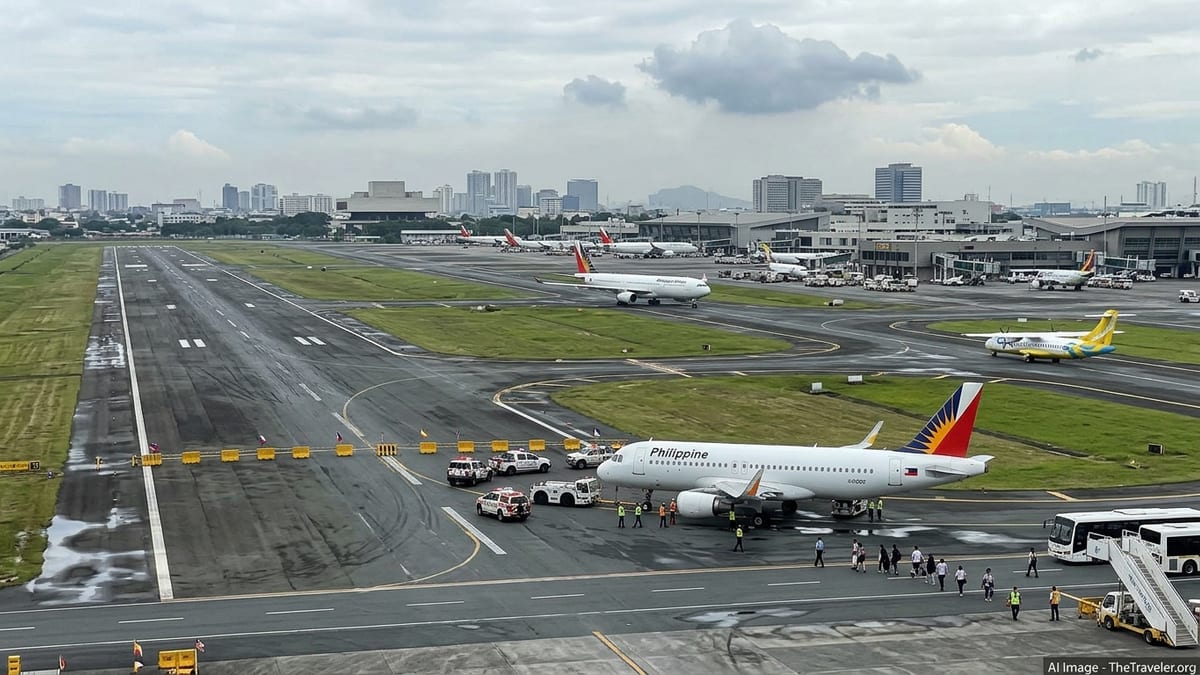
Runway incident at NAIA disrupts Sunday operations
The disruption began late Sunday morning, November 29, when Philippine Airlines flight PR2923 from Manila to Daraga, Albay, returned to NAIA shortly after departure because of a hydraulic system issue. The Airbus A320 made an emergency landing at the airport, and Philippine Airlines and the Civil Aviation Authority of the Philippines later confirmed that all passengers disembarked safely. However, multiple tires on the main landing gear were reported to have burst during the landing roll, leaving the aircraft disabled on Runway 06/24 and forcing its closure while emergency and maintenance teams responded.
Runway 06/24 is NAIA’s primary runway for larger aircraft, including most widebody jets that operate long-haul and some high-density regional services. With the aircraft immobilized on the pavement, air traffic control restricted movements and prioritized use of the secondary cross runway for smaller aircraft where possible. Aviation enthusiasts tracking the event reported that only narrowbody aircraft were able to depart and land during the closure, while many widebody flights were placed in holding patterns, delayed on the ground at their origin airports or diverted to alternative gateways such as Clark International Airport.
The airport operator, New NAIA Infrastructure Corp., worked with Philippine Airlines, CAAP and ground crews to remove the disabled aircraft and inspect the runway for damage and debris. By mid to late afternoon, the authorities had reopened Runway 06/24, but the hours-long interruption left a backlog across the schedule, particularly impacting long-haul departures and arrivals later in the day.
Impact on Philippine Airlines PR659 from Dubai
Among the most affected services was Philippine Airlines flight PR659, the carrier’s daily Dubai to Manila service operated by an Airbus A330-300. According to the airline’s published winter timetable, PR659 is normally scheduled to depart Dubai International Airport (DXB) Terminal 1 at 20:25 local time and arrive at NAIA Terminal 1 at 08:40 the following morning, with a planned flight time of around 8 hours 15 minutes. On November 29, however, the knock-on effects of the runway disruption in Manila meant the aircraft operating the outbound Manila to Dubai leg, PR658, was significantly delayed, which in turn pushed back the return sector.
Live tracking data for PR659 on November 29 shows that the flight did not depart Dubai at its scheduled 20:25 time. Instead, it left shortly after midnight local time, resulting in a delay of just under four hours on departure compared with the timetable. The late departure shifted the projected arrival into Manila from the standard 08:40 slot to around 12:30 local time on Monday, November 30, compressing the turnaround window for the aircraft and and affecting onward passenger connections, particularly to domestic destinations.
Flight status portals monitoring PR659 indicated that the service remained classified as delayed through the evening, with its estimated arrival time repeatedly adjusted as air traffic control in Manila sequenced incoming traffic around residual congestion. While the delay fell slightly short of six full hours, it represented a substantial extension of travel time for passengers on one of Philippine Airlines’ key Middle East routes, which typically carries a large number of overseas Filipino workers as well as leisure and business travelers.
Cebu Pacific’s 5J15 experiences shorter Dubai–Manila delay
Cebu Pacific’s Dubai to Manila service, flight 5J15, was also affected, although to a lesser extent based on available data. The low cost carrier’s published schedule for this route lists a 22:00 departure from Dubai Terminal 1 and an 11:00 arrival at NAIA Terminal 3 the following day, with a block time of approximately nine hours. Flight-tracking and schedule systems indicate that on the weekend of November 28–29, the 5J15 rotation left Dubai at around 23:08 local time, more than an hour behind schedule, and was projected to arrive in Manila roughly 30 to 35 minutes late.
Some third-party flight-status tools initially showed larger indicative delays for upcoming 5J15 departures on November 29 and 30 as airlines and airports recalibrated their operations, and passengers reported receiving schedule-change notifications showing revised early-morning departure times for Manila-bound flights. However, detailed movement records for the Dubai–Manila run during the period around November 29 point primarily to moderate delays of under two hours for Cebu Pacific rather than the six-hour disruption experienced by some long-haul services elsewhere in the network.
Cebu Pacific has resumed and maintained regular Dubai services in 2026 after previous capacity adjustments in the Middle East, and the route remains an important link for price-sensitive travelers between the Gulf and the Philippines. Even a delay of one to two hours can, however, have outsized effects for passengers with same-day domestic connections, tight ground transportation arrangements or work start times in Metro Manila, underscoring how disruptions on NAIA’s main runway ripple far beyond the immediate incident.
How a NAIA runway closure cascades into long-haul delays
The incident involving PR2923 illustrates how infrastructure and operational constraints at NAIA can quickly affect long-haul flights, even when the original problem occurs on a short domestic sector. With only two intersecting runways and limited opportunities to reroute traffic, the closure of the primary 06/24 runway obliges controllers to funnel movements to the shorter cross runway where performance limits restrict the size and weight of aircraft that can safely depart or land. In practice, this means that while some narrowbody domestic and regional flights can continue, many widebody operations to and from long-haul destinations must be slowed, held or diverted until the main runway is available again.
For Manila–Dubai operations, both Philippine Airlines and Cebu Pacific generally rely on widebody aircraft such as the Airbus A330 to handle demand and the distance involved. These aircraft typically require the full length and strength of Runway 06/24, particularly in Manila’s often hot and humid conditions, reducing flexibility during partial-airport closures. If a Manila-originating long-haul flight such as PR658 to Dubai departs late because of congestion following a runway outage, the inbound PR659 inevitably inherits that delay in Dubai, since it uses the same aircraft.
The effect is magnified during peak periods when ground handling resources, parking stands and airspace arrival slots are already heavily utilized. After a multi-hour closure, airlines must work with NAIA’s slot coordinators and air traffic control to rebuild the schedule, often prioritizing certain flights, spacing arrivals more widely to avoid ground saturation and arranging diversions or fuel stops for aircraft placed in extended holding. Passengers on affected international services can face longer boarding processes, gate changes, missed connections and congestion at immigration and baggage reclaim when multiple delayed flights arrive in close succession.
What travelers on Dubai–Manila flights should do next
For travelers booked on Dubai–Manila flights in the immediate aftermath of the November 29 runway incident, the most important step is to monitor flight status through official airline channels rather than relying only on generic timetables or third-party apps. Philippine Airlines provides real-time updates for PR658 and PR659 on its website and mobile app, while Cebu Pacific publishes advisory notices and live status data for 5J15 and related services through its digital platforms. These sources will reflect any further rolling delays, aircraft swaps or schedule normalization as NAIA’s operations settle.
Passengers whose flights were significantly delayed or who missed onward connections should review the conditions of carriage for their airline and, where applicable, contact customer service or their travel agent to discuss rebooking options. Philippine Airlines and Cebu Pacific each apply their own rules on meals, accommodation and compensation for disruption, which may differ by ticket type and the specific cause of the delay. Travelers connecting from Dubai to domestic destinations such as Daraga, Cebu or Davao might be reprotected on later flights, subject to seat availability once NAIA’s schedule stabilizes.
Looking ahead, both carriers’ winter 2026/27 schedules continue to show daily Dubai–Manila services, and there is no indication that the November 29 runway incident has led to structural changes on the route. However, the event highlights the value of building buffer time into itineraries that use NAIA as a connection point, especially during busy travel periods. When booking, travelers may wish to allow longer minimum connection times, particularly between international long-haul arrivals and onward domestic flights, and to ensure that contact details in their bookings are up to date so that any last-minute schedule changes reach them promptly.