


More news on this day
Early data from the 2026 Thanksgiving travel period indicate that unsettled weather and near-record traffic volumes, rather than a repeat of November’s high-profile technology failures, are driving most U.S. flight delays so far, even as travelers and lawmakers continue to scrutinize the resilience of the aviation system after a nationwide Federal Aviation Administration ground stop and a separate Delta Air Lines outage earlier this month.
Get the latest news straight to your inbox!
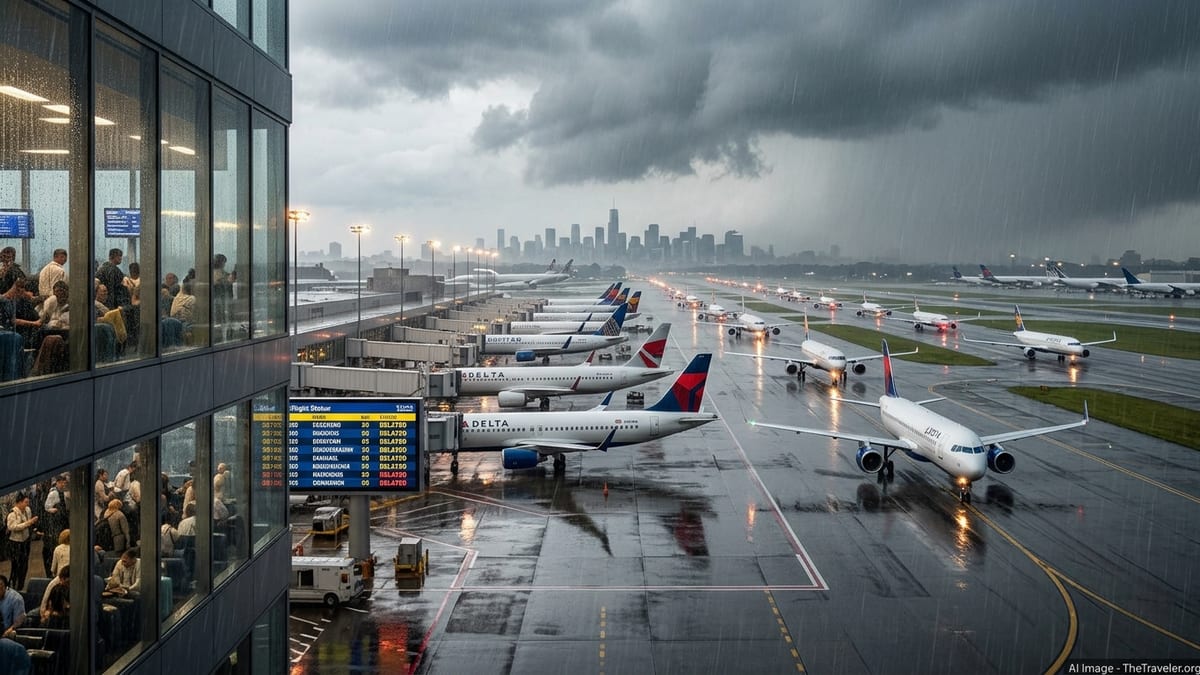
Record Holiday Schedules Meet Patchy Thanksgiving Weather
In a 23 November outlook, the U.S. Department of Transportation and the Federal Aviation Administration projected more than 417,000 flights nationwide over the nine-day Thanksgiving travel window from 23 November to 1 December 2026, describing it as the busiest holiday air travel period in at least 16 years. Officials expected peak days to top 50,000 scheduled flights as airlines concentrated operations through major hubs.
Transportation Secretary Sean P. Duffy has repeated in recent briefings that initial operational figures for the opening days of the official Thanksgiving period point primarily to weather and traffic volume as the main sources of delay, not fresh failures of federal infrastructure. His comments follow the department’s forecast language, which warned that controllers would be working near capacity in already complex corridors, leaving limited room to recover when storms or low ceilings appear.
Real-time status feeds from the FAA and airport operators through the Thanksgiving weekend show a familiar pattern for peak travel: periods of relatively smooth operations interspersed with congestion at a handful of weather-affected hubs. On the busiest days, some major airports have reported average delays clustering around 30 minutes during storms, with longer queues at times when adverse conditions overlap with tightly banked departure and arrival waves.
Storm Tracks Create Regional Bottlenecks, Especially in the East
Forecasts leading into the holiday identified a sequence of low-pressure systems moving across key travel corridors, particularly the Eastern Seaboard and parts of the Midwest. Meteorologists highlighted risks of strong coastal winds, heavy rain and reduced visibility around Thanksgiving Day itself on Thursday 26 November, conditions that can quickly constrain arrivals and departures when traffic is already dense.
In response, the FAA has implemented targeted traffic management initiatives at affected hubs, including reduced arrival rates, metered departure slots, reroutes around storm cells and increased spacing between flights in overloaded sectors. These measures are designed to preserve safety and prevent gridlock in the national airspace, but they increase the likelihood of knock-on delays for travelers connecting through impacted airports even if their origin and destination airports are reporting clear skies.
By the latter half of the holiday period, federal feeds and independent trackers pointed to particularly challenging stretches on the East Coast and in parts of the Midwest, where bands of heavy rain and strong winds periodically slowed operations and added hundreds of daily delays. In contrast, several interior and western hubs experienced comparatively minor disruption on the same days, underscoring how localized weather systems can create bottlenecks that ripple nationally when flight schedules are tight.
Passenger Volumes Near Pre-Pandemic Peaks Across Major Hubs
Airlines entered Thanksgiving 2026 with robust domestic and international bookings, and industry plans translated that demand into dense schedules across the U.S. network. In a 9 November release, American Airlines said it and its regional partners expected to carry more than 8 million customers on nearly 85,000 flights between 19 November and 1 December, illustrating how a single large carrier’s program contributes to a packed national timetable.
Major hubs including Atlanta, Dallas Fort Worth, Chicago O’Hare and the New York area airports have prepared for multimillion-passenger flows over the 10 to 12 days around Thanksgiving. Operators expanded staffing at security checkpoints, ramp and baggage areas, and in many cases warned that they had limited slack to absorb weather or technology disruptions once the peak period began, particularly on the Sunday after Thanksgiving when returns traditionally crest.
Advance sales data and airline commentary indicate that demand has remained strong despite base fares that on some routes are still above pre-2020 averages. For travelers, the practical impact has been crowded terminals, high load factors and pressure on airport services, even during portions of the week when skies have been largely clear. That background volume helps explain why relatively short-lived storms have translated into sizable queues when they intersect with already busy morning and evening banks.
Delta Weight-and-Balance Outage Adds Strain but Limited Direct Holiday Impact
One of the highest-profile technology incidents in the run-up to Thanksgiving occurred on Sunday 22 November, when Delta Air Lines reported an outage in its automated system for calculating aircraft weight and balance, a required safety check before every departure. According to the airline and contemporaneous FAA advisories, the automation platform stopped generating normal load sheets on Sunday morning, initially at Delta’s main hub in Atlanta before effects rippled through its network.
As engineers worked to restore the system, Delta staff resorted to manual workarounds to ensure each aircraft’s weight and distribution met regulatory limits. Because those calculations require accurate baggage and passenger counts and sign-off from dispatchers, the manual process was significantly slower and created bottlenecks in Atlanta, one of the world’s busiest hubs by passenger volume.
The FAA briefly issued a ground stop on some Delta flights bound for Hartsfield Jackson Atlanta International Airport at the airline’s request, before transitioning to a ground delay program as conditions stabilized. Delta said on Sunday afternoon that the system had been restored and that crews were working through backlogs, with residual disruptions into Monday as aircraft and crews were repositioned. Independent tallies suggest that roughly two-thirds of Delta’s scheduled flights experienced delays on 22 November, compared with much lower disruption rates at many other carriers that day.
By the time the official Thanksgiving flight window opened on 23 November, however, federal systems and subsequent airline communications indicated that the weight-and-balance automation outage had been resolved. While travelers caught in the 22 November queues experienced extended waits and missed connections, current data do not show that this specific incident has been a dominant driver of delays on the core holiday dates. Its main lasting effect has been to reinforce passenger concerns about the aviation system’s susceptibility to single-operator technology failures.
Inside the 13 November Nationwide FAA Ground Stop and the Modernization Debate
The Thanksgiving travel period is unfolding less than three weeks after a rare nationwide ground stop ordered by the FAA on Friday 13 November 2026, an event that continues to frame public and political discussion of aviation resilience. According to the agency’s question-and-answer document and congressional briefings, instability in a telecommunications network carrying radar data and controller voice communications between air traffic facilities led officials to halt most U.S. departures for about four hours and forty-five minutes that afternoon.
The FAA has attributed the disruption to issues that arose during modernization work on its Federal Telecommunications Infrastructure network. Investigators are examining how newly installed internet protocol routers interacted with legacy time-division multiplexing equipment at several sites, including a radio facility near El Dorado, Arkansas, and a radar site near Amarillo, Texas. According to the agency’s current account, a new router began sending traffic that overwhelmed older systems at 17 of the nation’s 22 en route centers, degrading the reliability of radar and voice data to the point that a systemwide pause was deemed necessary.
Federal summaries estimate that approximately 12,400 flights were canceled on 13 November as a direct result of the ground stop, with elevated cancellations and delays on 14 and 15 November as airlines rebuilt rotations. Lawmakers on key oversight committees have requested detailed technical documentation from the FAA and its primary network contractor, seeking clarity on when particular router models were installed, what testing preceded deployment and what safeguards were intended to confine any failures to smaller regions.
In media appearances and formal communications since mid November, Secretary Duffy and FAA leaders have argued that the November 13 event underscores the need for sustained investment to retire aging infrastructure and add redundancy to the national airspace system’s telecommunications backbone. They have pointed to funding requests in recent budget submissions that run into the tens of billions of dollars over multiple years for modernization programs, although specific figures and timelines remain under negotiation with Congress.
What Travelers Can Expect in the Closing Days of Thanksgiving 2026
As the 2026 Thanksgiving travel window enters its final stretch, federal forecasts and airline schedules indicate that flight volumes will remain elevated through the main return period, particularly on Sunday 29 November and into Tuesday 1 December. Historical performance data suggest that the Sunday after Thanksgiving is typically among the year’s busiest and most delay-prone days, as millions of travelers converge on a compressed set of departure times.
Short-range meteorological outlooks point to additional storm systems affecting portions of the East and Midwest during that interval, including the possibility of strong winds, low ceilings and localized thunderstorms. Even when such weather does not reach the threshold for airport closures, it can prompt traffic management initiatives that slow departure and arrival rates at affected hubs, leading to queues that extend across large parts of the network.
For travelers, the most immediate implications are practical rather than legislative. Federal agencies and airlines advise passengers to monitor weather along their routes, enroll in carrier alert systems and allow extra time at the airport, particularly when connecting through major hubs such as Atlanta, Chicago O’Hare, Dallas Fort Worth or the New York area airports. Those with tight onward connections in the remaining peak days may wish to select earlier departures or longer planned layovers where possible, since many traffic restrictions are applied regionally or en route rather than at a single airport.
Officials currently report no evidence of a renewed nationwide FAA system outage during the Thanksgiving period itself. However, with unsettled weather intersecting with near-capacity flight schedules and lingering concern from November’s earlier disruptions, pockets of delay remain likely as one of the most demanding holiday operations in recent years concludes.