


More news on this day
Severe winter weather across Bulgaria on 29 November has prompted the Road Infrastructure Agency to urge people to travel only if absolutely necessary, as heavy snow, strong winds and dangerous sea conditions disrupt roads, rail services, flights and coastal shipping nationwide.
Get the latest news straight to your inbox!
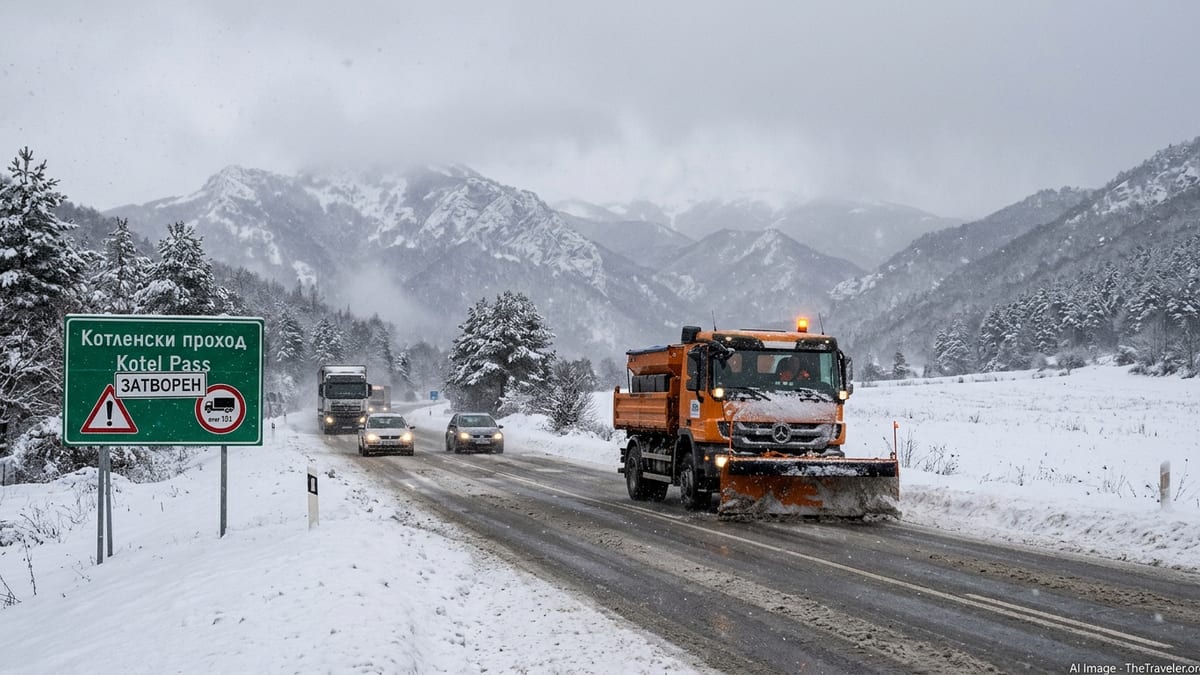
Road network strained as authorities advise against non-essential travel
Bulgaria’s Road Infrastructure Agency issued an appeal on 29 November for motorists to avoid travel unless strictly necessary, citing widespread snowfall, snowdrifts and poor visibility across much of the country. The agency said more than 1 000 snow-clearing machines were deployed on the national road network from early morning, but their work was repeatedly hindered by continuing snow, strong winds and drifting.
According to national and regional bulletins, restrictions were introduced for heavy goods vehicles over 12 tonnes on a number of roads and mountain passes, particularly in the Balkan and Rhodope ranges. In some sections, including parts of key intercity routes, traffic for all vehicles was temporarily halted where conditions became too dangerous or where stranded trucks blocked snowploughs from passing.
In eastern Bulgaria, heavy snow forced the closure of a nearly 31-kilometre stretch of the Burgas–Varna road between Obzor and Nesebar, with police turning vehicles back and directing drivers to signposted detours. Separate closures and restrictions were also reported on the Varna–Dobrich road and through the Kotel Pass, where authorities temporarily limited movement because of snow, ice and reduced visibility.
In the northwest, where winds were reported to be particularly strong, authorities noted snowdrifts forming on exposed stretches and ordered temporary bans on heavy lorries in parts of Vratsa region. The Road Infrastructure Agency reiterated standard winter advice that vehicles should be equipped with tyres suitable for snow and ice, with adequate tread depth, and that drivers should carry sufficient fuel, avoid risky overtaking and not obstruct winter service vehicles as they work.
Code Orange and Code Red weather alerts, coastal seas turn dangerous
The national meteorological service issued a Code Orange warning for significant snowfall in 16 districts on 29 November, including many parts of western and central Bulgaria. Under Code Orange, authorities flag a risk of substantial disruption from severe weather and advise travelers to closely monitor updates and prepare for difficult conditions on the roads.
Along Bulgaria’s Black Sea coast, the situation was further complicated by high winds and heavy seas, with a Code Red warning declared for strong wind and dangerous waves along the entire coastline. Code Red is the highest alert level and is used when weather conditions are expected to pose a high risk to safety and infrastructure, including for maritime transport and coastal roads and promenades.
The combination of blizzard conditions inland and storm-force winds at the coast affected both travel and local infrastructure. Media reports from several coastal districts described rough seas and waves impacting port operations and anchorage areas in Bourgas Bay, as well as the risk of flooding in low-lying parts of the shoreline. In some inland regions, wet snow and wind brought down trees and branches, adding to the difficulties for road users and complicating cleanup efforts.
Electricity supply was disrupted in dozens of settlements in northwestern Bulgaria, where heavy, wet snow and gusty winds damaged power lines and poles. Local utilities reported working with emergency teams through the morning to restore power progressively, while warning that access to some sites was slowed by blocked or uncleared roads.
Rail passengers face long delays as snow and fallen trees halt trains
Rail travel was severely disrupted on 29 November, with Bulgaria’s National Railway Infrastructure Company reporting that train movements had been suspended on multiple sections of the network because of heavy snow, fallen trees and technical faults. Traffic on the busy Sofia–Varna route was stopped between Eliseyna and Mezdra from shortly after 3am, after trees fell across the tracks in the Iskar Gorge and snow accumulated along the line.
A train carrying around 200 passengers became stuck near Eliseyna station in the early hours, leading to prolonged delays while crews worked to clear the track and restore power. Regional officials said that people on board experienced a long wait for onward travel, and that arrangements were made to move passengers to warmer locations as conditions allowed. Rail infrastructure managers later clarified that the evening Sofia–Varna fast train 2627, which was affected in the same area, had not derailed and that its heating remained in operation, countering initial media claims of a derailment and freezing carriages.
Separately, train movements were reportedly halted between Orizovo and Svoboda on the Plovdiv–Stara Zagora line from around 5.30am because of weather-related problems, with rail operators warning of knock-on delays for other services across the network. By mid-morning, some sections had seen power restored and limited traffic resuming, but services on several lines were still operating with significant delays or remaining suspended while inspections of the tracks and overhead power systems continued.
Bulgarian media reported that a second train sent through the Iskar Gorge later in the morning also experienced a technical failure, again interrupting traffic in both directions on the Sofia–Mezdra section. Rail authorities indicated that repair teams and rescue equipment were being deployed sequentially as weather conditions and access allowed, and said they expected operations to gradually normalize once snow stopped and the main obstructions were cleared.
Flights and coastal shipping affected, tanker runs aground near Sozopol
Air travel into and out of the Bulgarian capital was also disrupted. Sofia’s Vassil Levski Airport reported that heavy snowfall, strong winds creating blizzard-like conditions and low temperatures were making it difficult for ground crews to keep runways and taxiways clear and to de-ice aircraft efficiently. The airport warned of possible flight delays and urged passengers to check the latest status of their services directly with airlines, as well as to allow extra time to reach the airport because of poor road conditions in the city and surrounding region.
While most flights were expected to operate, albeit with delays, the combination of runway clearance, aircraft de-icing and air traffic control slot management meant that knock-on disruptions were possible throughout the day. Some carriers adjusted schedules or consolidated services in response to the adverse weather forecast, though detailed information varied by airline and route.
At sea, rough conditions in Bourgas Bay contributed to a navigation incident involving the oil tanker Kairos. According to information published on 29 November, the vessel began to drift on Saturday evening after its anchor failed to hold in the strong wind and high seas. By 7.55pm the tanker had run aground in the area of Cape Kolokita, southeast of the coastal town of Sozopol. Two crew members remained on board. Authorities did not immediately report pollution or injuries, but the grounding highlighted the additional risks posed by the storm conditions along the Black Sea coast during the weather alert.
Local and national maritime services were monitoring the situation around the grounded tanker and the wider coastal weather pattern. Any salvage or refloating operations are expected to depend on an improvement in sea conditions and detailed inspections of the hull and surrounding seabed, as well as coordination between port authorities, the vessel’s owners and environmental agencies.
Urban impacts, local disruptions and what travelers should do next
Beyond the national transport network, the heavy snow created a range of local challenges for residents and visitors. In Plovdiv, municipal authorities reported that Christmas decorations in the city center collapsed under the weight of the snow during the night of 28–29 November. No injuries were reported, but the municipality registered dozens of calls about fallen trees and branches and deployed teams to clear streets and public spaces.
In mountain regions such as around Bansko, the road linking the town with the Shiligarnika area was temporarily closed because of trees that had fallen under the snow load. Crews were sent to remove the debris and restore access, particularly important for local residents and businesses preparing for the winter tourism season. Elsewhere, local authorities organized the evacuation of stranded vehicles where snowdrifts had trapped cars and buses on exposed roads.
For travelers currently in Bulgaria, authorities recommend closely monitoring local radio, television and official online channels for the latest information on weather alerts, road closures and public transport changes. Motorists who cannot postpone trips are advised to use vehicles properly prepared for winter, including suitable tyres, snow chains where needed and sufficient fuel, and to carry warm clothing, food and water in case of delays.
Passengers with rail tickets are encouraged to check current service status with Bulgarian State Railways and the National Railway Infrastructure Company, as some services may be cancelled, rerouted or significantly delayed while snow-clearing and repair work continues. Air travelers should monitor airline notifications and airport updates for schedule changes, and allow additional time for airport formalities in case of congestion caused by the weather.
Forecasters indicated that in many parts of western and central Bulgaria snowfall was expected to ease from early afternoon on 29 November, which should gradually help road and rail crews restore more normal movement. However, with cold temperatures persisting and ice likely overnight, transport operators warn that residual disruption could continue into 30 November, and that conditions on less-traveled roads and in higher elevations may remain challenging even after main routes are cleared.