


More news on this day
As travelers chase eclipses across continents this decade, scientists are documenting how the brief darkening of the midday Sun delivers a sharp and unusual cool spell that reshapes local weather in real time.
Get the latest news straight to your inbox!
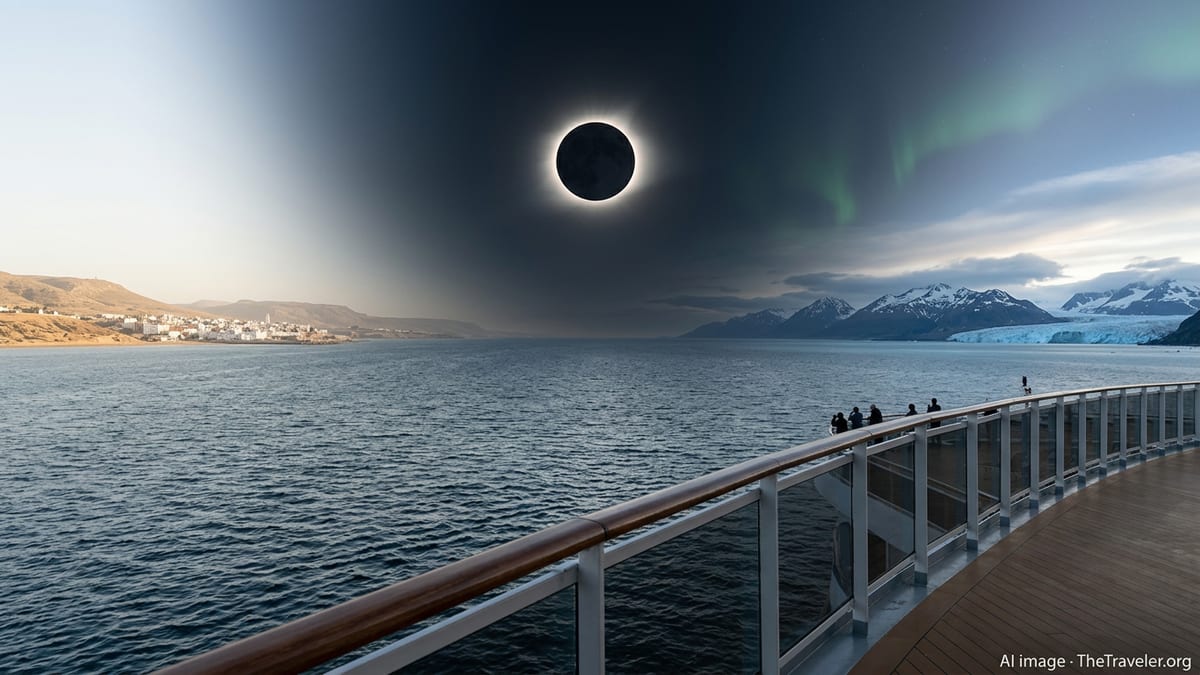
A Moving Shadow That Turns Day Briefly Cool
The total solar eclipse of April 8, 2024, which swept from Mexico across the United States into Canada, has become a benchmark case for understanding how eclipses alter near-surface weather. Meteorological networks, satellites and field campaigns now provide a detailed picture of how rapidly temperatures fell as the Moon’s shadow passed overhead, confirming what many travelers reported as an almost instant relief from spring warmth.
Analyses from national weather services and research groups indicate that air temperatures typically dropped between 3 and 6 degrees Celsius in the path of totality, with some locations registering falls closer to 7 degrees when local wind shifts reinforced the cooling. In parts of Texas, the Mississippi Valley and the Great Lakes region, surface stations showed a distinct V-shaped temperature trace as the eclipse progressed, with the minimum lagging maximum obscuration by several minutes.
Satellite land surface temperature products detected even sharper changes on the ground, in some cases on the order of 8 to 12 degrees Fahrenheit as sun-warmed surfaces suddenly lost their source of heating. For travelers gathered in parks, fields and roadside viewing areas, this translated into a noticeable, sometimes dramatic, transition from early afternoon warmth to conditions more reminiscent of evening.
According to scientific summaries of past eclipses, these short, sharp cool spells have been observed before, but the spatial coverage of modern instrumentation in 2024 has allowed researchers to track the phenomenon almost continuously along the track of totality. That coverage is now feeding into studies that compare how the atmosphere responds over land, coastlines and open ocean.
Calmer Winds and Subtle Shifts in Cloud Cover
Cooling is only the most obvious part of the eclipse weather story. As surface heating is temporarily cut off, the near-surface atmosphere becomes more stable and daytime convection weakens. Measurements from dense weather station networks during the 2024 event in states such as New York and Ohio show reductions in turbulent mixing and gustiness while the Sun was obscured, effectively quieting the boundary layer for an hour or more.
Researchers using flux towers and profiling instruments reported a downturn in turbulent kinetic energy as the shadow moved overhead, indicating that rising thermals and small-scale eddies that dominate a sunny afternoon were suppressed. For many observers on the ground, especially those who had been setting up telescopes and cameras in breezy conditions, the shift translated into lighter winds and a stillness that added to the eclipse’s uncanny feel.
Cloud behavior has drawn particular attention because of its importance for skywatchers. A growing body of work that combines satellite imagery and high-resolution modeling suggests that certain low, puffy clouds can thin or dissipate as the surface cools and convection weakens under the Moon’s shadow. Case studies of previous eclipses found reductions in shallow cumulus coverage along the track, a pattern that observers in parts of North America during 2024 also noticed when scattered clouds shrank or vanished near totality.
The response is not uniform, however. Over coastal waters and in more stratified cloud decks, the atmosphere’s greater thermal inertia can mute the cooling, limiting impacts on cloudiness. Recent analyses of marine boundary layer conditions during the 2024 eclipse point to smaller temperature drops over adjacent seas than over nearby land, emphasizing that travelers on ships or islands may experience a softer, more gradual shift than those viewing inland.
Inside the Atmosphere’s Vertical Response
While visitors felt the eclipse mainly as a surface chill and change in light, research teams were probing higher altitudes to understand how the entire column of air responds. Radiosondes, ground-based profilers and satellite soundings collected before, during and after 8 April 2024 show layered cooling patterns extending through the lower troposphere, along with increases in relative humidity as the air temperature fell.
Studies drawing on data from global observing systems indicate that the reduction in incoming solar radiation during the eclipse produced detectable temperature anomalies from the surface into the upper troposphere and lower stratosphere. These anomalies varied with location and background weather, but together they form a coherent signature of the eclipse’s passage imprinted on the atmosphere on time scales of just a few hours.
Far above commercial flight levels, the ionosphere also responded to the sudden shadow. Space weather research reports describe a pronounced decrease in ionization as ultraviolet and X-ray radiation from the Sun was blocked, leading to a temporary drop in electron densities. The resulting changes affected how radio waves propagated, a reminder that eclipse-induced cooling and dimming are not limited to the layers of air that travelers directly experience.
These multi-level measurements are valuable beyond pure curiosity. By providing a precisely timed and well-measured drop in solar energy input, eclipses act as natural experiments for testing how weather and climate models handle rapid changes in radiation. Modelers can compare simulated temperature, wind and cloud responses to the observed eclipse signature, helping to refine parameterizations that are critical for short-term forecasts and long-term projections.
Travel, Forecasts and the Hunt for Clear, Cool Skies
The 2024 eclipse triggered one of the largest short-distance travel surges for an astronomical event in recent North American history, with many people driving or flying into the path of totality in search of clear skies. For these travelers, weather forecasts were as important as eclipse maps, determining whether they would experience the fleeting cool and darkness directly or through gaps in cloud.
Publicly available records and user accounts highlight how viewers tracked temperature and cloud forecasts in the days leading up to 8 April, sometimes adjusting their plans at the last minute based on updated satellite imagery and model guidance. In some regions, especially around the Great Lakes and parts of the Northeast, last hour shifts in cloud cover created sharp contrasts between nearby locations, with one town enjoying a clear, cool totality while another remained under stubborn overcast.
The cooling effect itself is now appearing explicitly in some forecast products around future eclipses, which show a dip in modeled temperatures timed to the passage of the shadow. Although routine weather apps are not designed to capture such fine-scale, short-lived deviations, specialist outlooks and research-grade simulations can indicate how large a temperature drop is likely for different points along the path.
For travelers planning to pursue upcoming eclipses in Europe, North Africa and the Arctic later in the decade, recent studies of the 2024 event are informing expectations. Over higher latitudes or near sunset, the contrast may be weaker because the Sun is already low, but a noticeable cool spell remains likely where skies are clear. Awareness of these patterns is shaping advice about clothing, viewing comfort and equipment, as eclipse tourism grows into a recurring feature of global travel.
A Growing Field at the Intersection of Tourism and Science
The expanding observational record from recent eclipses is turning what were once scattered anecdotes into quantifiable meteorological case studies. In North America, Europe and parts of Asia, coordinated campaigns now combine citizen measurements with dense professional networks, creating a richer picture of how temperature, humidity, winds and clouds adjust when daylight briefly disappears.
For the travel sector, this emerging science is more than an academic curiosity. Destinations along future paths of totality are beginning to highlight the atmospheric experience as part of their marketing, emphasizing not only the visual drama of the corona but the feeling of afternoon suddenly turning cool and quiet. Tourism boards and operators are also paying closer attention to seasonal climate patterns and typical cloud regimes along eclipse tracks as they design itineraries.
At the same time, scientists are using the influx of travelers as an opportunity for large-scale public participation in data collection. Smartphone-based measurements of temperature and light, coordinated through citizen science programs, are helping to fill gaps between official observing sites. These contributions are refining understanding of small-scale variations in eclipse-induced cooling, such as differences between urban heat islands and nearby rural fields where many visitors choose to gather.
With several high-profile eclipses still to come this decade, the pairing of mobile observers and increasingly sophisticated instruments is set to deepen knowledge of how a few minutes of darkness reorganize the atmosphere. For travelers who chase these events, the chill that sweeps through the crowd as the Sun vanishes is becoming recognized not just as a sensory thrill, but as a visible expression of a rare and carefully studied atmospheric shift.