


Stockholm Arlanda Airport is Sweden’s largest air hub and the main gateway to the capital region, handling tens of thousands of passengers on a typical day. Whether you are connecting between Schengen and long-haul flights, arriving on a low-cost carrier, or flying domestically within Sweden, understanding how Arlanda’s terminals work will save you time and stress. This guide walks you through the current terminal layout, where airlines operate, how to transfer between flights, and what services you can expect on the ground.
Get the latest updates straight to your inbox!
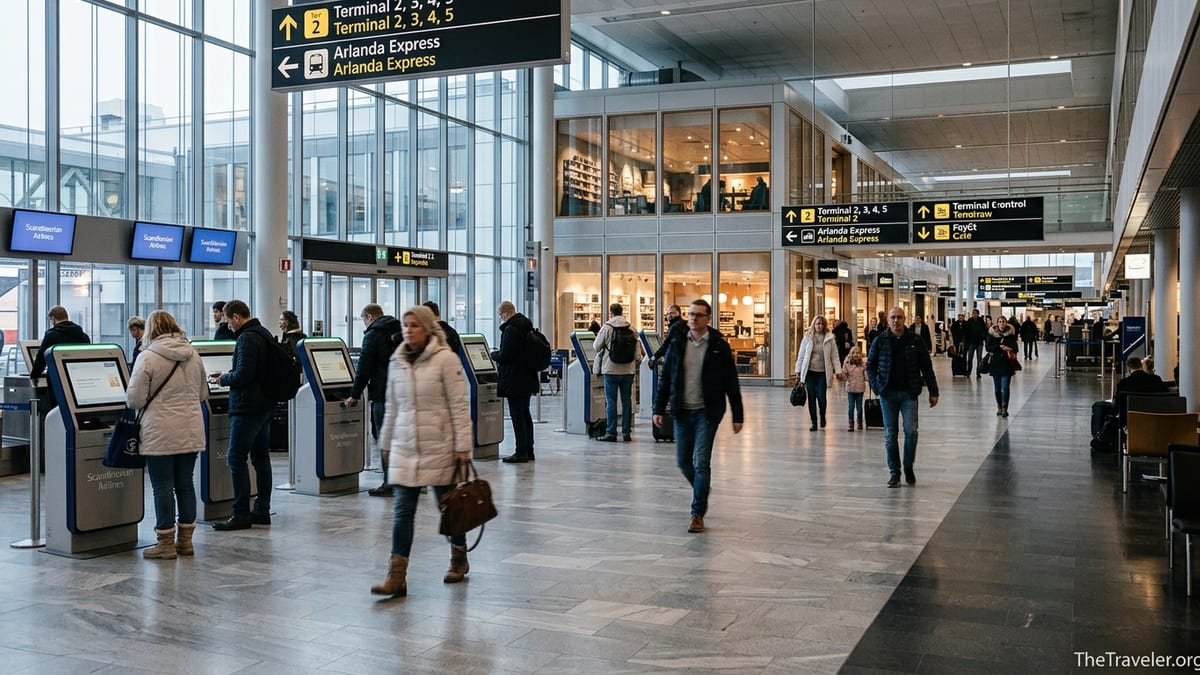
Stockholm Arlanda at a Glance
Stockholm Arlanda Airport sits roughly midway between central Stockholm and the university city of Uppsala, around 40 to 45 kilometers from each. It is managed by Swedavia, the state-owned company that operates most major Swedish airports. The airport serves as a primary hub for Scandinavian Airlines (SAS) and a major base for low-cost carriers like Ryanair and Norwegian, alongside a wide network of European and intercontinental airlines.
Arlanda has four terminals in operation: Terminals 2, 3, 4 and 5. There has never been a Terminal 1, a detail that often surprises first-time visitors. Terminals are physically arranged along a central spine, with SkyCity, an indoor complex between Terminals 4 and 5, acting as the heart of the airport where rail services, hotels and many services are clustered.
In recent years, Arlanda has gone through a substantial reconfiguration. During the pandemic, most activity was consolidated into Terminal 5, but as traffic returned Swedavia reopened and adjusted the use of Terminals 2, 3 and 4. Today, domestic and international flights can operate from several terminals, and security and boarding areas are divided between Schengen and non-Schengen departures rather than strictly domestic versus international.
For travelers, this means you should always check your booking or boarding pass to confirm which terminal your flight departs from. The information screens and the official airport app generally update quickly if an airline moves to a different check-in area or gate, which can occasionally happen during peak travel seasons or construction work.
Terminal Layout: T2, T3, T4 and T5 Explained
Terminal 2 is primarily used by a mix of European and leisure carriers operating point-to-point routes. It is smaller than Terminal 5 and can feel more basic in terms of shopping and lounge choices. For example, many low-cost and regional European airlines operate from Terminal 2, making it a common starting point for weekend breaks to cities like London, Berlin or Barcelona. Security queues here can fluctuate, so arriving on the earlier side during summer and holiday periods is often wise.
Terminal 3 is the most modest of Arlanda’s terminals and is often used for regional and charter-style operations. Some smaller airlines and seasonal services depart from here, especially during ski season or peak summer holiday months. Facilities are more limited, but you will still find essentials such as a café, basic shops and seating. Many passengers never use Terminal 3 at all, but if your ticket lists “T3” be aware that it is within walking distance of Terminals 2 and 4.
Terminal 4 was historically the main domestic terminal. Today it primarily serves a mix of domestic and short-haul European routes, including some low-cost carriers such as Ryanair and others that have shifted between terminals as Swedavia balances capacity. Terminal 4 is directly linked airside with portions of Terminal 5, allowing shared use of security and gate areas on some routes. On the landside, it is a short indoor walk to SkyCity and the rail station.
Terminal 5 is the largest and most modern terminal, handling the bulk of Arlanda’s traffic, particularly long-haul and many full-service European flights. If you are flying with SAS to major hubs such as Copenhagen, Frankfurt or New York, or on intercontinental airlines to destinations like Doha or Dubai, you will typically depart from Terminal 5. The terminal offers the widest selection of duty-free shopping, restaurants and lounges, as well as upgraded security lanes introduced as part of ongoing renovations.
Which Airlines Use Which Terminals?
Airline allocations at Arlanda can shift, especially around construction projects or seasonal schedule changes, but some patterns are relatively stable. Scandinavian Airlines (SAS) bases much of its international and long-haul operation in Terminal 5, including flights to North America and key European hubs. Domestic SAS flights may also depart from gates connected to Terminal 5, especially after the airside linkage between Terminals 4 and 5 was strengthened.
Low-cost carriers are more commonly found in Terminals 2 and 4. For example, Ryanair and other budget airlines often use Terminal 4, while carriers such as Wizz Air and Norwegian operate from either Terminal 2 or 5 depending on route and season. If you booked a low-fare ticket to destinations like Gdansk, Budapest or Alicante, double-check the departure terminal as it may not match where your airline operated in past years.
Many European network airlines, such as Lufthansa, KLM and British Airways, have historically operated from Terminal 5 because of better connectivity to long-haul and partnership flights. Smaller European and regional carriers without large connecting networks are more commonly assigned to Terminal 2. That means two passengers flying to the same city on different airlines might use different terminals completely, even if both flights depart within minutes of each other.
Charter operators serving popular Mediterranean or ski destinations frequently use Terminal 2 or 3, especially during peak holiday weeks when dedicated counters and ground staff are organized for package-tour groups. If you book through a tour company, your documentation should specify the terminal, but these flights sometimes move between T2 and T3 at short notice, so it is sensible to verify details the day before departure using the airport’s live departure boards or app.
Getting Between Terminals and Around the Airport
On the landside, moving between Terminals 2, 3, 4 and 5 is straightforward but can take longer than it looks on a map. Indoor walkways and corridors connect all terminals, passing through SkyCity between Terminals 4 and 5. For instance, a traveler arriving into Terminal 2 on a low-cost flight and needing to check in at Terminal 5 can walk through the signed indoor route, which typically takes 10 to 20 minutes at a normal pace, depending on crowd levels and luggage.
The Arlanda Express high-speed train is an important reference point for orientation. It has two stations underneath the airport: Arlanda South for Terminals 2, 3 and 4, and Arlanda North for Terminal 5. A traveler coming from central Stockholm can step off at Arlanda South and follow the clearly marked escalators up to Terminal 4, then walk to Terminal 2 or 3 if needed. Transfer between Arlanda South and Arlanda North is free for passengers using the train as an internal shuttle, which can be a time-saver if you need to move quickly between terminals in bad weather.
Airside, connectivity is more nuanced. Terminals 4 and 5 share a linked security and gate area on many routes, which can allow smoother connections if both flights are handled within the combined Schengen departure zone. A traveler flying domestically to Luleå from Terminal 4 and connecting onward from Terminal 5 to a European destination may not need to exit and re-clear security, though they will need to follow the signs carefully and factor in walking time between piers.
However, Terminal 2 typically operates as a separate security and gate area. If you land in Terminal 2 and your onward connection departs from Terminal 5, you will generally need to exit through arrivals, walk or take the train to the other terminal, and pass through security again. This can significantly increase minimum connection times, so self-connecting travelers should allow generous margins, particularly when traveling with checked baggage that must be rechecked with a different airline.
Arrivals, Departures and Security: What to Expect
Arrival areas at Arlanda are straightforward, with baggage reclaim halls located directly behind passport control or immediately after exiting the aircraft for domestic flights. For example, a long-haul arrival into Terminal 5 from North America will typically pass through non-Schengen border control, collect luggage at one of the large carousels, and then enter the public arrivals hall a short walk from rail and bus connections. Domestic arrivals into Terminals 4 or 5 skip passport control and usually exit directly into the landside corridor or SkyCity.
Security procedures are standard for a major European airport. At peak travel periods, especially early mornings and late Sunday afternoons, queues can build up, particularly in Terminals 2 and 5 where many leisure and business departures are concentrated. Swedavia periodically publishes general guidelines suggesting that international travelers arrive around 2 to 3 hours before departure, with slightly shorter times for domestic flights, although real-world experience suggests adding a buffer during summer, Christmas and Easter holiday weeks.
Recent investments in upgraded security technology in Terminal 5 have aimed to improve throughput and reduce bottlenecks, but travelers should still be prepared for typical screening rules: separate items like laptops and liquids if directed, and allow extra time if traveling with families or large hand luggage. Many airlines open check-in counters 2 to 3 hours before departure for short-haul flights and earlier for long-haul services, so arriving too early can simply mean waiting in the public areas before counters open.
Departure gates at Arlanda are divided between Schengen and non-Schengen areas. If you are flying within the Schengen Zone, such as to Copenhagen, Helsinki or Paris, you will usually head directly from security to the main concourses. For flights to destinations outside Schengen, such as the United Kingdom, the United States or the Middle East, you will pass through an additional passport control area before reaching your gate. This can add 10 to 20 minutes, so factor it into your boarding time.
Transport Links: Reaching Stockholm and Beyond
One of Arlanda’s strengths is the variety of options for getting to and from central Stockholm and Uppsala. The fastest is the Arlanda Express, a dedicated high-speed train that runs between the airport and Stockholm Central Station in around 18 minutes. Trains run frequently throughout the day, and although ticket prices are higher than regular commuter trains, advance online or app purchases and periodic promotions can bring the cost down, particularly for return journeys or off-peak travel.
Regional commuter trains operated by the public transport system also stop at Arlanda’s rail stations, providing a slower but often cheaper option, especially if you already hold regional travel cards. These trains connect both to Stockholm and to Uppsala, making them a popular choice for students and budget-conscious travelers. There is usually a supplemental station fee for using the airport stop, which is included in many ticket types but worth confirming at the time of purchase.
Express buses run between Arlanda and various parts of Stockholm, including major transport hubs and some hotel districts. These buses typically take around 40 to 50 minutes depending on traffic. For example, a traveler arriving late at night might opt for an airport coach that goes directly to a central bus terminal, then switch to the metro for the final leg. Several regional and long-distance bus companies also serve Arlanda, connecting it with towns further north or west.
Taxis and ride-hailing services wait outside each terminal. Swedish taxis are deregulated, so prices can vary between companies. Many providers advertise fixed fares to central Stockholm or Uppsala from the airport, and these are usually clearly displayed on the car door. As a rough guide, a fixed-price ride to central Stockholm often costs the equivalent of several Arlanda Express tickets but may be cost-effective for small groups or families with luggage. Always confirm the total price with the driver before starting your journey.
Services, Lounges and Practical Amenities
Across its four terminals, Arlanda offers a broad range of services, though the distribution is uneven. Terminal 5 and the SkyCity area have the largest concentration of shops, including duty-free outlets, Scandinavian design stores and travel essentials. You will find a mix of international chains and Swedish brands selling everything from fashion and accessories to local snacks like chocolate and crispbread that make easy souvenirs.
Food and beverage options range from quick grab-and-go kiosks to sit-down restaurants. In Terminal 5, passengers can choose between coffee bars, sandwich shops, casual burger or pizza outlets and more polished Nordic-style bistros. SkyCity, which is accessible without a boarding pass, houses several mid-range restaurants and cafés often used by rail passengers and hotel guests. Terminals 2, 3 and 4 have more limited but still adequate selections, so if you are connecting and have time you may prefer to eat in SkyCity or Terminal 5 before heading to a quieter pier.
Lounges are concentrated in Terminal 5, including airline-operated spaces for carriers such as SAS and partner airlines, as well as independent lounges that may be accessible via Priority Pass or paid entry. For example, a traveler flying economy with a oneworld or Star Alliance carrier might purchase lounge access for a few hours of work before a long-haul flight. Terminal 2 offers more modest lounge options, typically run by independent operators, and access rules can vary by ticket type and membership.
Other practical amenities include currency exchange desks, ATMs, VAT refund counters for non-EU residents, children’s play areas, prayer and reflection rooms, and medical services. SkyCity features a full-service hotel directly connected to the terminals, as well as hairdressing, basic fitness options and convenience stores. Free Wi-Fi is available throughout the airport, although bandwidth may vary in crowded gate areas during peak times.
Flight Connections and Planning Your Time
Planning a connection at Arlanda requires paying close attention to which terminals you are using and whether you are staying within the Schengen Area. A through-ticket on a single airline or alliance, such as a domestic SAS flight connecting to a SAS or partner long-haul departure from Terminal 5, usually comes with a protected minimum connection time that factors in walking distances and possible lines at security or passport control.
Self-connecting travelers, for example those arriving on a low-cost carrier into Terminal 2 and continuing on a separate ticket with a network airline from Terminal 5, should build in substantially more time. Two and a half to three hours is a sensible minimum in most cases if you must collect and recheck baggage, cross from one terminal to another on the landside, and clear security again. This is especially important early in the day, when security lines can be longest and trains or buses from Stockholm might be crowded.
If you have a long layover, Arlanda is positioned conveniently for a short excursion into nearby areas. Travelers with at least six to seven hours between flights might consider taking the train into central Stockholm to stroll around the Old Town or enjoy a waterfront café, returning via Arlanda Express or commuter rail. Those with shorter connections can stay at the airport, making use of lounges, restaurants or even a short-stay hotel room in SkyCity to rest between flights.
Families and travelers with reduced mobility should allow additional time. While the terminals are equipped with elevators, ramps and assistance services, the walking distances between some gates in Terminal 5 and the central areas can be considerable. Pre-booking mobility assistance through your airline can help coordinate wheelchairs or buggies to meet you at the aircraft and escort you through to your next gate or to arrivals.
The Takeaway
Stockholm Arlanda Airport is a busy, evolving hub where understanding the terminal layout can significantly smooth your journey. With four active terminals, a central SkyCity complex and mixed domestic and international operations, it pays to check your terminal and gate information carefully before you travel and again on the day of departure.
By knowing that Terminal 5 is the main long-haul and full-service hub, that Terminals 2 and 4 host a wide range of European and low-cost flights, and that Terminal 3 handles select regional and charter operations, you can better plan your arrival time, transport to and from the airport, and any necessary terminal transfers.
Combine this knowledge with realistic expectations about security, passport control and walking distances, and you will be well positioned to make tight connections, enjoy available lounges and services, and maybe even squeeze in a brief visit to Stockholm or Uppsala between flights. With a bit of planning, Arlanda can be an efficient and relatively stress-free gateway to Sweden and the wider region.
FAQ
Q1. How many terminals does Stockholm Arlanda Airport have?
Stockholm Arlanda Airport currently operates four terminals: Terminals 2, 3, 4 and 5. There is no Terminal 1, which often surprises first-time visitors.
Q2. How do I know which terminal my flight uses?
The terminal is usually shown on your booking confirmation, e-ticket and boarding pass. It is wise to check again closer to departure using the airport’s live departure information in case airlines have shifted terminals.
Q3. Can I walk between all the terminals at Arlanda?
Yes, all four terminals are connected landside by indoor walkways and corridors, although walking between the furthest points can take 15 to 20 minutes, so allow extra time.
Q4. Are Terminals 4 and 5 connected after security?
Many parts of Terminals 4 and 5 share a linked airside area, particularly for Schengen departures. This can allow you to connect between some flights without exiting and re-clearing security, but you should always follow the signs for your specific gate.
Q5. How long before departure should I arrive at Arlanda?
For most international flights, arriving around 2 to 3 hours before departure is a reasonable guideline. For domestic flights, 1.5 to 2 hours usually suffices, but in peak holiday seasons adding extra time is prudent.
Q6. What is the fastest way to reach central Stockholm from Arlanda?
The Arlanda Express high-speed train is generally the fastest option, taking about 18 minutes to Stockholm Central Station. It costs more than buses or commuter trains but saves significant time, especially during rush hour.
Q7. Is it easy to connect between a low-cost flight and a long-haul flight?
It can be, but you must plan carefully. If your flights are on separate tickets or use different terminals, allow at least 2.5 to 3 hours to collect bags, walk between terminals, and pass through security and any passport checks.
Q8. Are there lounges in all terminals?
Most lounges are in Terminal 5, including airline and independent options. Terminal 2 has more limited lounge choices, and Terminals 3 and 4 primarily focus on basic seating and services rather than extensive lounge facilities.
Q9. Can I stay overnight at or near Arlanda Airport?
Yes, there are multiple hotels connected to or very close to the terminals, including properties in SkyCity between Terminals 4 and 5. These are convenient for early-morning flights or late-night arrivals.
Q10. Is Arlanda accessible for travelers with reduced mobility?
Yes, the airport provides elevators, ramps and assistance services. If you need special support, inform your airline in advance so that wheelchair or escort assistance can be arranged from check-in or the aircraft door.