


More news on this day
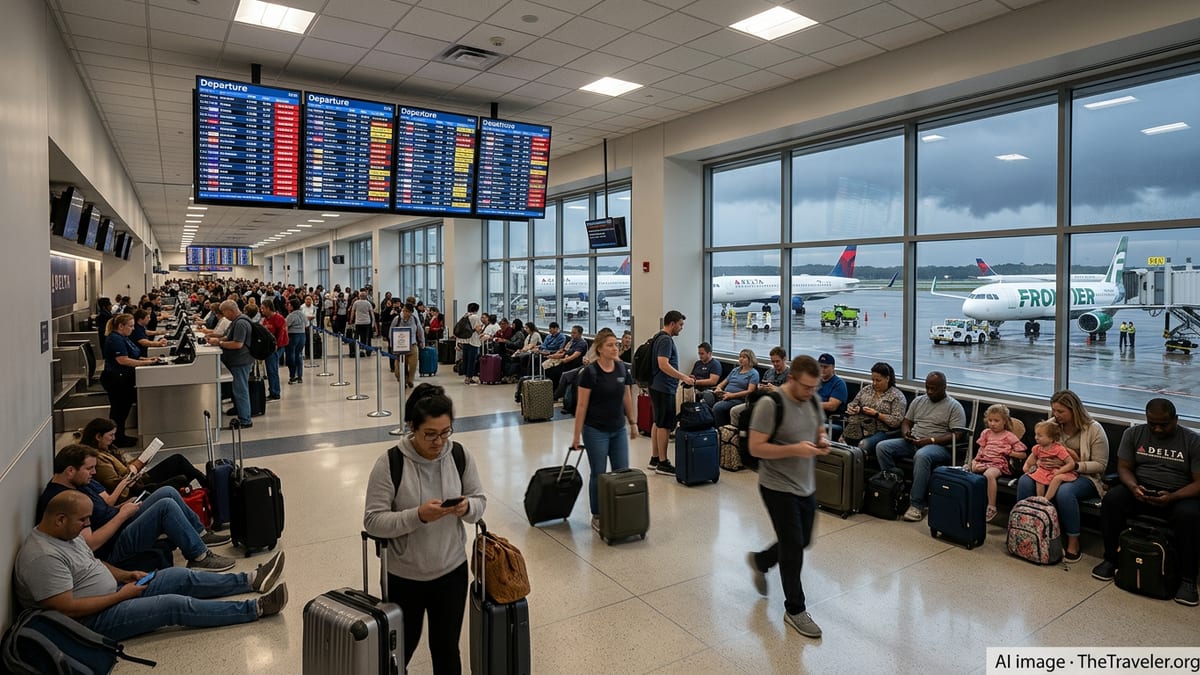
Summer travel through Denver International Airport faced major disruption as nearly 800 flights were delayed and more than two dozen were cancelled, stranding and rerouting thousands of passengers during one of the busiest weeks of the season.
Get the latest news straight to your inbox!
Severe Weather And Traffic Management Programs Slow Arrivals
Publicly available flight tracking data and local aviation reports indicate that a series of strong thunderstorms over the Denver area triggered a formal traffic management program for incoming flights, sharply reducing the rate at which aircraft could land at Denver International Airport. When this type of program is activated, flights bound for Denver are often held at their origin, assigned lengthy ground delays or placed into airborne holding patterns while controllers meter arrivals into the airspace.
Accounts from recent days describe aircraft circling for extended periods near alternate airports such as Cheyenne while storms moved over the Denver metro area. When convective weather repeatedly rebuilds over the same corridor, capacity at a high-altitude hub such as Denver can fall far below normal, even if the airport itself remains technically open. The result is a rapid buildup of delays that can quickly number in the hundreds.
At the same time, Denver continues to manage ongoing airfield and taxiway work highlighted in recent Federal Aviation Administration construction outlooks. While such projects are planned to maintain safety and efficiency in the long term, they can limit runway and taxiway availability during peak demand, magnifying the impact of any weather disruption.
Nearly 800 Flight Delays And Two Dozen Cancellations
Data compiled from flight-status monitoring services for Wednesday, July 29, show that close to 800 departures and arrivals at Denver International Airport operated behind schedule, with delays ranging from minor schedule slips of 30 minutes to holds of several hours. In addition, at least 27 flights were cancelled outright as the operational picture deteriorated, leaving some aircraft and crews out of position for later rotations.
National tracking platforms consistently place Denver among the busiest and most delay-sensitive hubs in the United States, given its role as a central connecting point between coasts and the Mountain West. On a typical midsummer day, Denver handles well over a thousand scheduled flights, so when a substantial share of those operations is pushed back or scrubbed, the number of affected travelers escalates quickly.
Published coverage of the latest disruptions notes that the number of delayed flights at Denver rose sharply in the afternoon and early evening, a common pattern when storms develop after a relatively smooth morning push. Airlines attempted to recover schedules by turning aircraft quickly, but recurring ground stops and flow-control measures limited how fast operations could normalize.
Knock-On Effects For Airlines, Crews And Passengers
The large volume of delayed flights created familiar ripple effects for airlines using Denver as a hub. When departure banks fall behind schedule, flight crews can rapidly approach or exceed their legally permitted duty limits, forcing carriers to cancel or reassign later flights even after storms have moved away. Public posts from travelers in recent weeks describe flights that were repeatedly delayed in short increments before ultimately being cancelled once duty-time constraints became unavoidable.
Once aircraft and crews are out of position, the impact extends beyond Denver. Connections to smaller communities across the Rocky Mountain region are particularly vulnerable because many of those routes depend on a limited number of daily frequencies and on specific aircraft types. A missed connection in Denver can mean an unplanned overnight stay or rebooking for the following day, especially on heavily booked midsummer services.
For passengers, the combination of weather, traffic management programs and crew scheduling limits results in crowded gate areas, long customer service lines and challenges securing hotel rooms. Recent traveler accounts from Denver describe spending much of the day at the airport monitoring rolling delay estimates, only to opt for early-morning departures the following day when it became clear same-day travel was unlikely.
Context: A High-Altitude Hub Prone To Summer Disruptions
Denver International Airport has grown into one of the world’s busiest hubs, serving more than two dozen airlines and hundreds of nonstop destinations across North America, Europe and parts of Asia. Its central location makes it an important connecting point for both domestic and international itineraries, but it also places the airport squarely in a region known for rapid shifts in summer weather, including afternoon thunderstorms and hail.
Historical records show that Denver has experienced significant weather-related disruption in past years, including winter storms that shut down operations for extended periods and blizzards that stranded thousands of travelers. The latest wave of delays and cancellations fits into a broader pattern in which convective storms during the warm season periodically interrupt what is otherwise a highly reliable operation for such a large facility.
Aviation analysts note that, while modern air-traffic tools and improved forecasting have helped airlines and airports reduce some weather-related impacts, high-intensity thunderstorm events continue to pose challenges, particularly at busy hubs where traffic levels leave little room to absorb extended capacity cuts.
What Travelers Through Denver Can Do Now
Travel industry guidance suggests that passengers scheduled to fly through Denver during active weather periods should closely monitor their flight status and consider building additional time into connections. Early-morning departures often face fewer thunderstorm-related issues, as the most disruptive weather around the Front Range tends to develop later in the day during peak heating.
Experts also recommend that travelers use airline apps or text alerts to track gate changes and rolling delay estimates, and that they confirm any rebooked itineraries as soon as schedule changes appear. For those with critical same-day connections, looking at alternative routings that avoid known weather trouble spots can sometimes reduce the risk of severe disruption, even if it means a slightly longer journey.
With Denver positioned as a key link in the national air network, the episode of nearly 800 delayed flights and dozens of cancellations underscores how quickly conditions can shift for summer air travel. For passengers, staying informed and flexible remains the best strategy when storms build over one of the country’s busiest hubs.