


More news on this day
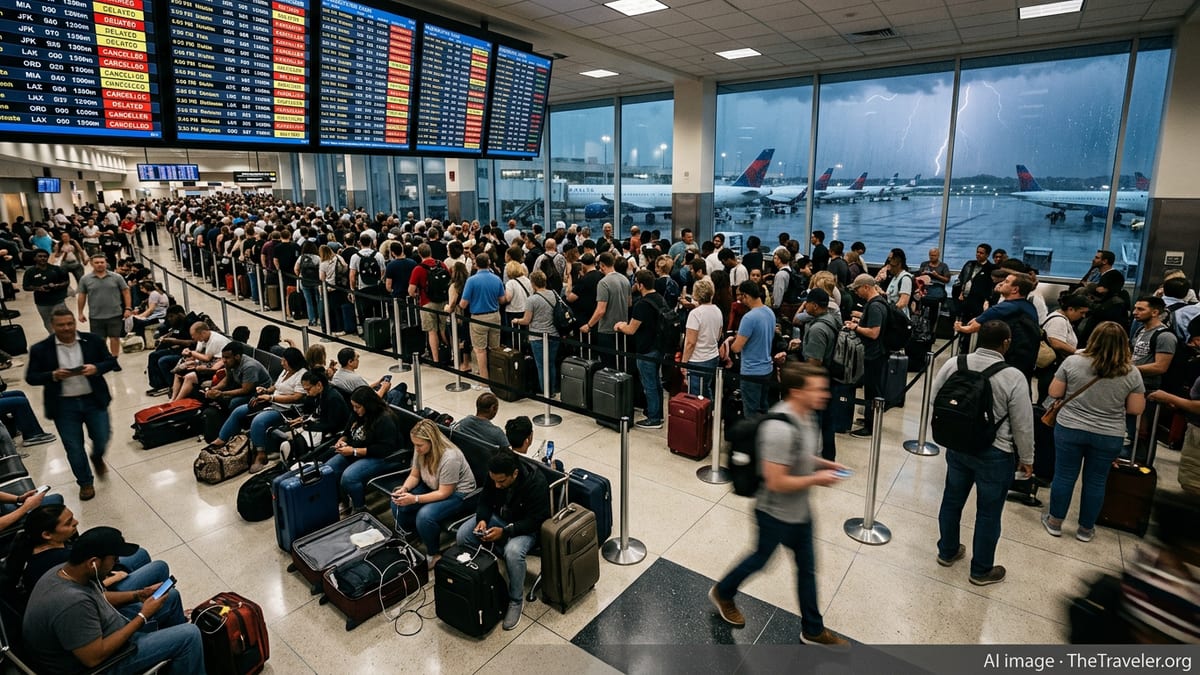
Thousands of airline passengers across the United States are facing severe disruption as storms and airspace constraints trigger widespread cancellations and delays at major hubs, snarling travel through Chicago, New York City, Newark, Boston, San Francisco, and Dallas–Fort Worth.
Get the latest news straight to your inbox!
Weather and Airspace Strains Push System to the Brink
Published coverage and real-time tracking data show that a powerful round of storms sweeping across the Midwest and Northeast has collided with already tight airspace capacity, producing a cascade of operational disruption. Flight-tracking platforms indicate that roughly 380 services have been canceled and more than 840 are delayed across the United States, with the brunt of the impact falling on some of the country’s busiest airports.
Chicago’s O’Hare and Midway airports, key hubs for both domestic and international traffic, have seen some of the highest levels of disruption. Reports indicate that thunderstorms prompted temporary ground stops and extensive holding patterns, with hundreds of flights either scrapped or forced into long delays. As one of the main connecting points in the national network, problems in Chicago have quickly rippled outward to other cities.
On the East Coast, New York’s three-airport system and nearby Newark Liberty International have struggled under a combination of convective storms and heavy traffic demand. Publicly available airspace status updates describe weather-related constraints and departure backlogs, pushing average delays well beyond an hour on some routes. Those slowdowns have contributed significantly to the nationwide tally of late-running flights.
Further south and west, Dallas–Fort Worth, a primary connector for the central and southern United States, has also experienced rounds of weather-related disruption. Recent days have brought repeated thunderstorms in North Texas, often forcing temporary flow restrictions that back up departures and arrivals. Alongside constraints in the Northeast, these interruptions have created a cross-country patchwork of delays that is proving difficult to unwind.
Major Hubs Buckle Under the Volume of Disrupted Flights
The concentration of cancellations and long delays at a small number of high-traffic hubs has magnified the impact on travelers. Industry data and federal air traffic summaries indicate that airports such as Chicago O’Hare, Newark, Dallas–Fort Worth, and the New York City facilities consistently rank among the nation’s most disruption-prone locations when weather or capacity issues strike.
At Chicago, the combination of hub-and-spoke operations and dense scheduling means that a relatively short ground stop can strand aircraft and crews in the wrong place for hours. When storms moved through the region, dozens of early flights were pushed back or canceled outright, reducing the buffer in the system for the rest of the day. As the delays accumulated, later departures faced crew time limits and aircraft rotation conflicts, leading to further cancellations.
Newark and the wider New York metropolitan airports have encountered similar strains. Publicly accessible delay advisories describe traffic management programs that slow the rate of arrivals into constrained airspace when storms or low ceilings develop. While these measures are designed to maintain safety, they inevitably reduce capacity and prolong taxi and holding times, which can quickly translate into missed connections for passengers on tight itineraries.
Dallas–Fort Worth remains highly vulnerable whenever convective weather parks over North Texas. With many flights scheduled in close succession to support national connections, even a relatively brief storm cell can trigger a backlog of departures waiting for ramp closures to lift. Once those aircraft finally push back, they often face slot constraints further along their routes, stretching the disruption well beyond the storm’s immediate footprint.
Knock-On Effects Hit Boston and San Francisco
While the heaviest disruption is centered on Chicago, New York City, Newark, and Dallas–Fort Worth, secondary hubs such as Boston and San Francisco are also feeling the effects. These cities serve as vital coastal gateways, and their operations depend on consistent inbound flows from the Midwest and central United States. When flights from Chicago or Dallas run late or are canceled, aircraft and crews scheduled to operate from Boston or San Francisco later in the day can quickly fall out of position.
In Boston, reports indicate that a portion of the day’s arrivals from Chicago and New York have been affected, with some services canceled and others arriving significantly behind schedule. That has reduced the number of available aircraft for onward flights to smaller East Coast and Canadian destinations, compressing seat availability and leaving some travelers waiting for rebooking.
San Francisco, meanwhile, has been wrestling with its own weather and flow constraints in recent weeks, and the latest disruptions elsewhere in the network add another layer of complexity. Delays on eastbound transcontinental services can lead to late-returning aircraft, which in turn affects late-night and early-morning departures to Asia and other long-haul markets. With runway capacity at a premium during periods of low visibility or strong onshore winds, the margin for recovery remains thin.
The combination of these regional strains means that passengers flying between any of the affected hubs, or connecting through them on cross-country journeys, are especially likely to encounter altered schedules, missed connections, or unplanned overnight stays.
Passengers Confront a Maze of Rebookings and Missed Connections
For travelers on the ground, the systemwide pressures are translating into long queues, last-minute itinerary changes, and difficult choices about whether to wait out delays or abandon trips entirely. Data from flight-tracking services shows a broad band of delayed departures lasting from under an hour to several hours, with some long-haul and connecting flights pushed deep into the night or canceled.
Published information from airline customer advisories indicates that carriers are relying heavily on automated rebooking tools, mobile app notifications, and self-service kiosks to manage the surge in disrupted itineraries. However, the volume of affected passengers at the largest hubs has still generated substantial lines at staffed customer service desks, particularly for travelers seeking complex reroutes or those whose trips involve multiple airlines.
In addition, capacity constraints on popular alternative flights are limiting options for same-day recovery. When hubs like Chicago and New York experience numerous cancellations in a short window, spare seats on later departures are quickly consumed, leaving some passengers with rebooked flights one or even two days later than planned. That dynamic is particularly challenging for families, international visitors, and travelers with fixed-event deadlines.
Disruption also extends beyond the airports themselves. With storms causing power outages and transportation issues in some regions, passengers arriving late at night can struggle to secure ground transport or last-minute accommodation. Travel industry observers note that these cascading problems are increasingly common whenever multiple major hubs are hit by severe weather at the same time.
Airlines and Regulators Emphasize Safety as Recovery Begins
Publicly available guidance from aviation authorities and airline communications stresses that, despite widespread frustration, cancellations and extended delays are often the safest response when convective storms, low visibility, or airspace congestion threaten flight operations. Safety protocols require additional separation between aircraft and may halt departures entirely when lightning, wind shear, or other hazards are detected around runways and approach paths.
Recent federal air traffic statistics underline how concentrated the impact can be at the largest facilities. Core hubs including Dallas–Fort Worth, Newark, Chicago, and New York airports routinely record some of the highest annual cancellation totals, reflecting both their heavy traffic and their exposure to varied weather systems. Each severe event adds to that tally and tests contingency plans designed to keep the broader network functioning.
As storm cells move out of the most heavily affected regions, tracking dashboards indicate a gradual reduction in the number of new cancellations, though the backlog of delayed flights can take many hours to clear. Recovery is often complicated by crew working-hour limits, mandatory maintenance windows, and the need to reposition aircraft to cover future schedules.
For now, publicly available information suggests that passengers planning to travel through Chicago, New York City, Newark, Boston, San Francisco, and Dallas–Fort Worth should be prepared for potential last-minute changes. Airlines are advising customers through their online channels to monitor flight status frequently on the day of departure, arrive at airports earlier than usual, and be ready to adjust connections as the system works to absorb the shock of this latest round of nationwide disruption.