


Athens is one of the few capitals where an entire day of world‑class sights fits comfortably into a single walking loop. This itinerary links the Temple of Olympian Zeus and Hadrian’s Arch with the Acropolis Museum, the Acropolis itself, Plaka, Syntagma Square, the National Garden and the Panathenaic Stadium. All are within about 6 to 7 kilometers of mostly gentle walking, with plenty of cafés, shaded parks and viewpoints along the way.
Get the latest updates straight to your inbox!
How this Olympieion walking route works
For this route, you will start near the Acropolis Museum, climb the Acropolis in the cool morning, drop down through Plaka to Syntagma, stroll the National Garden to the Panathenaic Stadium, and then finish in the afternoon light at the Temple of Olympian Zeus and Hadrian’s Arch. This creates a natural loop that works well whether you are staying around Koukaki, Plaka or near Syntagma Square.
The total walking distance is roughly 6 to 7 kilometers, not counting wandering small streets or detours. Most segments between major sights are 5 to 15 minutes on foot. For example, Syntagma Square to the National Garden gates is only about two minutes, while the stroll from the Panathenaic Stadium to the Temple of Olympian Zeus typically takes 10 to 15 minutes at a relaxed pace.
You can complete this as a long half‑day if you move fast, but most travelers are happier if they allow a full day with breaks. A typical schedule might be 8:30 Acropolis Museum café, 9:30 Acropolis entry, midday Plaka and lunch, 15:00 Syntagma and the National Garden, 16:00 Panathenaic Stadium, and 17:00 to 18:30 at the Temple of Olympian Zeus and Hadrian’s Arch, finishing with sunset views of the Acropolis from the Olympieion site.
Because this loop passes through central neighborhoods like Koukaki and Plaka, there are many places to adjust your route. If the midday heat is intense, you can spend longer inside the Acropolis Museum or sit in shaded cafés along Adrianou Street, then continue once the sun is lower.
Tickets, opening hours and timing strategy
The Acropolis, the Temple of Olympian Zeus archaeological site, the Roman Agora, Hadrian’s Library and several other ruins use the same national e‑ticketing system run under the Greek Ministry of Culture. In 2026, a standard Acropolis single‑site ticket in high season costs around 20 euros, while a combined multi‑site ticket that includes the Acropolis and several other archaeological sites in Athens is around 30 euros. It is important to note that this combo covers archaeological sites, not the Acropolis Museum, which has a separate ticket and management.
For the Acropolis Museum, recent visitor guides for 2026 report general admission at around 20 euros in the busy season (April to October) and 15 euros in the lower season (November to March), with reduced rates for students and other eligible groups. The museum operates extended hours in summer, and shorter, often 9:00 to 17:00 style hours in winter, so always check the latest schedule shortly before you visit rather than relying on older guidebooks.
The Panathenaic Stadium keeps relatively straightforward hours. The official visitor information states that from March to October it generally opens from 8:00 to 19:00, and from November to February from 8:00 to 17:00, with last entry at closing time. As of a price update effective 1 October 2025, general admission has risen to about 12 euros, with a reduced 6 euro ticket for eligible visitors. Audio guides are usually included in the ticket, and note that restroom use here may carry a small separate fee, so having a couple of euros in coins can be practical.
The Temple of Olympian Zeus site typically follows the same broad seasonal timetable as other major archaeological sites in Athens, opening around 8:00 and closing between about 17:00 and 20:00 depending on the month. Since heat can be punishing around midday from June to September, many visitors now favor an early morning Acropolis slot and a late afternoon visit to open, exposed ruins like the Olympieion, when columns catch warm light and temperatures are easier.
Start at the Acropolis Museum and climb to the Acropolis
Begin your day near the Acropolis metro station on Dionysiou Areopagitou Street, the pedestrian promenade that traces the southern slope of the Acropolis hill. The Acropolis Museum stands here in glass and concrete, facing the Parthenon. Even if you do not tour the galleries immediately, it is worth starting with a coffee in the museum café or restaurant, which offers direct views of the Acropolis through floor‑to‑ceiling windows. Prices for a simple espresso or freddo cappuccino are usually in the 3 to 5 euro range, similar to other central Athens cafés, but the view is far better than average.
To reach the Acropolis from the museum, follow Dionysiou Areopagitou westward for a few minutes until you see the entrance area and ticket checkpoints. This southern approach is often less chaotic than the main western entrance and brings you past the Theatre of Dionysus and the Odeon of Herodes Atticus as you climb. Plan for a 15 to 25 minute ascent depending on your pace and how often you stop for photos of the city spreading out toward the sea.
On the summit, the Parthenon dominates, but you will also want time for the Erechtheion with its Caryatids, the Propylaea gateway and the sweeping views over Athens toward Lycabettus Hill. A practical rule is to allow at least two hours on the rock itself. In summer, a morning entry between 8:00 and 9:30 is the most comfortable, and many travelers now buy timed tickets online via the official e‑ticket platform to avoid queueing in full sun outside the gates.
As you descend, consider exiting again on the south side so that you return toward the Acropolis Museum. Many visitors choose to then spend 90 minutes to two hours in the museum to see the Parthenon frieze, the Archaic Gallery and the excavated ancient neighborhood visible under glass floors. This indoor time helps break up the day so you are not continuously outdoors in the midday heat.
From the Acropolis to Plaka’s lanes and Syntagma Square
Leaving the Acropolis Museum entrance, walk downhill a short way to the junction with Makrigianni Street, then turn left toward the heart of Plaka. Within five minutes you will find yourself on narrow streets lined with tavernas, souvenir shops and neoclassical townhouses. Streets like Kydathinaion and Adrianou are particularly central. It is easy to detour to quieter back lanes by turning off onto smaller alleys lined with bougainvillea and balconies.
Plaka is an ideal lunch stop. Typical tavernas in this area serve moussaka, souvlaki and grilled fish with main dishes starting around 10 to 15 euros. For something quick, many visitors grab a pita gyro from small counters near Monastiraki or on Adrianou Street for about 3 to 5 euros, then sit on shaded steps to eat. If you would prefer a sit‑down meal with fewer tour groups, aim for side‑street places on streets slightly removed from the main flow, where locals also eat and the atmosphere is calmer.
After lunch, continue north toward Syntagma Square. The walk from central Plaka to Syntagma typically takes 10 to 15 minutes uphill but is not steep. You will emerge near Ermou Street, the main shopping artery with international brands, and then into Syntagma itself, dominated by the Greek Parliament building. Every hour, the ceremonial Evzones guards change shift in front of the Tomb of the Unknown Soldier. The more elaborate change with marching bands usually takes place on Sunday mornings, but even the regular hourly change is interesting to watch for a few minutes.
Syntagma is also where many central hotels are located, so this can be a convenient point to drop things off or take a short break in an air‑conditioned lobby. There are multiple bakeries and cafés on and around the square where you can pick up a cold drink or traditional koulouri bread ring for around 1 euro before continuing into the green shade of the National Garden.
Through the National Garden to the Panathenaic Stadium
At the eastern side of Syntagma Square, steps lead you down toward the main gate of the National Garden. Once inside, the traffic noise fades quickly. The garden offers a network of gravel paths, benches under palms and pines, and small ponds. It is a helpful microclimate in summer, often a few degrees cooler than the surrounding streets, and locals use it as a shortcut between neighborhoods. Families with children often pause at the small playground and animal enclosures, while runners use the loops for shaded exercise.
Walk southeast through the garden in the direction of the Zappeion Hall, an elegant 19th‑century building with a colonnaded façade used for events and exhibitions. From here, continue following signs for the Panathenaic Stadium. In total, the crossing from Syntagma Square, through the garden and out to the stadium usually takes 20 to 25 minutes at a leisurely pace, with several opportunities to sit on benches or visit small kiosks selling bottled water and snacks.
The Panathenaic Stadium, also known as Kallimarmaro, is striking for its bright white marble stands sweeping around a narrow track. Rebuilt in marble in the 19th century, it hosted the opening and closing ceremonies of the first modern Olympic Games in 1896 and continues to be used for major events. A ticket grants access to sit on the stands, walk down onto the track and visit a small exhibition underneath the seating that showcases Olympic torches and memorabilia from various Games.
Plan 45 to 60 minutes here for photos and the audio guide. Many travelers like to jog a short lap on the track or climb to the highest rows for a panoramic view over the National Garden and up toward the Acropolis. Because the marble reflects sunlight strongly, sunglasses and a hat are useful here in all seasons, and even more so in summer.
Temple of Olympian Zeus and Hadrian’s Arch in late afternoon light
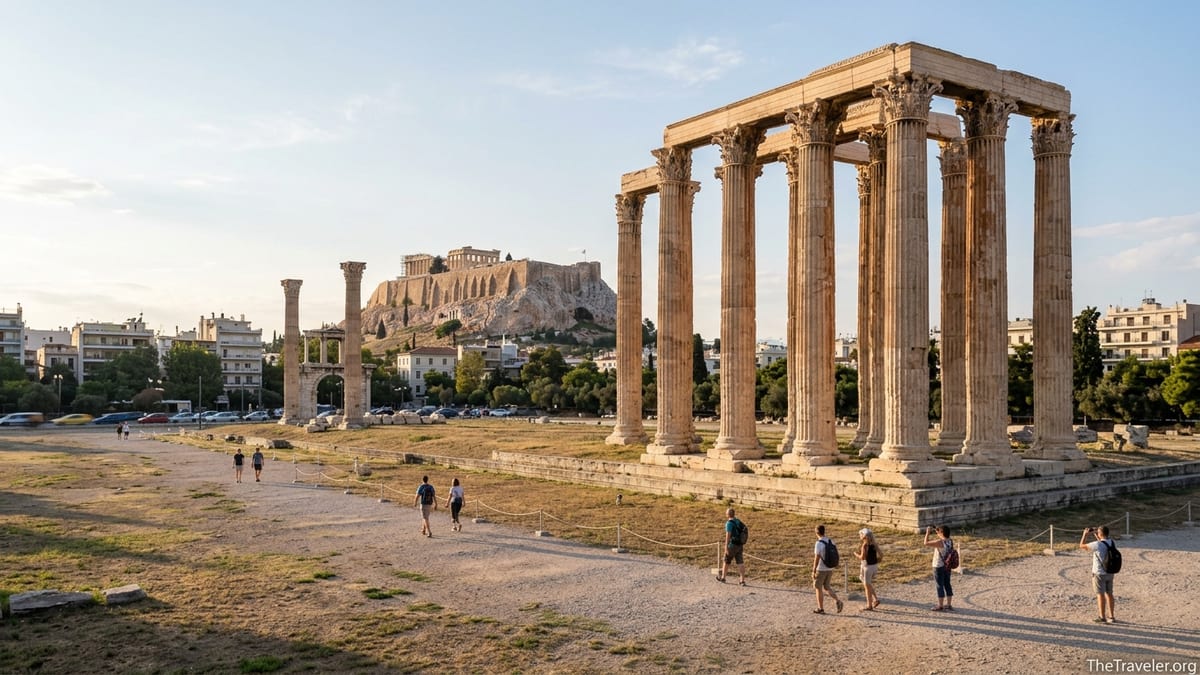
From the Panathenaic Stadium, it is an easy walk west to the Temple of Olympian Zeus and Hadrian’s Arch. Follow Vasileos Konstantinou Avenue for about 10 to 15 minutes, keeping the National Garden on your right. Soon the view opens up and you see the surviving columns of the Olympieion, with the Acropolis rising behind them. Hadrian’s Arch stands just outside the archaeological site on Amalias Avenue, a stone gateway that once symbolically marked the boundary between the old city of Theseus and the new Roman city of Emperor Hadrian.
The Temple of Olympian Zeus itself was once among the largest temples in Greece, with more than a hundred massive Corinthian columns. Today only a fraction stand, but their scale is still impressive. One fallen column lies on its side, and the detail in the fluted shafts is visible up close. In the late afternoon, when the light turns golden, many photographers like to frame the columns with the Acropolis in the background, using the arch as a foreground element from across the busy avenue.
A visit to the Olympieion site usually takes 30 to 45 minutes. There are information panels in English and Greek explaining the long history of construction and abandonment, from the Archaic beginnings through the Roman completion under Hadrian. Because there is little shade inside the fenced site, late afternoon is usually the most comfortable time, and it also fits naturally as the closing chapter of this walking loop.
Before or after entering the site, spend a few minutes at Hadrian’s Arch itself. Standing on the small traffic island near the base of the arch gives you the best sense of its height and proportions, though you need to be careful crossing multiple traffic lanes. From this vantage point, you can look back toward Syntagma and forward toward the Acropolis, seeing how tightly packed modern Athens is around its ancient monuments.
Practical tips for making the most of the route
Weather and heat are the main factors that shape how enjoyable this day will be. From June to early September, midday temperatures frequently exceed 32 degrees Celsius, and stone surfaces on the Acropolis and at the Olympieion radiate heat back upward. Plan your most exposed visits, such as the Acropolis hill and Temple of Olympian Zeus, for early morning and late afternoon whenever possible, using the National Garden, the Acropolis Museum and long lunch breaks to shelter during the middle of the day.
Footwear is another crucial detail. The polished limestone on the Acropolis and some paths around the Olympieion can be slick, especially if there has been recent rain in the cooler months. Closed‑toe shoes or secure sandals with good grip are more practical than smooth‑soled fashion sneakers. Carry at least one refillable water bottle per person. Fountains are available at several points, including near some archaeological sites and inside the National Garden, though they are not always obvious, so buying a 1.5‑liter bottle from a kiosk for around 1 euro is a simple backup.
Food and restrooms are widely available around the route, but not always inside the archaeological sites. The Acropolis Museum has modern facilities and a good restaurant, while cafés around Makrigianni Street, Plaka and Syntagma provide toilets for customers. Inside the Panathenaic Stadium, restrooms are accessible but may involve a small access fee based on recent policy changes. At the Temple of Olympian Zeus, facilities can be limited, so it is worth planning ahead before you enter.
If you are traveling in shoulder seasons such as April, May, late September or October, the weather is usually ideal for this sort of walking itinerary, with daytime highs between roughly 18 and 26 degrees Celsius. Winter visits can still be rewarding, as crowds at the Acropolis and Acropolis Museum are smaller, but daylight hours are shorter and some sites close earlier, so begin your day earlier to fit in everything comfortably.
Suggested time breakdown and route variations
A realistic time breakdown for many travelers would be around two hours for the Acropolis, up to two hours for the Acropolis Museum, one to one and a half hours for Plaka including lunch, 30 minutes at Syntagma Square, about 30 to 45 minutes to traverse the National Garden, 45 to 60 minutes at the Panathenaic Stadium and 30 to 45 minutes at the Temple of Olympian Zeus and Hadrian’s Arch. This adds up to roughly eight to nine hours including walking and breaks, essentially a full yet unhurried day.
Families with younger children or travelers with limited mobility might shorten the day by choosing only one of the major climbs, usually the Acropolis itself, and then visiting the other sights that involve less elevation gain. For example, you could spend the morning at the Acropolis and Acropolis Museum, take a long lunch and rest in Plaka, then skip the stadium and simply continue via the National Garden directly to the Olympieion site and Hadrian’s Arch.
If you prefer more museum time, another variation is to start earlier at the Acropolis, descend and explore Plaka first, and then schedule the Acropolis Museum for the hottest hours between about 13:00 and 16:00. The museum’s climate‑controlled galleries and seating areas are an effective way to escape the sun. You can then emerge in late afternoon to walk Syntagma, the National Garden, and finally the Temple of Olympian Zeus.
Public transport is available at multiple points along the loop. Metro stations at Acropolis, Syntagma and Evangelismos form a triangle around the route, and tram and bus lines run along Amalias Avenue and Vasileos Konstantinou Avenue. This makes it easy to shorten the day if needed. For instance, after visiting the Panathenaic Stadium you can reach Evangelismos metro in about 10 minutes on foot instead of continuing to the Olympieion if energy is low.
The Takeaway
Linking the Temple of Olympian Zeus with the Acropolis, Acropolis Museum, Plaka, Syntagma, the National Garden and the Panathenaic Stadium creates a single coherent story of Athens, from classical temples and Roman arches to modern civic squares and Olympic revival. Because the route is walkable and threaded with parks and cafés, it suits a wide range of travelers, from first‑time visitors with only one full day in the city to repeat guests who want to experience familiar icons from new angles.
By paying attention to timing, especially in high summer, and by buying key tickets such as the Acropolis and Acropolis Museum in advance, you can avoid much of the standing and waiting that exhausts many visitors. Small, practical choices, like carrying water, choosing sturdy footwear and using the National Garden as a green corridor between dense urban spaces, make a disproportionate difference to how enjoyable the day feels.
Most importantly, give yourself space simply to pause and look. Sit for ten minutes on the steps of the Panathenaic Stadium, imagining the first modern Olympic crowds, or rest on a bench near Hadrian’s Arch with the Acropolis glowing behind it. This walking loop is not only a checklist of major sites but also a chance to feel how ancient and modern Athens fit together, column by column and street by street.
FAQ
Q1. Can I realistically do this entire walking route in one day?
Yes, most reasonably fit visitors can complete this loop in a full day of about eight to nine hours, including sightseeing stops and meal breaks, if they start in the morning and pace themselves.
Q2. In what order should I visit the sights for the best experience?
A practical order is Acropolis Museum area, Acropolis, Plaka and lunch, Syntagma Square, National Garden, Panathenaic Stadium, then the Temple of Olympian Zeus and Hadrian’s Arch in late afternoon light.
Q3. Do I need separate tickets for the Acropolis and Acropolis Museum?
Yes, the Acropolis archaeological site and the Acropolis Museum are separate institutions with different tickets, so you should budget for both if you plan to visit each on the same day.
Q4. Is there a combo ticket that includes the Temple of Olympian Zeus and other ruins?
The Ministry of Culture offers a multi‑site archaeological ticket that covers the Acropolis and several other ancient sites in Athens, which may include the Temple of Olympian Zeus, though details and inclusions can change, so you should confirm current conditions before purchase.
Q5. How much walking is involved on this route?
Expect around 6 to 7 kilometers of walking, plus additional steps within each site. The steepest part is the climb up and down the Acropolis; the rest is mostly gentle city walking and park paths.
Q6. Is this itinerary suitable in summer heat?
It can be, provided you start early, visit the Acropolis and other exposed sites before 11:00 or after 17:00, spend midday in shaded areas or the museum, carry water and wear a hat and sunscreen.
Q7. Can I follow this route with children or older relatives?
Yes, but you may want to shorten it by skipping one or two stops, allowing longer rest breaks, and using public transport between Syntagma and the stadium or the Olympieion if anyone becomes tired.
Q8. Are there good places to eat along the way?
Plaka and the streets around Makrigianni and Adrianou offer many tavernas and cafés with Greek dishes, while Syntagma and nearby Ermou Street have bakeries, casual restaurants and coffee chains for quick snacks.
Q9. Do I need to book guided tours in advance?
Guided tours are optional. Some travelers book a guided Acropolis or Acropolis Museum tour ahead of time for historical context, then explore the rest of the loop independently using maps and on‑site information panels.
Q10. What should I bring for this walking itinerary?
Bring comfortable walking shoes, a refillable water bottle, sun protection, a small daypack for tickets and camera, and light layers in cooler months, as exposed sites can feel windy even when the city streets are mild.