


Few corners of Athens bring the city’s Roman past into focus as clearly as the Temple of Olympian Zeus and Hadrian’s Arch. Standing just a few steps apart on the edge of the modern center, they are easy to visit together on foot and even easier to photograph badly if you arrive at the wrong time of day or stand in the wrong place. This guide walks you through a practical route, the best photo angles, and how to connect these ruins with nearby streets and Plaka so they fit smoothly into a wider day exploring Athens.
Get the latest updates straight to your inbox!
Understanding the Site: Roman Athens in a Nutshell
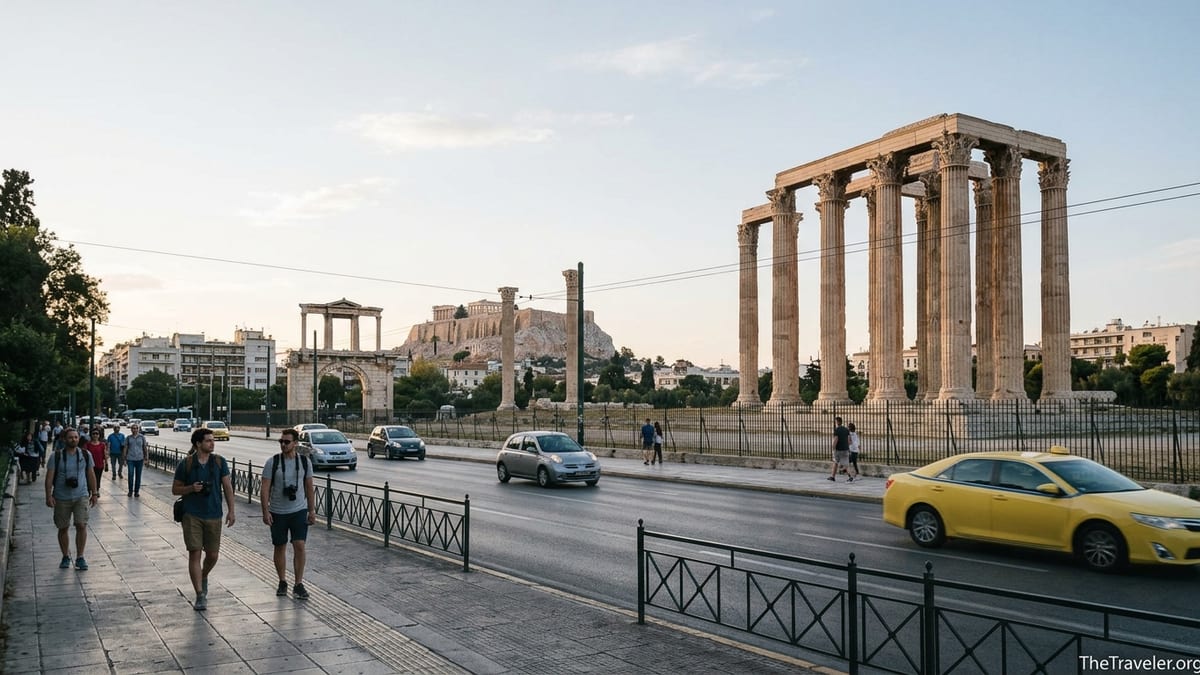
The Temple of Olympian Zeus, often called the Olympieion, was the largest temple in ancient Athens and one of the biggest in the Greek world. Only 15 of its original more than 100 Corinthian columns still stand, but their sheer height makes the ruin feel surprisingly monumental. Construction began in the 6th century BC and dragged on for centuries before the Roman emperor Hadrian finally completed it in the 2nd century AD. When you stand inside the archaeological site today, you are essentially in the ceremonial heart of Roman Athens.
Hadrian’s Arch sits just outside the fenced temple grounds, straddling the modern Leoforos Vasilissis Amalias. In antiquity it marked the symbolic boundary between classical Athens and the newer Roman quarter, its inscriptions facing “the city of Theseus” on one side and “the city of Hadrian” on the other. It is a compact monument compared with the temple, but because it rises directly beside a busy avenue and the modern tram tracks, it has become one of the city’s most photographed silhouettes.
Both monuments lie an easy 10-to-15-minute walk southeast of Syntagma Square. They sit between the National Garden and the residential district of Mets, with the Acropolis rampart visible behind them on clear days. For itinerary planning, it helps to treat them as a natural link between the political center around Syntagma, the museum and Acropolis cluster to the west, and the cafés and lanes of Plaka and Makrygianni that wrap around the slopes of the Acropolis.
Because interpretation on-site is relatively light compared with the Acropolis Museum, many travelers find these ruins more impressive with a bit of advance context. Even a quick mental picture that you are standing at the formal gateway into Hadrian’s reimagined city, with a colossal gold-and-ivory statue of Zeus once towering inside the temple, can change how you experience what is now an open field of columns against the skyline.
Best Order to Visit and Ideal Times of Day
If you are coming from central Athens, the most efficient order is usually Hadrian’s Arch first, then the Temple of Olympian Zeus interior. The arch stands in an open, unfenced area that you can visit at any time, so it works well as a flexible starting or backup option if you are early, late, or find the temple site briefly closed. Beginning at the arch also orients you to the way the Romans framed their entrance to the sanctuary before you step inside.
Light is the main reason to think about timing. In summer, mornings from about 8:00 to 10:00 and late afternoons from roughly 17:30 onward give you softer, lower sun and more flattering angles on both sites. Midday, especially from June to August, can be punishingly hot with harsh overhead light that flattens the columns and makes photography difficult without blown highlights. In winter and shoulder seasons, the sun stays lower, so the light is more forgiving throughout the day, but you will still get the most depth and texture in the first and last couple of hours of opening times.
For many visitors, combining the temple and arch with the Acropolis makes sense. One workable pattern is to take a morning slot at the Acropolis, walk down via Dionysiou Areopagitou toward the Arch of Hadrian around late morning, and then finish at the temple interior before drifting into Plaka for a late lunch. Another is to reverse that order on a hotter day: start with the temple at opening time, see the arch while the avenue is still relatively quiet, and then head uphill to the shaded streets and cafés of Plaka as the heat builds.
In practical terms, the temple site typically opens in the morning and closes around sunset, with slightly reduced hours outside peak season. Ticket prices change periodically, and the past combined ticket that used to cover multiple Athens sites has recently been phased out in favor of individual entries and seasonal passes. It is wise to check the Greek Ministry of Culture’s current listing shortly before your trip, then decide whether to prebook a timed slot or simply buy on arrival at the ticket booth on Athanasiou Diakou Street.
The Core Walking Route: Syntagma, Arch, Temple, and Plaka
The most straightforward walking route begins at Syntagma Square, the transport hub in front of the Greek Parliament. From Syntagma, walk south along Leoforos Vasilissis Amalias, keeping the National Garden on your left. The sidewalk is wide and level, and in around ten minutes you will see Hadrian’s Arch appear ahead of you, framed by traffic and tramlines. This stretch is busy but feels safe and is well lit even at dusk, making it a sensible choice for solo travelers or families with strollers.
Once you reach the arch, you can explore its base from both the city side and the temple side by using the pedestrian crossings at the traffic lights. There is no ticket or barrier; you simply step off the curb when the light changes and walk up to the marble. Many people stop on the small triangle of paving stones on the western side of the avenue, which gives you a clear, slightly angled view of the arch with the Acropolis visible through the opening on a clear day.
From the arch to the temple entrance is a matter of steps, not minutes. Turn your back to the National Garden and face the columns: along Athanasiou Diakou Street, just a short walk south from the arch, you will see the official gate and ticket kiosk for the Temple of Olympian Zeus. In practice, travelers often pause to photograph the temple from the sidewalk first, using the iron railings as a visual frame, then head through the gate once they are ready to commit to the visit.
After exploring the interior of the site, the most rewarding way to continue on foot is toward Plaka. Exit the temple, walk back past Hadrian’s Arch toward Syntagma, then cut right into the backstreets as soon as you see the first smaller side streets, such as Lysikratous. Within just a couple of blocks the traffic noise drops dramatically, replaced by the chatter of cafés and the sound of cutlery from tavernas. You can then meander uphill along Kydathineon or Adrianou, using the Acropolis as your visual compass as you drift deeper into Plaka’s lattice of lanes.
Inside the Temple Site: What to See and How to Walk It
Once inside the archaeological site of the Temple of Olympian Zeus, you find yourself in a surprisingly open expanse of grass and pathways dotted with scattered blocks and column drums. The most imposing feature is the cluster of standing Corinthian columns at the center, with one fallen column laid out on the ground like a collapsed stack of drums. A simple, effective walking circuit begins by heading straight towards the standing columns, then looping counterclockwise around them using the dirt paths.
As you move around the columns, pause at different points to change the backdrop. Facing north, you can align the columns with the Acropolis and Parthenon on the hill behind, a classic Athens skyline shot. Facing west, you bring in Hadrian’s Arch and the traffic of modern Amalias Avenue as a contrast. Turning toward the south and east, you see the quieter residential quarters of Mets and the distant hills that frame the city, giving a sense of how the sanctuary once opened toward the countryside.
Do not rush past the smaller remains near the northern boundary of the site. Low walls and foundations here mark traces of Roman baths, parts of Themistoclean fortifications, and domestic buildings that were absorbed into the sanctuary complex. There is usually a simple information board in both Greek and English summarizing what you are looking at. Spending even five minutes here helps you understand that this was not just an isolated temple but a larger ceremonial and residential district under Hadrian.
On hot days, shade inside the site is limited, mainly from a few scattered trees near the fences. Bring water, a hat, and sunscreen, especially if visiting between late morning and mid-afternoon in July or August. There is typically no café on-site; the nearest refreshments are at kiosks and cafés back toward Syntagma, along Amalias Avenue, or tucked into the first streets of Plaka. Many travelers time their visit so that they step out of the temple grounds and reach a shaded café within ten to fifteen minutes.
Photo Angles and Camera Tips for Both Monuments
For Hadrian’s Arch, one of the most effective angles is from the northwest corner, near the traffic light where Amalias intersects the small side street leading toward the Acropolis Museum. Stand back several paces to capture the full height of the arch and include a slice of the Acropolis hill framed within it. A focal length around 24 to 35 mm on a full-frame camera (or the standard 1x lens on a recent smartphone) will usually give you enough width without severe distortion.
Another strong composition is from the opposite side of the avenue, with your back to the temple. Here you can contrast the arch against the greenery of the National Garden and the line of modern buildings along Amalias. Visit in the early morning or late afternoon if you want warm side-light catching the carving on the marble; around midday, the arch tends to look flatter, and the bright sky behind it can trick your camera into underexposing the stone, so consider using exposure compensation to brighten the frame a touch.
Inside the Temple of Olympian Zeus, a classic photograph is taken from the northwest corner of the fenced path, with the standing columns aligned visibly against the Acropolis in the distance. Walk toward the fence, then step back until you can see both sets of monuments in your frame. A slight crouch helps separate the temple’s column tops from the hill behind. For a more abstract shot, move in close to one of the column bases and tilt your camera upward, using a wide lens to exaggerate the fluting and give a sense of height.
Smartphone users can get excellent results by tapping to expose on the columns rather than the sky, which keeps the marble from going too dark. If your phone has a “portrait” or “telephoto” lens around 2x or 3x, try it for detail shots of the capitals and weathering. In peak season the site can be busy with tour groups, so if you are aiming for cleaner images, arrive at opening time or just before closing, when the number of people in the background drops noticeably and the light is softer.
Walking Connections: National Garden, Stadium, and Plaka
One of the advantages of visiting the Temple of Olympian Zeus and Hadrian’s Arch is how naturally they fit into a wider walking loop through central Athens. From the arch it is only a few minutes’ stroll north into the National Garden. Many travelers cut through the garden on broad gravel paths toward the Parliament building, enjoying a patch of filtered shade and glimpses of small ponds and sculptures before emerging back onto Syntagma Square.
In the opposite direction, a short walk southeast from the temple leads toward the Panathenaic Stadium, the all-marble arena used in the first modern Olympic Games. A feasible half-day walk for reasonably fit visitors is to start at Syntagma, cross the National Garden, visit the stadium, loop back to the temple and arch, and then finish by wandering into Plaka for a meal. This route has relatively gentle gradients and a mix of tree shade, open ruins, and narrow village-like streets.
Plaka itself begins just behind the main roads that skirt the Acropolis. From the temple, walk back past the arch and continue along Amalias until you reach the first pedestrian-friendly side streets, then drift uphill toward Kydathineon and Flessa. Here you will find a dense cluster of tavernas, souvenir shops, and neoclassical façades with peeling shutters and cascading bougainvillea. It is an easy place to stop for a simple lunch of souvlaki or a Greek salad and iced coffee before continuing to the Acropolis Museum or looping back to your hotel.
For those staying in the Makrygianni or Koukaki areas, south of the Acropolis Museum, the temple and arch work nicely as a pre-dinner stroll. You can walk along the pedestrianized Dionysiou Areopagitou, which wraps the southern flank of the Acropolis, then swing down toward the arch as the street curves. The light on the columns of the temple is often particularly warm in the hour before sunset, and the lower traffic volumes later in the day make it easier to pause and take in the scene.
Practical Tips: Tickets, Safety, and Seasonal Considerations
Ticketing for Athens’ archaeological sites has changed in recent seasons, with the old combined multi-site ticket discontinued and individual pricing adjusted. As of mid-2026, most visitors buy separate tickets for the Acropolis, Ancient Agora, Roman Agora, and the Temple of Olympian Zeus, either through the official online system or at on-site kiosks. Prices are posted clearly at the entrance, and there are often reduced or free admission days for EU youth and on specific cultural dates, so it is worth checking in advance and carrying a passport or ID if you hope to qualify.
Security and safety around the temple and arch are generally good during daylight hours. The area is well patrolled, and the constant flow of tour buses and groups keeps it lively. That said, this is a busy capital city. Keep valuables zipped and avoid leaving bags unattended while setting up a tripod or backing away for photos. At night, the arch and temple are visible from the street but the interior site closes, so most visitors restrict their after-dark photos to quick handheld shots from the sidewalk before heading back toward more crowded parts of Plaka or Syntagma.
Summer brings intense heat, especially from late June through August. Midday temperatures can climb above 35 degrees Celsius, and there is little shade in the temple grounds. Plan for hats, sunscreen, and at least a half-liter of water per person for even a short visit. In shoulder seasons, such as April, May, September, and October, the combination of milder temperatures and long daylight hours makes walking the loop between Syntagma, the temple, and Plaka particularly pleasant. Winter days are shorter and occasionally rainy, but crowds are thinner and the low sun can give the columns a dramatic, golden light.
Accessibility is a mixed picture. The pavements along Amalias are generally smooth, and the short distance between arch and temple gate is manageable for wheelchairs and strollers. Inside the temple site, however, some paths are uneven or dusty. There is usually a main, more compacted track that most visitors follow, but anyone with limited mobility should be prepared for a few bumps and perhaps avoid the roughest side paths. If you need to minimize walking, consider arriving by taxi directly to the temple entrance on Athanasiou Diakou and exiting the same way rather than trying to string multiple sites together in one long circuit.
The Takeaway
Visiting the Temple of Olympian Zeus and Hadrian’s Arch is about more than ticking off another pair of ruins. In a compact, walkable area you see how Roman ambition reshaped Athens, how a colossal sanctuary once anchored the city’s ceremonial life, and how a single arch tried to draw a symbolic border between old and new. When you approach the two sites with a clear route and a sense of what you are looking at, the scattered columns and solitary gateway resolve into a coherent story.
The best way to experience that story is on foot, at a gentle pace, linking Syntagma, the National Garden, the temple, the arch, and the side streets of Plaka. Arrive when the light is soft, move slowly enough to try several angles at each stop, and leave space in your schedule for a coffee in a nearby square. With a little planning, this short walk can become one of the most atmospheric chapters in your wider exploration of Athens.
FAQ
Q1. Can I see both the Temple of Olympian Zeus and Hadrian’s Arch without buying a ticket?
The arch is completely free to visit, as it stands on an open patch of ground beside the main avenue. To enter the fenced archaeological site of the Temple of Olympian Zeus and walk among the columns, you need a paid ticket purchased either online or at the on-site kiosk.
Q2. How long should I plan to spend at the temple and arch together?
Most visitors are satisfied with about 45 to 60 minutes total, including time for photos at the arch, walking the loop inside the temple grounds, and pausing to read a few information panels. Photography enthusiasts or history fans might extend that to 90 minutes, especially if waiting for a particular light or angle.
Q3. Is it better to visit before or after the Acropolis?
It depends on your energy and the weather. On very hot days, many travelers prefer to tackle the Acropolis early and then drift downhill to the temple and arch late morning. On milder days, starting at the temple at opening time and then working up toward the Acropolis and Plaka keeps the walk pleasantly varied.
Q4. Are there good sunset views from the Temple of Olympian Zeus?
You do not see the sun setting directly behind the Acropolis from the temple grounds, but the low golden light in the late afternoon or early evening often makes the columns glow warmly and adds long shadows across the site. It is a rewarding time to photograph, provided your visit fits within the seasonal opening hours.
Q5. Can I combine the temple and arch with a visit to the Panathenaic Stadium on foot?
Yes. The stadium lies a short walk east of the temple, and many visitors link the three into a single loop from Syntagma. For example, you can walk through the National Garden to the stadium, continue to the temple and arch, and then finish in Plaka, all within a relaxed half day.
Q6. Is the area around the temple and arch safe at night?
The main avenues and nearby squares remain active into the evening, and most travelers feel comfortable walking between Syntagma, the arch, and Plaka after dark. As in any major city, keep an eye on your belongings, avoid poorly lit side streets late at night, and use registered taxis or ride-hailing services if returning to accommodation further away.
Q7. Are tripods allowed for photography inside the temple site?
Rules can vary over time, but small travel tripods are sometimes restricted at major archaeological sites in Greece unless you have a permit, especially if they resemble professional equipment. Handheld shots, monopods, and smartphone stabilizers are usually fine. If in doubt, check the latest guidelines or ask the staff at the gate before setting up.
Q8. What should I wear for this walking route in summer?
Light, breathable clothing, a brimmed hat, and comfortable walking shoes are strongly recommended. The pavements and pathways reflect heat, and there is limited shade inside the temple grounds. Many travelers also bring a refillable water bottle and a small pack of sunscreen and sunglasses to stay comfortable.
Q9. Is the route suitable for children and strollers?
The sidewalks between Syntagma, the arch, and the temple are generally stroller friendly, and older children often enjoy the drama of the towering columns. Inside the site, some paths are uneven, so pushing a stroller may be slightly bumpy but still manageable with care. Families often break the walk with stops in the National Garden or Plaka for snacks and shade.
Q10. Can I see the temple and arch if I only have a long layover in Athens?
If you have at least four to five hours in the city center, it is realistic to take the metro or taxi from the airport or port to Syntagma, walk down to the arch and temple, explore briefly, and then return. Keep an eye on transport times and security queues, but many layover travelers find this short loop gives them a satisfying first taste of both ancient and modern Athens.