


The Temple of Olympian Zeus in Athens is one of those ruins that looks strangely familiar long before you ever see it. You glimpse its soaring marble columns from the Acropolis, from the tram along the coast, even from a taxi crawling around Syntagma Square. Yet few visitors know that this shattered giant took more than six centuries to complete, that an emperor modeled himself on Zeus inside its sanctuary, or that a single storm in the 19th century toppled one of its last standing columns. This guide unpacks the human story behind those columns, from early Zeus worship and the ambitions of ancient tyrants to Hadrian’s grand plans for Roman Athens and the later damage that left the Olympieion in ruins.
Get the latest updates straight to your inbox!
Zeus Worship in Athens and the Birth of the Olympieion
Long before anyone dreamed of a forest of marble columns on this spot, Athenians were already worshipping Zeus in several forms. Across the city, shrines honored Zeus Polieus as protector of the city on the Acropolis, Zeus Herkeios as a guardian of the household, and Zeus Meilichios as a more chthonic, underworld‑leaning deity. These local cults reflected everyday needs: protection from storms, good harvests, healthy children, and safety in war. For an ancient Athenian walking from the Agora to the Acropolis, offerings to Zeus might mean a small clay figurine on a family altar or the sacrifice of an animal during a civic festival.
The Olympian aspect of Zeus, Zeus Olympios, emphasized his role as king of the gods and the figure who presided over the cosmic order. This image was reinforced at the great Panhellenic sanctuary of Olympia in the Peloponnese, where the Olympic Games were held every four years in his honor and where a colossal gold and ivory statue of the god once sat in a temple of its own. By the 6th century BC, Athenian rulers wanted their city to share in that prestige. The flat ground between the Acropolis and the Ilissos River, a short walk from today’s Syntagma Square, offered a natural stage for an ambitious sanctuary that could rival those of the western Peloponnese.
When visitors today step through the ticket gate and see the open expanse of the Olympieion, it can be hard to imagine how sacred this landscape once felt. In antiquity, the sanctuary formed a kind of hinge between the old urban center around the Acropolis and the more open countryside along the Ilissos. Pilgrims would have approached across simple bridges or tracks, bringing animals for sacrifice and votive offerings, with the Acropolis rising behind them and, eventually, the gleam of marble columns ahead. The choice of this site underlined Zeus Olympios as a god who stood slightly apart from the everyday bustle of the city while still watching over it.
Modern travelers catch an echo of that role in the way Athenians still use the site today. Locals cut through the park around the ruins on their way from the Zappeion gardens to the Makrygianni neighborhood, joggers trace loops past the fence in the early morning, and the columns serve as a constant visual reminder of the city’s ancient religious center of gravity, even if Zeus has long since ceded ground to museums and photo stops.
Peisistratid Ambition: A Tyrant’s Unfinished Project
The first serious attempt to monumentalize the sanctuary came under the Peisistratid tyrants in the late 6th century BC. Peisistratos and his sons sought to consolidate their power with grand building projects, and an enormous temple for Zeus Olympios fitted their agenda perfectly. Around 515 BC, under Peisistratos’ son Hippias, work began on a Doric temple that was intended to be among the largest in the Greek world. The idea was as political as it was religious: by aligning themselves with Zeus, the tyrants claimed divine sanction for their rule and projected Athens as a rising power.
Archaeological evidence suggests that the Peisistratid design followed the traditional Doric style seen at sites like Olympia, with heavy fluted columns and a relatively sober exterior. Foundations and a few elements of the early phase survive beneath the later structure. For a modern visitor, none of this is obvious at first glance, but site signage and reconstructions in guidebooks often show how a more austere, early temple lies hidden below the Roman Corinthian forest that finally rose centuries later.
History, however, did not cooperate with the tyrants’ plans. In 510 BC, the Peisistratid regime was overthrown with help from Spartan forces, and the new democratic government in Athens had no interest in finishing a monument so closely tied to its predecessors. For decades, the half‑built foundations of the Olympieion stood as a silent reminder of abandoned tyranny, and civic attention shifted to other sacred projects, most notably the rebuilding of the Acropolis after the Persian Wars.
Travelers who have visited multiple ancient sites in Greece often notice the difference this makes on the ground. At Olympia or Delphi, large classical temples to Zeus or Apollo stand relatively complete in their plans, even if their roofs are gone. At the Olympieion, by contrast, the sense of a long, broken story is palpable. The vast rectangle of the temple’s footprint, now mostly bare, reflects centuries of interrupted ambition, beginning with the Peisistratids’ failure to finish what they started.
A Temple Centuries in the Making
After the fall of the Peisistratids, the Olympieion spent a long time caught between aspiration and neglect. Classical Athens of the 5th and 4th centuries BC poured its energies into other projects. Pericles’ building program favored the Parthenon, the Propylaia, and the Erechtheion on the Acropolis, while other parts of the city gained new stoas, theaters, and civic buildings. The half‑finished Olympieion, with its massive foundations and scattered column drums, must have seemed like a white elephant on the city’s edge, impressive but awkward in its incompletion.
In the 3rd century BC, a new patron appeared in the form of Antiochus IV Epiphanes, a Hellenistic king from the Seleucid dynasty who ruled over parts of the Near East. Keen to win Greek favor and to leave his mark on Athens, Antiochus hired the Roman architect Cossutius to redesign and restart the temple around 174 BC. Under their direction, the plan shifted to a grandiose Corinthian order, with slender, elaborately carved capitals and a scale that would eventually require 104 columns. Though work progressed, political instability and Antiochus’ death brought another halt around 164 BC, leaving the Olympieion once again unfinished.
For modern travelers trying to piece this together on site, one useful mental image is to picture the temple evolving like a long‑running architectural project that keeps changing hands and style. Where the Peisistratid phase would have resembled the sturdy Doric lines of the Temple of Hephaestus in the Athenian Agora, the later plan envisioned something closer to the showy Corinthian temples Romans built in cities like Baalbek or Gerasa. Over time, each restart introduced new techniques and decorative tastes, but no one managed to carry the project over the finish line until the Roman imperial era.
By the time the Roman Empire absorbed Greece in the 2nd century BC, the Olympieion was already a kind of local joke and a major opportunity. Here was a colossal, partly built sanctuary in one of the most storied cities of the Mediterranean, just waiting for a ruler with enough resources and vanity to complete it. That opportunity would ultimately fall to Hadrian, the philhellene emperor whose love affair with Athens transformed the city’s skyline.
Hadrian and the Roman Transformation of the Olympieion
Hadrian, who ruled from AD 117 to 138, cultivated a deep personal attachment to Greece. He visited Athens several times, sponsored festivals, and launched ambitious building programs that turned the city into a showcase of Roman beneficence toward classical culture. When he took up the long‑stalled Olympieion project, it was as much a statement of his identity as a cultured, Greek‑loving emperor as it was a religious act. In the early 2nd century AD, he ordered the completion of the temple on the grand Corinthian plan, and by around AD 124 to 132, the Olympieion finally stood finished.
The completed temple was one of the largest religious buildings in the eastern Mediterranean. Measuring nearly 100 meters long and about 40 meters wide, with a double row of Corinthian columns along each side and additional columns at the front and back, it dominated the skyline of Roman Athens. Ancient writers and modern reconstructions suggest that inside stood a colossal chryselephantine or richly adorned statue of Zeus, flanked or mirrored by images of Hadrian himself. Some inscriptions and statues even portrayed Hadrian as a kind of living counterpart to Zeus Olympios, underscoring the close link between emperor worship and traditional cult.
For visitors today, the connection between Hadrian and the temple is clearest in the surrounding landscape. Just to the northwest stands Hadrian’s Arch, the marble gateway that once marked the symbolic boundary between the “city of Theseus” and the “city of Hadrian.” Walking from the arch into the Olympieion grounds, you are effectively retracing the ceremonial route that might have been used in imperial processions. In the 2nd century AD, Athenians could have looked up from the Agora and seen the colossal temple of Zeus aligned with the new library, aqueducts, and other Hadrianic monuments that reshaped their city.
In practical terms, Hadrian’s patronage also meant steady imperial funding, skilled Roman engineers, and a supply chain capable of transporting massive Pentelic marble drums from the quarries northeast of the city. Modern engineers who study the surviving columns are often struck by how precisely the drums were cut and fitted, with iron clamps and dowels holding the stacked segments together. That technical mastery, coupled with imperial resources, finally overcame the logistical obstacles that had doomed earlier attempts to finish the temple.
Life, Ritual, and Spectacle in Roman Athens
Once completed, the Olympieion became a focal point of religious and civic life in Roman Athens. The cult of Zeus Olympios absorbed imperial ritual, and festivals in honor of both the god and Hadrian drew crowds from across the Greek world. Inscriptions found on site record dedications from cities and individuals, while statue bases suggest a forest of honorific monuments in the sanctuary’s precinct. The temple’s scale alone would have turned every major ceremony into a kind of urban spectacle.
Imagine standing in the colonnade on a festival day in the 2nd century AD. Priests in white garments lead animals toward an altar, musicians with flutes and drums accompany the procession, and smoke from sacrifices rises against the bright Attic sky. Citizens of Athens mingle with visiting dignitaries from Asia Minor, Italy, or the islands, all craning their necks to take in the towering columns and the shimmering statue inside. In an era before skyscrapers, this building would have been overwhelming in the same way that a visitor today feels dwarfed standing below a modern stadium or high‑rise.
The temple also reinforced Athens’ status within the Roman Empire as a cultural and religious showcase. Emperors sought legitimacy by associating themselves with the city’s classical past, and the Olympieion provided a ready‑made stage for that message. Some scholars think that imperial cult ceremonies, in which Hadrian and his successors were honored as quasi‑divine, took place here alongside the worship of Zeus. For ordinary Athenians, taking part in these rites would have meant negotiating a world where ancient gods and living emperors shared space within the same sanctuary.
Modern archaeological work has recovered fragments of this Roman‑era life: statue bases with dedicatory inscriptions, architectural reliefs, and traces of auxiliary buildings around the main temple. When travelers explore the site today, they walk across the same ground where Roman festivals once unfolded, though the music, crowds, and incense have long since been replaced by tour groups, school excursions, and the hum of nearby traffic on Leoforos Amalias.
Decline, Damage, and the Fate of the Columns
Like many pagan temples, the Olympieion’s fortunes declined as Christianity gained ground in the later Roman Empire. By the 4th and 5th centuries AD, imperial edicts curtailed traditional cults, and many larger sanctuaries were stripped of their valuables or repurposed. At some point, the statue of Zeus disappeared, whether through official removal, looting, or gradual destruction. The temple’s roof and upper structures, once sheathed in marble and decorated with bronze fittings, began to fail without regular maintenance. Earthquakes, which periodically affect the region, likely accelerated the process.
During the Byzantine and later Ottoman periods, the site became a convenient quarry. Cut marble blocks, column drums, and decorative fragments from the Olympieion were reused in churches, city walls, and houses throughout Athens. Travelers from the late Middle Ages report seeing more columns standing than today, but steadily fewer over time. By the 15th century, accounts mention around 20 columns still upright. Later, one column was deliberately dismantled to provide building material for a nearby mosque, an episode recorded in a Greek inscription that names the Ottoman official responsible.
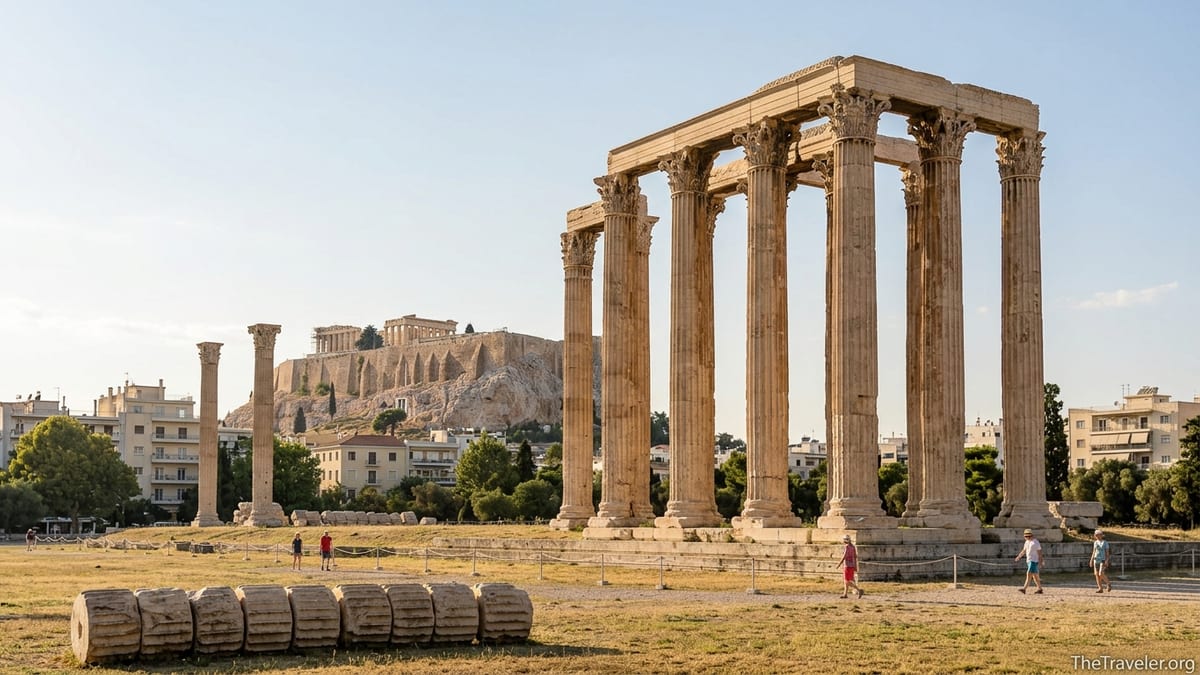
Nature also took its toll. In 1852, a powerful storm toppled one of the surviving columns, which still lies where it fell, its drums neatly aligned on the ground like a collapsed stack of coins. For many modern visitors, this toppled column is one of the most striking sights at the site, offering a cross‑section of how each column was built from individual segments, clamped together and then fluted as a single vertical element. Standing beside it, you can see the metal dowel holes and the sheer size of each drum, details that vanish when you view the intact columns from afar.
Urban development around the site introduced new kinds of pressure. As 19th‑ and 20th‑century Athens expanded, the area near the Olympieion saw the construction of roads, the National Garden, and residential neighborhoods. The Greek state gradually recognized the temple’s archaeological value, leading to systematic excavations and, later, protective measures. Today, the fenced archaeological park and controlled access reflect both the vulnerability of the remaining columns and their importance as a symbol of the city’s layered past.
The Surviving Columns: Reading Ruins on the Ground
Of the original 104 columns that once ringed the Olympieion, only 15 still stand upright today, with the fallen 16th column lying on the ground. Each surviving column rises about 17 meters, roughly the height of a modern five‑ or six‑story building. They are built in the Corinthian order, with slender fluted shafts and capitals carved with acanthus leaves curling outward in delicate tiers. From a distance, the effect is of a light, almost lacy crown atop a massive shaft of marble, a contrast that becomes even more apparent in the angled light of early morning or late afternoon.
For travelers, the best way to appreciate these columns is to circle them slowly at ground level. From the southeast corner of the site, you can line up the columns with the Acropolis in the background and get a sense of how the ancient city’s sacred landscape once connected. On a clear winter day, the white of the marble contrasts with the deep blue Attic sky, while in summer the heat haze makes the columns shimmer slightly, evoking how they might have looked when newly built and polished.
Up close, the surfaces tell more intimate stories. Weathering has softened some of the flutes, while others retain sharp edges that hint at the precision of the original carving. Patches of darker staining reveal where lichens and pollution have interacted with the stone. In places, you can spot the fine horizontal joints between drums and the occasional ancient repair, evidence that even in antiquity these structures required careful upkeep. Guides at the site sometimes point out how the fluting stops just above the base, leaving a narrow unfluted band that helped protect the shafts from chips and wear.
Photography‑minded visitors often find the light most rewarding in the first couple of hours after opening and in the hour before closing, when the low sun throws long shadows between the columns. Standing just outside the roped areas, you can frame individual capitals against the sky or capture the rhythm of the colonnade receding into the distance. Unlike more crowded monuments, the Olympieion’s wide open space usually leaves enough room to experiment without too many people in the frame, especially outside the peak summer weeks.
Visiting Today: Practical Impressions of the Olympieion
Modern travelers typically reach the Temple of Olympian Zeus on foot from central Athens. From Syntagma Square, it is about a 10‑ to 15‑minute walk along broad avenues lined with cafes and kiosks selling cold water and coffee. The entrance to the site sits near the busy intersection by Hadrian’s Arch, where tour buses pause and independent visitors queue briefly to buy tickets or present combination passes that also cover the Acropolis and other major ruins. On summer afternoons, the pavement outside can be hot enough to make shade on the nearby sidewalk a sought‑after refuge while you wait.
Once inside, the atmosphere changes quickly. The archaeological park is mostly open grass and low scrub, punctuated by the surviving columns and a few scatterings of masonry. In high season, you might share the space with several small group tours in different languages, but even then the sheer size of the enclosure allows quiet corners to linger and take photographs. In the cooler months, the site can feel almost contemplative, especially on overcast days when the usual hard Attic light softens and the marble appears warmer and creamier.
There is very little shade inside the main precinct, so many travelers plan their visit for early morning or late afternoon, pairing it with a walk through the adjacent National Garden or up to the Panathenaic Stadium. Local guides frequently recommend bringing water, sunscreen, and a hat, especially in July and August when daytime temperatures often climb above 30 degrees Celsius. Benches near the perimeter fence and under a few scattered trees offer places to sit and absorb the view of columns framed by modern apartment buildings and the rocky mass of the Acropolis.
Interpretive panels around the site provide basic historical information, but travelers with a deeper interest in the long construction timeline and Hadrian’s role often supplement their visit with a stop at the nearby Acropolis Museum or the National Archaeological Museum. There, reliefs, inscriptions, and architectural fragments from Roman Athens place the Olympieion in a richer context. A common pattern is to visit the site early, retreat to a nearby cafe during the midday heat, and then return to the broader Hadrianic landscape in the evening by walking from the Arch toward the Plaka and Monastiraki districts.
The Takeaway
The Temple of Olympian Zeus is more than a photogenic cluster of columns between the Acropolis and the modern city center. It is the material trace of centuries of political ambition, religious change, and urban transformation. From the Peisistratid tyrants who first tried to harness Zeus Olympios for their own legitimacy, through the Hellenistic kings who restarted the project, to Hadrian who finally completed it and fused imperial cult with ancient worship, the Olympieion encapsulates the shifting balance of power in the Greek world.
Standing today among the surviving columns, travelers can read the scars of abandonment, recycling, and natural disaster that reduced a 104‑column colossus to just 15 standing shafts. At the same time, the temple’s setting amid busy roads, tram lines, and apartment blocks underscores the way Athens has always layered new lives onto old foundations. Spending even an hour here, preferably with a bit of historical background in hand, turns what might otherwise be a quick photo stop into a vivid encounter with how cities and sacred places evolve over time.
FAQ
Q1. How many columns of the Temple of Olympian Zeus are still standing today? Fifteen columns are still standing upright, and a sixteenth lies on the ground where it fell during a storm in the 19th century, giving visitors a clear view of how each column was built from stacked drums.
Q2. When did construction of the Temple of Olympian Zeus begin and when was it finally completed? Work began in the late 6th century BC under the Peisistratid tyrants, but the temple was only completed in the early 2nd century AD, around the reign of Emperor Hadrian, after more than six centuries of intermittent building.
Q3. What role did Hadrian play in the history of the Olympieion? Hadrian provided the funding, political will, and engineering expertise to finish the long‑abandoned project, completing the colossal Corinthian temple and integrating the cult of Zeus Olympios with imperial worship in Roman Athens.
Q4. Why was the Temple of Olympian Zeus left unfinished for so long? The fall of the Peisistratid tyrants, shifting political priorities in classical Athens, and later upheavals in the Hellenistic world repeatedly stalled work, leaving earlier phases incomplete until the Roman Empire could marshal the necessary resources.
Q5. What happened to the statue of Zeus that once stood inside the temple? Ancient sources and archaeology suggest that a large cult statue of Zeus, possibly accompanied by images of Hadrian, stood inside, but it was removed or destroyed as traditional pagan cults declined in late antiquity, leaving no identifiable remains on site.
Q6. How was the site used after the rise of Christianity? As Christianity spread, the Olympieion lost its religious function, and much of its stone was quarried for churches, fortifications, and houses, while the area gradually became part of the broader urban fabric of Byzantine and later Ottoman Athens.
Q7. Is it worth visiting the Temple of Olympian Zeus if I have already seen the Acropolis? Yes, because the Olympieion offers a different perspective on Athens, highlighting Roman imperial influence, the evolution of Zeus worship, and the scale of ancient monumental building in a more open, less crowded setting.
Q8. What is the best time of day to photograph the surviving columns? Early morning and late afternoon generally provide the most atmospheric light, with long shadows between the columns, softer contrast on the marble, and fewer crowds in the archaeological park.
Q9. Can I visit the Temple of Olympian Zeus with the same ticket as the Acropolis? Depending on current regulations, combination tickets sold in Athens often include both the Acropolis and several other archaeological sites such as the Olympieion, so visitors should check at official ticket offices for up‑to‑date options.
Q10. How long should I plan to spend at the site? Many travelers find that 45 to 90 minutes is enough to walk the perimeter, study the columns up close, read the information panels, and take photographs, especially when pairing the visit with nearby sights like Hadrian’s Arch and the National Garden.