


More news on this day
Delta Air Lines has activated a one-day “Northeast weather flexibility” waiver for Thanksgiving Day flights at nine major airports from Washington, D.C. to Boston, allowing eligible passengers to move their November 26, 2026 trips without change fees as forecasters warn that a powerful coastal storm could disrupt one of the year’s busiest travel days.
Get the latest news straight to your inbox!
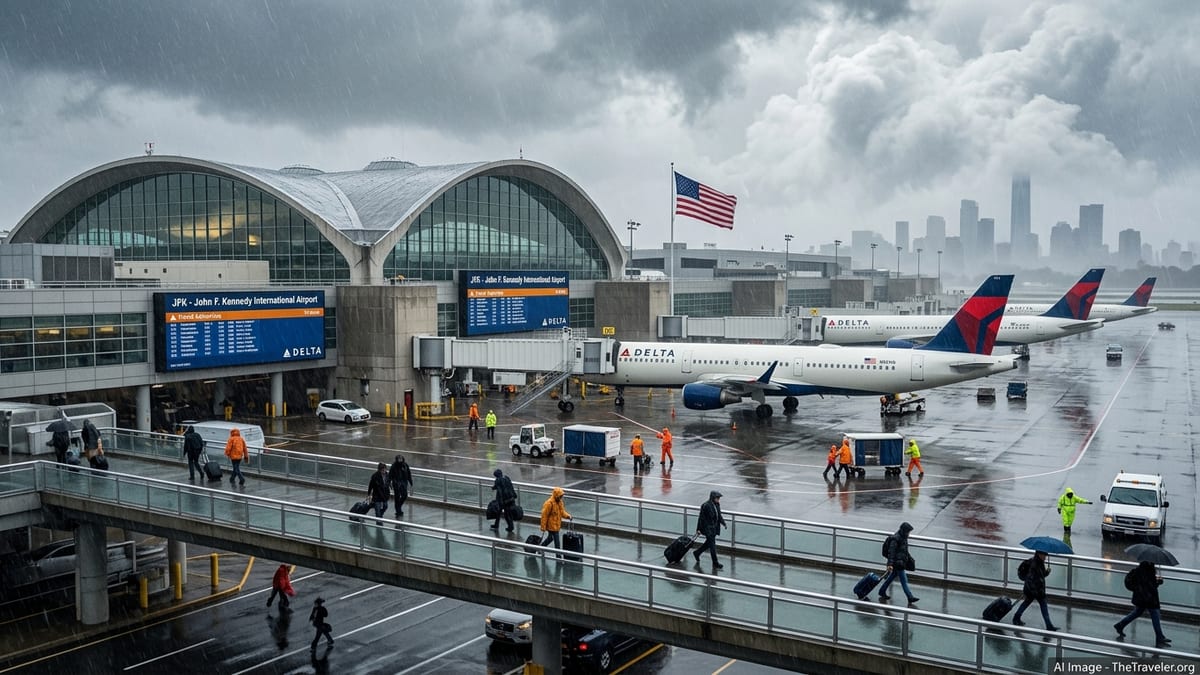
Who Is Covered By Delta’s Northeast Weather Flexibility Waiver
Delta’s advisory applies to customers booked to travel on Thursday, November 26, 2026, to, from or through nine airports in the Mid-Atlantic and Northeast. According to the airline’s current weather alerts and travel-advisory pages, the waiver covers Baltimore/Washington International (BWI), Boston Logan (BOS), New York John F. Kennedy (JFK), New York LaGuardia (LGA), Newark Liberty (EWR), Philadelphia (PHL), Washington Dulles (IAD), Ronald Reagan Washington National (DCA) and Westchester County in White Plains (HPN). The carrier says travel to, from or via these airports on that date “may be impacted” by the forecast storm and that affected customers can change their plans once at no extra charge if they stay within the waiver’s rules.
The airline describes the policy as “Northeast Weather Flexibility” and lists it among its current SkyWatch weather advisories and travel waivers. It is flagged as a response to severe weather risks in the northeastern United States rather than an airport-specific operations issue. For travelers, that means the waiver is tied to the date and geography of the storm, not to a particular flight number or time of day. The advisory is time-limited to the Thanksgiving holiday itself, rather than a multiday event.
Delta’s professional agency bulletin confirms the same list of nine airports and the one-day scope of the policy for November 26. The internal guidance characterizes the measure as a “travel exception policy,” signaling that standard fare rules are being relaxed due to an external disruption risk. The bulletin also notes that such exception policies may change without advance notice, so customers are advised to check Delta’s advisory pages close to departure, especially if forecast conditions worsen or additional airports are affected.
Key Rebooking Rules, Deadlines And eCredit Options
The waiver does not give unlimited flexibility, and Delta sets several conditions for making a fee-free change. The impacted-travel window runs from November 26, 2026 through November 26, 2026, which means the original itinerary must include travel on Thanksgiving Day and involve at least one of the nine listed airports. Customers who qualify must rebook on or before Saturday, November 28, 2026, and the new departure date must also fall on or before November 28. If a new flight is selected within that period, the usual change fees are waived and Delta says it will not collect a fare difference as long as seats are available in the originally ticketed cabin.
There are limits to that flexibility. Delta’s advisory specifies that the initial ticket must have been issued on or before November 24, 2026 to qualify, which excludes last-minute purchases made closer to the storm. The airline also requires that the new itinerary be booked in the same cabin as the original ticket. If the same booking class is not available, or if a traveler chooses a different routing that prices higher, any applicable fare difference may still be collected even when the change happens within the waiver window. Customers who postpone their trip to a date after November 28 are also subject to any difference between the old and new fares, even if the change itself is processed before the waiver deadline.
For passengers who decide not to travel at all, Delta’s policy allows cancellations with the value of the unused ticket retained as an eCredit. The carrier defines an eCredit as a monetary credit that can be applied toward a future Delta ticket, including government taxes and fees. Examples include residual value from a changed ticket, travel vouchers issued as compensation and promotional flight credits from co-branded credit cards. Under the current rules, eCredits produced from cancelled trips under this waiver can generally be used toward new travel within one year of the original ticket’s issue date, although any fare difference on the replacement itinerary remains payable. Travelers considering this option should review the specific eCredit terms associated with their booking in Delta’s “My Trips” section before canceling.
What Forecasters Expect From The Thanksgiving Coastal Storm
The waiver coincides with a coastal storm that the National Weather Service and NOAA’s Weather Prediction Center say is expected to intensify along the East Coast and move northward into the Mid-Atlantic and New England on Thanksgiving Day. Federal forecasters describe a “potent Thanksgiving Day storm” with the potential for heavy rain, strong onshore winds and areas of flooding from the Ohio Valley to the Eastern Seaboard, including the I‑95 corridor that links Washington, D.C., Philadelphia, New York City and Boston. Outlooks published November 24 and November 25 highlight the risk of damaging gusts, marine hazards and coastal flooding where high astronomical tides align with the storm’s peak.
Weather service discussions for the Northeast, including regional forecast offices in Boston and surrounding areas, indicate that rain is expected to spread northward during Thursday, becoming heavier in the afternoon and evening in parts of southern New England. Gusty easterly or northeasterly winds are forecast along exposed coasts and higher terrain, with some locations modeled to see gusts in the 50 to 60 mph range. Local emergency-management briefings for coastal New England and Long Island reference similar figures and warn of scattered power outages, tree damage and travel delays if the highest wind projections are realized. The strongest impacts are generally expected closer to the shoreline, but inland airports could still face reduced visibility, crosswinds and air-traffic management initiatives if conditions deteriorate.
National and regional outlooks also point to widespread rainfall totals on the order of 1 to 2 inches along much of the Mid-Atlantic and Northeast coast, with locally higher amounts possible where bands of heavier rain set up. While the storm is not currently being described as a significant snow producer for the I‑95 corridor itself, the combination of heavy rain, saturated ground from prior systems and strong coastal winds increases the risk of urban and small-stream flooding in some metropolitan areas. NOAA’s guidance suggests that the storm should begin to pull away from the Northeast late Friday into Saturday, with more settled, cooler weather returning for the remainder of the long weekend, but that improvement will come after the peak Thanksgiving travel period.
How Other Airlines And Regions Are Preparing For Holiday Weather Risks
Delta is not alone in adjusting plans ahead of the Thanksgiving storm and broader holiday-week disruptions. Other large U.S. carriers have issued similar one-day or short-window waivers for the Northeast around November 26 in response to the same coastal system, with coverage lists that largely overlap Delta’s focus on major hubs such as Boston, the Washington-area airports and New York’s main fields. Some airlines have paired their Northeast storm waivers with separate advisories tied to air traffic control constraints or prior technical issues, which can compound delays if bad weather forces reroutes and ground stops in already stressed parts of the network.
At the same time, West Coast travelers face a different but related weather concern. NOAA and the National Weather Service have highlighted the risk of significant coastal flooding and rough surf along stretches of the Pacific coast this week as strong Pacific systems coincide with very high astronomical tides. In the San Francisco Bay Area, forecasters and local officials have warned that low-lying areas near San Francisco International Airport could see higher-than-normal water levels. United Airlines has published a San Francisco-area flooding travel waiver allowing customers to adjust some SFO flights without fees on key travel days, and other carriers serving the airport have issued their own weather-related advisories around the holiday period.
These overlapping waivers underscore how sensitive the U.S. air travel system is to synchronized coastal storms during peak demand weeks. Federal weather briefings circulated to emergency managers ahead of the holiday note that heavy rain and high winds are expected along both the Atlantic and Pacific coasts through parts of Thanksgiving week, even as much of the nation’s interior remains comparatively dry. For travelers connecting between coastal hubs, that means potential exposure to both East and West Coast weather disruptions on the same itinerary, especially on the Wednesday and Thursday of Thanksgiving week when volumes are highest and slack in airline schedules is limited.
What Thanksgiving Travelers Should Do Now
For passengers booked on Delta itineraries involving the nine covered Northeast airports on November 26, the most immediate decision is whether to stay with existing plans or use the waiver’s limited rebooking window. Because the change-fee waiver and fare-protection rules only apply if both the change and the new departure date fall on or before November 28, customers who want to shift into an earlier or slightly later flight around Thanksgiving should act before that deadline. Inventory for peak departures on November 27 and November 28 is likely to be tight, so searching a range of times or, where feasible, nearby airports such as BWI versus DCA or JFK versus LGA could improve options.
Travelers who are primarily concerned about cancellation risk rather than schedule convenience may choose to wait and monitor conditions, but they should be aware that once the waiver expires, standard fare rules resume. If the flight later operates as scheduled or with only modest delay, voluntary changes could then involve both change fees where applicable and any fare increase. By contrast, if Delta cancels a flight outright because of the storm, customers are generally entitled to rebooking or a refund under the airline’s disruption policies, independent of the weather waiver. That means the best course of action can depend on an individual’s flexibility, tolerance for uncertainty and the importance of arriving exactly on Thanksgiving Day.
Regardless of carrier, holiday-week travelers moving through the Northeast or West Coast should keep a close eye on updated forecasts from the National Weather Service and check their flight status frequently in the 24 hours before departure. Building in extra time for airport transfers, security screening and ground transport is advisable given the likelihood of weather-related congestion. If conditions worsen, airlines may expand their waivers or add new cities, so reviewing the relevant advisory pages on the morning of travel can reveal additional options. With strong coastal storms on both sides of the country intersecting one of the busiest travel periods of the year, informed and early decision-making will be central to minimizing disruption, whether that means adjusting departure days under a waiver like Delta’s or preparing for delays while keeping plans in place.