


More news on this day
Harrisburg International Airport in Middletown is preparing for a concentrated Thanksgiving rush as U.S. air travel heads for its busiest holiday skies in 16 years and millions of infrequent flyers return to the air, prompting a focus on staffing, communication and managing potential delays across Pennsylvania’s airports.
Get the latest news straight to your inbox!
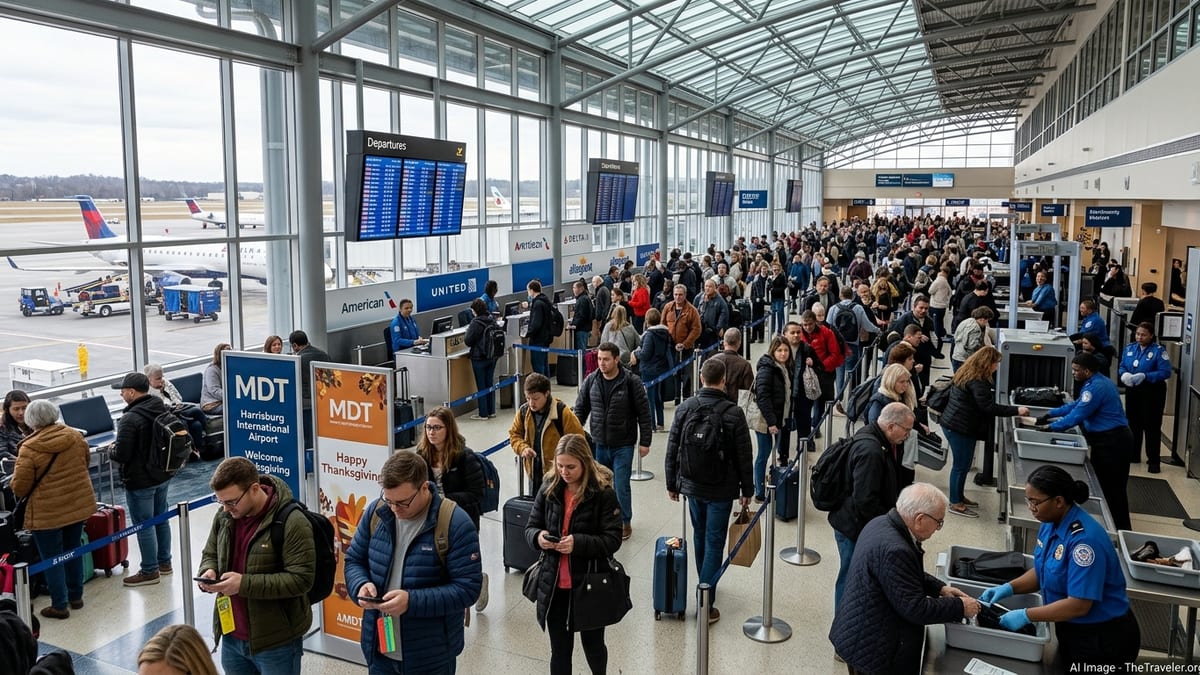
Holiday week brings surging but uneven crowds at MDT
Thanksgiving week activity at Harrisburg International Airport is building in waves, with early morning and late afternoon periods on Wednesday, November 25, emerging as the busiest as regional travelers try to time their departures before and after family gatherings. The pattern mirrors national forecasts that call for 417,000-plus flights across the United States between November 23 and December 1, the highest Thanksgiving-period flight count since before the 2008 financial crisis.
Airport officials in Middletown say they expect this Thanksgiving to be among the busiest in Harrisburg’s history, capping a year in which the airport has already set multiple monthly passenger records. In June 2026, MDT handled more than 157,000 travelers, a 4 percent increase on the same month a year earlier, and the airport reports that traffic through the summer and early fall has remained strong.
The rising volumes are occurring even as national forecasters expect a slight dip in overall Thanksgiving travel compared with 2025. AAA projects about 81.5 million Americans will journey at least 50 miles from home for the holiday this year, marginally fewer than last year’s 81.6 million, but still near record territory. For Harrisburg, the more important change is in how people are traveling, with a greater share flying and a growing proportion using smaller regional hubs instead of driving to Philadelphia or Baltimore.
Staffing, security and wayfinding adjusted for infrequent flyers
To handle the holiday influx, Harrisburg International Airport has increased front-line staffing in several key areas, including TSA checkpoints, airline counters and customer-service positions in the terminal. Additional staff are being deployed throughout the week to help direct passengers unfamiliar with the building, answer questions on parking and ground transport, and manage queues before they become bottlenecks.
Airport managers say a defining feature of Thanksgiving is the number of people who fly only once or twice a year. That can lengthen interactions at ticket counters and security screening, since many passengers are less familiar with ID requirements, liquid rules and digital boarding passes than frequent business travelers. By stationing more employees in the check-in hall and near security, officials hope to resolve issues before passengers reach the front of the line.
Signs in the terminal highlight recommended arrival times and explain security procedures in plain language, while the airport’s website and social feeds have been priming travelers for several days with reminders about prohibited items, checked-bag cutoffs and parking availability. Harrisburg continues to promote its mobile-friendly parking tools, which allow drivers to check which lots are open and their walking distance to the terminal before leaving home.
Delays remain a concern across Pennsylvania airports
Despite the local preparations, flight delays remain a key risk for Thanksgiving travelers across Pennsylvania. Federal statistics compiled through late summer show that about one quarter of arriving flights at Harrisburg International in 2026 had reached the gate at least 15 minutes behind schedule. Harrisburg’s delay share through August was in the mid-20-percent range, placing it near the top of the list among Pennsylvania’s commercial airports by proportion of late arrivals rather than by passenger volume.
Lehigh Valley International in Allentown has had a slightly higher rate of arrival delays this year, while large hubs such as Pittsburgh and Philadelphia are closer to the national average. Even so, any weather system or air traffic control constraint in the northeastern corridor can quickly ripple through the region’s airports, especially during peak holiday periods when schedules are tightly packed and recovery time between flights is limited.
Nationwide, the Bureau of Transportation Statistics reports that on-time performance improved modestly through much of 2026 compared with some earlier post-pandemic years, but disruptions remain concentrated on a handful of peak days. Historic data show that the Sunday and Monday after Thanksgiving are among the most delay-prone days of the year, as airlines operate extremely full schedules and aircraft and crews have little slack to absorb even minor issues. Travelers using Harrisburg this weekend may find outbound flights earlier in the holiday more punctual than their returns.
National forecasts shape expectations at smaller hubs like Harrisburg
While Harrisburg International serves a relatively small catchment compared with major coastal hubs, its Thanksgiving operation is closely tied to national capacity plans set by the Federal Aviation Administration and the largest U.S. airlines. The FAA expects more than 50,000 flights per day across the country on the busiest days of this week, with traffic management initiatives ready to be activated in congested airspace if storms or low visibility require extra spacing between aircraft.
Two recent technology outages at major U.S. carriers in November have heightened traveler concern about potential knock-on effects as the holiday rush peaks. Those incidents, which affected Delta Air Lines and United Airlines systemwide earlier in the month, did not originate at Harrisburg but underscored that a disruption at a large hub can quickly strand passengers at smaller spoke airports. At the same time, there have been no ground stops or extraordinary FAA measures specifically targeting Harrisburg so far this week, and delay maps for the northeastern states showed only minor slowdowns on Wednesday morning.
The seasonal weather outlook for Pennsylvania is mixed but not extreme, with forecasters watching for pockets of rain and gusty winds along the Mid-Atlantic and Northeast that could reduce arrival and departure rates at larger hubs. Even modest delays at Philadelphia, Newark or Chicago can reverberate into Harrisburg’s schedule, because many MDT flights are short connector segments feeding into those national networks. Airport officials are therefore urging passengers not to assume that a clear local sky guarantees an on-time departure.
How travelers can reduce disruption during the Thanksgiving rush
With Harrisburg International expecting one of its busiest Thanksgiving periods in years and delay rates already elevated, airport and airline guidance converges on a few practical steps for passengers. The most consistent advice is to download and use airline mobile apps for real-time updates, boarding passes and rebooking options in case of irregular operations. Because airlines, not airports, control most schedule and rebooking decisions, having a direct digital channel to the carrier is critical if flights are delayed, canceled or moved to a different gate.
Travelers are also advised to allow extra time at the airport, particularly on the morning of Thanksgiving and the Sunday that follows, when national screening volumes are expected to approach or exceed last year’s records. TSA recommends arriving at least two hours before domestic departures, and Harrisburg officials say earlier arrival gives more buffer to handle unexpected parking congestion, longer than usual check-in counters or secondary screening at security. Families traveling with children or large groups may want to add additional time to stay together through the process.
Passengers connecting through large hubs like Chicago, Atlanta, Charlotte or Philadelphia may wish to select longer connection times for Thanksgiving itineraries than they would normally accept, as this can provide a cushion against modest inbound delays that might otherwise cause a missed onward flight. For those still booking, early morning departures are statistically less prone to long delays because aircraft and crew are more likely to be starting their day at Harrisburg rather than arriving from another city.
What to watch at Harrisburg and across Pennsylvania after the holiday
Once the Thanksgiving rush subsides early next week, airlines and regulators will begin assessing how well the system handled the first major holiday of the winter season. The Department of Transportation’s detailed on-time performance data for November 2026 will not be published until later in the year, but Harrisburg will be watching those figures closely, given its relatively high share of delayed arrivals through August.
In the nearer term, travelers should look for post-holiday updates from Harrisburg International on parking patterns, checkpoint wait times and any operational lessons that might affect December’s Christmas and New Year’s travel peaks. If the airport confirms that this Thanksgiving period set new local passenger records, that could influence how aggressively it schedules staff and coordinates with airlines for the rest of the winter season.
For passengers planning December trips from Harrisburg or other Pennsylvania airports, the key guidance remains to monitor bookings, verify flight times repeatedly in the days before departure and keep contingency plans in mind for significant disruptions. While this Thanksgiving’s national forecasts highlight near-record activity, the experience at Harrisburg will ultimately be shaped by the interplay of local staffing, regional weather and how well the broader U.S. air network absorbs another holiday stress test.