


More news on this day
Heavy rain from a developing coastal storm and one of the busiest travel weeks of the year are creating pockets of flight delays across Florida on Wednesday, November 25, as millions of Americans head to the skies ahead of Thanksgiving.
Get the latest news straight to your inbox!
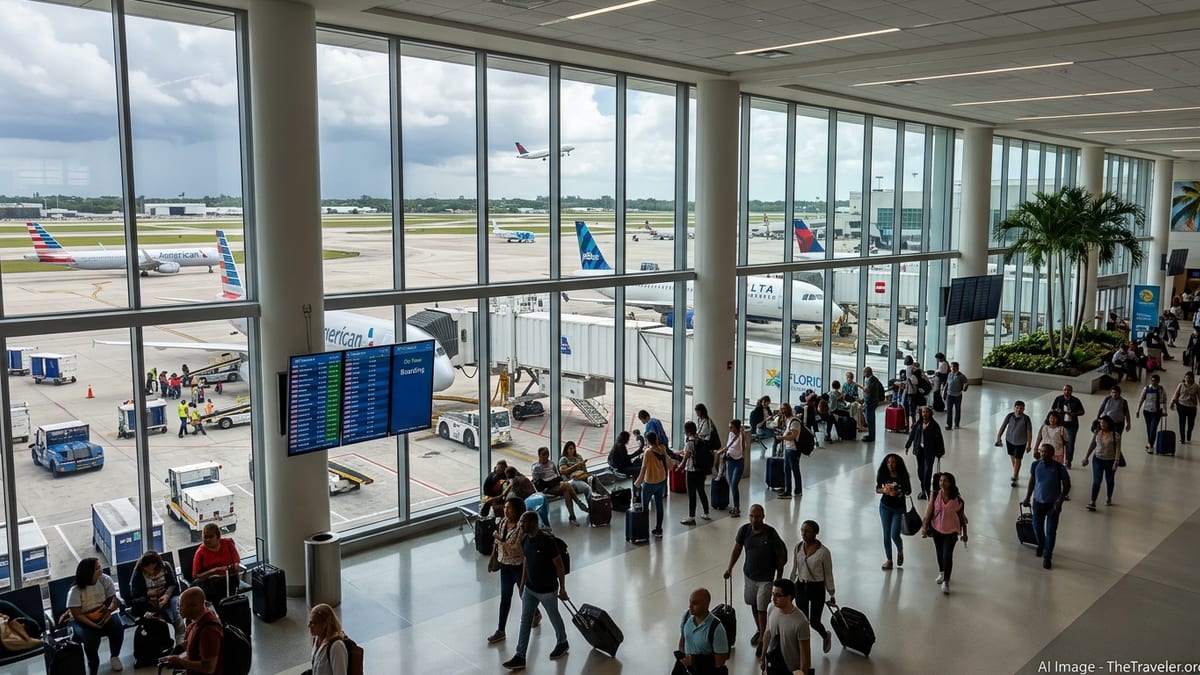
Stormy Thanksgiving Eve meets near-record U.S. travel
Forecasters expect a strong coastal storm to sweep up the eastern half of the United States through Thanksgiving Day, bringing widespread rain, wind and some snow from Florida to New England. National and regional outlooks from NOAA and state emergency agencies show heavy rain reaching much of the Florida Peninsula on Wednesday, particularly along the southeast coast and central east coast, before the system tracks north along the Atlantic seaboard into Thursday.([noaa.gov](https://www.noaa.gov/news/thanksgiving-week-weather-potent-coastal-storms-rain-and-snow-to-impact-travel?utm_source=openai))
The weather arrives as U.S. holiday travel again approaches near-record levels. AAA’s November forecast projects about 81.5 million Americans will travel at least 50 miles from home for Thanksgiving between Tuesday, November 24, and Monday, November 30, only slightly below last year’s 81.6 million. About 5.96 million of those travelers are expected to fly, making airports a particular pressure point if storms or operational problems arise.([newsroom.aaa.com](https://newsroom.aaa.com/2026/11/aaa-thanksgiving-holiday-travel-forecast/?utm_source=openai))
Although the developing nor’easter is expected to intensify as it lifts up the East Coast, its early stages are already affecting air travel in Florida on November 25. Early-morning data from flight tracking and delay-monitoring services show thousands of delays nationwide and a modest but noticeable build-up at key Florida hubs that historically see higher-than-average disruption around major holidays.([delayguard.ai](https://www.delayguard.ai/flight-delays-today?utm_source=openai))
Nationwide delays climb as Florida’s busiest hubs feel strain
As of early Wednesday morning, November 25, flight-tracking services were reporting several thousand delays and hundreds of cancellations for flights within, into or out of the United States. One widely used delay dashboard showed more than 9,000 delayed flights and over 500 cancellations recorded by around 8 a.m. Eastern, reflecting both weather-related slowdowns and residual operational issues from a series of recent airline and air traffic control technology glitches.([apnews.com](https://apnews.com/article/d4bdb732da930205ec3453d35c28daa2?utm_source=openai))
Florida, which ranks as the fifth-worst U.S. state for flight disruptions over the past year according to an analysis of federal data by insurance provider Squaremouth, is again prominent on the list of airports experiencing pre-holiday strain. The firm’s most recent review, covering July 2024 through June 2025, found that about 23.7% of flights involving Florida airports were delayed or canceled, with several of the state’s facilities featuring among the most disruption-prone in the country.([squaremouth.com](https://www.squaremouth.com/travel-advice/us-flight-delays-by-state?utm_source=openai))
That historic pattern appears to be repeating this week. Local reports citing FlightAware data on Monday, November 23, documented more than 130 delayed flights and a dozen cancellations at Fort Lauderdale-Hollywood International Airport and a similar volume of delays along with several cancellations at Miami International Airport, even before the worst of Wednesday’s rain arrived. While operations are dynamic and can improve or deteriorate quickly, those figures underline how sensitive the state’s busiest hubs are during peak travel periods, particularly when weather systems begin to move through.([bocanewsnow.com](https://bocanewsnow.com/2026/11/23/thanksgiving-week-flight-delays-pile-up-at-fort-lauderdale-miami-airports/?utm_source=openai))
How key Florida airports are performing on November 25
Conditions vary significantly across Florida’s airports as the day before Thanksgiving begins. As of around 8 a.m. Eastern on Wednesday, November 25, flight-tracking platforms showed no nationwide ground stops at any U.S. airport, and no active FAA ground delay programs at Fort Lauderdale, Miami or Orlando. That means departures and arrivals are moving, but many flights are operating behind schedule as airlines and air traffic control slow the pace to safely manage traffic through bands of rain and low clouds.([delayguard.ai](https://www.delayguard.ai/flight-delays-today?utm_source=openai))
At Fort Lauderdale-Hollywood International (FLL), live delay monitoring sites described moderate disruption, with several dozen flights departing or arriving late and a small number canceled by early morning. Historic data for the airport show that about 28% of departures during previous Thanksgiving weeks have run at least 15 minutes late, suggesting that travelers there should be prepared for timing to slip further if storms intensify through the day.([flightdelays.today](https://www.flightdelays.today/airport/fll?utm_source=openai))
Miami International (MIA) and Orlando International (MCO) are also seeing early pockets of disruption, although without the kind of system-wide gridlock associated with an FAA ground stop or a major airline outage. Miami, which historically records one of the higher delay rates among large U.S. hubs, is expected to sit near the national average for disrupted operations this holiday, while Orlando’s recent performance has been only slightly better. Both airports can see delay rates climb quickly when thunderstorms and low ceilings reduce the number of flights that can safely land or depart in a given hour.([delayguard.ai](https://www.delayguard.ai/thanksgiving-flight-delays?utm_source=openai))
Smaller regional airports, including West Palm Beach, Tampa, Jacksonville and Sarasota, were showing only limited delays and virtually no cancellations early Wednesday, according to the same datasets. However, the combination of widespread rain and heavier traffic later in the day means even these airports could encounter longer security queues and intermittent takeoff holds, especially during the busiest late-afternoon and early-evening departure banks.([delayguard.ai](https://www.delayguard.ai/flight-delays-today?utm_source=openai))
What the weather means for flyers through Thanksgiving
Meteorologists expect Wednesday to be the wettest day across much of Florida, with several forecasts pointing to 2 to 3 inches of rain across southeast Florida and somewhat lower totals across the central east coast, including parts of the Orlando area. A state-level five-day outlook circulated on November 24 highlights a reasonable worst-case scenario of up to 4 to 6 inches across the Miami and Fort Lauderdale metro area, along with a low-end risk of severe thunderstorms in South Florida.([content.govdelivery.com](https://content.govdelivery.com/attachments/FLDEM/2026/11/24/file_attachments/3870831/5%20Day%20Weather%20Outlook%2011-24-26.pdf?utm_source=openai))
While this system is expected to intensify into a stronger coastal storm further north, Florida’s experience is likely to center on localized flooding, reduced visibility and occasional lightning rather than snow or ice. For aviation, the most immediate impacts tend to be longer spacing between arriving aircraft in heavy rain, temporary ground stops during lightning in the vicinity of ramps, and increased go-around or diversion rates when crosswinds or visibility fall below an aircraft’s operating limits.
Beyond Florida, the same coastal storm is forecast to bring heavy rain, strong winds and coastal flooding to the Carolinas, mid-Atlantic and Northeast from late Wednesday into Thanksgiving Day, increasing the risk of delays and cancellations at major hubs such as Atlanta, Charlotte, Washington, New York and Boston. That means disruptions in Florida can ripple outward as aircraft arriving from or heading to those regions run late or are re-routed around storm cells.([time.com](https://time.com/article/2026/11/23/weather-disruption-thanksgiving-travel/?utm_source=openai))
Travelers should also remain aware that the current weather system is arriving on top of a busy month for air operations. Earlier in November, the U.S. system experienced a rare nationwide ground stop due to an FAA network malfunction, followed days later by an IT outage at United Airlines and then a separate automation problem affecting Delta’s weight-and-balance system. Those issues have been resolved, but they reduced the margin for error for airlines heading into the Thanksgiving rush, as aircraft and crews had less recovery time before one of the busiest weeks of the year.([apnews.com](https://apnews.com/article/d4bdb732da930205ec3453d35c28daa2?utm_source=openai))
How travelers can navigate Florida’s pre-holiday disruptions
With no FAA ground stops in place at Florida airports on the morning of November 25 but a clear signal of growing delays, the most important step for travelers is to monitor their specific flight and allow additional time at the airport. Airlines’ own mobile apps and text alerts typically show schedule changes before they appear on departure boards, and several independent services aggregate live data on departure punctuality, airport congestion and evolving weather hazards for major U.S. hubs.([delayguard.ai](https://www.delayguard.ai/flight-delays-today?utm_source=openai))
Security and border wait times can add further unpredictability, especially at busy international gateways such as Miami and Orlando. The Transportation Security Administration offers an official app that includes crowd-sourced checkpoint wait estimates for many U.S. airports, while Customs and Border Protection provides tools that summarize typical and current processing times at international arrivals facilities and key land border crossings. These resources are not guarantees but can help travelers decide when to leave for the airport and whether to expect extended lines at immigration or security.
Given the forecast for continued rain across parts of Florida through Wednesday night and a strengthening nor’easter farther north on Thanksgiving Day, travelers flying between November 25 and November 27 should be prepared for evolving conditions. That includes checking in online as early as possible, reconfirming departure times on the morning of travel, watching for gate changes, and having a back-up plan in case a connection through a weather-affected hub is disrupted. Those with flexibility may find that early-morning or late-night departures are less prone to cascading delays, while travelers with tight same-day connections through airports along the East Coast corridor should weigh the risk of missed onward flights.
Forecast updates through Wednesday from NOAA, state emergency agencies and airline operational centers will determine whether delay levels in Florida remain manageable or worsen into the evening peak. For now, Florida’s largest airports are operating without formal traffic-management programs, but with enough rain-related slowing and Thanksgiving demand that passengers should expect crowded terminals, busier-than-usual security lines and a higher-than-average chance of late arrivals and departures as the holiday weekend begins.