


More news on this day
Japan’s tourism rebound is running into fresh headwinds as flight data show China–Japan cancellations topping 30 percent in August, compounding a steep decline in Chinese visitors that is rippling through key destinations and travel-reliant businesses.
Get the latest news straight to your inbox!
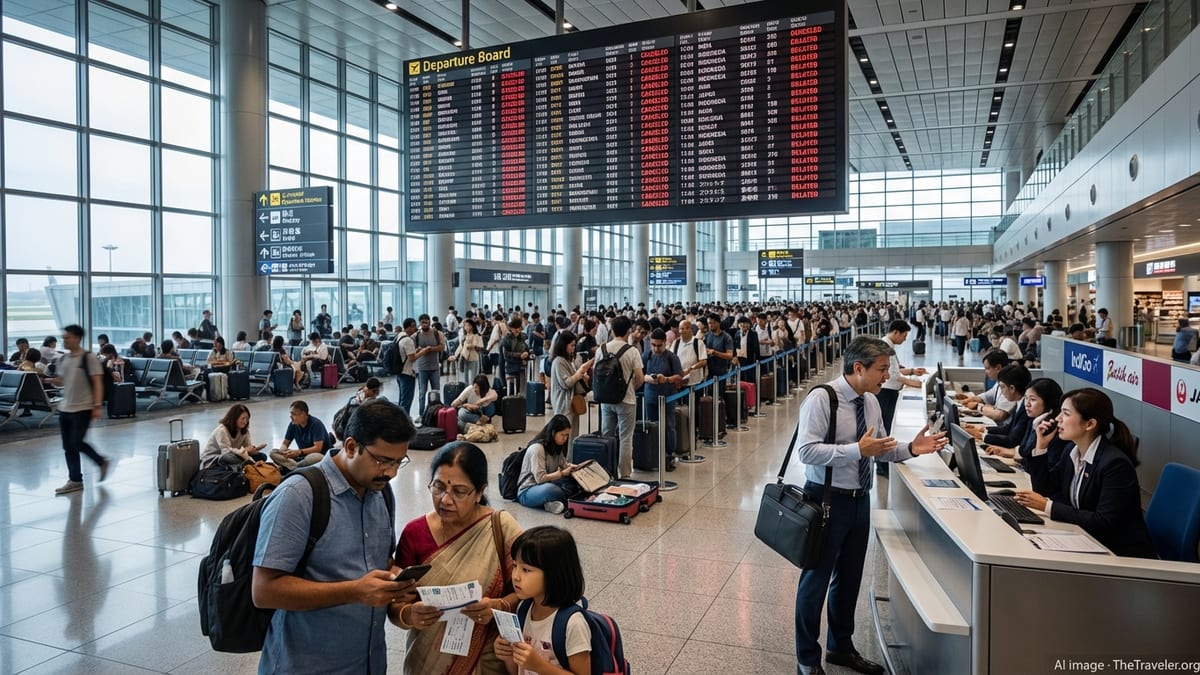
China–Japan Routes See Sharp Capacity Pullback
Industry data from Chinese aviation tracker Flight Master, cited in recent coverage, indicate that 1,120 flights from the Chinese mainland to Japan were canceled in August, corresponding to a cancellation rate of about 30.1 percent on those routes. Separate reporting based on the same dataset notes that 18 routes between the two countries were fully suspended during the month, underscoring how abruptly capacity has been pulled back at the height of the summer travel season.
The August figures follow similarly elevated disruption earlier in the summer. Data compiled from aviation information provider Hangbanguanjia show that in June 1,488 flights between the Chinese mainland and Japan were canceled, with cancellations accounting for roughly 37.5 percent of scheduled services. In July, tracking platforms recorded 1,195 canceled flights and complete suspensions on a dozen routes, suggesting that a pattern of sustained, high-level disruption is now entrenched rather than temporary.
While cancellations can spike in any given month because of weather, the persistence of reductions and the outright suspension of multiple routes across June, July and August point to structural rather than purely seasonal factors. Capacity has been cut on both leisure and business-oriented city pairs, further weakening connectivity just as other regional markets are moving closer to pre-pandemic flight levels.
The combination of outright route suspensions and elevated cancellation rates is reducing options for independent travelers and tour groups alike, often forcing price-sensitive passengers into longer, less convenient itineraries via third countries or out of the market altogether.
Chinese Visitor Numbers Slump After Travel Advisory
The flight pullback coincides with a marked decline in Chinese visitor arrivals to Japan over the past several months. According to Japan National Tourism Organization statistics summarized in recent media coverage, visitors from mainland China have fallen year on year for six consecutive months, with some recent months registering drops of 50 to 60 percent compared with the previous year.
Analysts tie much of this decline to Beijing’s advisory issued in late 2025, which warned of heightened safety risks for travel to Japan. Subsequent reporting compiled by international and Japanese outlets describes a wave of cancellations of airline tickets and package tours, with hundreds of thousands of Japan-bound bookings from China reportedly scrapped in the weeks that followed.
Economic research published in early 2026 highlights that Chinese and Hong Kong visitors together accounted for around 30 percent of all inbound tourists to Japan in 2025, underscoring how exposed the country’s tourism recovery is to a downturn in this single source market. With that share now shrinking, the impact is particularly acute in regions that had oriented their visitor strategies around Chinese group tours and high-spending free independent travelers.
Some destinations that relied heavily on Chinese holidaymakers during peak periods such as Lunar New Year and the Golden Week holidays are experiencing sharper declines than the national average. Local tourism promotion bodies and hotel operators in Kansai and Kyushu, for instance, have flagged significant drops in bookings from China since the advisory, alongside higher cancellation rates on flights serving regional airports.
Economic Pain for Airlines, Retailers and Regional Hubs
The contraction in China–Japan air links is affecting airlines on both sides. Chinese carriers have removed or reduced frequencies on multiple routes to Tokyo, Osaka, Fukuoka and other cities, while Japanese airlines have adjusted schedules to reflect weaker demand and added uncertainty. Aviation-focused commentary notes that the loss of dense, short-haul regional traffic undermines aircraft utilization and yields, particularly for widebody fleets that had relied on East Asia routes to balance long-haul exposure.
On the ground, the decline in Chinese arrivals is weighing on duty-free retailers, department stores and outlet malls that had come to depend on so-called shopping tourism. Prior to the current downturn, surveys and spending data consistently showed Chinese travelers ranking among the highest per-capita spenders in Japan, especially on cosmetics, luxury goods and electronics. Publicly available analyses now point to softer sales in these categories at major urban hubs such as Tokyo’s Ginza district and Osaka’s Umeda area.
The chill is especially visible in regional cities and resort areas where Chinese visitor spending once underpinned entire local ecosystems of hotels, restaurants and tour operators. Reports from prefectures that targeted the Chinese market over the last decade describe a pullback in new tourism-related investment and growing caution among smaller businesses that expanded during the boom years. Some localities are beginning to re-evaluate incentive schemes and marketing budgets that were calibrated to a very different demand profile.
At the macro level, research houses have noted that inbound tourism has been one of the few bright spots supporting Japan’s service-sector recovery. A sustained shortfall in visitors from China, even as arrivals from the United States, Europe and Southeast Asia continue to grow, raises questions about whether headline inbound targets can be met without a restoration of travel flows from Japan’s largest pre-crisis market.
Japan Looks to Diversify Source Markets
In response to the China travel slump, national and local tourism organizations are placing greater emphasis on diversifying source markets. Recent strategy documents and policy briefings point to increased promotional activity in Southeast Asia, North America and Europe, with particular focus on attracting longer-stay visitors and repeat travelers who are less sensitive to short-term geopolitical tensions.
Some of this diversification was already underway as overall inbound arrivals reached record levels in 2025, even while Chinese numbers lagged earlier peaks. Japan National Tourism Organization data show that visitors from South Korea, Taiwan and the United States have risen steadily, helping to offset part of the shortfall from China. Industry analysis suggests that these markets may continue to grow, especially if the weak yen persists and airlines shift capacity toward more resilient routes.
However, replacing the scale and spending power of Chinese tourists is challenging. Economic assessments from banks and think tanks emphasize that even robust growth in other segments may not fully compensate for the near-term loss of millions of Chinese visitors per year, particularly in regions that lack diverse international demand. This reality is informing discussions about how to broaden product offerings, from outdoor and cultural tourism to high-end gastronomy and wellness, in order to appeal to a wider array of travelers.
Some regions are also intensifying efforts to tap Japan’s domestic market and nearby Asian countries for events and niche tourism, such as cycling routes, hot-spring retreats and anime-related travel. While these initiatives cannot quickly replace China’s role, stakeholders view them as important hedges against geopolitical risk and as a pathway to a more balanced inbound portfolio over the medium term.
Outlook: Uncertain Path for China Travel Recovery
Looking ahead, the trajectory of China–Japan travel remains uncertain. Analysts monitoring both aviation schedules and booking patterns note that there has been no clear sign of a rapid rebound in direct flights, and that cancellation rates remain high on many routes heading into the autumn travel period. The persistence of suspended city pairs suggests that airlines are reluctant to restore capacity until demand and policy signals stabilize.
Geopolitical tensions and the continuation of the travel advisory are likely to keep many risk-averse Chinese travelers on the sidelines or redirect them toward alternative destinations in Southeast Asia and Europe. At the same time, pent-up demand and the long-standing popularity of Japan among Chinese tourists create potential for a strong rebound should conditions improve, as evidenced by earlier waves of rapid recovery when restrictions eased.
For now, tourism businesses and local governments in Japan are planning around a baseline in which Chinese arrivals remain depressed while other markets expand. This scenario implies a more gradual and regionally uneven recovery, with major urban gateways better positioned to capture diversified demand than smaller destinations that had become heavily reliant on Chinese tour groups. The scale of August’s flight cancellations underlines how quickly a geopolitical shock can reshape travel flows, and how important resilience and diversification have become to Japan’s tourism strategy.
China-Japan flight cancellations stand at 30% in August, Global Times
Flight cancellations and suspended routes data, Seetao
Chinese visitor decline and cancellations context, ECNS
Inbound tourism risks and Chinese market dependence, Daiwa Institute
Analysis of China–Japan travel slump, South China Morning Post