


On the southern slope of the Acropolis, just below the Parthenon, lie the worn marble seats of the Theatre of Dionysus, often called the birthplace of Western drama. For many first-time visitors to Athens it is overshadowed by the more photogenic Parthenon above, yet this open-air theatre is where the plays of Aeschylus, Sophocles, Euripides and Aristophanes were first performed to crowds of thousands. This guide explains exactly what the Theatre of Dionysus is, how it fits into an Acropolis visit, how tickets work in 2026, what you will actually see on site, and how to make the most of your time there.
Get the latest updates straight to your inbox!
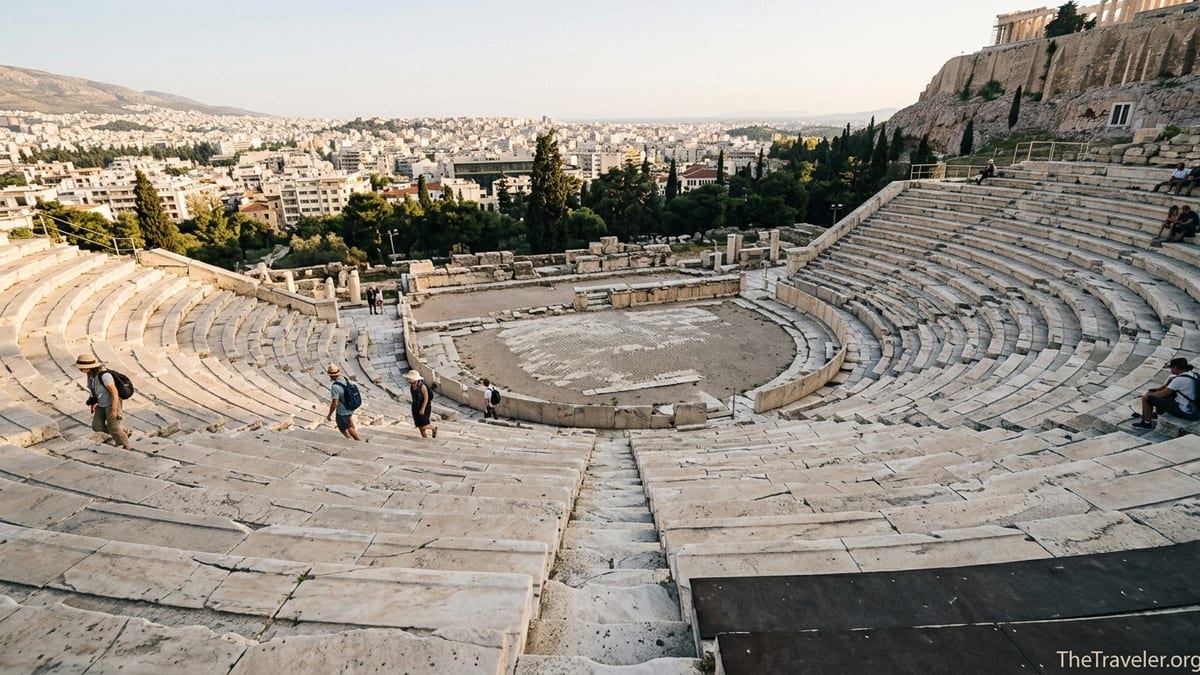
What Is the Theatre of Dionysus and Why It Matters
The Theatre of Dionysus is an ancient Greek open-air theatre carved into the south slope of the Acropolis hill in central Athens. It began as a simple wooden performance space in the 6th century BC and was rebuilt in stone in the 4th century BC, eventually seating an estimated 15,000 to 17,000 spectators. Today, visitors walk across broken marble tiers and along the circular orchestra where choruses once danced in honor of Dionysus, the god of wine and theatre.
For anyone interested in theatre, literature or European culture, this is effectively the “stage zero” of Western drama. It is widely regarded as the world’s first permanent stone theatre, and it was here that many of the great tragedies and comedies were premiered during the City Dionysia festival. Standing in the front rows, it is easy to imagine Athenian citizens in the 5th century BC watching the debut of Sophocles’ plays with the Acropolis temples looming above them.
In its heyday the theatre was more than entertainment. Performances were civic and religious events tied to Athens’ democracy and festivals. Attending the theatre was part of what it meant to be an Athenian citizen. Modern visitors can still trace elements of the original layout: the semi-circular seating (the cavea), the circular orchestra for the chorus, and the remains of the stage building, or skene.
Today the Theatre of Dionysus is an archaeological site rather than an active performance venue. You walk among ruins rather than take a seat for a show, but the setting is powerful. The site is usually much quieter than the Acropolis summit, offering a more reflective counterpoint to the crowds at the Parthenon.
Where It Is and How It Connects to the Acropolis
Geographically, the Theatre of Dionysus occupies a broad natural hollow on the south slope of the Acropolis hill, around a 10 to 15 minute walk uphill from the pedestrian Dionysiou Areopagitou promenade. If you stand outside the Acropolis Museum and look up toward the rocky hill, the theatre lies just behind the museum, slightly to the east, hugging the slope beneath the Parthenon.
Administratively, the Theatre of Dionysus is part of the “Acropolis and Slopes” archaeological zone. That means you do not buy a separate ticket just for the theatre in 2026. Entry is through the same paid zone that includes the Acropolis summit, the southern and northern slopes, and monuments such as the Odeon of Herodes Atticus and the Asklepieion sanctuary. Once your ticket is scanned at the gate, you are free to move between the theatre and the upper Acropolis within your timed entry window and for as long as normal opening hours allow that day.
Most independent visitors encounter the theatre either by entering the Acropolis from the southeast gate on Dionysiou Areopagitou, which brings you first past the Theatre of Dionysus before you climb to the summit, or by descending from the Parthenon via the south path at the end of a visit. In practice a common pattern is to book a morning slot for “Acropolis and Slopes,” walk straight through the theatre area on the way up when the light is softer, then stop for photos and exploration on the way back down once the main Parthenon visit is done.
Because the site is stepped and uneven, walking between the theatre and the Acropolis summit involves a modest but steady uphill climb on stone paths. Visitors with limited mobility may find it helpful to focus on the lower areas around the theatre and the nearby south-slope sanctuaries, which still provide good views of the Acropolis without requiring the full ascent.
Tickets, Opening Hours and Practical Entry Tips in 2026
In 2026, the Theatre of Dionysus is accessed with the same “Acropolis and Slopes” ticket used for the Parthenon and other structures on the hill. The former multi-site combination ticket that once covered several different archaeological sites in central Athens has been discontinued, so you will buy a dedicated ticket for this zone. Prices and policies can change, but as a rough guide, standard adult entry to major Greek archaeological sites in Athens typically ranges from around 15 to 20 euros in the high season, with reduced prices or free entry on specific dates for EU youth and certain categories of visitors.
Timed entry slots are now standard for the Acropolis and therefore for the Theatre of Dionysus. When purchasing online through the official booking system, you will choose a one-hour entry window, such as 8:00 to 9:00 or 17:00 to 18:00. This is the time during which you must enter the archaeological zone. Once inside, you are not usually rushed out precisely at the end of the hour, but you should expect staff to begin guiding people toward the exits close to the posted closing time. If you plan to linger in the theatre for photographs or quiet time, allow for this when choosing your time slot.
Queues at the main Acropolis entrance can be long in peak months such as June, July and August, especially for early-morning and mid-morning time slots. One practical approach if you are interested in the Theatre of Dionysus specifically is to select a late-afternoon or early-evening slot when the sun is lower and the south slope is bathed in warm light. In recent seasons, local residents have reported that the side entrances near the south slope and theatre often see shorter lines later in the day than the main western gate, making entry less stressful.
If you are under 25 and an EU citizen, or belong to other eligible groups, you may receive free or discounted entry on presentation of ID at the ticket office or gate. Non-EU youth sometimes receive reduced admission during low season, though the exact rules can shift. To avoid surprises, bring a passport or official ID and be prepared for signs that clarify the current policy at the entrance. Finally, remember that Acropolis Museum tickets are separate. A common first-time mistake is to assume that a museum ticket covers the theatre or vice versa; in practice, you will need two different tickets if you plan to do both on the same day.
What You Will See: Layout, Highlights and Photo Spots
On entering from the south side, you first pass the sanctuary of Dionysus with foundations of temples and altars that predate the stone theatre. Continuing uphill, the main cavea of the Theatre of Dionysus opens before you, a sweeping semi-circle of marble and stone tiers curving around the orchestra. Only a portion of the original 4th-century seating survives, but the scale is still impressive. Some front-row seats, carved as individual throne-like chairs, are among the most photogenic features and were reserved in antiquity for priests and city dignitaries.
The orchestra, the circular or slightly horseshoe-shaped space at the bottom of the seating, was the core of performance in classical Greek theatre. From the visitor paths you can look down into this space and imagine the chorus singing and dancing there. Behind it are remains of the stage building, where actors would have changed masks and costumes and appeared through doorways representing palaces or temples. Fragments of sculpted reliefs that once decorated the stage front are visible, including scenes from the life of Dionysus such as his birth and his arrival in Attica.
Photographers will find some of the best angles by standing halfway up the remaining rows and looking down toward the orchestra with Athens sprawled in the background. Early morning provides softer light and fewer shadows across the seats, while late afternoon creates a golden tone that emphasizes the texture of the marble. Another popular photo perspective is from the side path that runs just above the top of the cavea, where you can frame both the theatre and the rocky Acropolis slope above in one wide shot.
Visually, it is important to set your expectations. Unlike the almost-intact Roman theatre of Herodes Atticus a short walk away, the Theatre of Dionysus is more fragmented. You will not see a complete backdrop or a performance-ready stage. The experience is more about atmosphere, historical significance and the chance to walk through the birthplace of tragedy than about polished architectural forms. Wearing shoes with good grip is essential, as many of the marble surfaces have been smoothed by centuries of footsteps and can be slippery, especially after rain.
A Short History: From Sacred Performances to Stone Theatre
The roots of the Theatre of Dionysus lie in religious festivals to Dionysus that were celebrated in Athens during the archaic period. Early performances involved choral hymns known as dithyrambs sung and danced around an altar in the open air. Over time, actors, dialogue and narrative plots were added, giving rise to the distinct art forms of tragedy and comedy. Initially, temporary wooden seating would have been erected on the slope for festival audiences, and ancient writers even mention a collapse of such wooden stands in Athens, which may have encouraged the move toward more permanent structures.
Between the 5th and 4th centuries BC, as Athenian drama flourished, the theatre evolved physically. The orchestra was formalized as a defined circular performance area, and a permanent stage building was introduced. In the mid-4th century BC, under the influence of architects working on major civic projects, the cavea was rebuilt in stone, expanding up the slope and divided by staircases into wedge-shaped seating sections. The theatre’s capacity at this point is thought to have reached many thousands of spectators, and its configuration became a model for later Greek theatres across the Mediterranean.
In the classical period, the theatre hosted the annual City Dionysia festival, during which new plays by dramatists such as Aeschylus, Sophocles, Euripides and Aristophanes were performed in front of large juries and voting audiences. Victorious playwrights and choregoi, the wealthy citizens who financed productions, received public honors, making the theatre a stage for both artistic achievement and civic competition. The dramas addressed myths, war, politics and ethics and were part of how the city discussed its own identity.
In Hellenistic and Roman times, the theatre was modified to suit changing tastes, with alterations to the stage and seating. Over centuries, earthquakes, spoliation and simple neglect took their toll, and much of the original structure was dismantled or reused elsewhere. Modern archaeological excavations and careful restoration have stabilized the remains you see today. While only fragments survive, they are enough to convey both the original scale and the steep, intimate curve of the seating that wrapped around performers below.
Nearby Monuments and How to Combine Your Visit
The Theatre of Dionysus sits within a cluster of important sites on and around the south slope of the Acropolis, making it easy to combine with other highlights in a single outing. Just a short walk uphill along the same path lies the Roman-era Odeon of Herodes Atticus, a largely intact stone theatre still used for concerts during the Athens and Epidaurus Festival. Even when closed for events, you can peer down into its interior from the path, giving a vivid contrast with the more ruined state of the Dionysus theatre.
Immediately below the theatre, the Acropolis Museum occupies a modern glass-and-concrete building that showcases sculptures from the Parthenon and other Acropolis monuments. Many travelers choose to visit the theatre and slopes in the morning, then cross the pedestrian street to the museum for an air-conditioned afternoon of exhibits and lunch in the museum restaurant with its clear view of the Parthenon. Remember that the museum, while physically close to the theatre, operates on a separate ticket and schedule.
Within the same Acropolis and Slopes ticketed area you will also find the Asklepieion, the sanctuary of the healing god Asclepius, and the small Stoa of Eumenes, as well as footpaths that loop around the hill with changing views of Athens. If you have extra energy, you can continue beyond the Acropolis zone after your visit to explore the Areopagus rock, the Roman Agora, or the lively Plaka district with its tavernas and souvenir shops, all within 10 to 20 minutes’ walk.
Because distances between these sites are short but involve repeated climbs and descents, planning your route carefully can save effort. For example, one efficient circuit is to enter at the south slope gate, explore the Theatre of Dionysus and the other slope sanctuaries, continue upward to the Parthenon and other summit temples, exit via the same southern side, then cross to the Acropolis Museum or head into Plaka. This avoids backtracking and limits how often you need to tackle the steeper western approaches.
First-Time Visiting Tips: Timing, Comfort and Etiquette
To enjoy the Theatre of Dionysus fully, timing is crucial. The south slope of the Acropolis is exposed and catches strong midday sun, especially from late spring to early autumn. For cooler temperatures and softer light, aim for the first or last available time slots of the day. In July, for example, an 8:00 entry lets you reach the theatre before most crowds, while a 18:00 or 19:00 slot can provide pleasant golden-hour conditions and thinner lines at the side gates.
Footwear and water are not optional details here. Much of the approach to the theatre and the seating area itself consists of worn stone and gravel. Sandals with good tread or light hiking shoes are better than smooth-soled fashion shoes. Carry a refillable bottle; there are public fountains around central Athens, but you should not rely on finding one exactly when you want it near the theatre. A hat and sunscreen are strongly recommended in sunny months, as much of the site offers limited shade.
Photography is unrestricted for personal use, but drones are not allowed without special permits, and climbing onto fragile sections of the ruins is prohibited. Respect signs and roped-off areas; they exist both for visitor safety and to protect vulnerable ancient stone. Sitting on the surviving front-row throne seats is often discouraged or blocked to prevent further wear. Staff may remind visitors not to eat inside the archaeological zone, though carrying snacks in your bag for after the visit is fine.
If you are particularly interested in theatre history, consider bringing or downloading a plan of the site that labels features like the skene, parodoi (side entrances), and cavea sectors. Guided tours that focus on the Acropolis sometimes include a brief stop at the Theatre of Dionysus, but many spend only a few minutes there before heading uphill. If this monument is a priority for you, look specifically for a tour description that mentions the theatre in detail, or plan to visit independently before or after a general Acropolis tour.
FAQ
Q1. Can I visit the Theatre of Dionysus without visiting the Acropolis summit?
You cannot purchase a separate ticket just for the Theatre of Dionysus in 2026. Access is bundled within the Acropolis and Slopes ticket, which also allows you to visit the summit. Once inside, you are free to spend more time on the slopes and skip the higher temples if you prefer, but the admission product is the same.
Q2. How much time should I allow to see the Theatre of Dionysus properly?
Most visitors spend about 20 to 40 minutes exploring the theatre itself, taking photos and reading any on-site panels. If you combine it with a walk through the other south-slope sanctuaries and a relaxed climb to the Parthenon, plan for at least two to three hours inside the Acropolis and Slopes area overall.
Q3. Is the Theatre of Dionysus suitable for children?
Yes, children can enjoy the open space and the idea of an ancient “stadium for plays,” but you will need to supervise closely on the uneven steps. Bringing a simple story or myth associated with Dionysus or a famous play can make the visit more engaging for school-age children.
Q4. Are there any live performances at the Theatre of Dionysus today?
As of 2026, the Theatre of Dionysus is not used for regular performances and is treated primarily as an archaeological site. For live shows in an ancient setting, visitors usually attend concerts or theatre events at the nearby Odeon of Herodes Atticus, which remains an active venue.
Q5. What is the best way to photograph the Theatre of Dionysus?
For wide shots, stand halfway up the seating facing the orchestra so you can capture the curve of the cavea and the city beyond. Early morning or late afternoon light avoids harsh shadows. For details, focus on the carved marble throne seats and the reliefs along the stage front, taking care not to cross ropes or barriers.
Q6. Is the site accessible for visitors with limited mobility?
Access to the immediate vicinity of the theatre from the south entrance is gentler than the climb to the Acropolis summit, but surfaces are still irregular, with slopes and steps. Visitors using mobility aids may reach some lower viewpoints but will find large parts of the seating inaccessible. Checking current accessibility notes from the site authorities before your trip is advisable.
Q7. Can I see the Theatre of Dionysus from outside the ticketed area?
From Dionysiou Areopagitou street you can glimpse parts of the south slope through fences and trees, but the main theatre interior is not clearly visible without entering the paid archaeological zone. To stand among the seats and see the orchestra up close, you will need a valid Acropolis and Slopes ticket.
Q8. What should I wear when visiting the Theatre of Dionysus?
Comfortable walking shoes with good grip, lightweight clothing suitable for the season, a sun hat and sunglasses are recommended. In cooler months, a windproof layer is useful, as the exposed hill can feel chilly even when the city below is mild.
Q9. Is there shade or seating if I need a break?
Shade is limited around the theatre itself, though you may find some shelter along the paths and near surrounding trees. Original stone seats are part of the monument and not intended for long rest stops, so consider planning a café break before or after your visit in the streets around the Acropolis Museum or in nearby Plaka.
Q10. Can I combine the Theatre of Dionysus with the Acropolis Museum in one day?
Yes, this is a very common and practical combination. Many travelers visit the Acropolis and the Theatre of Dionysus in the morning using a timed ticket, then cross the street to the Acropolis Museum for lunch and an afternoon among the exhibits. Just remember that the museum requires a separate ticket and has its own closing time.