


First–time visitors to Athens are often surprised to discover that the Theatre of Dionysus does not have its own separate ticket booth or standalone ticket. This historic cradle of Greek drama sits on the South Slope of the Acropolis, and access is wrapped into a broader “Acropolis and Slopes” ticket. Recent changes to Greece’s archaeological ticketing system have created fresh confusion, especially around time slots and discontinued combo passes. This guide untangles how Theatre of Dionysus access actually works in 2026, and walks you step by step through booking, entrances, and on-the-day logistics.
Get the latest updates straight to your inbox!
Where the Theatre of Dionysus Fits in the Acropolis Ticket System
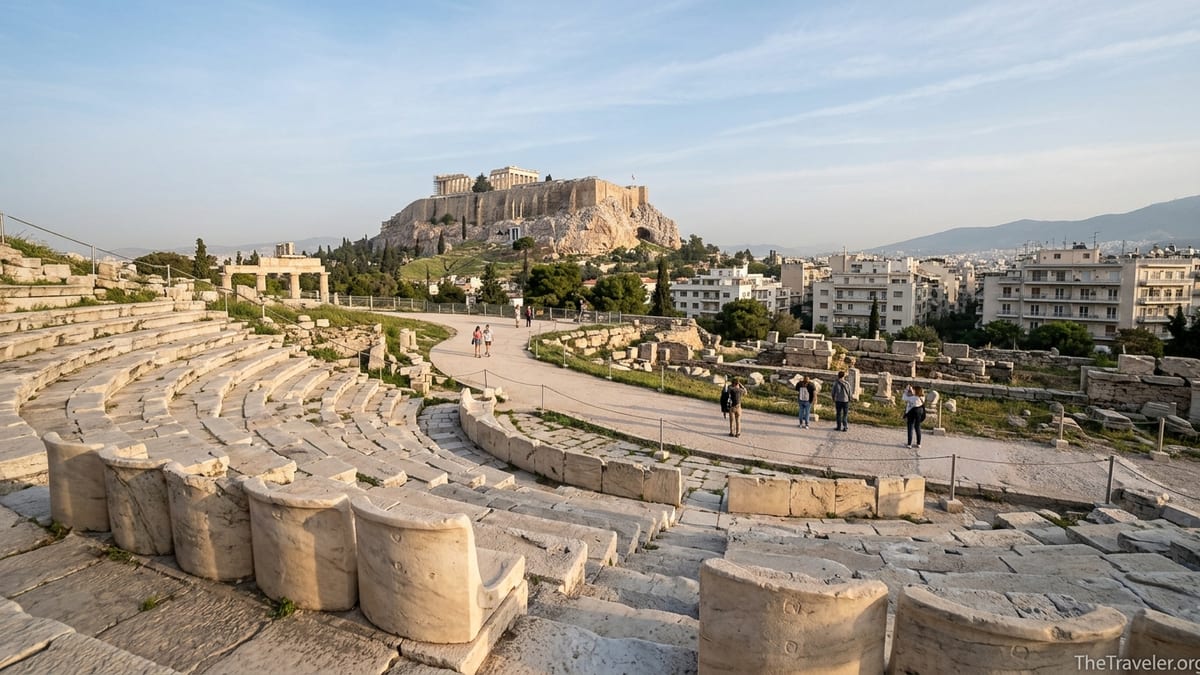
The Theatre of Dionysus is physically part of the Acropolis archaeological site, carved into the southern flank of the hill below the Parthenon. In ticketing terms, it sits inside what the Greek authorities classify as “Acropolis and Slopes.” That means there is no ticket labeled “Theatre of Dionysus only” on the official system. When you purchase a standard Acropolis entry, you are paying for the Acropolis rock itself plus its surrounding slopes, including the Theatre of Dionysus on the south side and the Odeon of Herodes Atticus further west.
Practically, this means that any official Acropolis ticket that explicitly includes the slopes automatically includes the Theatre of Dionysus. When you see “Acropolis and Slopes” listed in the product description on the official Hellenic Heritage e-ticket platform or on your PDF ticket, that is your confirmation that the theatre is covered. Separate entries such as the Ancient Agora, Roman Agora or Temple of Olympian Zeus are completely different sites with their own standalone tickets and do not control access to the Theatre of Dionysus.
For example, a visitor booking the basic “Acropolis Entry Ticket” for approximately 30 euros in high season will receive access to the hilltop monuments plus the South Slope path that runs past the Theatre of Dionysus. There is no need to pay an extra fee or buy any additional local ticket once you are inside the fenced Acropolis and Slopes site. Guided tours and third party ticket bundles may add narration or museum entry, but the underlying monument access is the same Acropolis and Slopes ticket defined by the Ministry of Culture.
This structure also explains why you might see the Theatre of Dionysus listed in tour descriptions but not as a clickable option on the official booking portal. Operators are simply highlighting a key landmark that lies along the South Slope route. If your voucher or tour description says it includes “Acropolis and Slopes” or specifically mentions the South Slope, you should expect to walk past or into the Theatre of Dionysus as part of your visit.
Recent Ticket Changes: What Still Exists in 2026
In the past, Athens offered a popular multi-site combined ticket that bundled the Acropolis, Ancient Agora, Roman Agora, Hadrian’s Library, Kerameikos, the Temple of Olympian Zeus, and Aristotle’s School. Travelers often used this 5-day pass as a one-stop solution for the city’s major classical sites. From 2024 onward, however, the Ministry of Culture has gradually withdrawn these multi-site combo options for Athens and emphasized separate admission to each site. The most up to date reports from 2025 and 2026 confirm that the classic multi-site pass covering seven different archaeological areas is no longer sold, either online or at the gates.
What remains consistent is the single Acropolis and Slopes ticket. This is the ticket that governs access to the Theatre of Dionysus. Some accommodations and local guides still casually refer to this as a “combo” ticket because it includes both the rock and the surrounding slopes. That can be misleading if you are expecting broader city-wide coverage. As of the 2025–2026 seasons, you should plan to purchase separate admissions for the Acropolis and Slopes, for the Ancient Agora, and for other major sites, unless you are on a very specific package arranged by a tour company that bundles prices on your behalf.
Another evolution is the widespread introduction of timed entry to the Acropolis. The Acropolis and Slopes ticket now requires you to choose a specific half-hour or hourly entry window when buying through the official portal or at on-site self-service machines. This timing requirement applies to your initial entry to the fenced Acropolis and Slopes site, which is when your visit to the Theatre of Dionysus will also begin. You cannot freely walk into the slopes hours before or after your booked slot in the hope of seeing the theatre separately.
If you visited Athens before 2020, it is worth resetting your expectations. You may recall simply queuing up at the South Slope gate, buying a paper ticket on the spot, and wandering in at any time during opening hours. Crowd management and digital ticketing changes introduced since then mean that 2026 visits are more structured. Allow some extra planning time to secure an appropriate slot, particularly in peak months such as May, June, and September, when morning and late afternoon windows sell out first.
How to Book Official Tickets That Include the Theatre of Dionysus
The safest way to secure valid Acropolis and Slopes tickets, with guaranteed access to the Theatre of Dionysus, is to use the official Hellenic Heritage e-ticket platform operated for the Greek Ministry of Culture. This system centralizes ticketing for state-run archaeological sites and museums and is explicitly listed on government announcements as the only official online sales channel. Using the official portal ensures that you pay standard prices, see the latest time-slot availability, and receive a scannable QR code recognized by the on-site scanners at Acropolis entrances.
On the booking interface, look for the Acropolis category and then select the product that clearly mentions “Acropolis and Slopes.” You will be prompted to choose a date and time slot. The system typically displays a range of half-hour or hourly windows, such as 8:00–8:30 or 9:00–10:00, depending on how capacities are configured for that season. Once you choose your preferred slot, you will enter visitor details, select any eligible discounts, and pay by card. Your ticket arrives as a PDF with a QR code and a line stating that it is valid for “Acropolis of Athens and Slopes.” That wording confirms inclusion of the Theatre of Dionysus.
As a concrete example, a couple planning an Athens trip for early May 2026 might log in two weeks before their date, select “Acropolis and Slopes,” and see morning time slots from 8:00 onward priced at roughly 30 euros per adult at the standard high season rate. They choose 8:30–9:00, pay online, and download their tickets. On the day, they can head straight to the South Slope gate with their QR codes on a smartphone, rather than joining the purchase queue. This kind of advance booking is especially useful in busy travel windows when same-day slots can be limited.
Many visitors also buy Acropolis and Slopes tickets through reputable resellers or bundled guided tours that include entry. These third party platforms can be legitimate and convenient, but they do not replace the need for an underlying official ticket. If you book a morning “Acropolis and Theatre of Dionysus guided tour,” the operator should either provide a voucher that they themselves convert into official tickets at the gate, or send you a QR code based on tickets they have already purchased from the official system. Before committing, check that the description explicitly includes “Acropolis and Slopes” access and clarifies whether the ticket price is included or must be paid separately on site.
Entrances, Routes, and Seeing the Theatre on the Ground
There are two main access points to the Acropolis and Slopes: the main western gate near the Propylaea and the southeastern entrance on the South Slope. The Theatre of Dionysus is most directly reached from the South Slope gate, which sits a short walk uphill from Dionysiou Areopagitou pedestrian street. From this entrance, the path leads you past the remains of the Asklepieion and then to the cave-like niches and marble seating of the Theatre of Dionysus, often within the first 10 to 15 minutes of your visit.
Visitors who begin at the main western entrance will typically ascend to the Parthenon first and then follow paths that circle the plateau. From the upper level of the Acropolis rock, you can look down into the Theatre of Dionysus and see its semi-circular form, but you will not be walking through the cavea at close range. To experience the theatre up close, including the front rows of carved marble seats and the orchestra area, it is better to either start your visit at the South Slope entrance or allow time to continue down the South Slope path after exploring the summit.
A typical route for theatre enthusiasts is to book a morning Acropolis and Slopes slot, enter via the South Slope gate, pause at the Theatre of Dionysus for photos and exploration, continue along the path past the Odeon of Herodes Atticus, and then ascend to the Parthenon and Erechtheion. This loop can comfortably take two to three hours at a moderate pace. Families with children or travelers in summer heat sometimes reverse the sequence: they head straight to the top first for Parthenon views while the day is cooler, then descend via the slopes to the Theatre of Dionysus once the crowds on the summit grow thicker.
Keep in mind that access inside the theatre itself may be partially roped off at times for conservation reasons. Even when seating rows are not walkable, the main South Slope path still brings you to excellent vantage points for photographs and for appreciating the scale of the ancient performance space. The crucial detail is that your Acropolis and Slopes ticket is what admits you to this entire circuit, regardless of which entrance you choose or whether you begin with the summit or with the slopes.
Time Slots, Seasonal Hours, and When to Visit
The Acropolis and Slopes operate with defined opening hours that shift seasonally, typically with longer days from April through October and shorter ones in the winter months. Within those hours, entry is controlled by timed tickets that are checked electronically at the gates. Your time slot governs when you may enter the fenced site, not how long you can stay. Once inside, you can move between the Parthenon, the South Slope, and the Theatre of Dionysus at your own pace, within the overall closing time for that day.
In practice, morning slots between opening and roughly 10:00 a.m. are the most popular among visitors who want cooler temperatures and softer light for photography in the Theatre of Dionysus and on the Parthenon plateau. Late afternoon or early evening slots, when available, are also prized for gentler sun angles and a more relaxed atmosphere on the South Slope. Midday visits in high summer can be extremely hot and bright, with limited shade on the stone seating of the theatre, so consider bringing water, a hat, and sunscreen if your schedule only allows a midday entry.
Typical travelers report that arriving about 15 to 20 minutes before the start of their time slot works well. For example, if your ticket is for 8:30–9:00, plan to be at the South Slope gate by 8:15 with your QR code ready. You will first pass through security screening, then have your ticket scanned. There is usually a small queue early in the morning, but it tends to move steadily. Arriving much earlier than your slot does not guarantee early admission, as staff check the time printed on your QR code. Arriving after the end of your window can result in delayed or denied entry if crowds are heavy.
During shoulder months such as March or November, crowding is lighter and more same-day slots are available. However, weather can be changeable, and rain can make the slopes and theatre steps slippery. If you schedule a visit in the cooler months, consider packing a light rain jacket and shoes with solid tread. The Theatre of Dionysus remains atmospheric in cloudy conditions, and the muted light can actually make the details of the marble seating easier to photograph than in harsh midday sun.
Common Ticket Confusions and How to Avoid Them
One of the most persistent misunderstandings is the belief that a separate, cheaper ticket exists just for the Theatre of Dionysus. Travelers sometimes arrive at the South Slope gate expecting to buy a “theatre ticket” without paying the full Acropolis and Slopes price. Because the theatre is within the fenced Acropolis archaeological zone, staff can only sell the standard Acropolis and Slopes admission. If you are budget-conscious and mainly interested in ancient theatres, you might consider pairing the Theatre of Dionysus visit with a walk around the exterior of the Odeon of Herodes Atticus on the same ticket, or visiting the well-preserved theatre in the Ancient Agora on a different day with that site’s separate entry.
Another source of confusion is the status of the old multi-site combined ticket. Guidebooks printed before the recent changes may still describe a pass that covers seven Athens sites over five days. Visitors sometimes spend valuable time at secondary sites such as Hadrian’s Library asking where they can purchase this pass, only to learn it is no longer available. To avoid frustration, plan as though each site requires its own ticket and budget accordingly, then look for occasional promotional discounts or free entry days that might ease overall costs rather than relying on a city-wide archaeological pass.
Third party “skip-the-line” offers can also mislead. Some commercial sites use that phrase to market what are essentially standard Acropolis and Slopes tickets packaged with an audio guide or tour. Others publicize skip-the-line benefits that the Ministry of Culture has explicitly warned do not exist beyond the timed entry system itself. If a reseller promises exclusive gates or faster security access purely because of their ticket, treat that claim with skepticism. The genuine advantage you are paying for should be clear, such as the presence of a licensed guide, hotel pickup, or a well-reviewed small-group experience.
Finally, travelers sometimes mix up museum tickets with archaeological site tickets. The Acropolis Museum is run as a separate institution with its own building, opening hours and pricing, despite being closely associated with the Acropolis monuments. Buying an Acropolis Museum ticket does not grant you access to the Theatre of Dionysus or to the Acropolis and Slopes, and vice versa. If you plan to see both the museum and the Theatre of Dionysus, you will need two distinct tickets. Many visitors choose to tour the museum either the evening before or after their Acropolis visit to spread out the experience and avoid cultural overload.
Discounts, Free Entry, and Practical Money-Saving Tips
Greek law grants free or reduced entry to various categories of visitors, such as young people of certain ages, students from specified institutions, and people with disabilities and their companions under defined conditions. These concessions apply to the Acropolis and Slopes as well as to other state-run sites, which means they directly affect what you pay to reach the Theatre of Dionysus. The exact rules and required proofs, such as passports or student IDs, are outlined in official Ministry of Culture documents and are periodically updated, so it is worth checking for changes close to your travel dates.
For families, one common real-world scenario involves teenagers and students. For example, a family of four visiting in July could find that the parents pay full price for Acropolis and Slopes tickets, while a 17-year-old or an eligible university student might receive either free or reduced admission upon presenting valid identification. At the ticket control, guards often verify ages or student status before allowing the concession. It is wise to carry physical IDs rather than relying solely on digital copies, as policies on accepting phone images can vary by staff member.
Occasionally, Greece designates free entry days for state archaeological sites, typically linked to cultural events or specific dates. On those days, both the Acropolis and Slopes and the Theatre of Dionysus within them can be visited at no charge, although crowds are significantly heavier and queues longer. Budget travelers comfortable with dense crowds sometimes plan around such dates to save on tickets, while others prefer to pay the standard fee in exchange for a more relaxed experience.
Regardless of discounts, you can reduce stress and avoid unnecessary spending by bringing your own water and snacks for after your visit rather than relying on vendors clustered outside the main entrances. While eating is restricted on the archaeological site itself, you can comfortably pause for a drink of water near the South Slope paths, then plan a café stop back on Dionysiou Areopagitou or in nearby Plaka once you have exited. This approach leaves your time inside the Acropolis and Slopes focused on the monuments, including the Theatre of Dionysus, rather than on searching for refreshments.
The Takeaway
The key to understanding Theatre of Dionysus access is to remember that the theatre is part of the Acropolis and Slopes archaeological site, not a separate attraction. In practical terms, any valid Acropolis and Slopes ticket issued through the official Hellenic Heritage system admits you to the theatre via the South Slope path. There is no need and no option to buy a theatre-only ticket at a lower price. Once you grasp this, a lot of the confusing language in tour listings and unofficial websites starts to make sense.
In 2026, you should plan for three main things: booking an Acropolis and Slopes time slot in advance, choosing your preferred entrance and route so you can see the Theatre of Dionysus up close, and ignoring outdated references to multi-site combo passes or magical skip-the-line tickets. Focus on the essentials instead. Secure an official timed ticket, arrive a little before your slot, bring water and sensible footwear, and allow at least two hours to explore the slopes and summit without rushing. You will see not only the Parthenon but also the place where Athenian audiences once watched the tragedies of Aeschylus, Sophocles, and Euripides unfold.
With a bit of preparation and realistic expectations about what your ticket does and does not include, visiting the Theatre of Dionysus becomes a highlight rather than a logistical puzzle. Standing among the worn marble seats, looking up at the Acropolis rock and out over the city, you can appreciate how Athens has layered modern systems like timed digital tickets onto a landscape that has been welcoming audiences for more than two thousand years.
FAQ
Q1. Is the Theatre of Dionysus included in the standard Acropolis ticket?
The Theatre of Dionysus is included in any official ticket labeled “Acropolis and Slopes.” There is no separate Theatre of Dionysus-only ticket sold by the state.
Q2. Can I visit the Theatre of Dionysus without climbing all the way to the Parthenon?
Yes. If you enter through the South Slope gate with a valid Acropolis and Slopes ticket, you can spend your time on the slopes and around the theatre without going up to the summit.
Q3. Do I need a specific time slot just for the Theatre of Dionysus?
No. You choose a time slot for entry to the Acropolis and Slopes site as a whole. Once inside during that slot, you can visit the Theatre of Dionysus at your own pace.
Q4. Which entrance should I use if the Theatre of Dionysus is my main priority?
The South Slope entrance on Dionysiou Areopagitou pedestrian street is the most direct access point. From there, the Theatre of Dionysus is one of the first major monuments you reach.
Q5. Is the old multi-site combo ticket for Athens archaeological sites still available?
No. The well-known multi-site combined ticket that once covered several Athens sites has been phased out. You now buy separate tickets for the Acropolis and for each other site.
Q6. Does a ticket for the Acropolis Museum include the Theatre of Dionysus?
No. The Acropolis Museum has its own separate ticket and entrance. To visit the Theatre of Dionysus, you need an Acropolis and Slopes ticket, not just a museum ticket.
Q7. Are “skip-the-line” tickets for the Theatre of Dionysus worth it?
There is no separate skip-the-line ticket for the theatre. What matters is having a timed Acropolis and Slopes entry. Any extra payment should be for a guide or added services, not for a special queue.
Q8. Can I buy Acropolis and Slopes tickets for the Theatre of Dionysus on the day of my visit?
Often yes, especially outside peak season, but popular morning slots can sell out. Booking online in advance through the official system is the safest option in busy months.
Q9. How long should I allow to see the Theatre of Dionysus and the rest of the Acropolis?
Most visitors find that two to three hours is enough to walk the South Slope past the Theatre of Dionysus, see the Odeon of Herodes Atticus, and explore the Parthenon area without hurrying.
Q10. Is the Theatre of Dionysus accessible for visitors with limited mobility?
Access involves sloping paths and uneven stone surfaces that can be challenging. Visitors with mobility concerns should check current accessibility details and consider support such as walking poles or assistance.