


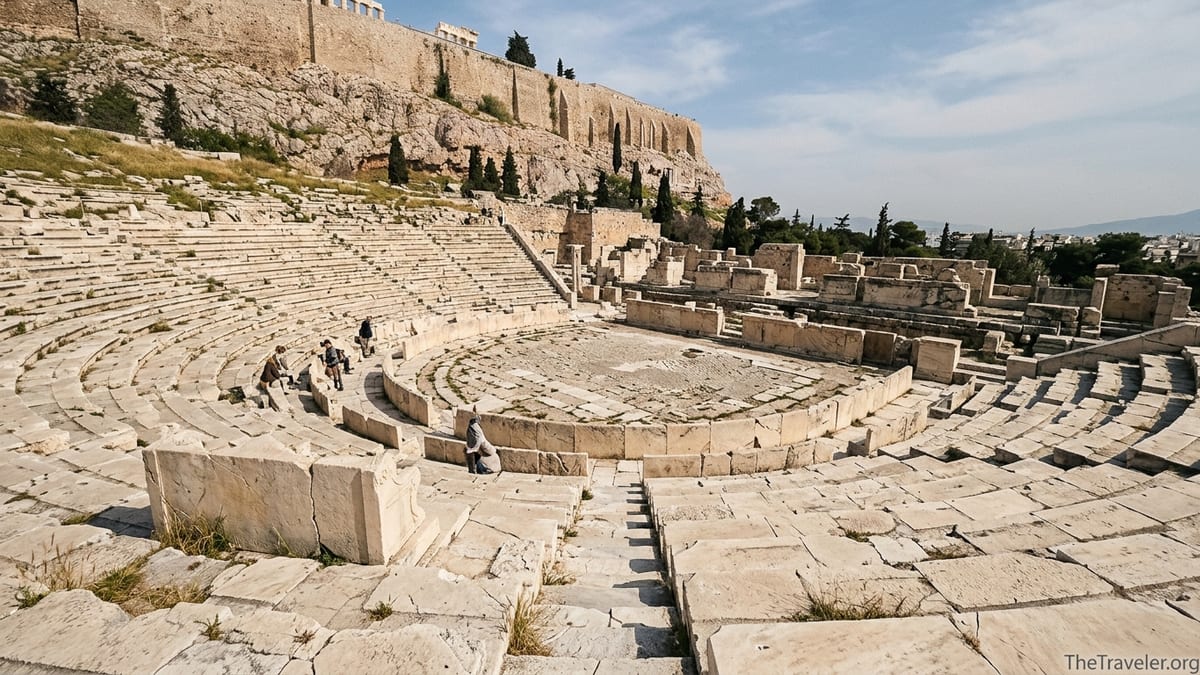
Clinging to the south slope of the Acropolis in Athens, the Theatre of Dionysus looks at first like a broken ring of stone seats. Yet this is where Western drama was born, where Athenians watched the first performances of tragedies and comedies that still appear on modern stages. For travelers, it is not just another ruin but a place where you can literally sit where ancient spectators once laughed, wept and argued about the great questions of their time.
Get the latest updates straight to your inbox!
How Old Is the Theatre of Dionysus Really?
The Theatre of Dionysus is widely considered the world’s earliest permanent theatre. Archaeologists trace its origins to a simple, probably wooden performance space created in the 6th century BCE during the rule of Peisistratos and his sons, when the state festival of the City Dionysia was formalized. By around 500 BCE a more structured open-air theatre was operating on this same slope, though almost nothing of that earliest phase survives above ground today.
The stone remains you see now mostly date from the 4th century BCE, when the Athenian statesman Lycurgus oversaw a major building program. During this phase the theatre was rebuilt in stone and marble with proper tiered seating and a more elaborate stage building. So while visitors are walking through a site that has been used for over 2,500 years, the visible architecture reflects centuries of additions, collapses and reconstructions rather than a single moment in time.
Dating the theatre matters for travelers who also visit later sites like the Roman Odeon of Herodes Atticus a few steps away. The odeon, with its intact stone tiers and modern concert schedule, is a product of the 2nd century CE Roman world. By contrast, the Theatre of Dionysus embodies the classical and early Hellenistic city. Standing between the two makes it easier to appreciate just how long Athens functioned as a performance capital, from the first tragedies of the 5th century BCE to today’s summer festivals.
When guides or brochures describe this as the “birthplace of theatre,” they are summarizing a long process rather than a single founding date. Ritual songs for Dionysus were performed here before there were formal plays, and tragedy evolved gradually out of those choral performances. Seeing the rough stone outlines on site can feel almost underwhelming until you realize you are standing where that evolution unfolded.
Exact Location and What You See on the Ground
The Theatre of Dionysus sits on the southern slope of the Acropolis hill in central Athens, just below the Parthenon. For a modern visitor, this means the site is inside the main Acropolis archaeological zone, accessed through the south entrance area that also leads to the Odeon of Herodes Atticus. In practical terms, if you buy a combined Acropolis ticket, you can walk straight from the Acropolis Museum area to the theatre in under five minutes.
On the ground, the most recognizable feature is the semi-circle of marble seats at the bottom of the cavea, the auditorium carved into the hillside. These first rows include the ornately carved throne-like “prohedria” seats reserved in antiquity for priests and civic dignitaries, including the high priest of Dionysus. Behind them, higher up the slope, are fragments of additional tiers in rougher stone. The upper rows that once stretched far up the hillside have largely disappeared, but you can still sense the original scale.
Near the center, the orchestra forms a flattened circle of packed earth and stones where the chorus once danced and sang. In front of it, the remains of the stage building from the Roman period are visible as a low, rectangular platform and foundation walls. Many visitors are surprised that the stage looks small compared with modern theatres. In reality, most of the dramatic action in 5th century BCE tragedy took place on or just above that level, with the chorus occupying the orchestra below.
For orientation, imagine a modern traveler entering around mid-morning in spring or autumn. The sun comes from the east and then south, casting sharp light on the seating but leaving the stage building in partial shadow. In high season you will often see small student groups gathered at the front rows, using photocopied plans or tablet reconstructions to picture how the missing tiers once rose above them and how the landscape would have looked when 10,000 or more Athenians packed the slopes.
Dionysus and the Sacred Origins of Performance
The theatre is dedicated to Dionysus Eleuthereus, a local form of the god Dionysus associated with wine, ecstasy and liberation. Just uphill are the remains of his sanctuary, with foundations of temples and altars that anchored the religious side of the City Dionysia. For ancient Athenians, attending plays here was not leisure in the modern sense but a form of communal worship performed as part of a state-sponsored festival.
During the City Dionysia in March or early April, a wooden image of Dionysus was paraded into the city from outside the walls and brought into the sanctuary by the theatre. Imagining that procession can enrich a visit today: picture the statue carried along the route, accompanied by musicians and citizens, and then stationed close enough that the god was thought to be present as spectators watched new tragedies. Many scholars believe that early drama grew out of choral hymns to Dionysus, known as dithyrambs, that were originally performed in this context.
The link to Dionysus also explains why the themes of Greek tragedy are so often about boundary-breaking experiences: madness, disguise, transformation and the tension between order and chaos. A traveler who has just toured the rational, measured architecture of the Parthenon and then steps down to the Theatre of Dionysus is moving from the world of Athena, goddess of wisdom, to the world of Dionysus, the god who tests the limits of human understanding.
Modern visitors sometimes expect to find elaborate Dionysian iconography all over the theatre. In reality much of the clear Dionysus imagery comes from Roman-period reliefs that now line parts of the stage area, including scenes of the god with satyrs, maenads and theatrical masks. They are weathered and fragmentary, but pausing to study them gives a tangible sense of how strongly later generations still associated this place with the god of theatre.
Playwrights Who Premiered Their Works Here
For lovers of drama, the greatest thrill of the Theatre of Dionysus is knowing that so many canonical works were first performed on this slope. In the 5th century BCE, the plays of Aeschylus, Sophocles and Euripides all competed here during state festivals, as did the comedies of Aristophanes a little later in the century. These were not small literary events but major civic competitions attended by thousands of citizens, resident foreigners and visitors from allied cities.
Imagine Aeschylus’ Oresteia trilogy being staged for the first time around 458 BCE, complete with full chorus, elaborate costumes and masks. Or picture Sophocles’ Oedipus Tyrannus, probably first produced in the later 5th century BCE, unfolding against temporary painted backdrops on a simple wooden skene. When you stand in the lower rows today, you occupy the same sightlines where ancient spectators first heard lines that modern actors still speak in theatres from London to New York.
Comedy had its own powerful presence here. The biting political satire of Aristophanes would have resonated across the marble and limestone tiers as he mocked generals, demagogues and even the goddesses of Olympus. Plays like The Clouds and Lysistrata were not merely entertainment; they were part of an ongoing public conversation about war, peace and social norms. For a modern traveler, knowing that these works were written for a specific performance space helps explain details like the use of large gestures, projective speech and clear physical comedy that had to reach spectators sitting far up the slope.
Even after the classical “Golden Age” the theatre remained active. Later Hellenistic and Roman authors, as well as revivals of earlier plays, continued to be mounted here. While the original wooden scenery and props are long gone, archaeologists have identified cuttings in the stone for stage machinery and architectural changes that accommodated new scenic techniques, reminding visitors that this was a living performance venue that evolved like a modern theatre district.
How Many People Could the Theatre Hold?
Capacity is one of the most frequently repeated “facts” about the Theatre of Dionysus, and also one of the most debated. Older guidebooks and some casual sources still claim a figure of 25,000 spectators, often by extrapolating from the broad sweep of the hillside. More recent archaeological assessments tend to give lower and more cautious estimates, often around 15,000 to 17,000 when the theatre was fully developed in stone.
Part of the confusion comes from the fragmentary state of the upper seating. Only the lower 20 or so marble rows are clearly visible today, with rougher limestone and bedrock traces higher up. Specialists reconstruct the missing tiers by comparing measurements with better-preserved theatres elsewhere in Greece and by analyzing cuttings in the rock. For a non-specialist traveler it is helpful to treat capacity numbers as approximate. Whether there were 15,000 or 17,000 people here on a festival day, the experience would have felt like being in a packed modern sports stadium or huge open-air concert.
To make the scale more concrete, consider that most contemporary performances at the nearby Odeon of Herodes Atticus, which is restored and in active use, seat around 5,000 spectators. Standing in the Theatre of Dionysus and mentally tripling that crowd gives a good intuitive sense of ancient conditions: dense seating, limited personal space, and a constant low murmur that the chorus and actors had to project over.
Modern ticketing information boards at the site sometimes mention that seats in antiquity were assigned by tribe or civic group and that the state provided subsidies so even poorer citizens could attend major festivals. This helps explain why such an enormous capacity was needed. Attendance in the theatre was partly a civic duty, and performances could last from morning until late in the day, with audiences cycling through a full trilogy of tragedies plus an accompanying satyr play.
Roman-Era Changes and What Survives Today
Like many Greek theatres, the Theatre of Dionysus was significantly remodeled during the Hellenistic and Roman periods. By the 1st century BCE and later, the Romans favored more elaborate stage buildings with high facades, sculptural decoration and technical machinery, and Athens adapted its venerable theatre to these new tastes. Stone and marble elements were added to the skene, and the front of the stage was rebuilt several times.
One of the most visible Roman interventions for visitors today is the so-called bema, a raised stage front decorated with marble reliefs depicting scenes from the life and cult of Dionysus. These reliefs, dating to late Roman times, show the god with his followers and theatrical masks. They once formed an elegant backdrop for performances and ceremonial events, although the colors and finer details have faded with centuries of exposure.
The Romans also altered the orchestra, gradually transforming it from a nearly full circle, well suited to a large chorus, into a more horseshoe-shaped space adapted to performances focused on the raised stage. This shift reflects a broader change in performance culture over time, as chorus-driven tragedy gave way to more individualized acting styles and, in some periods, to spectacles like pantomime or declamation.
For a traveler comparing sites, it can be revealing to visit both the Theatre of Dionysus and the Roman Odeon of Herodes Atticus on the same day. The odeon preserves a largely Roman design, complete with high stage building and steep, carefully restored cavea. The Theatre of Dionysus, by contrast, is more eroded and uneven, its Roman additions sitting atop earlier Greek foundations. Walking across its irregular stones provides a more archaeological experience, one that requires imagination but rewards those willing to read the different building phases like layers in a history book.
Restoration, Excavation and Visiting in the 21st Century
The Theatre of Dionysus lay partly buried and misidentified for centuries. Systematic excavations in the late 19th century uncovered the marble seating and stage remains that visitors see today. Since then, Greek archaeological services and cultural organizations have undertaken periodic stabilization and partial restoration projects, consolidating loose blocks, resetting seats and improving drainage to protect the site from winter rains.
Unlike the Odeon of Herodes Atticus, which underwent a full-scale mid-20th-century restoration to make it suitable for modern concerts, the Theatre of Dionysus has been treated more cautiously. Most interventions aim to preserve what survives rather than to rebuild missing tiers. As a result, the theatre retains a ruin-like character, with gaps and irregularities that can make walking tricky. Comfortable shoes are strongly recommended, especially for visitors who want to climb the higher levels for a broader view of the Acropolis slopes.
Access policies have evolved. At times, parts of the seating and stage area have been roped off to limit wear, while other seasons have allowed relatively free roaming. Typically, travelers today can sit in the lower marble rows and walk carefully across parts of the orchestra, though climbing all the way to the top of the cavea is often restricted. On busy days, especially in spring and early summer, small tour groups cluster near the front, so independent visitors looking for quieter moments may prefer early opening hours or late afternoon light.
In practical travel terms, the theatre is easiest to combine with a visit to the Acropolis Museum and the rest of the Acropolis complex. Many guided tours include a brief stop at the Theatre of Dionysus but focus their commentary on the Parthenon. Travelers deeply interested in theatre history may prefer to linger here on their own after the group has moved on, taking time to trace details like the cuttings for wooden stage structures, the inscriptions on honorary seats, and the lines of stairways that once organized crowd movement.
Common Myths and Misconceptions Explained
Because the Theatre of Dionysus is so heavily freighted with cultural meaning, it attracts a cluster of persistent myths that guides and travelers often repeat. One of the most common is that the theatre always looked exactly like it does in modern digital reconstructions, with neat rows of seats and a grand, fully intact stage. In reality the theatre changed appearance several times over the centuries, shifting from a mostly wooden structure to fully stone seating, and then through multiple Hellenistic and Roman facelifts.
Another frequent misconception is that every stone you see today belongs to the age of Aeschylus, Sophocles and Euripides. In fact, much of the visible architecture dates from later periods, especially the 4th century BCE and subsequent Roman renovations. Standing on the site where tragedies premiered does not mean you are standing on the exact same stone blocks that supported the earliest audiences. For many visitors this realization actually deepens the experience, turning the theatre into a palimpsest where different eras of performance history overlap.
Travelers sometimes also confuse the Theatre of Dionysus with the nearby Odeon of Herodes Atticus, especially from a distance. The odeon’s restored tiers and intact facade lead some to assume it was the cradle of tragedy, when in fact it is several centuries younger and built for a different set of performance traditions, including music and oratory under Roman rule. When you are on site, a useful rule of thumb is that the more ruinous semi-circle lower on the slope is the older Greek theatre, while the higher, better-preserved stone venue with a tall back wall is the Roman odeon.
A final myth concerns acoustics. Many modern descriptions claim that an actor whispering at the center of the orchestra could be heard perfectly at the very top row. While Greek theatres did have impressive natural acoustics and masks probably helped project sound, conditions varied with wind, crowd noise and the number of people present. It is more realistic to imagine powerful, trained voices performing in a context where most, but not absolutely every, word would carry clearly. Travelers who test the acoustics informally today must also remember that missing tiers and altered surfaces change how sound behaves compared with antiquity.
The Takeaway
For contemporary travelers, the Theatre of Dionysus offers a rare chance to connect famous texts and ideas to a specific landscape. Here, under the Acropolis, drama moved from sacred song to structured tragedy and comedy, shaped by the expectations of Athenian citizens who filled the hillside to witness new works. The site may appear modest compared with fully reconstructed Roman arenas elsewhere in the Mediterranean, but its influence on global theatre and storytelling is hard to overstate.
Walking among the surviving seats and stage remains, visitors can think of the theatre’s long life: an early wooden performance space, a 4th-century BCE marble rebuild, grand Roman embellishments, centuries of abandonment and burial, and careful modern efforts at preservation. Each phase has left traces visible to a patient eye. Knowing a few key facts about the theatre’s age, location, Dionysian roots, famous playwrights, evolving capacity and common myths transforms the ruins from a quick photo stop into a highlight of an Athenian itinerary.
Whether you are a theatre professional, a student reading Greek tragedy for the first time, or a casual traveler with only a passing interest in antiquity, the Theatre of Dionysus rewards unhurried exploration. Take the time to sit in the front rows, look up toward where the missing tiers once rose and imagine the swell of a festival crowd. In that moment, the broken stones begin to feel less like a relic and more like the quiet shell of a space that once contained the full range of human emotion.
FAQ
Q1. Where exactly is the Theatre of Dionysus located in Athens?
The Theatre of Dionysus is on the south slope of the Acropolis hill, within the main Acropolis archaeological zone, a short walk uphill from the Acropolis Museum area.
Q2. How old is the Theatre of Dionysus?
The earliest performance space here dates to the 6th century BCE, while most of the surviving stone structures were built or rebuilt in the 4th century BCE and later Roman periods.
Q3. Which famous playwrights had their plays performed here?
Aeschylus, Sophocles, Euripides and Aristophanes all saw their works staged at the Theatre of Dionysus during major Athenian festivals such as the City Dionysia.
Q4. How many people could the theatre hold in ancient times?
Scholarly estimates vary, but many modern studies suggest a capacity in the rough range of 15,000 to 17,000 spectators when the stone cavea was fully developed.
Q5. Is the Theatre of Dionysus the same as the Odeon of Herodes Atticus?
No. The Theatre of Dionysus is an older Greek theatre lower on the slope, while the Odeon of Herodes Atticus is a later Roman-period venue with more complete stone seating and a tall stage building.
Q6. Can visitors still sit in the theatre today?
Yes, in most seasons visitors can sit on the lower marble rows and walk carefully around parts of the orchestra, though access to higher or more fragile areas is often restricted.
Q7. Why is the theatre dedicated to Dionysus?
It was part of a sanctuary to Dionysus Eleuthereus, and major dramatic festivals held here were religious events in honor of the god, whose cult was closely linked to music, dance and theatrical performance.
Q8. How different did the theatre look in Roman times?
In Roman times the theatre had a more monumental stage building, decorative reliefs and a modified orchestra, reflecting new performance styles and architectural tastes compared with the classical period.
Q9. Is everything visible today from the time of the great tragedians?
No. While the site is the same, much of the visible stonework dates from the 4th century BCE and later. Earlier wooden structures and some original seating have not survived.
Q10. How much time should a traveler plan to visit the Theatre of Dionysus?
Most visitors spend 20 to 40 minutes here, but theatre enthusiasts may want up to an hour to explore the seating, stage remains and views of the Acropolis slopes in detail.