


More news on this day
Thousands of passengers across Europe faced major disruption after a wave of delays and cancellations centered on Paris airports added fresh strain to an already busy summer aviation network.
Get the latest news straight to your inbox!
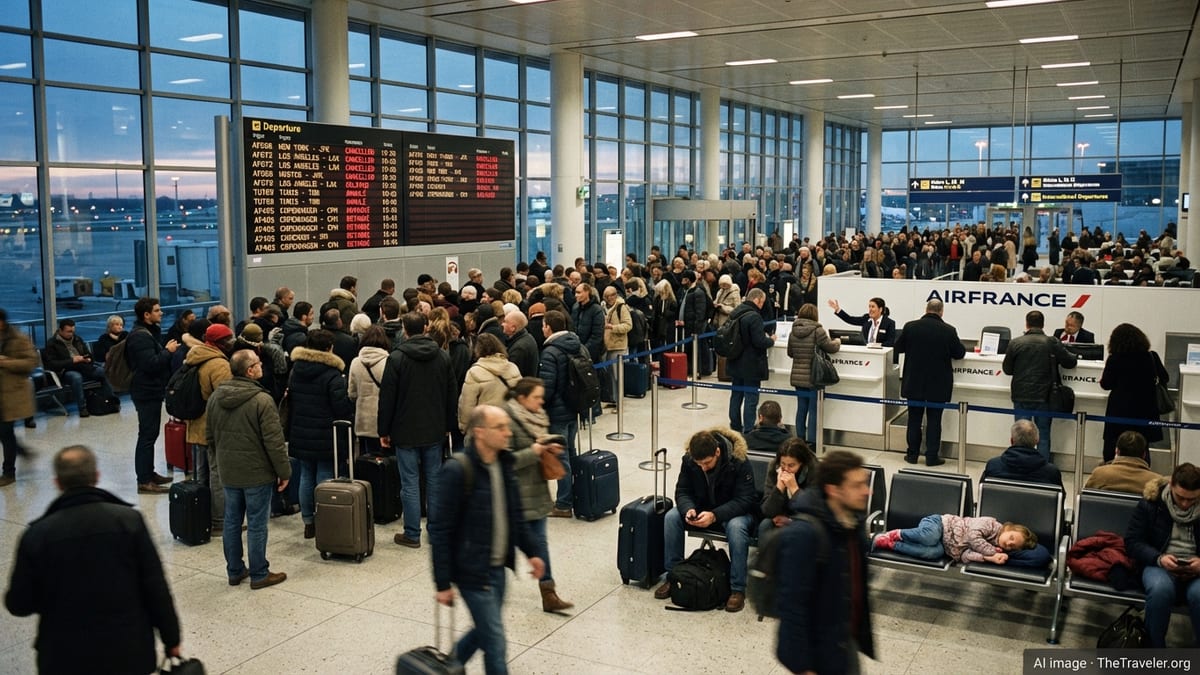
Widespread Delays and Cancellations Centered on Paris
Reports from live flight-tracking and passenger-rights platforms indicate that Paris Charles de Gaulle and Paris Orly are at the heart of a fresh bout of disruption affecting European air travel. Across Paris and a dozen other European airports, data collated from operational feeds points to roughly 3,618 delays and 159 cancellations in a single day, with knock-on effects spreading through hubs from Frankfurt and Amsterdam to Mediterranean leisure gateways.
Departure and arrival boards for Charles de Gaulle and Orly on 27 August 2026 show a steady stream of late-running services, with some flights pushed back by several hours and others withdrawn entirely from schedules. Real-time boards for Charles de Gaulle list multiple departures as delayed or canceled through the afternoon peak, while Orly’s live displays show a similar pattern of rolling hold-ups on both domestic and international routes.
Air passenger-compensation platforms that monitor disruption levels at major hubs also show an elevated number of cancellations and significant late departures from Paris, corroborating the scale of the day’s operational problems. Although the precise distribution of delays and cancellations varies across airports and airlines, the cluster of disruption around the French capital is prompting missed connections and rebookings across the European network.
Secondary hubs and regional airports are reporting the impact as delayed arrivals from Paris cascade into subsequent rotations. Flights from the French capital to destinations including Frankfurt, Bologna, and several Mediterranean cities feature among the canceled or heavily delayed services, leaving aircraft and crews out of position and compounding congestion later in the day.
Network Under Pressure After Busy Summer Peak
The latest disruption comes as Europe’s aviation system operates near peak capacity in the late-summer holiday period. Eurocontrol’s most recent summer network briefings describe a sustained high level of traffic in August 2026, with average daily movements running above last year and persistent pressure on air traffic flow management across the continent. According to its European Aviation Overview, traffic in late July and early August already exceeded 2025 levels, with the network handling more than 36,000 flights per day on average.
Eurocontrol’s all-causes delay analysis for the summer season highlights that staffing and capacity constraints in air traffic control, particularly in France, Spain and Greece, have been a significant driver of en route delays. The agency’s rolling seasonal plan for 2026 notes that France continues to account for a substantial share of network-wide en route delay minutes, making it a critical hotspot whenever weather or local operational pressures increase.
While Eurocontrol’s aggregate data for July and August 2026 point to some improvement in average delay per flight compared with 2025, the figures still show millions of minutes of delay across the network. Even a modest uptick in disruption on a busy day can therefore translate into thousands of delayed flights and hundreds of cancellations when traffic is this dense, especially around major hubs such as Paris Charles de Gaulle.
Network managers have repeatedly warned that during the summer peak, disruptions tend to propagate quickly from one region to another. When a high-volume node such as Paris faces constraints, subsequent rotations, crew rosters, and airport ground handling operations across Europe can rapidly feel the effect.
Operational Factors Behind the Disruptions
Early assessments suggest a combination of factors is contributing to the latest wave of delays and cancellations. Published performance analyses by Eurocontrol show that, in recent months, the leading drivers of delay across Europe have included en route air traffic control capacity, weather-related flow restrictions, and reactionary delays as late-running aircraft disrupt subsequent flights.
Historical data compiled for European policymakers on delay and cancellation causes indicate that technical issues, crew availability, and industrial action can also play a significant role, although their share fluctuates by season and by airline. In the 2023 to 2025 period, technical problems and industrial action together accounted for a notable proportion of operational cancellations across the region, according to aggregated figures derived from airline reporting.
On particularly busy travel days, even localized storms or temporarily reduced runway capacity can lead to distance-based spacing between aircraft and lower airport arrival or departure rates. That effect is often magnified at hub airports like Charles de Gaulle, where small schedule perturbations can quickly lead to ground queues, missed slots, and diverted flights as airlines try to recover their rotations.
Publicly available operational dashboards for Paris this week also show pockets of longer-than-usual turnaround times for some flights, consistent with the reactionary delay pattern described in Eurocontrol’s reports. As aircraft arrive late, ground handlers, catering, and fueling teams work against the clock to prepare departures, but any shortfalls in staffing or ramp capacity can prolong the recovery.
Impact on Passengers and Airlines
The immediate impact of the disruption is being felt by passengers facing missed connections, extended waits in terminals, and short-notice changes to travel plans. At Charles de Gaulle, live trackers show long-haul services among those affected, with some widebody flights departing significantly behind schedule or being canceled outright. At Orly, disruption to short- and medium-haul flights is particularly noticeable on popular leisure and regional business routes.
Travel-rights organizations note that, under European passenger-protection regulations, certain cancellations and long delays departing from EU airports can entitle travelers to compensation or assistance, depending on the cause of disruption and how much notice was given. Passengers are being encouraged, via public-facing tools, to check the status of their specific flight and review whether they may be eligible for reimbursement or rebooking support.
For airlines, the operational and financial implications are substantial. Late-summer flights typically operate with very high load factors, leaving little spare capacity to re-accommodate disrupted passengers. Aircraft and crews knocked off their planned rotations can require repositioning, bringing additional cost at a time when carriers are already contending with elevated fuel prices and ongoing staffing challenges.
Airlines are making tactical adjustments such as swapping aircraft types, consolidating lightly booked services, and rescheduling certain departures to off-peak hours where possible. However, given the already tight infrastructure and staffing situation at key European hubs, these measures offer only limited relief when disruption reaches the scale seen today.
Outlook for the European Aviation Network
Recent Eurocontrol flash briefings suggest that the underlying resilience of the European network has improved somewhat compared with earlier post-pandemic summers, with average delay per flight edging lower despite higher traffic levels. The latest weekly update for mid-August describes the overall situation as relatively stable, though still characterized by recurrent congestion in certain airspace sectors and at a handful of airports.
Looking ahead to the remainder of August and into September, the Network Manager’s rolling seasonal plan continues to flag France and adjacent airspace as areas requiring close coordination among airlines, air navigation service providers, and airports. With traffic forecast to remain high into early autumn, any recurrence of local capacity issues, severe weather, or industrial action could trigger further days of large-scale disruption.
Passengers with upcoming travel through Paris and other major European hubs are being advised, via publicly available guidance, to monitor flight status closely, allow additional time for connections, and remain alert to schedule changes. Industry analysts note that while the network is coping better with peak volumes than in some previous summers, margins remain thin, and days like today underscore how quickly strain at a single hub can cascade across the continent.
As operational data from today’s events are fed into performance-monitoring systems, regulators and network planners are expected to scrutinize how well existing capacity plans, staffing levels, and contingency measures withstood the latest stress test. The findings are likely to inform further adjustments to traffic flow management and airport operations strategies for the remainder of 2026.
Eurocontrol all-causes delay to air transport in Europe, July 2026
Eurocontrol Flash Briefing 2026 Week 34
European Network Operations Plan 2026 Rolling Seasonal Plan