


More news on this day
India has approved a major capacity expansion between Whitefield and Bangarapet on the busy Bengaluru–Chennai rail corridor, positioning the 47-kilometre project as a key step in easing congestion around the tech hub and improving long-distance connectivity across southern India.
Get the latest news straight to your inbox!
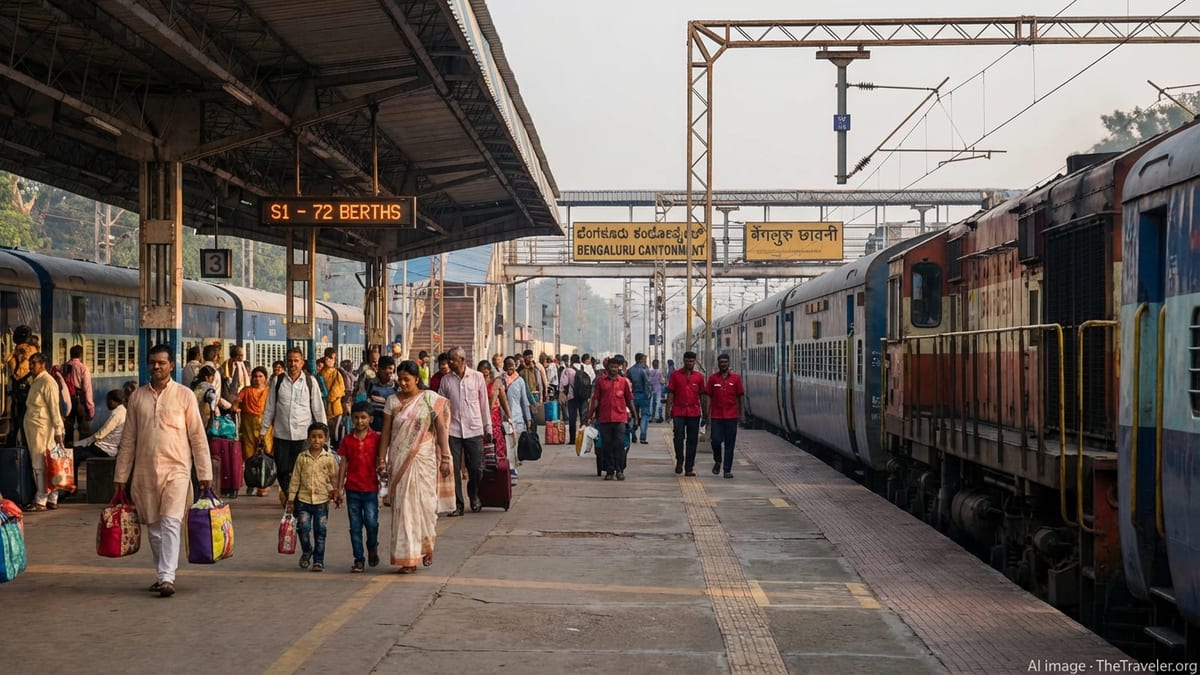
Cabinet Nod for 47 km Multitracking Corridor
According to recent Cabinet Committee on Economic Affairs decisions, the Whitefield–Bangarapet section east of Bengaluru will be upgraded with a third and fourth track over roughly 47 kilometres. Publicly available information indicates that the project forms part of a wider package of multitracking works approved in September 2026 with a combined estimated cost of about Rs 10,021 crore across several southern states.
Coverage of the decision notes that the Bengaluru-area component specifically includes Whitefield–Bangarapet, alongside projects such as Arakkonam–Renigunta, Hosur–Omalur and Salem–Karur–Dindigul, all intended to decongest high-density routes. The Whitefield–Bangarapet stretch is already a double line, and the sanctioned works will convert it into a four-track corridor to separate fast intercity services from slower passenger and freight movements.
Press statements and published reports describe the line as part of the South Western Railway zone’s efforts to increase capacity on one of India’s busiest freight and passenger corridors. The section connects Bengaluru’s eastern suburbs with industrial and mining belts in Karnataka and onward links into Tamil Nadu, which has pushed volumes close to saturation on the existing double line.
Network planning documents evaluated earlier in 2026 under the PM Gati Shakti framework had already identified a Whitefield–Bangarapet third and fourth line as technically feasible and necessary. The Cabinet approval gives the project a funding envelope and formal sanction to proceed toward land acquisition, detailed design and tendering.
Relief for Congested Bengaluru–Chennai Rail Corridor
The Whitefield–Bangarapet enhancement sits on the arterial Bengaluru–Chennai rail corridor, which carries a mix of long-distance expresses, suburban services and heavy freight. Reports from railway planners have repeatedly described the existing double track between Whitefield and Bangarapet as operating near or above optimal capacity, leading to delays, train regulation and limited paths for adding new services.
By adding two new tracks, the corridor can be reorganized to allow faster trains to overtake slower ones, while freight can be routed more predictably toward ports and industrial nodes in Tamil Nadu and beyond. Financial and infrastructure publications covering the project suggest that this segregation of traffic is expected to reduce detention times, cut operating costs and support higher average speeds on the Bengaluru–Chennai axis.
Regional analyses also point out that the upgraded section will complement earlier quadrupling works closer to the city, such as the Bengaluru Cantonment–Whitefield stretch, which were sanctioned to support both mainline and suburban operations. Together, these projects create a continuous high-capacity spine running from the city’s core through Whitefield and onward toward Bangarapet, making it easier to schedule additional trains without worsening bottlenecks.
In the medium term, the increased line capacity is likely to enable more direct services from Bengaluru toward Kuppam, Jolarpettai and Chennai, and to improve reliability for daily commuters who rely on existing passenger trains along the eastern corridor.
Linking Suburban Rail, Metro and Satellite Towns
The Whitefield–Bangarapet expansion is arriving at a time when Bengaluru is reshaping its broader rail-based transport network. The Bengaluru Suburban Railway project, which includes a corridor from Kengeri through the city toward Whitefield and further east, is designed to use and extend the existing mainline railway system to offer high-frequency commuter services.
Published route plans show that the Whitefield–Malur–Bangarapet section forms part of envisaged suburban and regional rail links to satellite towns, potentially allowing through services from western suburbs like Kengeri across the city to eastern districts. The new tracks between Whitefield and Bangarapet would give planners more flexibility to integrate commuter operations with long-distance trains on the same alignment.
The project also interlocks with the expansion of Bengaluru’s Namma Metro network, including the Purple Line corridor that already stretches from Kengeri to Whitefield. With metro and rail both converging at Whitefield and nearby hubs, transport observers note that a higher-capacity mainline corridor eastward can help distribute passenger flows and provide additional options for longer-distance commuters beyond the metro’s reach.
For satellite towns and peri-urban areas along the route, such as Malur and Bangarapet, the upgraded corridor is expected to support more frequent services and better connections into Bengaluru’s job clusters. This is in line with broader planning goals under national logistics and mobility initiatives, which emphasize tying major cities more tightly to their surrounding regions through rail.
Economic and Logistics Benefits for Southern States
Beyond passenger mobility, the Whitefield–Bangarapet multitracking scheme is positioned as a logistics enabler for both Karnataka and Tamil Nadu. According to financial and infrastructure sector coverage, the line forms part of key freight flows linking power plants, industrial estates and ports on the east coast.
By relieving capacity constraints east of Bengaluru, the new infrastructure is expected to facilitate heavier and more reliable freight movements, which can help shift some cargo from road to rail. Analysts have pointed out that this shift supports national targets for lowering logistics costs and emissions while improving turnaround times for bulk commodities and container traffic.
The project is grouped in the same Cabinet package as other strategic links such as the Secunderabad–Kazipet multitracking work and doubling projects between Hosur and Omalur and between Salem, Karur and Dindigul. Together, these alignments create a denser, more resilient rail grid across southern India, allowing alternative routings when certain sections are saturated or under maintenance.
Economic commentary suggests that once completed, the combined south Indian multitracking investments may also help decongest older routes and support new industrial corridors, particularly those aimed at export-oriented manufacturing clusters in and around Bengaluru, Hosur and Chennai.
Timelines, Costs and Next Steps
Government press releases place the total estimated cost of the five newly approved multitracking projects at around Rs 10,021 crore, with completion targeted by the end of the 2029–30 financial year. Within this package, the Whitefield–Bangarapet component accounts for a significant share of investment in Karnataka, reflecting the strategic importance of the corridor for both passenger and freight traffic.
Earlier notifications in the national gazette had already declared the Whitefield–Bangarapet work a special railway project, enabling streamlined land acquisition and statutory clearances along the 47 kilometre alignment. South Western Railway’s construction organization has been identified in public documents as the implementing agency for the corridor.
With formal approval now in place, the project is expected to move into detailed design, tendering and phased execution. Rail infrastructure works of this scale typically involve construction of additional bridges, signaling upgrades, yard remodeling and station modifications alongside laying new track, activities that are usually sequenced to keep existing services running during the build period.
Observers of Bengaluru’s transport build-out note that the Whitefield–Bangarapet upgrade will likely be implemented in parallel with other major schemes, including sections of the suburban rail and ongoing metro extensions. Coordination across agencies and projects will be important to manage construction impacts while keeping up with rising travel demand in and around the city.
Press Information Bureau: Cabinet approval for multitracking projects
Moneycontrol: Centre approves Whitefield–Bangarapet railway quadrupling project
The Indian Express: Cabinet clears eight railway multitracking projects
Financial Express: Whitefield–Bangarapet quadrupling and connectivity upgrades
Gazette notification: Whitefield–Bangarapet special railway project