


More news on this day
Rail operations near Ormonde were disrupted after a freight train derailed, leaving multiple cars on the ground and prompting a large-scale response to clear the line and evaluate potential damage to nearby land and infrastructure.
Get the latest news straight to your inbox!
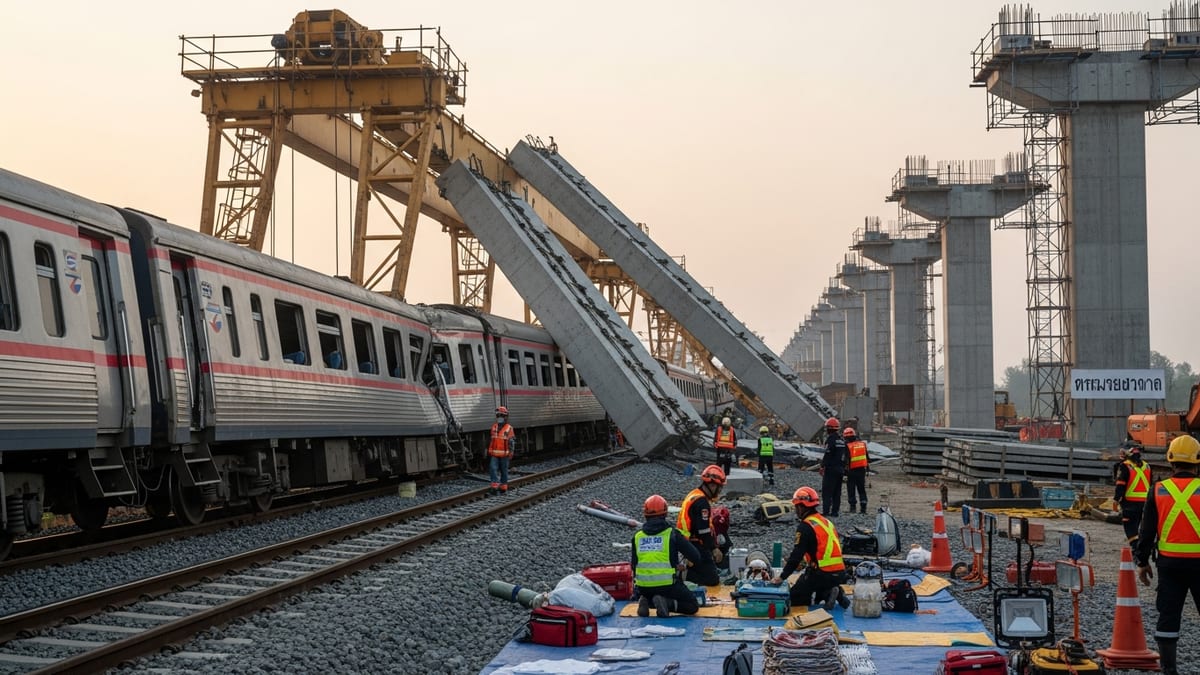
Freight consist scattered after derailment near Ormonde
Initial reports indicate that a section of a freight train derailed near Ormonde, sending multiple cars off the rails and onto adjacent ground. Images and early descriptions from the scene describe several wagons either tipped on their sides or leaning at sharp angles, with twisted couplers and damaged bogies visible along the right of way.
Publicly available coverage suggests the incident occurred on a busy freight corridor, with the train believed to be hauling a mixed consist. Some cars appear to have remained upright but off the track, while others were dragged into the ballast and surrounding soil, creating a field of debris that now stretches across several hundred meters of line.
There were no immediate indications of serious injury in early reporting, although a full accounting of crew and any nearby road traffic typically follows once emergency assessments are complete. Rail companies generally begin with securing the locomotives, isolating power and checking for fuel leaks before teams move systematically through the derailed section.
As is standard after an event of this type, the affected stretch of track has been closed while inspectors document the position of each car, check rail geometry and examine any broken components that might help establish the cause.
Track closed as cleanup and rerouting operations begin
Following the derailment, rail traffic through the Ormonde area has been heavily disrupted. Rail trackers and regional media reports show freight services halted or rerouted to parallel lines where capacity allows, leading to longer transit times for cargo moving through the corridor.
Recovery crews typically begin by separating relatively undamaged cars from the pileup so that they can be re-railed using heavy lifting equipment. In more severe sections, wreckers and cranes are brought in to cut away mangled steel, remove wheelsets from the ballast and clear any cars that have jackknifed across multiple tracks.
Ballast that has been displaced by derailed wheelsets will need to be excavated and replaced, and in some cases the underlying formation is checked for subsidence or washouts. Once wreckage is cleared, track gangs usually install replacement rail, fresh sleepers and new fastenings before completing detailed alignment and ultrasonic inspections.
During this process, freight operators commonly stage trains on either side of the closure or divert them to alternative routes, which can create knock-on delays for several days. Passengers using nearby lines, if any, may experience timetable changes or bus substitutions until the main track is certified for safe operation.
Questions over cause as investigators examine conditions
While the precise cause of the Ormonde derailment has not yet been established, investigators will look at a familiar set of factors that feature in many modern rail accidents. Published reports from other recent derailments highlight issues such as broken rail, defective wheels or axles, track geometry problems and cargo loading imbalances as recurring themes.
In similar cases, technical teams analyze data from onboard recorders, inspect damage patterns on wheels and rail heads, and review recent maintenance logs for the segment where the train left the track. Weather and ground conditions near Ormonde, including recent heavy rain or high temperatures, may also be examined for any role in undermining the trackbed or contributing to rail stress.
Attention often turns as well to train handling and signaling, though modern investigations typically show that failures in physical infrastructure or rolling stock are more common triggers in freight derailments than excessive speed on straight track. Any evidence of track deformation, broken fasteners or spreading gauge around the point where the first wheelset dropped will be critical to understanding what went wrong.
Once preliminary findings emerge, regulators and rail operators may temporarily adjust speed limits, inspection intervals or freight compositions over similar territory, using the Ormonde event as a reference point for risk reduction on comparable lines.
Environmental and community impacts under scrutiny
With several cars reported on the ground, attention in the Ormonde area has also turned to what the train was carrying and whether any cargo escaped into the surrounding environment. Coverage so far suggests that hazardous materials, if present, have not caused a major incident, but full manifest checks and site sampling generally continue for some time after the tracks are cleared.
Even in the absence of a chemical release, derailments can leave significant physical scars along the right of way. Soils may be compacted by heavy recovery equipment, drainage ditches can be blocked by ballast and debris, and nearby vegetation may be removed to create work pads for cranes and trucks. Local authorities often coordinate with environmental agencies to stabilize embankments, restore drainage and ensure that any contaminated soil is removed.
Communities close to the line can experience short term disruption in the form of road closures at level crossings, noise from heavy machinery and increased truck traffic as damaged components are hauled away. For some residents, visible wreckage and lingering fears about rail safety can heighten concern, particularly in areas where freight trains pass close to homes, schools or small businesses.
As operations normalize, rail companies typically work with local stakeholders on longer term mitigation, which may include upgraded crossings, refined routing of hazardous cargo or improved communication about train movements through the Ormonde area.
Derailment adds to broader concerns about rail safety
The incident near Ormonde arrives at a time when rail safety is under sustained public scrutiny in many regions. Recent derailments involving freight operations have reinforced questions about the adequacy of inspection regimes, investment in track maintenance and the balance between capacity demands and infrastructure resilience.
According to publicly accessible rail safety data and recent investigative reports, freight derailments often occur on secondary lines and yards, but high profile events on busier corridors attract wider attention. The Ormonde derailment, with multiple cars visibly on the ground, fits a pattern where even nonfatal incidents can carry significant economic and environmental costs.
Rail advocates note that, on a per ton mile basis, trains remain one of the safer and more efficient ways to move large volumes of goods. At the same time, they argue that events like the Ormonde derailment underline the importance of sustained investment in track renewal, modern monitoring technology and robust emergency preparedness along key routes.
In the coming weeks, the findings from the Ormonde investigation, and the speed with which full service is restored, are likely to feed into wider debates over freight rail regulation, infrastructure priorities and the expectations placed on operators moving heavy trains through communities that depend on both safety and reliable service.