

Travel as a plus-sized Black woman is never just about catching flights and collecting passport stamps. It is moving through airports designed for smaller bodies, navigating countries where Blackness is exoticized or erased, and answering the same questions about safety from loved ones who have never left home. Yet across hostels in Lisbon, beach bars in Jamaica, and night markets in Bangkok, plus-sized Black solo women are carving out space for themselves, traveling widely and on their own terms. This is what that experience can look and feel like in real life, and how to make it safer, more comfortable, and more joyful.
Get the latest updates straight to your inbox!
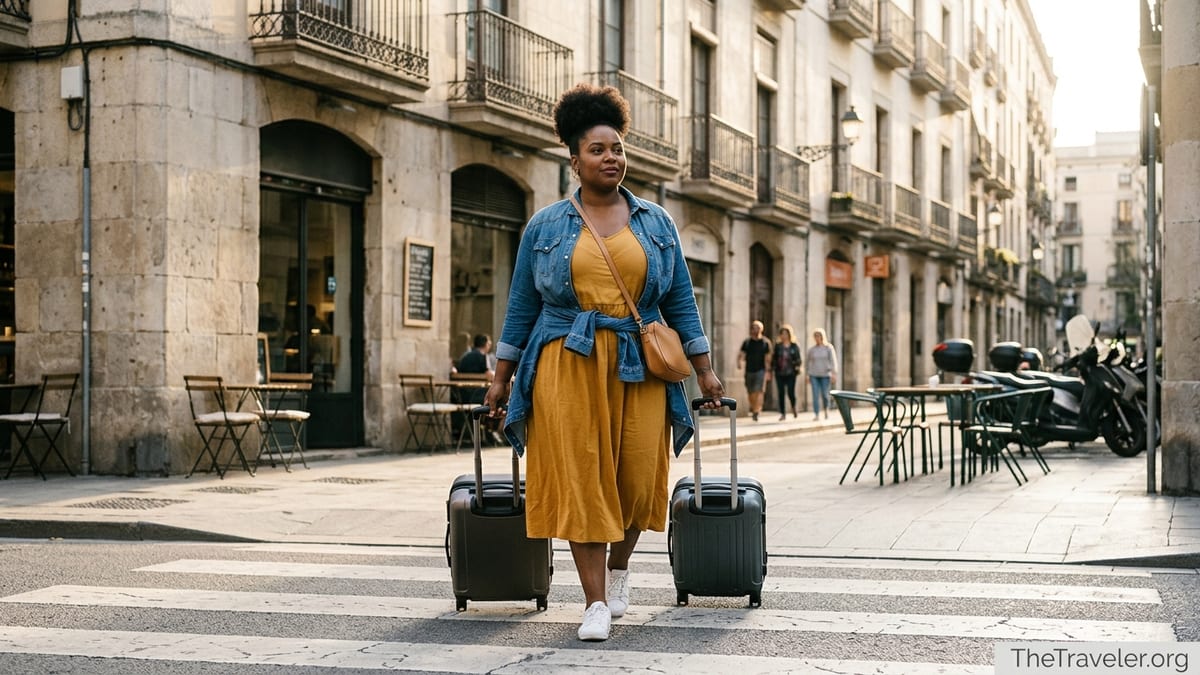
Carrying Multiple Identities Through the World
Travel looks different when you are plus-sized, Black, and a woman moving alone. Each identity shapes how strangers see you, what kind of attention you receive, and how safe or welcome you feel. Writer and creator Annette Richmond, who founded the community Fat Girls Traveling, has spoken publicly about how being a fat Black woman changed everything from how she is treated at immigration desks to who sits next to her on a bus. Her experiences, echoed by thousands of women in online communities, highlight that you are rarely just a tourist; you are read through stereotypes about race, gender and body size the second you enter a new space.
In practical terms, this can mean dealing with curious questions in places where Black travelers are still rare, such as smaller towns in Eastern Europe, or being completely ignored by taxi drivers in certain parts of Southern Europe who assume Black women are sex workers or cannot afford their services. In some parts of Asia, a plus-sized Black woman might find strangers openly staring or asking for photos, while in others she may be treated with warmth and admiration because Western pop culture has made Blackness seem cool. The reactions vary widely, even within the same country, which is why research before you go is so important.
Body size adds another layer. Airline seats, narrow restaurant booths and crowded minibuses are often built with smaller frames in mind. A plus-sized traveler may worry about fitting into a tuk-tuk in Bangkok, or whether a snorkeling wetsuit in Mexico will zip up. These concerns are not superficial. They affect what activities you feel comfortable booking and whether you feel you belong in that environment at all. Acknowledging that this is part of the reality, rather than minimizing it, is the first step toward planning trips that work for your body instead of against it.
At the same time, there is power in visibility. Black women have long had to fight for the right to leisure, from the era of the Negro Motorist Green Book in the United States to the rise of the modern Black Travel Movement. Today, plus-sized Black solo travelers who share their journeys on platforms like Fat Girls Traveling, Travel Divas or niche Instagram accounts are not just inspiring others; they are also quietly educating hotels, tour companies and tourism boards on what inclusion really looks like.
Airports, Airlines and the Realities of Flying While Plus-Sized
For many plus-sized Black solo travelers, the most stressful part of any trip is not the destination but the flight. Aircraft seat width in economy on major U.S. carriers typically ranges between about 17 and 18.5 inches, and seat pitch can be as tight as 30 inches on some low-cost airlines. For a size 18 or 22 woman, that can mean hours of squeezing into armrests, worrying about encroaching on a neighbor’s space, or dealing with outright hostility from other passengers who believe they are entitled to every millimeter of their seat.
Recent debates about airline policies have made this experience even more visible. Some carriers in North America allow what they call “customers of size” to purchase an additional seat in advance and request a refund later if the flight does not sell out, while others require passengers who cannot safely lower both armrests to buy a second seat outright. Reports and traveler complaints online describe inconsistent enforcement: plus-sized travelers being escorted off nearly full flights when staff decide, at the gate, that they suddenly need extra space. For a solo traveler who has already saved hard for her trip, paying effectively double for the same flight is not a minor inconvenience; it can mean canceling the experience entirely.
There are ways to reduce some of this stress. Many plus-sized Black women report feeling more comfortable on airlines that publish clear “customer of size” policies on their websites and have a record of staff handling these situations discreetly rather than publicly shaming passengers. Booking a specific seat rather than relying on first-come, first-served boarding can help you choose an aisle where you can shift slightly into the aisle when service carts are not passing. For long-haul flights from cities like New York or Atlanta to London, Accra or Johannesburg, it may be worth paying extra for a bulkhead or extra-legroom economy seat. While these seats can add anywhere from about 60 to 200 dollars to a one-way ticket, they often provide noticeably more space and can make a 7 to 10 hour flight more bearable.
Race and gender show up here too. A Black woman who asks for a seatbelt extender or requests to move to an empty row may be met with more suspicion than a white passenger making the same request. Some travelers recount cabin crew questioning whether they are in the “right” cabin or loudly announcing that a seatbelt extender is needed. When this happens, having rehearsed language in mind can help: calmly saying “I requested this for my comfort and safety” and then putting in earbuds can avoid an argument. In complaints after the flight, focusing on specific behavior rather than the airline as a whole has led some women to receive apologies, points or partial refunds, and it also puts pressure on carriers to train staff better.
Accommodation: Finding Beds, Bathrooms and Beaches That Work for Your Body
Once you land, the next question is where you will sleep, shower and unwind. Plus-sized Black solo travelers often find that boutique guesthouses, historic buildings and budget hostels in cities like Paris, Lisbon or Havana can have steep, narrow stairwells, tiny showers with fixed glass partitions, or older mattresses that sag in the middle. For a woman in a larger body, this can turn a charming heritage stay into a daily workout or even a safety hazard.
Chain hotels and newer apartment-style rentals usually offer more predictable infrastructure: wider beds, elevators, and walk-in showers. In a city like London, a centrally located three-star chain hotel might cost around 150 to 220 dollars a night if booked a few months in advance, while a private room in a social, design-forward hostel with elevators and modern bathrooms could run 60 to 120 dollars. In destinations like Bali or Mexico’s Yucatán Peninsula, the same budget could stretch much further, with mid-range beach resorts offering spacious rooms and king-sized beds for a fraction of big-city rates, especially in low season.
For beach destinations, the question becomes whether the property is genuinely body-inclusive. A plus-sized woman might wonder if the resort offers sturdy loungers that do not dig into thighs, if there are pool steps rather than only ladders, and whether complimentary robes will actually fit. Some properties, often highlighted by body-positive travel communities, make a point of using wider pool loungers, armless dining chairs and accessible bathroom fixtures, not just for disabled guests but also for larger-bodied guests. When in doubt, many solo travelers find it helpful to email properties directly with specific questions about bed size, shower type and whether sun loungers have weight limits, rather than just asking if the hotel is “plus-size friendly.”
For Black women, there is an added layer of wondering how staff and other guests will treat them. In some all-inclusive Caribbean resorts, Black American women report being mistaken for staff or entertainers, while in parts of Southeast Asia they might be followed around by resort photographers eager to capture their “exotic” look for marketing images. Choosing accommodations that have been positively reviewed in Black traveler groups can drastically reduce the number of awkward or offensive encounters, because those reviews usually describe not only facilities but also staff attitudes toward visibly Black guests.
Street-Level Reality: Safety, Racism and Colorism on the Road
Safety is often the first concern raised when a Black woman says she wants to travel alone. Much of this fear is shaped by news coverage rather than statistics, but it is true that solo women, particularly women of color, move through the world with extra calculations in mind. Safety tips for female travelers in general emphasize strategies such as arriving during daylight, using registered taxis or ride-hailing apps where available, and limiting alcohol intake when out alone. For Black women, those strategies are layered on top of awareness of how racism and colorism show up differently in each place.
In Western Europe, Black women report a spectrum of experiences. Cities like London, Amsterdam and Berlin tend to have large Black and immigrant communities, which can translate into a sense of anonymity and relative safety, though not an absence of racism. In smaller towns in parts of Italy or Eastern Europe, some travelers describe being openly stared at, photographed without consent, or subject to rude comments about their hair or skin. In East Asia, from Tokyo to Seoul, a plus-sized Black woman may encounter more curiosity than hostility, with people asking to touch her braids or take selfies. While this can feel objectifying, it is often rooted in unfamiliarity rather than explicit malice, and each traveler decides individually how much patience she has for that.
Colorism adds another dimension, especially in regions with a history of colonialism and slavery such as the Caribbean and Latin America. Dark-skinned Black women may be treated differently from lighter-skinned travelers, including other Black people, when it comes to who is perceived as attractive, respectable or wealthy. This can affect everything from how quickly you are served at a bar in a beach town in the Dominican Republic to whether a taxi driver in Rio de Janeiro agrees to take you to a certain neighborhood at night. Solo travelers increasingly share these patterns in online forums and private groups so that others can adjust expectations, select neighborhoods strategically and decide which destinations feel aligned with their emotional bandwidth at that time.
None of this means that travel as a plus-sized Black woman is inherently unsafe. Many Black women describe feeling more relaxed abroad than in parts of the United States, particularly when it comes to gun violence or interactions with law enforcement. However, it does mean that research is nonnegotiable. Reading destination-specific threads in Black women traveler communities and solo female travel forums, checking government travel advisories, and using crowd-sourced safety maps that rate neighborhoods based on street lighting, harassment reports and crime levels can give you a more realistic picture than glossy tourism marketing alone.
Clothing, Comfort and Dressing Your Body in Different Cultures
Packing as a plus-sized Black solo traveler can be an emotional exercise. Many mainstream outdoor and travel brands still carry limited size ranges in bricks-and-mortar stores, even if they offer extended sizes online. That means a woman planning a hiking trip in Costa Rica or a walking-heavy city break in Paris might have to order her moisture-wicking tops, quick-dry shorts and anti-chafe shorts weeks in advance. The good news is that more brands are gradually expanding their size ranges, and specialized plus-size activewear labels have emerged, making it easier to find leggings that will not roll down halfway through a walking tour.
On the ground, cultural norms dictate what feels comfortable and respectful. In conservative parts of North Africa or the Middle East, for example, a Black woman might receive less unwanted attention if she wears loose, breathable trousers and knee-length tunics that cover her curves, compared with tight dresses that might feel fine in Miami or London. In Southeast Asia’s temple complexes, reach-for items like lightweight maxi dresses with sleeves can both respect dress codes and feel comfortable in humidity. In beach destinations such as Jamaica or Mexico’s Riviera Maya, plus-sized travelers increasingly report seeing more diverse bodies in bikinis, not just slim influencers, which creates a more liberating atmosphere.
Race shapes these style choices too. Black women often factor in haircare and skincare that other travelers never think about. In many European and Asian cities, it can still be difficult to find hairstylists who know how to work with natural coils or braids, or to buy foundation shades deep enough for darker skin tones. Some solo travelers book a protective style such as box braids or faux locs before departure, planning for it to last a three- or four-week trip, and pack travel-sized satin pillowcases and bonnets to protect their hair in hotels and hostels. Others scout out Black-owned salons in cities like London, Paris, Accra or Cape Town before they go.
As a plus-sized traveler, comfort extends to undergarments and swimwear. Anti-chafe balms or shorts can mean the difference between enjoying a full day walking around Rome and cutting sightseeing short because of painful thigh chafing. Many women mention bringing at least one swimsuit that truly fits and supports their bust, purchased from dedicated plus-size swim brands rather than general high-street chains, so they are not at the mercy of limited resort boutique sizing when they arrive. These details may sound small, but they dramatically impact confidence, and confidence in turn influences where you feel you can go and what you feel you can do alone.
Community, Representation and the Power of Being Seen
Representation matters at every stage of the journey. For decades, tourism marketing overwhelmingly centered thin, white, heterosexual couples or families in its imagery. That absence has had real-world effects. Black travelers, and Black women in particular, have long noted that not seeing anyone who looks like them in brochures, films or social media feeds contributed to the idea that travel was not “for” them. Researchers looking at Black travel experiences have found that Black travelers have built vibrant communities on social media in part to fill that gap, using hashtags and niche groups to share practical information and encouragement.
For plus-sized Black solo travelers, this community can be the difference between shelving a dream trip and booking it. Platforms created by Black and plus-size travelers curate destination guides, packing tips and honest conversations about safety, desirability and joy on the road. In these spaces, you will find trip reports from women who spent a week eating their way through Lisbon alone, or who joined group tours in Bali and Egypt as the only plus-sized Black woman and came back with new friendships and a fuller sense of what they were capable of.
Offline, group trips curated specifically for Black women have exploded in popularity, with companies organizing everything from luxury yacht weeks in Croatia to wellness retreats in Costa Rica. Some of these operators explicitly highlight that they welcome all body types and will work with participants to ensure they feel comfortable during physically demanding activities like hikes or boat excursions. For a first-time solo traveler, joining such a group can be a gentler entry into independent travel. You technically travel “solo” in the sense of not bringing friends or family, but you are embedded in a community from day one.
At the same time, it is important to remember that not all group travel is automatically inclusive. A plus-sized Black woman joining a general adventure tour might still encounter microaggressions from fellow participants, such as assumptions about her fitness level, or experience being placed at the back of group photos. Reading reviews with an eye out for comments about group dynamics, guide attitudes and whether the trips attract a diverse clientele can help you choose spaces where you are more likely to feel truly seen and respected.
Claiming Joy: Why It Is Worth Doing Anyway
With all of these considerations, some might ask why plus-sized Black women should bother traveling solo at all. The answer lies in the specific kind of freedom many women describe once they do. Traveling alone means deciding your own schedule in Barcelona without negotiating with friends who want to party late when you would rather do a morning food tour. It means lingering in front of a painting in a Berlin museum without anyone rushing you, or booking a private driver for a day in Cape Town’s wine country because wine tasting in comfort, with air conditioning and music you like, feels worth the splurge.
For plus-sized women, solo travel can also be a reclamation of body autonomy. Instead of avoiding pool decks or walking tours because of fears about how they will look, many women find that being far from their usual social circles gives them permission to experiment. They wear the bikini in Tulum, take surfing lessons in Bali, or join a samba class in Rio. These experiences tell a different story about their bodies, one that centers capability and pleasure rather than shame.
Black women often speak about the relief of escaping certain pressures at home, whether that is workplace code-switching, family expectations or the constant vigilance required in a country with a long history of racial violence. That does not mean racism disappears abroad, but the flavor of daily life changes. In some cities, strangers might comment positively on a Black woman’s hair or style. In others, she might simply blend into the crowd in a way that feels new. When you combine that with the pride of handling logistics alone, navigating language barriers, and solving problems on the fly, solo travel can become a powerful tool for self-definition.
Of course, joy does not erase risk. It is entirely valid for a plus-sized Black woman to decide that certain destinations, activities or forms of transport do not feel worth it. What matters is that this is her decision, made from a place of informed choice rather than inherited fear. The more detailed, honest stories there are from women like her, the easier it becomes for the next traveler to see herself somewhere on the map.
The Takeaway
Traveling as a plus-sized Black solo woman means navigating a world not built with you in mind, from airplane seats and hostel bunk ladders to visa desks and nightlife districts. It involves carrying the weight of stereotypes about race, body size and gender, all while managing practical concerns about safety, comfort and cost. Yet in cities across the globe, Black women in larger bodies are not only managing these realities but thriving in spite of them, crafting trips centered on pleasure, curiosity and self-trust.
The key is preparation without paranoia. That might look like budgeting for a slightly more spacious flight, choosing accommodations reviewed positively by other Black women, and learning a few local phrases before you go. It also looks like building your own support network, whether through dedicated online communities, group trips or simply a WhatsApp thread with friends back home who can track your location. With these tools, solo travel transforms from something risky and out of reach into something challenging but doable and profoundly rewarding.
Ultimately, the world is not off-limits to plus-sized Black women. It is simply a landscape that must be navigated with clear eyes and a strong sense of self. Claiming your place in that landscape, whether that is watching the sun rise over a Moroccan medina or people-watching from a cafe in Lisbon, is both an act of personal joy and a quiet reshaping of who “belongs” in travel at all.
FAQ
Q1. Is it actually safe for a plus-sized Black woman to travel solo?
Yes, many plus-sized Black women travel solo every year without serious issues, especially when they research destinations, stay aware of their surroundings and trust their instincts.
Q2. Which destinations tend to feel more welcoming to Black solo women travelers?
Cities with diverse populations and established tourism infrastructure, such as London, Amsterdam, Toronto, Lisbon, Accra, Cape Town and many Caribbean islands, are often reported as feeling relatively welcoming.
Q3. How can I handle airline seating if I am worried about fitting comfortably?
Consider booking an aisle or extra-legroom seat, checking the airline’s customer of size policy in advance, and requesting a seatbelt extender discreetly once on board if needed.
Q4. Will I experience more racism abroad than in the United States?
Experiences vary by destination. Some Black women feel more relaxed abroad, while others report different forms of racism or colorism. Researching specific countries and cities can help set realistic expectations.
Q5. How do I find plus-size friendly accommodations?
Look for newer hotels or apartment rentals with elevators and walk-in showers, read recent reviews from plus-size and Black travelers, and email properties with practical questions about bed size, bathroom layout and furniture.
Q6. What should I pack as a plus-sized Black solo traveler?
Comfortable walking shoes, anti-chafe shorts or balm, climate-appropriate clothing that fits well, at least one swimsuit you love, and hair and skincare products that may be hard to find abroad are good starting points.
Q7. How can I reduce unwanted attention on the street?
Dressing in a way that aligns with local norms, carrying yourself confidently, avoiding isolated areas at night and keeping headphones handy can all help. Trusting your instincts and leaving uncomfortable situations quickly is essential.
Q8. Are group trips a good idea if I am nervous about going completely solo?
Yes, many Black women start with group trips curated for Black travelers, which provide built-in community, structured itineraries and hosts who understand the specific concerns of Black women on the road.
Q9. How do I deal with comments about my body or hair from strangers?
You can choose to educate, deflect with humor, set a firm boundary or walk away, depending on your energy and safety in the moment. You are never obligated to accept unwanted comments or touch.
Q10. What if my friends and family think solo travel is too risky for me?
Share your detailed plans, including where you are staying and how you will stay in touch, and explain the safety steps you are taking. Ultimately, it is your life and your decision, and being well prepared can help reassure both them and you.