


Belize’s three offshore atolls – Turneffe, Lighthouse Reef and Glover’s Reef – are marketed as the country’s ultimate underwater playgrounds. They all offer clear water, dramatic walls and abundant marine life, but each delivers a very different experience in terms of travel time, style of diving and snorkeling, cost and level of remoteness. This guide compares them side by side and explains when you actually need an atoll trip at all, and when Belize’s easier barrier reef diving will satisfy you just as well.
Get the latest updates straight to your inbox!
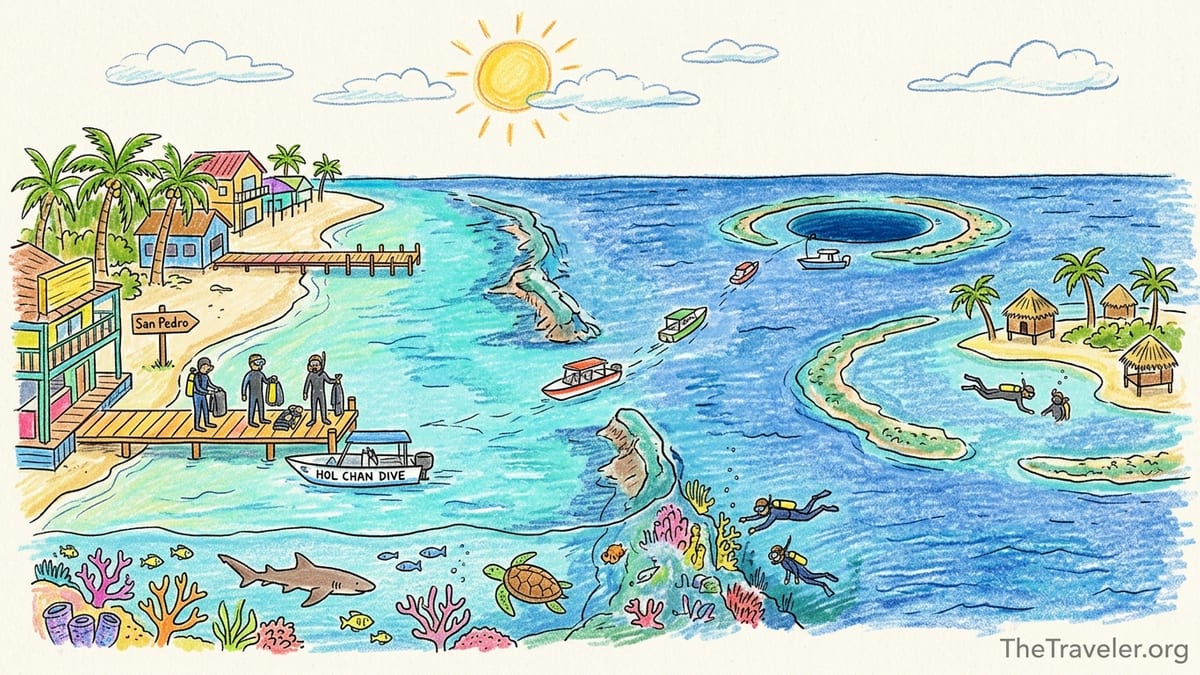
Belize’s Reef Options: Do You Need an Atoll at All?
Before you start comparing atolls, it helps to understand what you get without going offshore. Belize’s main barrier reef sits just a short boat ride from popular bases like Ambergris Caye, Caye Caulker, Placencia and Hopkins. From San Pedro on Ambergris Caye, many dive shops run two-tank trips to nearby sites like Hol Chan Marine Reserve, Tuffy Canyon or Esmeralda in roughly 15 to 25 minutes. These sites already offer healthy coral, nurse sharks, turtles and occasional eagle rays, often with very simple logistics and lower prices than the atolls.
For many new divers and casual snorkelers, this nearshore barrier reef is more than enough. The seas are usually more protected, boat rides are shorter, and you can mix diving with restaurant nights and beach bars in town. A typical two-tank barrier reef dive from Ambergris Caye or Caye Caulker might cost around 120 to 150 US dollars including tanks and guide, which keeps costs manageable over several days of diving.
What you mainly gain by going to an atoll is scale and drama. At the atolls you see longer, more continuous walls and outer-reef drop-offs, fewer other boats and generally clearer water. You also trade town life for either a focused dive lodge, a liveaboard yacht, or simple cabanas on tiny coral islands. The question is not whether the atolls are “better” than the barrier reef. It is whether their extra cost, travel time and remoteness fit your experience level and what you want from the trip.
If you are on a tight budget, are prone to seasickness, or are traveling with family members who do not dive, consider building at least two full days of local barrier reef diving or snorkeling into your itinerary first. Many travelers find that the shallow reefs off Ambergris Caye or Hol Chan, Shark Ray Alley and South Water Caye already deliver the “Belize reef dream” without ever having to sit through a three hour open ocean crossing.
Turneffe Atoll: Accessible Variety and Wall Diving
Turneffe Atoll is the closest atoll to the mainland, roughly 20 miles offshore from Belize City. Transfer boats from city marinas typically take 60 to 90 minutes depending on sea conditions and the size of the vessel, which makes Turneffe significantly easier to reach than Lighthouse or Glover’s. Several established dive lodges operate on Turneffe, including Turneffe Island Resort, Turneffe Flats, Blackbird Caye Resort and Belize Dive Haven, all offering package deals that bundle accommodation, meals, boat transfers and several dives per day.
Diving at Turneffe is known for variety. You can expect spur-and-groove coral formations, walls that drop from around 40 feet into deeper blue water, and mangrove shallows that harbor juvenile fish and macro life. Classic Turneffe dive sites like The Elbow, Black Beauty and Front Porch are often mentioned for schooling snapper, horse-eye jacks, turtles and reef sharks along the edges of the wall. Because Turneffe is large and ringed by reefs, resorts can usually find leeward sites with manageable conditions even when the wind kicks up on one side of the atoll.
From a cost perspective, Turneffe tends to be the mid-range atoll choice. A week at a dedicated dive resort here can start in the ballpark of 600 to 700 US dollars per person per night for packages that include accommodation, meals, transfers from Belize City and up to three dives a day, with premium beachfront bungalows and alcohol adding to the total. Compared with doing repeated long day trips from Ambergris Caye, this “live on the reef” model minimizes time spent bouncing on a boat and maximizes time actually in the water.
Turneffe also serves as a springboard to Lighthouse Reef for some operators. For example, Turneffe Island Resort advertises a weekly full day trip to the Great Blue Hole, Half Moon Caye and Long Caye, a run that can take roughly 1.5 hours from Turneffe to the Blue Hole instead of the two plus hours day boats typically face from Belize City or Ambergris Caye. That makes Turneffe appealing if you want a Blue Hole day without committing your entire week to a more remote atoll.
Lighthouse Reef: Great Blue Hole, Half Moon Caye and Big-Wall Spectacle
Lighthouse Reef Atoll lies farther offshore, beyond Turneffe, and is home to Belize’s best-known dive site: the Great Blue Hole. This nearly perfectly circular sinkhole ringed by coral is a symbolic draw for many divers, even if the actual dive is mostly a deep descent past overhangs and stalactites with relatively sparse reef fish. More consistently impressive are the nearby wall and reef dives at Half Moon Caye and Long Caye, where sheer coral-covered walls plunge into deep blue and schools of reef fish, eagle rays and reef sharks are common sights.
Most travelers experience Lighthouse Reef as part of a long day trip from Ambergris Caye, Caye Caulker or Belize City, or by staying on an atoll resort or liveaboard that anchors nearby. A typical Blue Hole day from San Pedro on Ambergris Caye might cost in the range of 280 to 330 US dollars for divers, including three dives (Blue Hole, Half Moon Caye Wall and a Long Caye site like The Aquarium or Long Caye Wall), breakfast and lunch on board. Expect to leave before dawn, ride for 2 to 3 hours each way on a fast dive boat, and return around sunset. Park fees for the Blue Hole and Half Moon Caye marine reserve are usually extra.
For many divers, the real reason to go to Lighthouse is Half Moon Caye Wall rather than the Blue Hole itself. At Half Moon Caye, you can drift along steep walls festooned with sponges and gorgonians, while garden eels cover the sandy flats and schools of horse-eye jacks swirl in the blue. Snorkelers who join these trips spend more time around the coral rim and at shallow patch reefs near the island. The island itself is a national monument with nesting red-footed boobies and a white-sand beach, which turns the lunch stop into more than a quick surface interval.
Lighthouse Reef is also the focus of most Belize liveaboard itineraries. Boats such as the Belize Aggressor III and IV typically run weeklong cruises from Belize City that split time between Turneffe and Lighthouse reefs, offering up to five dives a day with the convenience of stepping off the stern rather than riding out on day boats. Prices for a week on these liveaboards tend to start in the low to mid four figures per person, depending on cabin type and season, but they offer a way to see a wide spread of Lighthouse and Turneffe sites with minimal transport hassle.
Glover’s Reef: Remote Reefs and Snorkeling Far From the Crowds
Glover’s Reef Atoll sits in southern Belize, well away from Belize City, and feels distinctly more remote than Turneffe or Lighthouse. To reach it, travelers usually base out of Dangriga or Hopkins on the mainland, then take a boat transfer of around 1.5 to 3 hours depending on the operator and starting point. The atoll is a designated marine reserve and UNESCO World Heritage Site component, with a chain of small sand cays along its eastern rim.
Accommodation on Glover’s is more limited and often more low-key than on Turneffe or at Lighthouse. Options include simple eco-lodges and cabana resorts such as Isla Marisol Resort on Southwest Caye, which offers package deals including round-trip boat transfers from Dangriga, meals and daily diving or snorkeling. Prices can vary widely by season and room type, but multi-night adventure packages for two can easily run into several thousand US dollars once diving and transfers are included, reflecting the cost of operating so far offshore.
Divers and snorkelers who make the effort to reach Glover’s are typically rewarded with very clear water, extensive shallow reef flats and outer walls with abundant hard coral and less boat traffic than the more famous atolls. Snorkeling is especially strong here because large areas of the atoll are shallow enough to explore from shore or a small skiff, and you can access patch reefs with excellent coral and fish life in only a few fin kicks from many accommodations. Many experienced Belize divers rank Glover’s among their favorite places in the country precisely because it feels like a small, self-contained reef world.
The trade-off is that logistics are more complex. There are no regular public ferries, so you must time your stay to match a resort’s scheduled boat days or pay for a private transfer. Medical care and evacuation options are more limited, surface conditions can be rough at times, and there is little to do beyond water activities and stargazing. For travelers who want nightlife or easy day-trip variety, staying at Glover’s can feel too isolated. For those who dream of waking up every day surrounded by nothing but sea, reef and sky, it is close to ideal.
Travel Time, Logistics and Day-Trip Feasibility
Choosing between atolls often comes down to how much time you actually want to spend on boats. From Belize City, resorts on Turneffe typically schedule shared boat transfers around midday on certain days of the week, with journeys usually taking 60 to 90 minutes. That makes a Turneffe stay relatively compatible with international flight schedules into and out of Belize City, especially if you can match your flights to the resort’s transfer days and avoid paying for separate charter boats.
Lighthouse Reef is much harder to reach directly unless you are on a liveaboard or staying at one of the few small lodges that historically operated there. Most visitors instead access Lighthouse on long day trips from Ambergris Caye, Caye Caulker or the mainland. Expect a predawn start, 2 to 3 hours each way of open-water exposure, and a full day commitment. For some divers, this long ride is a memorable part of the adventure, with flying fish and sunrise views on the way out. For others, especially those prone to seasickness or back problems, it is a strong argument for either skipping Lighthouse or visiting by liveaboard instead.
Reaching Glover’s adds another step. You usually need to fly or drive from Belize City to Dangriga or Hopkins, stay a night, then catch a scheduled resort boat the next morning. Boat rides can be 1.5 hours or more in each direction. Day trips from the mainland do exist but are less common and tend to be weather dependent and expensive, since operators must account for fuel and long travel times. In practice, Glover’s works best for travelers who can commit at least four or five nights to staying on the atoll.
If you only have three or four full days in Belize and want to mix reef time with jungle or ruins, long atoll transfers are often not worth the lost days. In that case, a base on Ambergris Caye or Caye Caulker with one long Lighthouse or Turneffe day trip, plus one or two days on the barrier reef, can hit a sweet spot between experience and effort. Travelers with a week or more, especially those focused on diving, are better positioned to justify the travel time for a dedicated atoll stay.
Marine Life, Dive Style and Snorkeling Experience
All three atolls share some broad characteristics: clear tropical water, hard coral gardens, sponges and gorgonians, and reef fish communities with angelfish, parrotfish, grunts, snappers, groupers and the usual Caribbean cast. Reef sharks and nurse sharks are common, and eagle rays are regular visitors along walls. You are unlikely to see huge pelagic aggregations like in Galapagos or Cocos, but you do get the sense of being on the edge of deep ocean compared with the more sheltered inner barrier reef.
Turneffe’s diving often combines gentle drift dives along walls with some shallower patch reef and macro sites. The Elbow is popular for schooling fish and the chance of stronger currents, while sites closer to the mangrove shores can hide seahorses and smaller critters. Snorkeling at Turneffe depends a lot on where you stay; some resorts have patch reefs a short swim from the dock, while others rely on boat trips to nearby shallow sites.
At Lighthouse Reef, Blue Hole itself is a deep, mostly vertical dive that is not particularly exciting for snorkelers, who mainly see the ring of coral and a dark central void from the surface. Experienced divers sometimes appreciate the feeling of descending past ancient stalactites and the chance of spotting a few large sharks at depth, but many say that the shallow reef dives at Half Moon Caye and Long Caye are the true highlight. Here, walls start in the 30 to 40 foot range before dropping away, making them comfortable for advanced and intermediate divers. Snorkelers can enjoy clear water and good coral near the island, especially along marked snorkel trails in protected zones.
Glover’s shines for both diving and snorkeling because so much of its reef is shallow and close to shore. At many Glover’s accommodations, you can snorkel right from the beach or jetty, with patch reefs and turtle grass flats full of conch, rays and juvenile fish. Boat trips reach more exposed walls and channels where you might see schools of barracuda, turtles and larger reef sharks. The vibe is generally calm and low-key, with less of a production around each dive and more flexibility to jump in the water whenever conditions allow.
Resorts, Liveaboards and Costs: What You Actually Spend
Belize’s atolls are not budget destinations. Fuel, staff housing and supply runs all drive up the cost of operating far from the mainland, and your daily spend often reflects that. Expect atoll resort packages that include boat transfers, meals and diving to start in the mid hundreds of US dollars per night per person, and climb from there for more luxurious rooms or private guides. Be sure to account for marine park fees, gear rental if needed, and potential surcharges for special trips like the Blue Hole.
On Turneffe, classic dive lodges typically bundle three boat dives per day with full board. A diver might reasonably expect a seven night package with around 15 to 17 dives, airport transfers and meals to sit somewhere in the low to mid thousands of US dollars per person, not including bar tabs and tips. Lighthouse-focused liveaboards are in a similar or higher range but include up to five dives a day and eliminate the need for separate hotel nights in town. For some, the math of a liveaboard feels better value when you divide the cost by the number of dives and the lack of wasted boat time.
Glover’s Reef pricing varies more widely because accommodations range from rustic camp-style cabañas with shared facilities to more polished eco-resorts. Even so, once you add in boat transfers from Dangriga or Hopkins, three daily meals and daily diving or guided snorkeling, total costs can rival or exceed those at Turneffe. If you want to save, consider shorter stays or visiting Glover’s primarily to snorkel, which can be cheaper than full dive packages since reef entry is often possible directly from shore.
If your budget is tight, one pragmatic strategy is to base on the barrier reef and add a single splurge day trip to the atolls. For example, a diver basing on Caye Caulker might book two or three days of local two-tank dives, then spend roughly 300 US dollars on a one-off Blue Hole and Lighthouse day. This still delivers some of the atoll experience and marquee sites without committing your entire accommodation budget to offshore rates.
Which Atoll Is Best for You?
For first-time ocean divers or those freshly certified, Turneffe is usually the best atoll starting point. Boat rides are shorter than to Lighthouse or Glover’s, there are plenty of sites in the 40 to 60 foot depth range with mild currents, and resorts are well set up for courses and guided diving. If you are nervous about deep walls or long, rough crossings, you can still get a taste of outer reef grandeur here without pushing too far beyond your comfort zone.
Experienced divers who are comfortable with deeper profiles and who value variety in wall and reef scenery often gravitate toward Lighthouse Reef, especially if they can visit by liveaboard or stay out on the atoll itself. For this group, the Blue Hole is a once or twice in a lifetime novelty, but the main draw is doing multiple dives at Half Moon Caye, Long Caye and other Lighthouse sites without sitting through multiple three hour day-boat commutes.
Dedicated snorkelers and travelers who want a feeling of total escape are often happiest at Glover’s Reef. Its shallow reef flats, easy off-the-beach access and low-density tourism make it ideal for people who would rather spend all day drifting over coral heads and seagrass than gearing up for deep wall dives. Couples or small groups who enjoy simple island life, hammocks and starry skies generally adapt well to Glover’s slower pace, as long as they accept the trade-offs in comfort and medical access.
If you are traveling with a mixed group that includes non-divers, or if you want good restaurants and evening options, consider a compromise: base on Ambergris Caye or Caye Caulker, book several days of local barrier reef diving or snorkeling, and add a single long day trip to either Turneffe or Lighthouse. This delivers a taste of atoll walls, plus the social and culinary variety of town, and can be more satisfying for companions who do not want every waking hour dictated by a dive schedule.
The Takeaway
The Belize atolls are not interchangeable. Turneffe is the closest and most convenient, with extensive reef and wall diving from well-established lodges. Lighthouse Reef is the place for headline sites like the Great Blue Hole and Half Moon Caye, best enjoyed either on a liveaboard or as a carefully chosen long day trip. Glover’s Reef is the quiet outpost, ideal for remote reef accommodation, abundant shallow snorkeling and small guest numbers.
Ask yourself what you actually want most: number of dives, specific bucket list sites, or a certain kind of atmosphere on land. Then weigh that against your budget, time in Belize and tolerance for long boat rides. If your priority is easy, relaxed diving with some nightlife, Belize’s barrier reef from Ambergris Caye, Caye Caulker, Placencia or Hopkins may be all you need, with one atoll day as a highlight. If your dream is to wake up on a tiny island with the reef just steps away and dive or snorkel multiple times a day, then committing to Turneffe, Lighthouse or Glover’s for several nights becomes worth the extra planning and cost.
Whichever route you choose, build in some flexibility for weather, consider travel insurance that covers dive-related interruptions, and be realistic about your experience level. Belize’s reefs reward patience. Whether you are hovering over a shallow patch reef near San Pedro or drifting along a Glover’s wall with nothing but blue below, the combination of clear water, coral gardens and Caribbean light is what will stay with you long after you rinse the last salt from your gear.
FAQ
Q1. Is the Great Blue Hole worth it for new divers? For brand new or nervous divers, the Great Blue Hole is often not ideal because it involves a relatively deep, mostly vertical dive with fewer colorful reef fish than nearby Half Moon Caye or Long Caye. Many beginners enjoy a Blue Hole day more if they treat the Blue Hole as a single novelty dive and focus their expectations on the shallower reef dives that follow.
Q2. Can snorkelers enjoy Belize’s atolls as much as divers? Yes, especially at Glover’s Reef and around Half Moon Caye and Long Caye. Large areas of Glover’s are shallow enough to snorkel right from shore, and many Lighthouse trips include time at shallow patch reefs and beaches. The Blue Hole itself is not very exciting for snorkelers beyond seeing the circular reef and deep blue center from the surface.
Q3. Which atoll is best if I get seasick easily? Turneffe is usually the most manageable choice because it is the closest atoll to the mainland and involves shorter boat rides. You still cross open water, so medication and staying on schedule with resort transfer boats can help reduce discomfort. Day trips all the way to Lighthouse are generally the toughest for people who are prone to seasickness.
Q4. Are there budget ways to see the atolls? True budget options are limited offshore, but you can keep costs down by staying on the barrier reef and adding a single day trip to Turneffe or Lighthouse. Another tactic is to visit Glover’s or Turneffe primarily as a snorkeler, which can sometimes reduce package prices compared with full dive programs, especially if you are willing to stay in simpler accommodations.
Q5. Do I need advanced certification for Belize’s atolls? Many atoll dives are suitable for Open Water divers, especially shallower reef and wall sites at Turneffe and Glover’s. However, deeper profiles like the Great Blue Hole are typically recommended only for more experienced or Advanced Open Water divers who are comfortable with deeper descents, buoyancy control and longer boat days.
Q6. How many days should I spend at an atoll? To justify the travel time and cost, most travelers aim for at least four or five nights on an atoll, which allows three or four full days of diving or snorkeling. If your schedule is shorter, basing on Ambergris Caye, Caye Caulker, Hopkins or Placencia and adding one atoll day trip usually makes more sense.
Q7. Is a liveaboard better than a resort for Belize atolls? Liveaboards offer more dives per day and eliminate long daily boat rides, which many serious divers appreciate. Resorts, especially on Turneffe and Glover’s, appeal to those who want more space, private rooms on land and the option to skip a dive without feeling like they are missing part of a fixed schedule. The choice comes down to how intensively you want to dive.
Q8. Which atoll is best for non-diving partners? Turneffe often works best for mixed groups because it offers comfortable resorts, guided snorkeling, fishing and some spa-style amenities at certain properties. Glover’s can be wonderful for non-divers who love quiet beaches and snorkeling, but its remoteness and simple infrastructure may feel limiting to those who prefer more activity and variety.
Q9. When is the best time of year to dive Belize’s atolls? Conditions are generally good much of the year, with water temperatures usually in the upper 70s to low 80s Fahrenheit. Many divers favor the drier months from about February through May for clearer water and calmer seas, while summer and early fall can bring more afternoon showers and the need to keep an eye on tropical weather systems.
Q10. Should I choose Turneffe, Lighthouse or Glover’s for a once-in-a-lifetime trip? If you want famous names and dramatic walls, Lighthouse with Half Moon Caye and the Blue Hole is often the pick. If you value convenience and a balance of varied diving with comfortable lodging, Turneffe is the most versatile. If your dream is a quiet, remote reef base with exceptional snorkeling and few other visitors, Glover’s is the standout, provided you are comfortable with its extra remoteness.