


More news on this day
Typhoon Saudel is triggering severe disruption across Asian air travel networks, with thousands of passengers facing rolling delays and cancellations as eastern China’s coastal airports, including Wenzhou, Ningbo and Zhoushan, suspend or sharply curtail operations ahead of the storm’s landfall.
Get the latest news straight to your inbox!
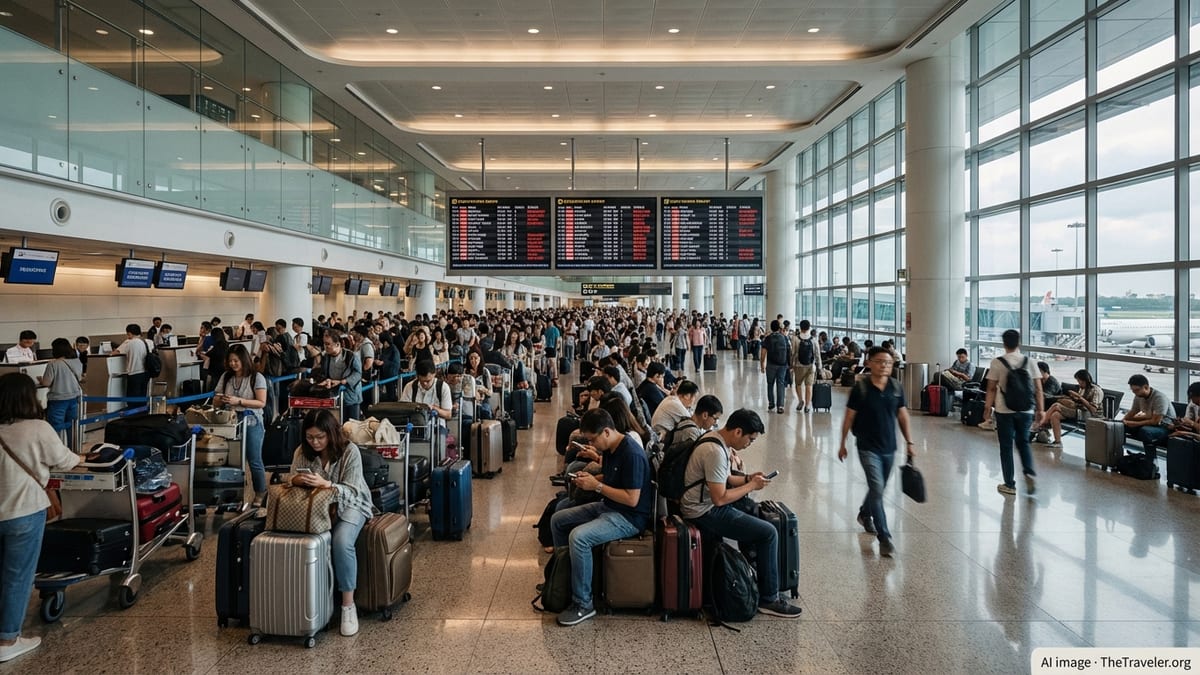
Airports Across Eastern China Cut Schedules as Storm Nears
Publicly available information indicates that Zhejiang and Fujian provinces are at the center of the latest disruption, as Typhoon Saudel tracks toward China’s east coast with sustained winds reported at severe typhoon strength. Meteorological bulletins describe the system as the 18th named storm of the western Pacific season, positioned southeast of Wenzhou earlier this week and forecast to make landfall along the coastline between Zhejiang and neighboring Fujian from late Thursday night into Friday morning local time.
Provincial emergency notices show that Zhejiang shifted into heightened typhoon response earlier this week, with coastal cities moving quickly to scale back transport services. In Wenzhou, maritime authorities already halted dozens of passenger ferry routes and completed the evacuation of thousands of island visitors as seas built ahead of the storm. Similar precautions are being reported in ports and airports along the East China Sea, where storm surges, heavy rain and strong crosswinds are expected to coincide with peak travel periods.
Reports from regional media describe Saudel as part of a broader sequence of powerful storms affecting China this summer, following earlier landfalls that brought torrential rain, floods and landslides. Local coverage notes that if Saudel strikes Zhejiang directly, it would match the province’s earlier record for the number of typhoon landfalls in a single season, further straining already busy transport hubs and emergency response systems.
Flight Delays and Cancellations Mount in Wenzhou, Ningbo and Beyond
Airports along the projected path of Saudel have begun sharply reducing traffic, with Wenzhou Longwan International Airport among the most affected facilities. Published airport data and flight-tracking platforms show that Wenzhou has already cancelled scores of flights as bands of heavy rain and high winds move closer, while neighboring Zhoushan has grounded a significant share of its operations. The combined impact is contributing to thousands of delays and hundreds of cancellations across the wider regional network as airlines re-time or divert services.
Ningbo Lishe International Airport has announced that all flights in and out of the city will be suspended from late Thursday evening, effectively pausing commercial operations for the period in which Saudel is expected to pass close to the coast. Regional press reports highlight that airport authorities in Zhejiang are bracing for a substantial spike in disruption metrics, with delays and cancellations likely to accumulate through Friday as the storm makes landfall and then weakens inland.
Further afield, ripple effects are being recorded across Asia’s aviation system. According to international news agencies, flights have already been cancelled or rescheduled in Taiwan and Hong Kong, where Saudel’s outer rainbands and unstable air have affected services at Taoyuan International Airport and selected routes from Hong Kong to Japan’s Okinawa. Additional knock-on delays are being reported at connecting hubs as carriers adjust schedules to keep aircraft and crews clear of the storm corridor.
Airlines Roll Out Flexible Policies for Affected Travelers
As the disruption intensifies, several regional and international airlines are updating ticket policies for routes into and out of eastern China. Public advisories from at least one major carrier serving Ningbo and Wenzhou show expanded flexibility for customers whose travel dates fall during the most critical period of August 27 and 28, including options to rebook, reroute or request refunds without standard change charges. These measures are designed to encourage passengers to move travel away from the storm window and reduce congestion at airport check in and service counters.
Industry guidance generally urges affected travelers to verify the status of their flights directly through airline websites, mobile apps or customer service channels rather than relying solely on airport departure boards. According to data platforms that monitor operations across Asia, the pace of schedule revisions is increasing as real time wind and rain forecasts are updated, leading to rolling adjustments that can affect departure times, routings and even aircraft types on short notice.
Travel insurers are also drawing attention to policy conditions related to weather disruptions. Local consumer advisories recommend that passengers retain documentation of delays and cancellations, including airline notifications and boarding passes, to support potential claims for additional accommodation, transport or other out of pocket expenses incurred while waiting for rebooked services.
Passengers Advised to Rethink Itineraries as Risk of Further Disruption Grows
Transport and weather bulletins across the region emphasize that Saudel’s impact on aviation may continue beyond the initial landfall, particularly if heavy rainfall persists inland and along the coast. Flooding, low visibility and gusty winds can extend the period of operational constraints at airports, while the repositioning of aircraft and crews often requires additional time once conditions improve. This combination can keep delay and cancellation figures elevated even after the core of the storm has weakened.
Travelers with itineraries involving multiple connections through East Asia are being urged to build greater flexibility into their plans. Public information from tourism and transport agencies advises passengers to consider voluntary rebooking away from the peak impact days, travel with carry on luggage where possible to simplify re-routing, and allow extra time for ground transport to and from airports in case of local flooding or road closures.
For those who must travel during the storm period, regional safety advisories highlight standard precautions at airports, including monitoring official weather alerts, following posted guidance on terminal access, and remaining prepared for extended waits as airlines work through backlogs. With Saudel arriving on the heels of other recent typhoons, Asia’s aviation system is expected to remain under pressure, and further waves of delays and cancellations remain possible as the storm’s final track and intensity become clearer.
South China Morning Post coverage on Typhoon Saudel flight disruptions
EFE report on China’s red alert and cancellations linked to Saudel
Zhejiang provincial update on Typhoon Saudel and emergency response
Airline advisory on flexible ticket conditions for Ningbo and Wenzhou