


More news on this day
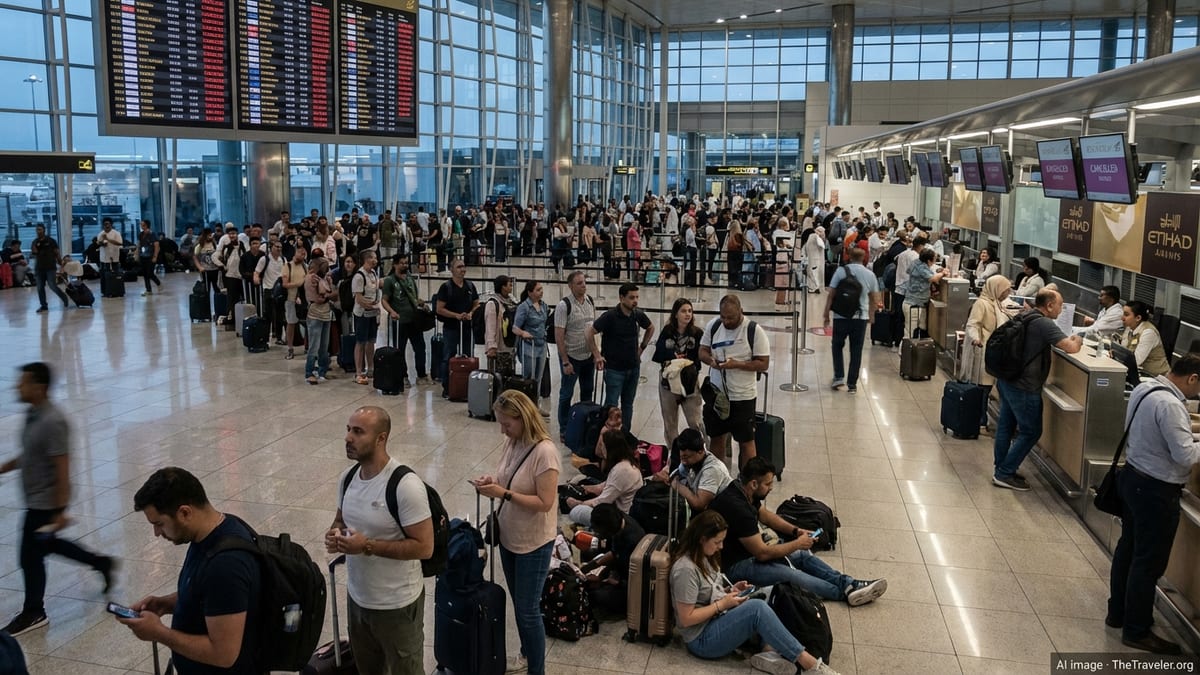
UAE carriers Emirates, Etihad, flydubai and Air Arabia are adjusting Gulf and wider Middle East schedules again, as a fresh escalation in US–Iran tensions triggers rolling cancellations, delays and last-minute timetable changes for passengers flying through Dubai, Abu Dhabi and Sharjah.
Get the latest news straight to your inbox!
Fresh escalation drives new wave of schedule changes
Publicly available reports on September 2 indicate that flights to and from the UAE are facing renewed disruption after US strikes on Iranian targets were followed by missile and drone launches attributed to Iran against American interests in Bahrain, Kuwait and Jordan. The latest flare-up has added pressure to an already fragile regional aviation environment, prompting airlines to review routings and frequencies across key Gulf corridors.
Coverage from regional outlets describes a mixed operating picture for travellers departing the UAE. Emirates, Etihad Airways, flydubai and Air Arabia are continuing to run the majority of their networks, yet several high‑risk or capacity‑constrained routes remain cancelled or reduced. Airlines are also highlighting that schedules may change with little warning as airspace restrictions and security assessments are updated through the day.
The pattern builds on weeks of intermittent disruption linked to earlier phases of the US–Iran standoff, when carriers trimmed services to Bahrain, Kuwait and select Saudi and Iraqi destinations. Recent developments have reinforced that volatility, with some flights restored only to be cut again as tensions spike.
Emirates adjusts Kuwait and Iraq operations
Dubai‑based Emirates continues to operate a broad intercontinental network, but its regional schedule shows targeted cancellations and reductions. According to flight-status round‑ups, the airline has cancelled services on select routes including Dubai–Basra, while maintaining limited daily operations to Bahrain despite wider uncertainty in Gulf airspace. Other flights, such as services to European hubs including Zurich and London Heathrow, are reported as delayed rather than cancelled as operational buffers tighten.
Separate coverage tracking international flight suspensions notes that Emirates’ Dubai–Kuwait routes remain fully suspended following earlier waves of Kuwait‑related disruption, even as a single daily Dubai–Bahrain rotation has been restored. This reflects a cautious approach toward destinations that have seen repeated airspace disruptions and temporary airport shutdowns in recent months.
Emirates is directing passengers to its official digital channels and airport information screens for real‑time status checks, as aircraft and crew are repositioned around changing airspace advisories. The carrier’s ability to re‑route long‑haul services around sensitive corridors has so far allowed most intercontinental flights to operate, albeit with possible delays.
Etihad and Air Arabia Abu Dhabi feel impact at Zayed International
Abu Dhabi’s Zayed International Airport is also seeing knock‑on effects from the latest tensions. A travel advisory published on September 2 lists a series of delayed Etihad arrivals and departures on routes including Islamabad, Karachi, Rome, Tel Aviv, Delhi, Peshawar, Chennai, Colombo, Kochi, Prague, Lisbon, Bangkok and Phuket, with further slippage possible as the day progresses. The pattern underlines how regional airspace constraints can ripple through an airline’s wider network.
Air Arabia Abu Dhabi is experiencing similar challenges on short‑ and medium‑haul routes. Flights from cities such as Ahmedabad, Calicut, Cairo, Sialkot, Bahrain, Faisalabad and Tbilisi have been reported as running behind schedule into Abu Dhabi, with corresponding outbound services also delayed. While these disruptions are generally measured in hours rather than days, they add uncertainty for passengers with onward connections.
Earlier in the summer, Etihad extended cancellations on specific Abu Dhabi–Kuwait flights through late July as the security picture around Kuwait remained unsettled. Those earlier adjustments are now feeding into a broader pattern of cautious capacity management as tensions with Iran continue to evolve.
flydubai and Air Arabia trim Gulf links but keep core networks running
Low‑cost carriers flydubai and Air Arabia, which rely heavily on regional connectivity, are also recalibrating parts of their schedules. Recent flight‑status compilations show Air Arabia cancelling several services linking Sharjah and Abu Dhabi with Kuwait and Bahrain, including Sharjah–Kuwait and Sharjah–Bahrain rotations and an Abu Dhabi–Kuwait flight. Other routes remain operational but are seeing intermittent delays as aircraft are reassigned.
Reports tracking the broader Middle East aviation picture indicate that flydubai has suspended or reduced selected Gulf services at various points during the summer as airspace advisories tightened, particularly around Kuwait and parts of Saudi Arabia. At the same time, the airline continues to operate a significant share of its short‑haul network, with passengers urged to arrive early at Dubai International and use online tools to verify departure times.
Both carriers have emphasized schedule flexibility in recent months, switching to alternative routings where possible and consolidating frequencies on days when demand and operational conditions allow. For travellers, this has translated into a patchwork of operating, delayed and cancelled flights that can change from one news cycle to the next.
International airlines extend suspensions to UAE and wider region
While UAE‑based carriers are largely maintaining skeleton services on many Gulf routes, several international airlines are taking a more conservative stance. Travel advisories compiled in recent days show that Lufthansa, Eurowings and SWISS have suspended Dubai operations through late October, with Eurowings tentatively planning to resume Dubai flights in early November. Other European and North American carriers, including Air Canada, KLM, British Airways and Finnair, have also prolonged suspensions on select Middle East routes as they reassess risk exposure.
Some of these airlines have simultaneously halted flights to regional cities such as Riyadh, Dammam, Muscat, Beirut, Amman and Tehran, creating additional pressure on the remaining carriers still serving those markets. For passengers, this reduces the range of one‑stop options into and out of the Gulf, pushing more demand onto the networks of Emirates, Etihad, flydubai and Air Arabia where capacity remains.
Industry tracking suggests that decisions on when to restore suspended routes will hinge on a combination of security assessments, insurance conditions and the stability of overflight permissions. Until those variables settle, travellers can expect a continued divergence between the operating patterns of Gulf‑based and foreign airlines.
What UAE‑bound travellers should do now
Across the UAE, the consistent message from published advisories is that travellers should check their individual flight status repeatedly before heading to the airport, even if a service was previously confirmed. With airspace conditions and security assessments changing quickly, a flight that appears on time in the morning can be delayed or cancelled later in the day.
Passengers are also being encouraged to build in extra time at airports in Dubai, Abu Dhabi and Sharjah, particularly if they are connecting to onward services. Allowing for longer check‑in, security and transfer windows can help mitigate the risk of missed connections caused by upstream delays on regional sectors.
Travel industry coverage further recommends monitoring airline apps, subscription alerts and airport websites for gate and schedule updates, as well as understanding the rebooking and refund policies that apply to each ticket. With Iran‑linked tensions continuing to influence flight paths and frequencies around the Gulf, flexibility and up‑to‑date information remain essential for anyone planning to travel via the UAE in the coming days.
Gulf News: UAE flight update amid Iran tensions
The National: Abu Dhabi airport delays and cancellations