


More news on this day
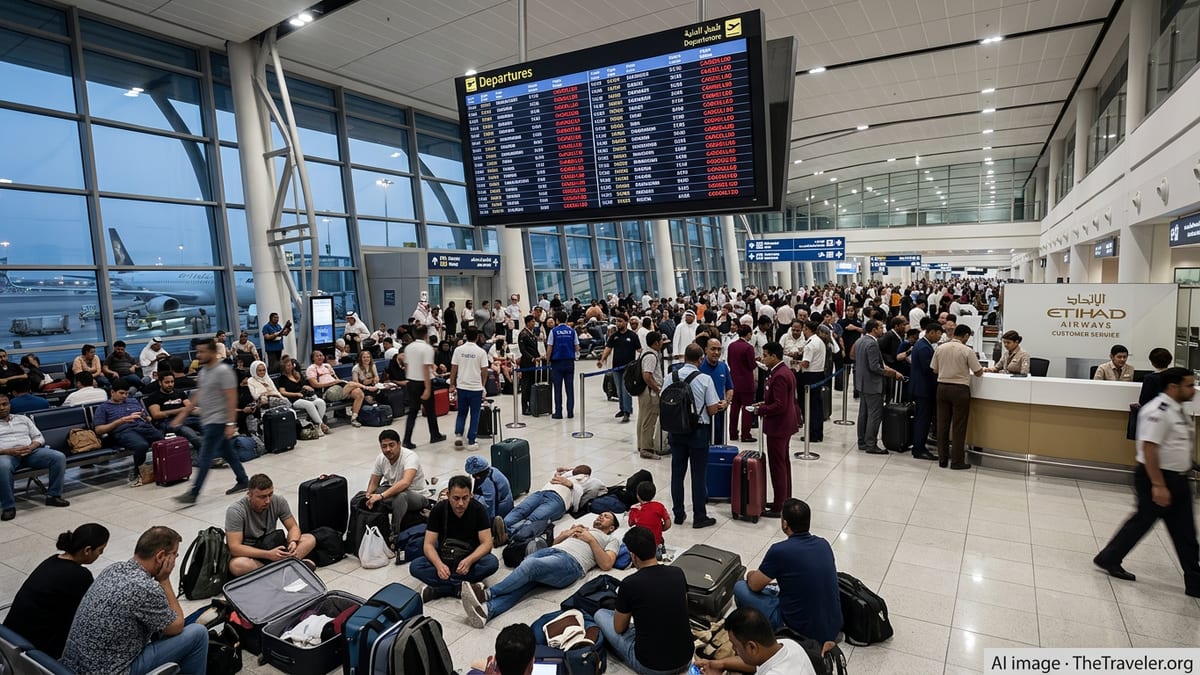
Air travel between the United Arab Emirates and Kuwait has been hit by a fresh wave of cancellations through July 21, as Emirates, Etihad Airways and Air Arabia adjust schedules in response to regional tensions and operational constraints, disrupting journeys for passengers across Dubai, Abu Dhabi and Sharjah.
Get the latest news straight to your inbox!
Carriers Extend UAE–Kuwait Cancellations Into July 21
Published flight-status information shows that Emirates has cancelled several services between Dubai International Airport and Kuwait International Airport on July 20 and July 21, extending a pattern of disruption that began late last week. Multiple Dubai–Kuwait rotations that normally operate daily are listed as cancelled, reducing capacity on one of the Gulf’s busiest short-haul corridors.
According to publicly available schedules, Etihad Airways has also cancelled flights EY653 and EY654 between Abu Dhabi’s Zayed International Airport and Kuwait on July 19 and July 20, citing operational reasons and wider regional conditions. Some Abu Dhabi–Kuwait services around this period remain marked as “awaiting update,” indicating that further changes are possible at short notice.
Sharjah-based low-cost carrier Air Arabia has likewise removed several Kuwait services from its near-term schedule. Recent updates on its booking and status pages show cancelled flights between Sharjah and Kuwait across the July 19 to 21 window, adding to the strain on travelers who rely on short Gulf hops for business, family and transit connections.
The latest adjustments come on top of earlier cancellations reported over the weekend, creating a rolling pattern of disruption rather than a single isolated shutdown. While some services are still operating, the patchwork of flights and last-minute changes is complicating travel planning for residents and visitors across the region.
Airport Disruption in Kuwait and Wider Regional Tensions
The cancellations follow a temporary suspension of take-off and landing operations at Kuwait International Airport after recent rocket and drone incidents in and around the country, according to regional news coverage. Kuwait’s authorities have periodically restricted movements at the airport while security assessments and airspace safety reviews are carried out.
Public reports indicate that Kuwait Airways has rescheduled a large share of its own commercial flights after the airport suspension, highlighting the scale of the disruption. The carrier has urged passengers to monitor their bookings closely, underscoring that schedules remain fluid as operational constraints and security considerations evolve.
Regional media also link the current wave of flight adjustments to broader US Iran tensions and related military activity across parts of the Gulf. Since the outbreak of the latest phase of the conflict earlier this year, airspace closures and temporary restrictions in several Middle East states have periodically affected key aviation hubs, with Kuwait International Airport among those most directly impacted.
In this environment, airlines are recalibrating routes and frequencies day by day around safety assessments, airspace availability and airport operating conditions. The result is an uneven recovery pattern in which some routes resume while others, such as UAE–Kuwait links this week, face fresh cancellations.
Impact on Passengers Traveling via Dubai, Abu Dhabi and Sharjah
The latest cancellations are particularly disruptive for travelers who use Kuwait as either an origin, a destination or a short regional connection linked to long-haul services through Dubai, Abu Dhabi or Sharjah. Many itineraries involve tight turnaround times between Gulf feeder flights and intercontinental legs to Europe, Asia, Africa and North America.
With several Dubai–Kuwait and Abu Dhabi–Kuwait rotations removed from schedules on July 19 to 21, passengers are seeing missed connections, enforced overnight stays and re-routings via alternative Gulf or regional hubs. Travelers who had planned quick weekend trips or business day trips between the UAE and Kuwait are also facing cancellations and last-minute changes.
Publicly available information from airline advisories indicates that affected customers are generally being offered free rebooking onto later services or alternative routings, subject to seat availability, as well as refund options where flights are fully cancelled. However, capacity constraints and the clustering of cancellations over a narrow timeframe mean that the most convenient replacement options are filling quickly.
Travel forums and social media posts from the weekend describe a mix of experiences, from relatively smooth same-day rebookings to cases where passengers are left with multi-day gaps before the next available flight. The situation underscores how even short-haul cancellations can ripple through global journeys when they affect major transit points like Dubai and Abu Dhabi.
What Air Travelers Should Do Now
Given the ongoing uncertainty, air travelers with plans involving Kuwait or transits via the UAE in the coming days are being urged by airlines and travel advisors to adopt a proactive approach. The most consistent guidance is to check real-time flight status on airline websites or apps repeatedly in the 24 hours before departure, rather than relying on older booking confirmations.
Passengers are also being encouraged to allow additional time and flexibility in their itineraries. That can mean avoiding very tight connections between Gulf feeder flights and long-haul sectors, building in longer layovers where possible, or considering alternative routings that bypass Kuwait for the time being if travel dates are not fixed.
For travelers whose flights have already been cancelled, the recommended first step is to manage changes online or via airline call centers, where options for rebooking or refunds are outlined. Some carriers are waiving change fees within specified date windows, although any fare difference for new travel dates can still apply, particularly on busy routes.
Experts also note that travelers who booked through online travel agencies may need to coordinate with both the intermediary and the airline, which can add processing time. Keeping documentation of cancellation notices, updated tickets and any out-of-pocket expenses is advisable in case passengers later seek reimbursement under fare rules or travel insurance policies.
Broader Implications for Gulf Aviation
The disruption on UAE–Kuwait routes this week is another reminder of how quickly Gulf aviation can be affected by geopolitical developments and localized security events. The corridor between the UAE and Kuwait is typically dense with short-haul traffic, feeding long-haul networks that position carriers such as Emirates, Etihad and Air Arabia as key global connectors.
Repeated periods of instability and airspace constraints over recent months have highlighted the vulnerability of these networks to sudden changes, from temporary airport suspensions to altered overflight permissions. Each round of cancellations forces airlines to adjust crew planning, aircraft rotations and revenue forecasts, even when the underlying disruptions last only days.
At the same time, the rapid scaling up and down of schedules shows the resilience and flexibility of Gulf carriers and airports, which have become adept at reconfiguring networks under pressure. As security assessments evolve and operational conditions stabilize, more services between the UAE and Kuwait may return, but near-term travel is likely to remain subject to short-notice adjustments.
For now, passengers planning journeys that touch Dubai, Abu Dhabi, Sharjah or Kuwait through at least July 21 should treat every leg of their itinerary as dynamic. Close monitoring, flexible planning and a clear understanding of airline policies on changes and refunds remain the best tools for navigating the latest phase of Gulf travel disruption.