


More news on this day
Major UAE carriers Emirates, Etihad Airways and Air Arabia have cancelled or suspended a series of flights between the United Arab Emirates and Kuwait, as an escalation in the US-Iran conflict once again disrupts air travel across the Gulf.
Get the latest news straight to your inbox!
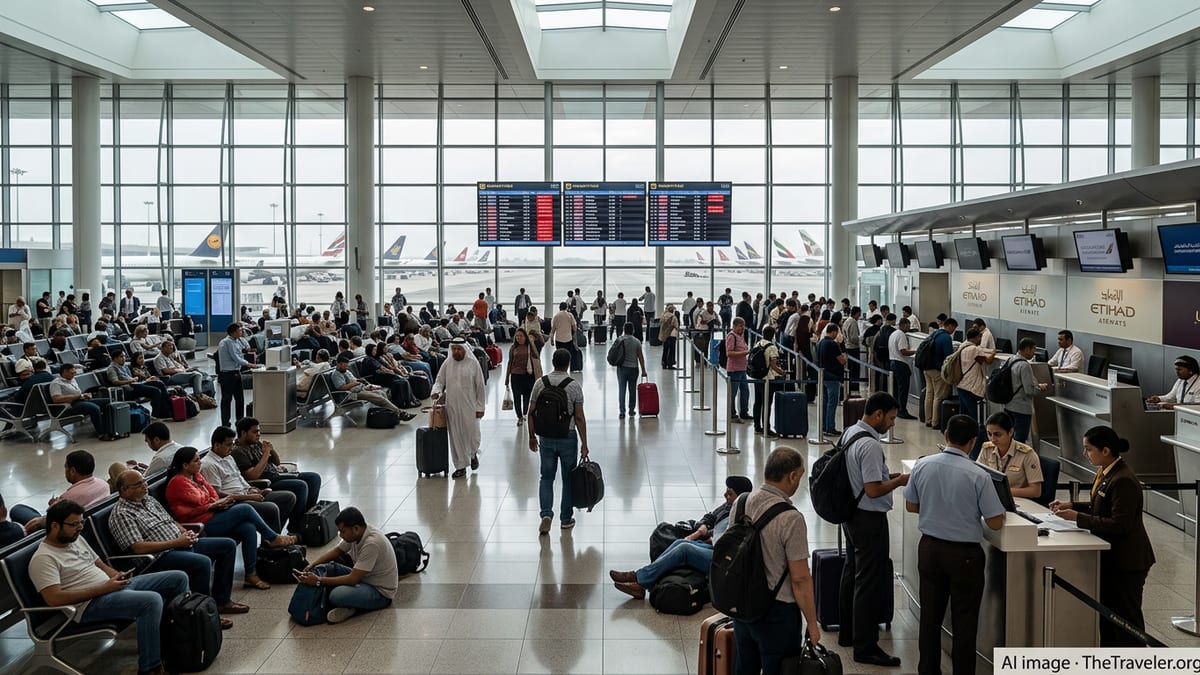
Targeted cancellations hit Emirates, Etihad and Air Arabia routes
Published flight status pages and regional media reports show that Emirates has cancelled a number of services between Dubai International Airport and Kuwait International Airport across the weekend and into Monday, affecting departures on July 19, 20 and 21. Several rotations on the busy Dubai to Kuwait corridor were removed from the schedule or listed as cancelled, reflecting heightened operational caution on this short-haul route.
According to recent schedules, Etihad Airways has also cancelled key services linking Abu Dhabi Zayed International Airport with Kuwait City. Its EY653 and EY654 flights on July 19 and 20 were marked as cancelled, with additional Abu Dhabi to Kuwait services labelled as under review or subject to change. Publicly available information indicates that Etihad is monitoring conditions closely and adjusting frequencies day by day.
Low cost carrier Air Arabia has followed a similar path, with flights between its Sharjah hub and Kuwait, as well as selected services from Abu Dhabi, either cancelled or assigned updated departure times. Travel advisories carried by regional outlets note that Air Arabia customers have been urged to check the latest status of their flights before travelling to the airport due to the fluid situation.
While the three UAE carriers have stopped short of a blanket suspension of travel to Kuwait, the pattern of targeted cancellations and rolling schedule reviews points to a more conservative operating posture as tensions in the wider region escalate.
US-Iran escalation puts Gulf aviation back on alert
The latest round of flight disruptions comes against a backdrop of renewed US-Iran hostilities that have unsettled Gulf airspace since early July. Coverage from regional newsrooms describes a series of military exchanges and drone and missile incidents that have raised fresh concerns about routes passing near sensitive areas, particularly around the northern Gulf.
Aviation analysts cited in industry and regional reports have highlighted that commercial airlines are once again facing a complex risk calculus. Operators are weighing direct exposure to potential conflict zones against the economic and logistical costs of cancellations, detours and prolonged blockages of key flight corridors.
Previous airspace closures and drone attacks earlier in the year forced Kuwait International Airport to halt regular operations for extended periods, with airlines diverting flights to Saudi airports and other regional hubs. Although Kuwait has gradually restored limited services, the airport remains closely watched by carriers and insurers whenever security conditions deteriorate.
The current pattern of selective cancellations by Emirates, Etihad and Air Arabia suggests a focus on minimizing exposure during periods of perceived higher risk, while preserving as much connectivity as possible for transit traffic through Dubai, Abu Dhabi and Sharjah.
Impact on passengers and summer travel plans
The timing of the latest cancellations is particularly sensitive, coinciding with the busy summer holiday window when demand for travel between the UAE and Kuwait typically peaks. Families, business travellers and residents commuting between the two countries have reported disrupted itineraries, with some forced to rebook on alternative dates or reroute via Saudi Arabian gateways.
Travel industry coverage indicates that affected passengers on Emirates, Etihad and Air Arabia are being offered options such as free rebooking, travel vouchers or refunds in line with each airline’s disruption policy. However, limited same-day availability and high seasonal loads mean that finding alternative seats at short notice can be challenging.
Online discussion among travellers and agents shows growing interest in flexible or refundable tickets, as well as a preference for itineraries that allow last minute changes without steep penalties. Some passengers are also exploring overland options via Saudi Arabia, especially when flying directly into Kuwait becomes uncertain.
For Kuwaiti students, medical travellers and workers who rely on frequent flights to the UAE’s major hubs, even short bursts of cancellations can have significant knock-on effects, ranging from missed appointments to complex visa and accommodation issues.
Airlines lean on dynamic scheduling and contingency planning
Operational data and published flight trackers indicate that, outside of the Kuwait market and a handful of other regional routes, UAE carriers are largely maintaining their global networks. Long haul flights to Europe, Asia, Africa and the Americas continue to operate, albeit in some cases on adjusted routings that avoid the most sensitive airspace.
Industry analysis suggests that Emirates, Etihad and Air Arabia are relying on dynamic scheduling tools and real time risk assessments to decide which flights to proceed with and which to cancel. Decisions may be influenced by factors such as route proximity to conflict areas, the availability of safe diversion airports, and evolving guidance from aviation regulators and insurers.
Gulf-based aviation specialists note that lessons from earlier phases of the 2026 Iran war have shaped airlines’ contingency planning. Carriers now move more quickly to scale down specific routes, preemptively reduce frequencies or consolidate services when tensions spike, instead of waiting for formal airspace closures.
This approach is visible in the Kuwait market, where UAE airlines have opted to trim or suspend individual flights while keeping other parts of their schedules intact, thereby preserving hub connectivity and minimizing systemwide disruption.
Travel advice for passengers bound for Kuwait and the wider region
Publicly available advisories from airlines, airports and consular services consistently stress that flight information to Kuwait and parts of the northern Gulf can change at short notice. Travellers are being encouraged to verify their flight status through official airline apps or customer service channels before leaving home, and again on the way to the airport.
Travel agents in the region are recommending that passengers build in longer connection times when transiting through Gulf hubs, and consider travel insurance products that cover war related disruptions or extended delays. Some guidance also highlights the importance of keeping contact details up to date with airlines so that schedule changes can be communicated quickly.
For now, the disruptions to UAE Kuwait flights remain concentrated on specific days and departures rather than representing a complete shutdown of the route. However, the experience of earlier airspace closures and airport suspensions means that both airlines and passengers are acutely aware of how quickly conditions can change when regional tensions escalate.
As the US-Iran conflict continues to evolve, the key question for travellers and the aviation sector alike is whether the latest round of cancellations signals a temporary precautionary phase or the start of a more prolonged period of instability for Gulf air travel.