


More news on this day
Across Ukraine, a web of rail investments and new European alliances is reshaping how future visitors will arrive, with today’s wartime logistics corridors already doubling as the backbone of a postwar tourism revival.
Get the latest news straight to your inbox!
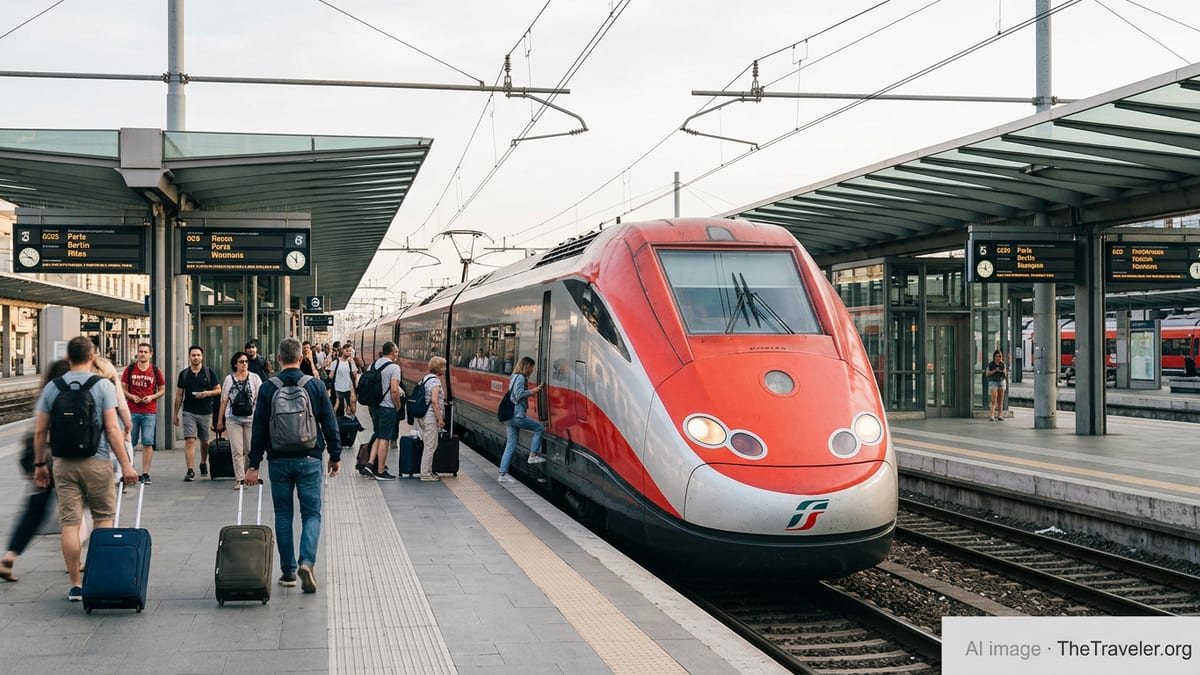
Rail lifeline evolves into future tourism backbone
Ukraine’s railways have been central to keeping the country moving in wartime, and are now emerging as a key platform for rebuilding tourism. Public information from Ukraine’s Ministry for Restoration indicates that a new model of state financing for long distance passenger services, approved in February 2026, is intended to make rail operations more predictable and closer to European public service standards. The mechanism is designed to cover the gap between socially affordable ticket prices and the real cost of running services, helping preserve an extensive national timetable that will be vital when leisure travel returns at scale.
Ukrzaliznytsia, the national operator, manages a network of around 20,000 kilometers and has historically contributed more than 2 percent of Ukraine’s prewar GDP, according to European development data. Rail has remained the dominant mode for domestic long distance travel, even during the conflict, positioning it as the natural backbone for rediscovering Ukraine’s cities, spa resorts and Carpathian mountain regions in more peaceful years. Maintaining through-services on core intercity routes, despite infrastructure damage, is seen by planners as an investment not only in mobility but also in tomorrow’s visitor economy.
Publicly available assessments of Ukraine’s recovery strategy highlight rail as a priority for reconstruction and modernization, particularly where it connects directly with the European Union. Many of the upgrades now funded for cargo and humanitarian supply are being specified with dual use in mind. Improved signalling, renovated stations and higher capacity cross-border links are expected to support future passenger flows ranging from business travelers to cultural tourists and rail enthusiasts.
Solidarity Lanes reshape cross-border connectivity
At the heart of this transformation is the European Union’s Solidarity Lanes initiative, launched in 2022 to keep Ukrainian exports and imports moving via rail, road and inland waterways. European Commission figures indicate that more than 2.3 billion euros has been mobilised to upgrade these corridors, with over 1.5 billion euros in grant support from the Connecting Europe Facility for better border infrastructure, rail capacity and intermodal hubs. While conceived as an emergency response, these projects are now widely described in official briefings as laying the ground for future cross-border passenger traffic.
Several funded schemes target key junctions where tourists are likely to pass in coming years. Upgrades around Uzhhorod and Chop in western Ukraine are expected to streamline movements toward Slovak and Hungarian networks, with onward access to cities such as Košice, Budapest and Vienna. Additional works at border points like Vadul-Siret, on the route into Romania, and improvements along the broader Trans-European Transport Network are intended to reduce bottlenecks that currently slow journeys for both freight and passengers.
European policy documents show that cross-border rail traffic between Ukraine and EU neighbors has already grown sharply since 2022, largely driven by diverted freight. This surge has highlighted infrastructure gaps, especially at busy entry points into Poland and Romania. Once reconstruction accelerates, the same expanded capacity, standardised procedures and modernised terminals are expected to turn what are now freight-heavy corridors into more passenger friendly gateways, shortening journey times for travelers heading to Lviv, Kyiv and Black Sea destinations.
Aligning Ukraine’s rail standards with the European Union
Beyond physical tracks and stations, Ukraine is working to align its rail standards and rules with those of the European Union, a step seen as crucial for smoother international services. A memorandum of cooperation signed in 2024 between Ukrainian Railways and the European Union Agency for Railways is described in public releases as a milestone in adopting EU legislation and technical norms. This cooperation covers areas such as interoperability, safety regimes and common approaches to rolling stock certification.
European Commission reporting on the Ukraine Facility, a support instrument for 2024 to 2027, stresses that reforms in the rail sector are part of a broader modernization drive linked to Ukraine’s EU accession path. Harmonising rules is expected to make it easier for European operators to run trains into Ukraine and for Ukrainian rolling stock to access more EU destinations. For travelers, this would translate into more through-ticketing options, familiar safety standards and the expansion of direct night and daytime services using cross-border compatible equipment.
Transport analysis associated with the extension of the EU’s Trans-European Transport Network to Ukraine and Moldova also points to a gradual standard-gauge expansion on selected corridors. While Ukraine’s domestic network is largely broad gauge, targeted standard-gauge links toward major hubs in Central Europe would ease operations for international trains and simplify the travel experience. The resulting mix of gauges, supported by upgraded transfer facilities, could open a range of multi-country rail itineraries that pair Ukrainian heritage cities with capitals such as Warsaw, Budapest and Vienna.
Tourism alliances lay soft infrastructure for recovery
Hardware on the tracks is being matched by new coalitions in the tourism sector. The Tourism Alliance for Ukraine, presented in 2025 as an open international initiative at a Ukraine Recovery Conference, has been framed in official descriptions as a platform to coordinate European and Ukrainian tourism stakeholders. Its public objectives include aligning Ukraine’s tourism legislation with EU standards, developing marketing strategies for destinations and supporting capacity building for local businesses.
The alliance brings together national and regional tourism bodies, European destination marketing organizations and sector associations that have pledged to prepare for a rapid restart of inbound travel once security conditions allow. According to information shared by Ukraine’s State Agency for Tourism, the initiative aims to integrate Ukraine into wider European itineraries, making it a natural extension of popular multi-country city and rail trips. That approach is expected to pair improved physical connectivity with coordinated branding, digital tools and market research.
Observers in the European travel trade note that Ukraine’s future positioning will likely emphasize both resilience and sustainability, drawing on its rail-centered access and green reconstruction plans. Early concepts discussed in public forums include themed routes combining Unesco listed sites, culinary experiences and rural stays accessible by regional trains. For tour operators accustomed to packaging night trains and scenic daytime lines across the continent, an upgraded Ukrainian network could become a compelling new component of Central and Eastern Europe programs.
European city hubs prepare to reconnect with Ukrainian destinations
On the European side of the border, major rail hubs are quietly strengthening their role as gateways for a future return of Ukrainian leisure travelers. Vienna, for example, has positioned itself as the European Union’s leading night train hub, with publicly available tourism information listing more than 25 cities connected by overnight services operated by Austrian Federal Railways. From Vienna, existing EuroNight and Railjet links already bind the city to Warsaw, Budapest and beyond, forming a lattice that can be extended eastward as conditions stabilise.
Before the full scale invasion, through coaches linked Kyiv with Vienna and other Central European cities via Lviv, using a combination of Ukrainian and EU operators. While current cross-border passenger services remain limited and subject to heightened security considerations, transport planners often reference these prewar patterns when outlining scenarios for restoration. Rehabilitated tracks, upgraded signaling and aligned operating rules under EU supported programs are likely to make the eventual reintroduction of such trains smoother and potentially more frequent than before.
City marketing agencies and national rail companies across Europe are also increasingly promoting rail as the default sustainable mode for medium haul travel, a trend that aligns with Ukraine’s long term reconstruction goals. As the country advances its transition toward a greener economy, cross-border trains are expected to play a central role in framing Ukraine as a rail accessible destination. For travelers planning future trips, the investment now flowing into corridors, stations and alliances suggests that once peace allows, a networked rail journey into Ukraine could feel less like a frontier crossing and more like a seamless continuation of European rail adventures.
EU funding for better transport connections with Ukraine
EU recovery and reconstruction support for Ukraine