


More news on this day
The United States has issued a fresh security alert urging Americans outside the Middle East to “seriously reconsider” travel to and through the region, citing a volatile security environment, renewed hostilities and the risk of sudden disruption to air travel.
Get the latest news straight to your inbox!
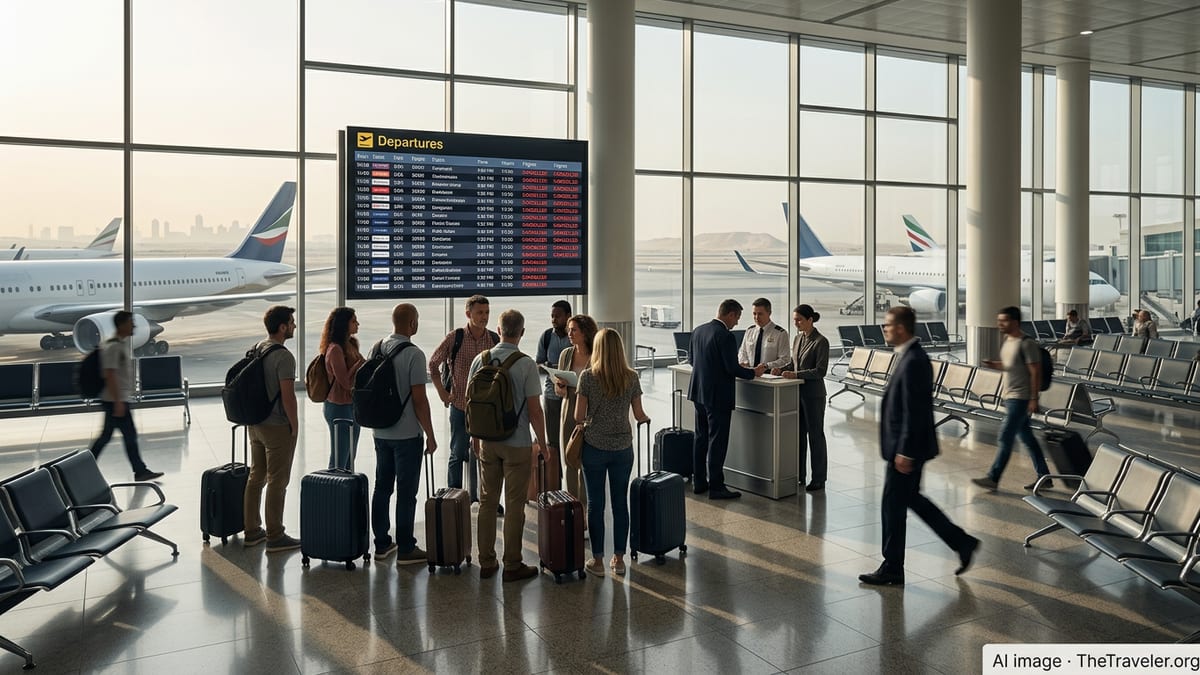
Alert Highlights Escalation Risk Across the Region
The latest warning, issued over the weekend and amplified through the State Department’s Travel.Gov social media channels, frames the Middle East as an area where security conditions could deteriorate with little notice. Publicly available information describes a “complex” environment shaped by renewed clashes involving Iran‑aligned Houthi forces in Yemen, ongoing tensions with Iran and a pattern of missile and drone incidents targeting infrastructure in several Gulf states.
Coverage from multiple outlets notes that the alert specifically advises Americans already in the region to exercise heightened vigilance and to stay informed through local media and official advisories. Travelers are urged to be ready to adjust plans quickly if violence escalates, with the possibility of rapid changes to airport operations or national entry rules.
The warning follows months of elevated concern about spillover from regional confrontations. Earlier government advisories had already underscored the risks of terrorism, air and missile attacks and localized unrest in parts of the Gulf, Levant and Arabian Peninsula, but the new language goes further in urging would‑be visitors to think carefully before committing to new trips.
Country Advisories: From ‘Reconsider Travel’ to ‘Do Not Travel’
Alongside the broad alert, the State Department’s detailed country‑by‑country advisories continue to show a patchwork of risk levels across the Middle East. As of late September 2026, destinations such as Saudi Arabia and Kuwait are at Level 3, meaning U.S. citizens are advised to reconsider travel because of threats that include terrorism and the potential for attacks linked to tensions with Iran. Official guidance for these countries stresses that drone and missile attacks, particularly near energy facilities and military sites, remain a concern.
Other locations in the region, including Iran, Iraq, Lebanon, Syria, Yemen and Gaza, are designated at Level 4, categorized as “Do Not Travel.” These notices cite risks such as armed conflict, civil unrest, terrorism, kidnapping and limited capacity of the U.S. government to assist citizens on the ground. Israel, the West Bank and Gaza collectively remain under heightened advisories that reflect periodic conflict, rocket fire and security incidents.
Gulf hubs that traditionally function as major transit points for global travelers, including the United Arab Emirates, Qatar, Bahrain and Oman, are also affected by elevated advisory levels. While these states still host significant international traffic, travelers are informed that the potential for regional escalation could disrupt flights and complicate contingency planning, even if tourism infrastructure continues to operate.
Impact on Air Travel and Transit Itineraries
The renewed alert is not limited to U.S. citizens whose final destination lies in the Middle East. It also speaks directly to Americans planning to use regional airports as transit points on long‑haul routes between the United States, Europe, Asia and Africa. The language urges those travelers to seriously reconsider itineraries that pass through Middle Eastern hubs, warning that closures of airspace or sudden cancellations could leave passengers stranded.
Recent months have already seen intermittent disruptions to commercial aviation linked to security incidents, according to open reporting. Some carriers have rerouted flights to avoid particular flight information regions, while others have temporarily suspended services to specific airports when tensions spiked. For travelers, this has translated into longer routes, unexpected layovers and, in some cases, last‑minute changes that increase costs and travel times.
Publicly available airline and airport information indicates that major Gulf hubs remain operational, but the U.S. advisory suggests that this situation could change rapidly during any new flare‑up. Travelers are encouraged to factor the risk of sudden diversions or cancellations into their planning, particularly if they are connecting to cruises, tours or events that are difficult to reschedule.
Guidance for Americans Already in the Middle East
For U.S. citizens currently living, working or vacationing in the Middle East, the alert emphasizes preparation rather than panic. According to official consular information, Americans are urged to maintain a low profile, review personal security practices, identify shelter options and ensure that travel documents and emergency funds are up to date. Those residing near high‑value infrastructure or border regions are specifically encouraged to have a plan for relocating or departing if conditions worsen.
The State Department continues to promote the Smart Traveler Enrollment Program, known as STEP, as a key channel for emergency communication. Enrolling allows U.S. embassies and consulates to send security updates by email or text and to contact citizens more easily during crises, including when commercial travel options are disrupted. Previous crises in the region have shown that travelers who are registered and reachable are more likely to receive timely information on evacuation flights or alternative routes.
Public advisory materials also recommend that Americans in the region monitor both local news and U.S. government updates for signals of changing risk, such as new missile or drone incidents, cross‑border strikes, or political developments that could trigger protests or unrest in major cities.
What Prospective Travelers Should Consider Now
For Americans still weighing a future trip to the Middle East, the new alert adds an extra layer of caution to what is already a complex planning environment. Travel publications note that tourism to parts of the region had begun to recover earlier in 2026, particularly to Gulf cities known for large events and shopping, but that inquiries often hinge on the perceived stability of air corridors and the availability of reliable medical and consular support.
Current guidance suggests that leisure travelers with flexible plans may wish to postpone or reroute nonessential trips until there is more clarity about the security situation. Those with unavoidable travel, such as for family reasons or work assignments, are encouraged to examine their destination’s advisory level, study contingency options for exit and consider travel insurance policies that explicitly address conflict‑related disruptions.
Published coverage also underscores the importance of understanding that U.S. government capacity to assist citizens is not uniform across the region. In countries where the security situation is most fragile, access to consular services can be sharply limited, especially if embassies or consulates reduce staff or operations. Travelers who decide to proceed despite the warnings are urged to plan as though local resources and commercial services could be constrained in the event of a sudden crisis.