


Landing at Venice Marco Polo Airport is exciting, but the first practical question most travelers face is simple: what is the easiest and cheapest way to reach Venice itself? For budget-conscious visitors, the bus to Piazzale Roma is usually the smartest answer. This guide walks through the main options from the terminal to Venice’s land gateway, how tickets work, what to expect with luggage, and how to keep your costs under control without adding stress to your arrival.
Get the latest updates straight to your inbox!
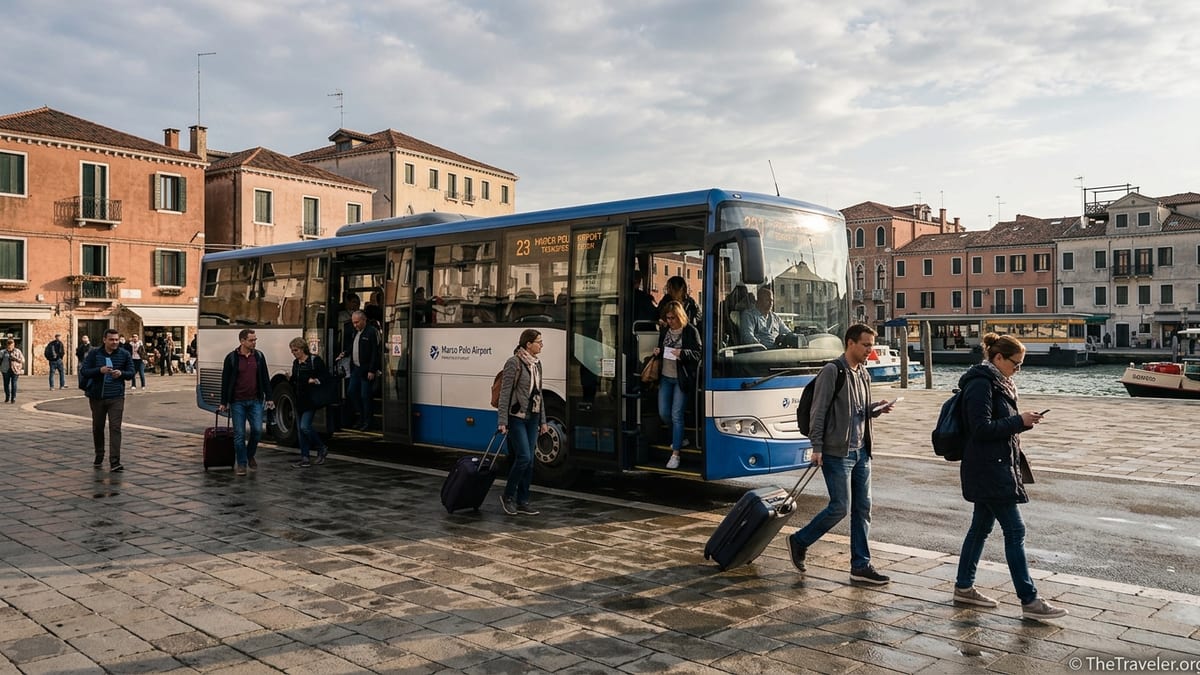
Why Piazzale Roma Is Your Best Budget Landing Point
Piazzale Roma is the western edge of Venice’s historic center and the last place cars and buses can go before the canals take over. Arriving here from Marco Polo Airport keeps things simple and affordable. From Piazzale Roma, you can walk across bridges to many central districts or transfer straight onto a vaporetto waterbus for the Grand Canal, Rialto, or San Marco. For most visitors staying in Cannaregio, Santa Croce, San Polo, or Dorsoduro, this is the most logical and budget-friendly entry point.
Unlike water taxis or private transfers that can cost several dozen euros per person, the airport buses run on fixed fares and frequent schedules. You board at clearly signed stops outside the arrivals area and get off directly at Piazzale Roma in about 20 to 30 minutes, depending on the service and traffic. For a solo traveler or a couple, the bus can often save you enough money to cover your first dinner in the city, while still delivering you to a central and well-connected hub.
Piazzale Roma is also a practical base if you are changing to long-distance transport. Venice’s main train station, Venezia Santa Lucia, is a short walk or one vaporetto stop away, and from there you can continue to Florence, Rome, Milan, or the Dolomites. For early morning departures, many travelers choose hotels and guesthouses in the Piazzale Roma and Santa Croce area precisely because of the quick, predictable bus links back to Marco Polo Airport.
For travelers worried about getting lost on their first day, the bus to Piazzale Roma offers a reassuringly straightforward route. You follow the airport exit signs to “Bus,” buy your ticket from the clearly marked counters or machines, then look for either ACTV or ATVO services to Venice. There is no need to navigate docks or water routes before you have had time to get your bearings.
ACTV Aerobus: Public Transport From the Airport
ACTV is Venice’s main public transport operator on both land and water. Its flagship bus from Marco Polo Airport into the city is commonly referred to as the Aerobus, operating as line 5. This service links the airport with Mestre on the mainland and then crosses the long causeway into Venice, terminating at Piazzale Roma. It is a city-style bus rather than a coach, with standing room, overhead handrails, and space at the front for suitcases and backpacks.
Travel time on the ACTV Aerobus is typically about 25 to 30 minutes from the airport to Piazzale Roma, depending on traffic near Mestre and over the causeway. Because it behaves like an urban bus, it can make a few extra stops en route compared with some coach services. That makes it slightly less comfortable if you are carrying very large luggage, but it keeps prices relatively low and offers flexibility for people staying in neighborhoods between the airport and Venice, such as Campalto or Mestre.
ACTV buses can be particularly attractive if you plan to buy time-limited ACTV passes for waterbuses and city buses. On the Venezia Unica platform you can combine, for example, a 24, 48, or 72 hour ACTV pass with an additional airport transfer by land. That means one purchase covers your ride into Venice plus unlimited vaporetti and local buses for the duration of your stay, which is convenient for visitors who expect to use public transport heavily once in the city.
A practical example: a couple arriving on a Friday afternoon might prebook a 48 hour ACTV pass that starts when they first validate it at Piazzale Roma, plus an add-on land transfer from Marco Polo. They take the Aerobus into town, check into a hotel in Dorsoduro, then use their pass for multiple vaporetto rides over the weekend to Burano, Murano, and back to the station for a Monday train, all under a single ticketing system.
ATVO Venice Airport Bus Express: Coach-Style Comfort
Alongside the local ACTV buses, private operator ATVO runs the “Venice Airport Bus Express” between Marco Polo Airport and Venice Piazzale Roma. ATVO uses coach-style buses with luggage stored in compartments underneath, which many travelers find more comfortable after a long flight. The service is direct or almost direct, skipping many intermediate city stops and focusing on the airport to Venice link.
Typical journey time on the ATVO Venice Express is around 20 to 25 minutes, slightly quicker than the ACTV Aerobus in light traffic. Departure boards at the airport and Piazzale Roma usually show ATVO services at regular intervals through the day, with frequencies tailored to flight patterns. Because of the coach layout, you get individual seats and no standing passengers, which makes the ride feel calmer when the bus is full.
Tickets for the ATVO bus are sold at dedicated counters in the arrivals area and at Piazzale Roma, as well as through automatic machines and authorized resellers. Some travelers prebook online and either print their tickets or show them on a mobile device, then validate or show them before boarding. The advantage of buying at the airport is that you can adapt easily if your flight is delayed or if you decide at the last minute to switch to another type of transport.
Consider a family of four arriving in the morning with two large suitcases and two cabin bags. The ATVO coach usually feels less crowded, and placing the big bags in the underfloor compartment frees up space inside. For parents managing tired children, the predictable comfort of a reserved seat and a direct route to Piazzale Roma can offset a small price difference compared with city buses.
Tickets, Payments, and Pass Options
Both ACTV and ATVO sell their tickets inside the terminal building at Marco Polo Airport. After baggage claim and customs, you enter the arrivals hall, where you find ticket counters and branded machines signposted for buses to Venice and Mestre. Buying immediately after landing is often the easiest option, as you do not need to search for vendors outside or worry about mobile data for online purchases.
ACTV tickets for the Aerobus line can be purchased individually as a one way airport transfer, or bundled with time-limited passes on the Venezia Unica system. Common passes cover 24, 48, 72 hours, or 7 days of unlimited public transport within Venice on ACTV boats and buses, with the airport route treated separately or as part of a specific combined offer. Prices are updated regularly, so travelers should check the current cost shortly before departure, but ACTV remains aimed at budget and everyday users.
ATVO tickets are generally sold as single or return bus journeys, sometimes with discounted return tickets if bought together. In recent years, many travelers have reported paying a handful of euros per person for a one way journey, with return tickets providing modest savings. ATVO also participates in some integrated ticketing arrangements with ACTV and Trenitalia for connections via Mestre, which can be useful if you are heading straight from the airport to the mainland train station.
Contactless bank cards and major credit cards are increasingly accepted on ACTV services, including a specific tap-in and tap-out “EMV” payment method that lets you tap your card at the validator when boarding the airport bus. However, this system has its own fare rules that are distinct from time-limited passes, and it does not automatically convert into a 24 hour transport ticket. Travelers relying entirely on tap-to-pay should pay attention to posted fares and remember to validate correctly when boarding and, where required, when leaving the bus.
Where to Board at Marco Polo and What the Ride Is Like
The walk from the arrivals hall to the bus stops at Marco Polo Airport is short and fully signposted. After buying your ticket, you exit the terminal and follow the “Bus” and “Public Transport” signs along a covered walkway. Outside, the area is divided into clearly numbered bays, with separate locations for ACTV, ATVO, and other operators. Electronic displays usually show the next departures to “Venezia – Piazzale Roma,” which helps you confirm you are in the right place.
ACTV city buses and ATVO coaches are branded in different colors and have their company names displayed on the front and sides. Many visitors check the destination sign on the front of the bus before boarding and also confirm with the driver that the service is going to Piazzale Roma, not only to Mestre. Once on board, ACTV buses tend to feel like any other European urban bus, with standing passengers, stop buttons, and basic seating. ATVO coaches feel more like intercity buses, with larger seats, overhead shelves for smaller bags, and closed doors to the luggage bay under the floor.
On the road, both services follow a similar route. They leave the airport access roads, join the mainland highway, and pass through or alongside Mestre before crossing the long bridge over the lagoon into Venice. As you approach the city, you can often see the water and boats on either side, which gives a first glimpse of the Venetian landscape even before you leave the bus. The approach to Piazzale Roma can be busy at peak times, but the final section is short and mostly straightforward.
The ride itself is usually quiet and uneventful. During commuter hours, buses can be crowded with airport workers, local residents, and travelers. Outside peak times you might find spare seats even on popular departures. Many visitors use the ride to check maps for their onward walk, download a vaporetto timetable, or simply take a breath after the flight before stepping into Venice’s maze of alleys and bridges.
Arriving at Piazzale Roma: Luggage, Transfers, and Orientation
When the bus pulls into Piazzale Roma, it usually stops in a dedicated bay alongside other airport and regional buses. If you arrive with ATVO, the driver opens the luggage compartment, and passengers collect bags from the side of the coach. ACTV passengers simply step down from the bus with their luggage, often using the front or middle doors. The entire square is busy but compact, with clear lines of sight to the main exits and canal-side areas.
From the bus bays, one direction leads to the large parking garage and road out of Venice, while the other leads toward the canal, bridges, and vaporetto piers. Travelers staying near the train station can either walk across the modern Ponte della Costituzione bridge, which arcs over the canal to Santa Lucia station, or follow local signs to the waterbus stops. Rolling a suitcase across the bridge is possible, though there are steps, so some visitors opt for a short vaporetto ride instead.
Luggage handling at Piazzale Roma is mostly a matter of common sense. There are no airport-style trolleys by default, so you carry or roll your bags to your onward transport. Many hotels in Venice provide detailed walking instructions that start from Piazzale Roma or Santa Lucia, often including landmarks like fields, churches, or small bridges. It is wise to have these directions saved offline in case mobile data coverage is patchy among the narrow streets.
For example, a traveler staying in central San Marco might walk from Piazzale Roma to the nearest Grand Canal vaporetto stop, board line 1 or 2, and ride down the canal to San Marco Vallaresso or San Zaccaria. Another guest with accommodation in Cannaregio might find it easier to walk via Santa Lucia station and then follow a series of signed sestiere directions rather than rely on water transport. In both cases, starting at Piazzale Roma gives a simple, fixed reference point in the city.
Costs, Value for Money, and When to Consider Alternatives
Compared with water taxis or private car services, both ACTV and ATVO buses represent very good value. Where a private water taxi across the lagoon to a hotel near San Marco can cost around ten times more per person than a bus ticket, the bus to Piazzale Roma keeps the total transfer cost manageable, especially when multiplied by several travelers. The tradeoff is that you still have to manage one more leg, usually on foot or by vaporetto, from Piazzale Roma to your lodging.
For solo travelers and couples staying within a 15 to 20 minute walk of Piazzale Roma or Santa Lucia station, the bus is typically the best balance between price and convenience. A backpacker staying in a Cannaregio hostel, for instance, can land at Marco Polo, buy an ACTV or ATVO ticket, and be on foot in Venice within about an hour. Even if they later add a multi-day vaporetto pass for island visits, the overall local transport spend remains modest compared with many European capitals.
Families, travelers with reduced mobility, or visitors staying deep in San Marco or Castello may decide that the extra comfort or directness of an alternative is worth considering. Instead of the bus, some opt for the dedicated airport waterbus operator that sails straight from the airport’s dock to several stops around the city. Others, particularly those with very early or very late flights, might choose a prebooked road transfer directly to Tronchetto or Piazzale Roma and then a short taxi boat if needed. Even then, understanding the bus options is useful as a fallback if there are delays or disruptions.
In most typical scenarios, though, the airport bus is the budget traveler’s default choice. By checking current schedules and fares on official Venice transport channels a few days before travel, you can confirm which service best matches your arrival or departure time and make small savings by choosing passes or returns that fit your itinerary.
The Takeaway
Using the bus from Venice Marco Polo Airport to Piazzale Roma is one of the simplest and most economical ways to begin a stay in the lagoon city. ACTV’s Aerobus line offers a true public transport experience, integrated with Venice’s wider network of buses and vaporetti, while ATVO’s Venice Airport Bus Express provides coach-style comfort and a mostly direct run. Both terminate at Piazzale Roma, putting you within easy reach of Santa Lucia station, the Grand Canal, and the main walking routes into the historic center.
Choosing between the two comes down to your priorities. If you want to combine your airport transfer with multi-day public transport passes and are comfortable with a city bus, ACTV is usually the logical fit. If you value a reserved seat, separate luggage compartments, and a slightly more comfortable ride after a long flight, ATVO may be worth a small extra cost. In both cases, buying tickets at the airport, following the clear signs to the bus bays, and preparing your onward route from Piazzale Roma will help your arrival in Venice feel smooth rather than stressful.
For visitors on a budget, every euro saved on transfers can be spent instead on a spritz in a neighborhood bar, a plate of cicchetti by a quiet canal, or an evening vaporetto ride along the Grand Canal. With a bit of planning, the bus from Marco Polo Airport to Piazzale Roma becomes not just a necessity, but the first efficient step in making Venice work for your wallet as well as your imagination.
FAQ
Q1. How long does the bus from Marco Polo Airport to Piazzale Roma take?
The journey usually takes about 20 to 30 minutes, depending on traffic and whether you choose the coach-style ATVO service or the ACTV Aerobus line.
Q2. Do I need to buy my bus ticket in advance?
No, you can buy tickets on arrival at Marco Polo Airport from official counters and ticket machines. Prebooking can be helpful at busy times but is not essential for most travelers.
Q3. Which is cheaper, ACTV Aerobus or ATVO?
Prices are broadly comparable and can change over time, but ACTV is often the slightly more budget-focused option, especially when combined with multi-day ACTV transport passes.
Q4. Can I use my Venezia Unica or ACTV pass on the airport bus?
Time-limited ACTV passes on their own typically do not include the airport bus, but Venezia Unica offers combined products where you add a land airport transfer to your pass when you buy it.
Q5. Is there space for large suitcases on the bus?
Yes. ACTV buses have open standing areas where you can keep bags near you, while ATVO coaches have underfloor luggage compartments, which are more comfortable for larger suitcases.
Q6. What if my flight is delayed and I miss the bus I planned to take?
Both ACTV and ATVO run regular services throughout the day, so you can simply take the next available bus using a valid ticket. Staff at the counters can advise if you are unsure.
Q7. How do I get from Piazzale Roma to my hotel?
From Piazzale Roma, you can walk to many areas of Venice or transfer to a vaporetto waterbus on the Grand Canal. Many hotels provide step by step directions starting from Piazzale Roma.
Q8. Can I pay with a contactless credit or debit card?
Contactless payment is increasingly supported, especially by ACTV, but systems have specific rules. It is safest to confirm on the spot or buy a physical ticket from a machine or counter.
Q9. Is the bus suitable for late night or very early flights?
Services run for much of the day, but very early morning or late night options may be less frequent. Always check the latest official timetable for your specific travel date.
Q10. Are buses from Marco Polo to Piazzale Roma accessible for travelers with reduced mobility?
Most modern buses and coaches have low floors or lifts and designated spaces, but capacity and access can vary, so travelers with specific needs should check details on official operator channels before travel.