


More news on this day
Thousands of airline passengers have been left stranded at UK airports and across Europe after a fresh air traffic control outage triggered widespread cancellations, long delays and scenes of confusion captured in videos shared from terminals and departure gates.
Get the latest news straight to your inbox!
New glitch hits NATS flight processing system
Publicly available information indicates that National Air Traffic Services (NATS), which manages much of the UK’s airspace, experienced a significant technical problem in its flight processing systems this week, forcing restrictions on air traffic and disrupting airline schedules. Reports describe the issue as a “system” or “technical” fault that affected the way flight data is handled, prompting safety measures that sharply reduced capacity.
Coverage from European broadcasters and UK outlets indicates that more than 1,000 flights to and from UK airports were delayed or cancelled in a single day as controllers and engineers worked to stabilise operations. Services at major hubs including London Heathrow and Gatwick were among those affected, with some airports temporarily limiting movements while the fault was addressed.
According to published analysis of previous NATS incidents, similar outages have been linked to problems with the automated processing of flight plans, forcing controllers to enter information manually at much slower speeds. While the latest disruption is still being examined, early reporting suggests a comparable type of system failure, rather than a loss of radar coverage or communications.
Airlines have described the disruption as a network-wide issue for UK airspace rather than a problem at any single airport. That scale has magnified the impact for travellers, particularly those connecting via the UK on long-haul itineraries.
Passengers stranded as delays ripple through the network
Video footage published by international news channels and on social platforms shows crowded departure halls, queues snaking around check-in islands and passengers sitting on the floor near charging points as they wait for updates. At Edinburgh Airport, Sky News video shows travellers bedding down with blankets and camping chairs outside the terminal after late-night cancellations left them with no immediate accommodation options.
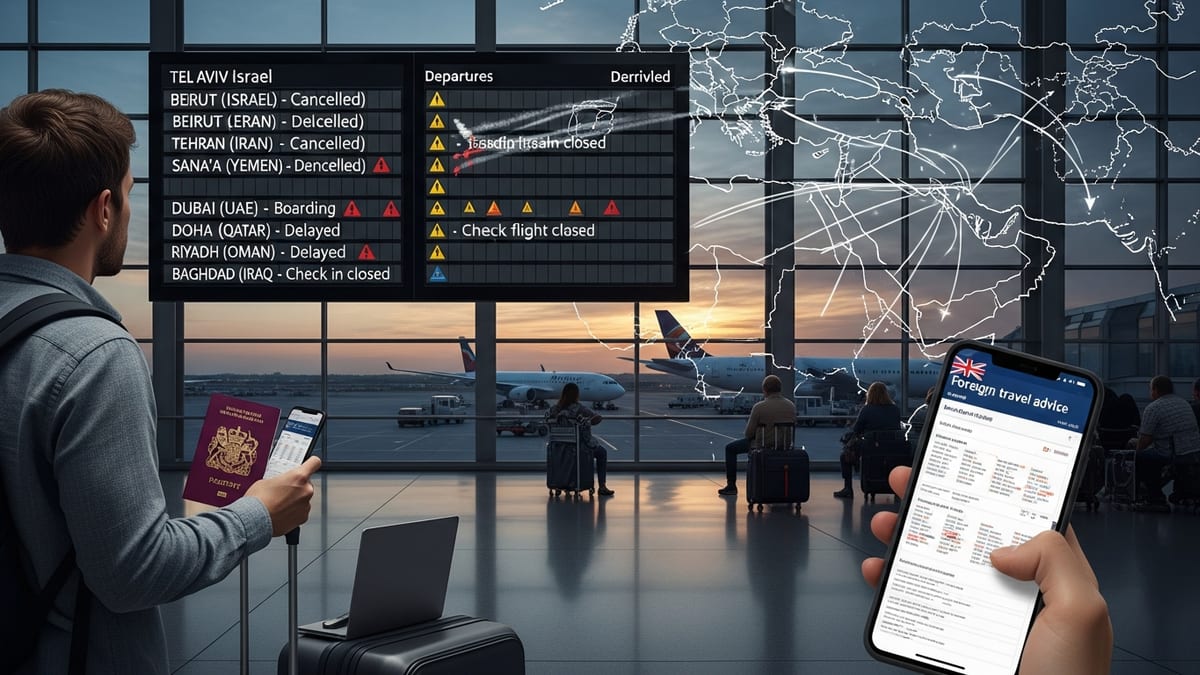
Separate video clips from outlets including Euronews and Bloomberg capture departure boards filled with “cancelled” and “delayed” notices at Heathrow and other major hubs, as well as aircraft held on the ground while air traffic flow rates were restricted. Travellers described being kept on board parked aircraft for extended periods while crews awaited clearance to depart.
The knock-on effect extended beyond the UK. Flights from European cities that rely on UK overflight or connections faced cancellations or diversions, leaving passengers stranded far from home or holiday destinations. Social media posts highlighted families stuck overnight in transit airports, with luggage already checked and limited information on when replacement services might operate.
Airlines began trimming schedules and consolidating services in response to the reduced capacity, a tactic that helped stabilise operations but added to the volume of disrupted trips in the short term.
Airports and airlines advise: check before you travel
Airport statements published on official websites and social feeds urged passengers not to travel to terminals unless their flight was confirmed. One major London hub advised travellers to check directly with their airline before setting out, warning that further last-minute cancellations were possible as the system recovered and aircraft and crew were repositioned.
Published coverage shows that some carriers activated disruption plans used in earlier NATS outages, including offering rebooking on later services, rerouting passengers via alternative European hubs and, where required under air passenger rights rules, arranging hotel stays and meal vouchers. However, the scale of the disruption meant that available hotel rooms around some key airports quickly became scarce.
Consumer groups and regulators have previously urged airlines to provide clear, timely information when large-scale air traffic problems occur. After the August 2023 NATS failure, a report commissioned by the UK Civil Aviation Authority highlighted passenger frustration with inconsistent communication at the airport and via apps. Early commentary around the latest outage suggests that information quality varied again between carriers, with some passengers reporting prompt alerts and others learning of cancellations only on arrival at the terminal.
Travel organisations are encouraging affected passengers to keep records of delay times, boarding passes and receipts in case they are eligible for reimbursement of reasonable expenses. However, industry analysis notes that technical faults in air traffic control systems are often treated as extraordinary circumstances, which can limit compensation rights under UK and EU rules.
Echoes of the 2023 bank holiday meltdown
The latest disruption has drawn immediate comparisons with the August 28, 2023 outage that hit UK air traffic control on one of the year’s busiest bank holiday travel days. At that time, hundreds of flights were cancelled and hundreds of thousands of passengers were delayed after NATS experienced a failure in automated flight-plan processing, according to official post-incident reporting.
Videos from that 2023 incident, widely archived by outlets such as Sky News, ITV and other broadcasters, showed similar scenes of travellers stranded at airports including Manchester, Edinburgh and London hubs. Some passengers camped overnight in terminals or outside airport buildings, while others spent long hours in queues for rebooking desks and customer service counters.
Subsequent investigations into the 2023 event concluded that a rare combination of flight-plan data triggered the failure and emphasised that, despite the disruption, safety margins were maintained. Aviation analysts now point out that although the root causes of this week’s fault have not yet been fully detailed, the recurrence of large-scale disruption is likely to intensify scrutiny on the resilience of the UK’s air traffic control infrastructure.
Industry commentary also notes that repeated outages can undermine passenger confidence at a time when air travel demand remains strong. For airlines, each major incident adds operational complexity and cost, particularly when aircraft and crews are left out of position across multiple bases.
What travellers should do if affected
Travel experts interviewed by broadcasters and quoted in travel industry reports are advising passengers caught up in the latest disruption to focus first on confirming their booking status, either through airline apps or official websites. Many carriers allow free rebooking in the event of air traffic control problems, though options may be limited on peak travel days.
Where flights are cancelled, passengers are generally entitled to a choice between a refund and alternative transport at the earliest opportunity, depending on the carrier’s obligations and local regulations. Public guidance from regulators and consumer bodies encourages travellers to avoid making independent alternative arrangements, such as buying new tickets with other airlines, without first checking the potential impact on their rights to reimbursement.
For those yet to travel, the consistent message from airports and airlines is to treat schedules as highly fluid until the backlog eases. Travellers heading to or through the UK in the coming days are being urged to allow extra time for connections, keep a close eye on live flight information and ensure that contact details in airline bookings are up to date for receiving alerts.
For now, video from terminals across the UK and Europe continues to capture the human side of a technical failure: families sleeping in rows of seats, lines at customer service counters and the collective hope that flights will soon resume something closer to normal patterns.
Euronews: UK airports face more disruption after air traffic control glitch
Channel News Asia: Major UK airports in chaos after air traffic control issue
Sky News: Stranded travellers camp outside Edinburgh airport after ATC failure