


Capital One Lounges have quickly become some of the most talked-about airport spaces in the United States, praised for serious food, strong coffee and thoughtful extras like quiet rooms and yoga spaces. At the same time, changing entry rules, limited locations and frequent crowds mean the experience is not always straightforward. Whether you hold a Capital One card already or are simply considering a day pass, it pays to understand how these lounges work before you plan an itinerary around them.
Get the latest updates straight to your inbox!
Where You Will Actually Find a Capital One Lounge
Despite the buzz, Capital One Lounges are still concentrated in a handful of major U.S. airports as of mid‑2026. Full Capital One Lounge locations are open at Dallas Fort Worth (DFW), Denver (DEN), Washington Dulles (IAD), Las Vegas (LAS) and New York JFK (Terminal 4). Capital One also operates smaller, food‑focused Capital One Landing spaces at Washington Reagan National (DCA) and New York LaGuardia (LGA). A lounge in Charlotte (CLT) is planned but not yet open, so you should not count on it for an upcoming trip unless Capital One has formally announced an opening date.
In practical terms, that means the travel value of a lounge visit depends heavily on your route. For example, a traveler flying American Airlines through DFW Terminal D can easily build a longer layover to enjoy the original Capital One Lounge above gate D22, while someone flying United through Houston has no Capital One option at all and would need to rely on Priority Pass or an airline club instead. Before you get excited about the brand, check your actual departure and connection airports and confirm there is a lounge in the correct terminal and concourse.
It is also important to note that Capital One Landings are not full lounges in the traditional sense. At DCA and LGA the Landing locations function more like upscale restaurants with bar seating and dining tables, centered on chef‑driven small plates rather than showers and nap rooms. That can be perfect if you have 45 minutes between shuttles up and down the Northeast Corridor and mainly want a proper meal and a drink, but it is not a replacement for a full lounge if you need to shower after an overnight flight.
Because the network is still small, many travelers first encounter a Capital One Lounge at DFW, often on a long‑haul trip to Europe or South America. The DFW location in Terminal D has turned into a destination in its own right, particularly for families and leisure travelers starting vacations. If you are connecting through Dallas, it is one of the easiest places to sample the concept and decide whether to plan future trips around these lounges.
Who Can Get In and What It Costs in 2026
Anyone can access a Capital One Lounge, but the cost and process depend on which card you hold. The most straightforward option is the Capital One Venture X Rewards Credit Card or its small‑business sibling. Primary cardholders enjoy unlimited complimentary entry to Capital One Lounges and Capital One Landing locations, as well as to more than a thousand Priority Pass lounges worldwide, provided they show a same‑day boarding pass and their physical card. There is no separate lounge membership fee for the primary cardholder; the lounge access is built into the annual fee of roughly four hundred dollars.
Guest access, however, has become more restrictive. Beginning in February 2026, Venture X cardholders no longer have automatic free guest privileges. Unless you meet a high annual spending threshold across your Venture X account, you should plan to pay roughly forty‑five dollars per adult guest and around twenty‑five dollars for each child aged 2 to 17 at Capital One Lounges and Landings, with infants typically free. Priority Pass lounges generally charge about thirty‑five dollars per guest. For a family of four stopping at the Denver lounge before a ski trip, that can mean paying close to one hundred and fifty dollars in guest fees if only one parent holds the card.
Authorized users have also seen changes. Additional cardholders on a Venture X account no longer receive automatic complimentary lounge access. Instead, the primary cardholder can opt to pay an annual lounge access fee, currently about one hundred twenty‑five dollars per authorized user, which grants that person the same entry privileges at Capital One Lounges, Landings and Priority Pass locations as the primary cardholder. If your partner travels solo several times a year, that fee can be far cheaper than repeatedly paying day‑pass prices, but it is money you need to budget for when deciding how to structure your account.
Travelers without any eligible Capital One card still have options, though they are not cheap. Capital One sells single‑visit day passes to its lounges for around sixty to sixty‑five dollars per person, subject to space. For comparison, a typical airline club day pass in the same airport often runs in a similar price range, usually between fifty and seventy‑five dollars. If you only fly once a year and want to treat yourself to a quiet workspace and good food at Dulles, a paid day pass can still make sense, but frequent travelers are generally better off with an annual‑fee card that includes lounge access.
Timing, Entry Rules and Crowd Management
One of the most important things to understand before your first visit is that Capital One enforces a three‑hour rule at its lounges. In most cases you may only enter within three hours of your scheduled departure time, or during a same‑day layover. Unlike some airline clubs, you cannot typically use a Capital One Lounge on arrival after a flight unless you are making a same‑day connection. Frequent flyers who are used to popping into lounges at the end of a trip for a shower are sometimes surprised to be turned away.
Hours vary slightly by location but are generally generous. The Dallas lounge usually opens at 6 a.m. and closes around 9 p.m., which comfortably covers the morning bank of eastbound departures and most evening transatlantic flights. Denver and Las Vegas typically open at 5 a.m., while JFK’s Terminal 4 lounge has been promoted as operating around the clock, which is especially useful for international passengers connecting at odd hours. Still, seasonal schedule changes and occasional maintenance closures happen, so it is smart to verify current hours inside your Capital One app or on airport signage on the day you travel.
Crowding is another real‑world consideration. Capital One Lounges have developed a reputation for high demand, particularly at DFW during holiday periods and on Sunday afternoons. When the lounge hits capacity, staff place arriving guests on a waitlist and send a text message when space opens up. In practice, wait times can range from a few minutes to more than half an hour. If you have a short connection, you should not count on being able to walk straight in. Travelers with tight layovers at DFW often keep the nearby American Airlines Admirals Club in Terminal D as a backup option if they also hold that access.
Finally, remember that each visitor must present both a qualifying card or day‑pass confirmation and a same‑day boarding pass. If you are traveling with a friend on separate reservations, make sure the lounge staff can see that you are indeed departing that day. At times staff will also check your flight’s departure time and may decline entry if your departure is significantly delayed and your new boarding time is more than three hours away, so be prepared for some flexibility depending on how crowded the lounge is.
What the Experience Is Really Like Inside
Every Capital One Lounge has its own design and local touches, but a few elements define the experience across the network. The food is a cut above what you will find in many traditional airline clubs, emphasizing chef‑driven dishes and regionally inspired menus. At DFW, for example, you might see brisket sliders, jalapeño pimento cheese and Texas‑style breakfast tacos on the buffet alongside lighter options such as quinoa salads and roasted vegetables. At Denver, menus lean into hearty mountain fare, with items like bison chili and roasted root vegetables appearing seasonally.
Beverages are another strong point. Full bars pour local craft beers, regional wines and a focused list of cocktails that often incorporate house infusions or syrups. Travelers at the Las Vegas lounge, for instance, can order a bartender‑made old fashioned or a signature gin spritz without an extra fee, while non‑drinkers have access to espresso drinks, cold brew coffee on tap, and a range of teas and craft sodas. Unlike many airline clubs where the premium drinks list carries a surcharge, most Capital One cocktails and better spirits are included in the entry cost, though truly top‑shelf bottles may be excluded.
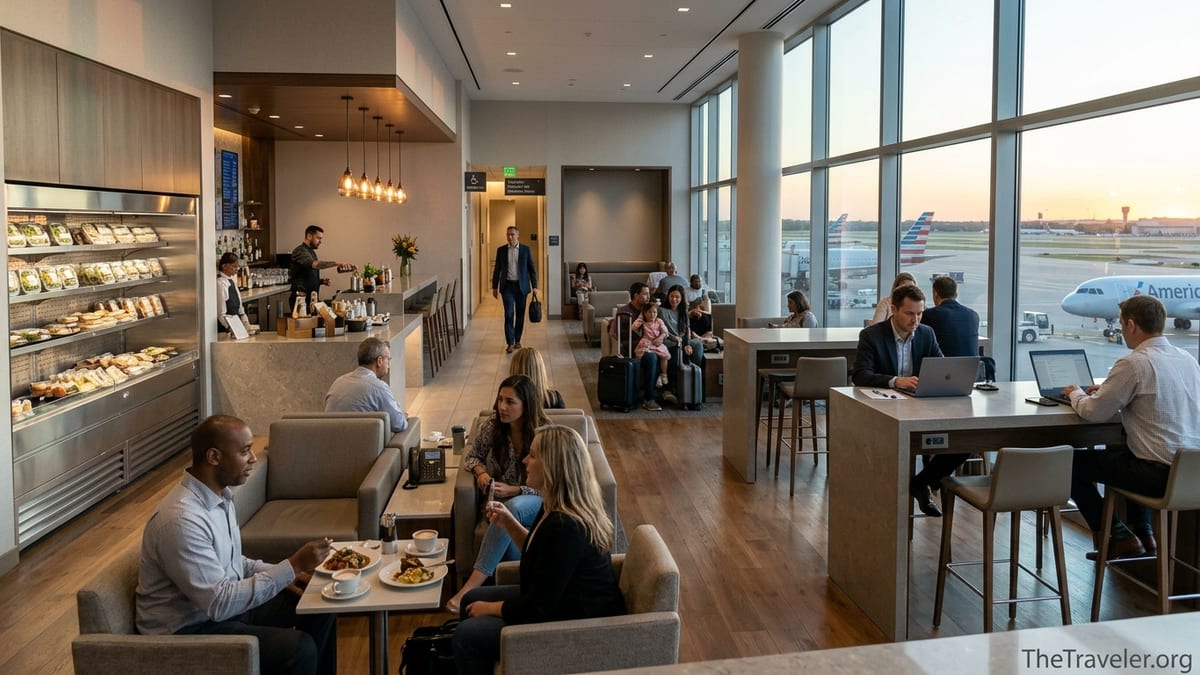
Seating and layout are generally well thought out, though they can feel busy during peak times. Expect a mix of communal work tables with power outlets at nearly every seat, semi‑enclosed booths ideal for couples, individual lounge chairs facing tarmac views, and a few quieter corners for phone calls. At DFW and IAD, families will appreciate separate family rooms with softer seating and space for children to spread out. Some locations, such as Dallas and Denver, also feature prayer or meditation rooms, which can be invaluable on long international itineraries.
One standout feature across the lounges is the emphasis on grab‑and‑go food. Near the entrance you will often find refrigerated cases stocked with neatly packaged salads, sandwiches, breakfast boxes and snacks that you are explicitly encouraged to take with you onto your flight. Typical items might include turkey and brie sandwiches on ciabatta, overnight oats with berries, veggie wraps and small bags of trail mix. For a traveler connecting through JFK on a tight schedule, being able to swipe in, grab a latte and a boxed salad in five minutes, and head straight to the gate can make the difference between boarding hungry and settling in comfortably.
Amenities That Stand Out Compared With Other Lounges
Beyond food and drink, several amenities distinguish Capital One Lounges from many legacy airline clubs. Fitness and wellness spaces are one example. At DFW, you will find a compact cycling and yoga room with a couple of bikes, mats and resistance bands, allowing you to loosen up after a cross‑country flight. Showers are available at select locations, equipped with spa‑style toiletries and rainfall showerheads. These facilities can be particularly valuable for passengers arriving from overnight flights from Europe and connecting to domestic legs, even though using the lounge technically requires an onward boarding pass.
Quiet rooms and relaxation spaces are another signature feature. Some lounges include small, dimly lit rooms with reclining chairs or daybeds that allow you to rest away from the bustle of the main seating area. While these are not full private sleeping suites, they offer a level of rest that most standard airline clubs cannot match. Travelers with a long afternoon layover before a red‑eye might combine an hour of laptop work, a shower and a short nap, effectively turning the lounge into a compact co‑working and recovery space.
Business travelers will appreciate functional touches such as lockers where you can safely stow a carry‑on while you shower, as well as fast Wi‑Fi and abundant charging ports. Several lounges provide semi‑private work pods or small meeting rooms that can be reserved on demand, which are useful if you need to take a confidential client call or join a video meeting. Compared with many Priority Pass lounges that offer only basic seating and snacks, these work‑oriented amenities can make a big difference on a day packed with meetings and flights.
Compared with rival products, Capital One’s lounges are often described as a hybrid between an American Express Centurion Lounge and an upscale co‑working space. The design tends to be modern but not flashy, with warm woods, neutral fabrics and plenty of natural light. If you are used to more dated airline clubs with low ceilings and muted lighting, walking into the high‑ceilinged Denver location, with its views of the concourse below and the Rockies in the distance, can be a refreshing surprise.
How to Decide if a Capital One Lounge Is Worth It for You
Whether these lounges are “worth it” depends entirely on your travel patterns and expectations. If you primarily fly out of or through airports with Capital One locations, such as DFW, DEN, IAD, JFK or LAS, and you value good food and a comfortable place to work, then building your routine around them can make sense. A frequent business traveler who flies from Washington Dulles to the West Coast monthly, for example, could easily use the lounge ten or twelve times per year, extracting significant value from a Venture X card’s lounge access alone, especially when factoring in the ability to visit Priority Pass lounges on other routes.
For occasional travelers, the math is different. Suppose a couple takes one international vacation per year and departs from JFK Terminal 4. Buying two day passes at around sixty dollars each adds over one hundred dollars to the cost of the trip. That might still be worthwhile if you plan to arrive at the airport early, eat both breakfast and lunch, enjoy drinks and work in quiet comfort for several hours. But if you habitually arrive at the airport ninety minutes before departure and rarely eat more than a quick snack, spending that much on a short visit may not be the best use of your budget.
Guest fees and the new spending‑based guest benefit make a real difference for families. Parents who previously relied on free guest access may now face nearly two hundred dollars in extra costs for a family of four to use the lounge even once. In that scenario, it can be worth running the numbers on paying the annual lounge access fee for an authorized user so that both adults can enter on their own cards, reducing or eliminating guest charges. Alternatively, some families decide to skip the lounge entirely and put those funds toward a nicer hotel or a special meal at their destination.
Finally, think about what kind of airport experience matters most to you. Capital One Lounges excel at offering superior food, pleasant design and a few genuinely useful extras such as showers and quiet rooms. If your top priority is simply boarding early and having space for your carry‑on bag, paying for lounge access will not change that. On the other hand, if you hate hunting for power outlets in crowded gate areas or trying to take a conference call over constant boarding announcements, the ability to retreat into a well‑equipped lounge can transform the feel of a travel day.
Practical Tips for a Smooth First Visit
A little preparation goes a long way toward making your first Capital One Lounge visit smooth. If you have a Venture X or similar card, make sure it is activated and physically in your wallet before your trip. Although some lounge agents can look up your account or use a digital card in the Capital One app, relying on that introduces friction at the door, especially when the lounge is crowded. If you are an authorized user whose access depends on a paid lounge access benefit, double‑check that the fee has been processed and your lounge privileges are active before you travel.
Plan your airport arrival with the three‑hour rule and possible waitlist in mind. At busy times, it may be better to clear security and head directly to the lounge check‑in desk rather than stopping at a coffee shop en route. If there is a wait, ask staff for a realistic estimate. At DFW, for instance, a thirty‑minute quoted wait on a Sunday afternoon may still leave you enough time for a quick plate of food and a drink before boarding, but not for a leisurely shower. Keep an eye on your flight’s boarding time while you are in the lounge so you do not miss it; announcements are not always audible in quieter corners.
Inside, it can be tempting to treat the lounge like an all‑you‑can‑eat buffet, but pacing yourself will make for a more pleasant experience. Start with a coffee or sparkling water and a light snack, then see how busy the food stations and bar are before queuing for a full meal. If you plan to grab food for the flight, wait until closer to boarding so your items stay fresh. Many regulars use the grab‑and‑go section strategically, picking up a salad and a can of sparkling water for a three‑hour domestic leg where otherwise only buy‑on‑board snacks would be available.
Finally, respect the shared nature of the space. Avoid taking calls on speakerphone, limit time in the quiet or nap rooms so others can use them, and leave shared worktables tidy. Staff are often happy to explain how particular amenities work, such as how to reserve a shower or where to store luggage. Treating the lounge as a hosted living room rather than a private office will help keep the atmosphere pleasant for everyone, including you.
The Takeaway
Capital One Lounges and Landings represent a newer, more food‑forward style of airport lounge, with strong coffee, restaurant‑quality dishes and thoughtful extras like showers, family rooms and quiet spaces. Their small but growing footprint in key U.S. hubs means they can significantly improve travel days that pass through Dallas, Denver, Dulles, Las Vegas or New York JFK, and their Landing offshoots add welcome dining options at Washington Reagan and LaGuardia.
At the same time, lounge access in 2026 is subject to stricter guest rules, capacity limits and the familiar realities of airport operations. Before you count on a visit, you will want to confirm there is a lounge in the right terminal, understand the three‑hour entry rule, budget for any guest or authorized‑user fees, and build in enough time in your itinerary to enjoy the experience. When approached with realistic expectations and a bit of planning, a stop at a Capital One Lounge can turn an ordinary layover into a comfortable, even memorable, part of your trip rather than something to simply endure.
FAQ
Q1. Do I need a Capital One card to use a Capital One Lounge?
Not strictly. Holding a qualifying Capital One card such as Venture X gives you complimentary entry, but travelers without eligible cards can usually buy a single‑visit day pass at the door, subject to space.
Q2. How early can I enter a Capital One Lounge before my flight?
In most cases you can enter up to about three hours before your scheduled departure time, or during a same‑day layover. Arriving much earlier than that or trying to visit after landing is likely to result in being turned away.
Q3. Are food and drinks free inside Capital One Lounges?
Yes, the buffet food, grab‑and‑go items and a curated list of alcoholic and non‑alcoholic drinks are included in your entry. A few top‑shelf spirits or specialty items may carry an extra charge, but most guests never see a bill.
Q4. Can my family come in with me if I have a Venture X card?
They can, but you should expect to pay guest fees unless you have met Capital One’s annual spending requirement that unlocks free guests. As a rule of thumb, budget around forty‑five dollars per adult and a bit less per child for each visit.
Q5. Do Capital One Lounges have showers and nap rooms?
Several locations, including Dallas and Denver, offer shower suites and small quiet or relaxation rooms. Availability varies by lounge and works on a first‑come, first‑served basis, so ask at the front desk if you want to use them.
Q6. What is the difference between a Capital One Lounge and a Capital One Landing?
A Capital One Lounge is a full‑service space with buffets, bar, seating, and often showers and quiet rooms. A Capital One Landing, like those at DCA and LGA, is more like an elevated restaurant and bar focused on sit‑down dining rather than extensive lounging amenities.
Q7. Can I get into a Capital One Lounge with Priority Pass alone?
No. Capital One Lounges do not accept general Priority Pass memberships as standalone entry. However, Venture X cardholders can enroll in Priority Pass for access to other lounges worldwide, separate from Capital One’s own spaces.
Q8. How crowded are Capital One Lounges?
They can be very popular, especially at peak times such as Sunday evenings or holiday travel periods. When the lounge is full, staff will place you on a waitlist and text you when space opens up, so having a backup plan is wise.
Q9. Is it worth buying a day pass if I only have a short layover?
If your layover is under about ninety minutes, you may struggle to fully enjoy the food, drinks and amenities. In that case, it can make more sense to grab a quick meal in the terminal unless you particularly value a quiet place to sit and work.
Q10. How do Capital One Lounges compare with airline clubs and Centurion Lounges?
Capital One’s spaces tend to offer better food and more modern design than many traditional airline clubs, with amenities like grab‑and‑go fridges and wellness rooms. Compared with American Express Centurion Lounges, the overall feel is similar in quality, though exact offerings vary by airport and crowding levels can be high in both networks.