


Psarou Beach in Mykonos is one of the most exclusive stretches of sand in the Cyclades, a small bay where turquoise water, high-end beach clubs and yacht tenders all compete for space. Choosing when to visit is not a minor detail here. The difference between a June weekday and an August Saturday can mean anything from a relaxed swim with plenty of sand to yourself to a standing-room-only scene where a pair of sunbeds can rival a boutique hotel night. This guide breaks down the best months, days and even times of day to visit Psarou so you can match the beach’s intense energy to the kind of holiday you actually want.
Get the latest updates straight to your inbox!
Understanding Psarou Beach and Its Seasons
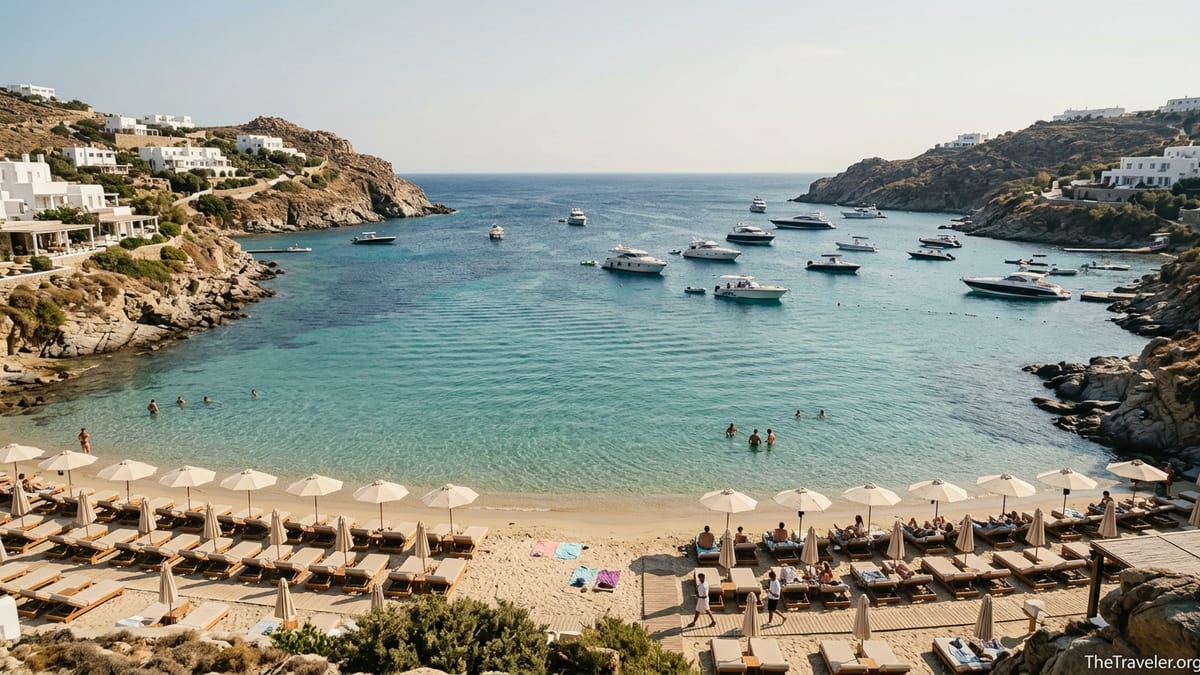
Psarou sits on Mykonos’s sheltered south coast, a relatively short drive from Mykonos Town and just around the headland from Platis Gialos. It is famous for its clear, calm water and for Nammos, one of Greece’s most expensive and talked-about beach clubs, alongside smaller but still upscale setups that line most of the sand. In summer the bay fills with yachts and tenders, and the soundscape shifts from lapping waves in the morning to DJ sets and champagne-fuelled lunches by mid-afternoon.
Like the rest of Mykonos, Psarou is highly seasonal. From roughly late May to early October, beach clubs operate at full or near-full capacity and sunbeds cover most of the sand. Outside these months, the bay is much quieter and facilities may be limited or closed, which can be charming for a winter walk but disappointing if you expect full service with cocktails brought to your lounger. For most visitors, the decision is not whether to come in high or low season globally, but which slice of that late-spring-to-early-autumn window will deliver the right blend of warmth, atmosphere and value.
The island’s famous meltemi winds, strongest from mid-July to late August, also shape the experience. These northerlies cool down intense summer heat, which is welcome, but they can make more exposed north-coast beaches choppy. One reason Psarou is so popular is that its south-facing, enclosed bay stays relatively protected, so even on windy days you will often find swimmable, clear water here while other beaches are rough.
Month-by-Month: When Psarou Shines
Late May and June are widely considered one of the best times to experience Mykonos, and that holds especially true at Psarou. Daytime highs usually sit in the mid-20s Celsius (mid to high 70s Fahrenheit), most restaurants and shops are open, and the water is generally warm enough for comfortable swimming by early June. Beach clubs at Psarou are operating with their full menus and staff, but advance sunbed reservations are easier and prices, while still high, are often slightly lower than in August. A couple arriving in mid-June might pay a premium for front-row beds at a major club, but it is less likely they will hear “fully booked” for every option.
July and especially August are peak months for Psarou. Air temperatures reach the high 20s to low 30s Celsius (low to mid-80s Fahrenheit), the sea is at its warmest, and the beach is often at capacity by late morning. This is when you are most likely to see entourages arriving by tender from anchored yachts, large group tables ordering magnums of rosé at lunch and a wall of sunbeds with almost no free sand. Visiting during the first two weeks of August, many travelers report needing to reserve loungers days in advance and paying top-tier rates for even second-row beds.
September may be the single best month for travelers who want a lively Psarou without the most intense peak-season pressure. Water temperatures stay warm, the weather is typically settled and sunny, and most venues remain fully operational. Yet family holiday traffic drops sharply once European schools reopen, and the late-season crowd skews more toward couples and groups of friends on flexible schedules. By late September, some clubs might start shortening hours or scaling back events, but on a practical level you are more likely to be quoted more reasonable sunbed prices and find space for a spontaneous long lunch by the water.
In October, the experience shifts again. Early October can still bring pleasant beach weather, especially in the first half of the month, with warm afternoons and relatively calm seas. However, the atmosphere is noticeably quieter, some high-end venues begin closing for the season, and evening temperatures can be cool enough to need a light jacket. If your priority is simply swimming and enjoying Psarou’s scenery without a party vibe, a warm spell in early October can feel like a bonus, but you should not count on the full peak-season services.
Weather, Wind and Water: What to Expect by Season
From late May through September, Mykonos typically enjoys hot, dry, sunny weather with relatively low humidity. Psarou benefits from this pattern with long, bright beach days and reliably warm water from roughly mid-June onward. In late May or very early June the sea can still feel brisk to some, especially in the morning, but by high summer many visitors swim comfortably for long stretches. Because Psarou’s bay is shallow near the shore, it often feels slightly warmer than more exposed stretches of coast.
The meltemi winds are a key seasonal factor. They tend to pick up from mid-July, peaking around late July and into August. On the north coast of Mykonos, these winds can make sunbathing unpleasant and cause whitecaps and strong chop. Psarou’s south-facing orientation and headlands shelter it from the worst of the gusts, so even on a blustery day you might find people comfortably swimming, paddleboarding or simply floating close to shore. This makes Psarou a strategic choice if your trip falls in late July or August and you run into a particularly windy spell.
In spring shoulder season, particularly late April and early May, daytime highs are usually mild and pleasant, ideal for hiking, exploring Mykonos Town and long lunches at tavernas overlooking calmer, less busy beaches. At Psarou, though, the full “scene” is not yet in place. You may find limited loungers set up and some clubs in soft-opening mode, which can be attractive if you only want a quick swim and a quiet drink rather than a party. Sea temperatures at this time are cooler, so many visitors prefer shorter dips or just enjoying the view.
Winter on Mykonos, from November through March, brings cooler temperatures, occasional rain and stronger winds. Psarou is still beautiful, but it functions more as a scenic bay for a brisk walk or a photo stop on a drive around the island rather than a day-long swimming and lounging destination. Many hotels in the Psarou and Platis Gialos area close completely, and you should not expect sunbed service or open beach bars on a random day in January.
Crowds, Prices and the Psarou “Scene”
Psarou is one of the most commercially intense beaches on Mykonos. In peak season, much of the sand is occupied by organized sunbeds belonging to beach clubs like Nammos and neighboring venues, and a typical visit revolves around reserving a set of loungers, ordering food and drinks and staying for several hours. Prices reflect both the high-end branding and the limited space in the bay. In July and August, prime front-row beds can cost into the low hundreds of euros per set for the day once you include minimum spends on food and beverages.
During June and September, you still encounter a luxury environment, but the experience is less pressured. For example, a couple arriving on a midweek June morning may be quoted a noticeably lower minimum spend for second or third-row beds than friends encountered during August of the previous year. They are also more likely to be able to stroll from one end of the beach to the other and compare options in person instead of feeling committed to whichever venue had a spare booking weeks earlier.
Crowd density varies sharply not just by month but by weekday. Saturdays in late July can see the beach full of group celebrations, pre-wedding parties and large tables ordering elaborate seafood spreads. Midweek days in early June or late September still feel busy but more balanced, with a mix of international visitors, Greek weekenders, and people making Psarou one stop in a longer island-hopping itinerary. If you find yourself sensitive to noise, the spacing between loungers and the volume of music matter as much as the headcount; some clubs maintain a more restaurant-like atmosphere, while others push the party element by mid-afternoon.
There is also a small section of Psarou that remains public and largely free of organized sunbeds, usually toward one end of the bay. In the middle of August, even this sliver can be shoulder-to-shoulder by noon. In May, early June or late September, though, you stand a better chance of laying out a towel without feeling squeezed between rows of loungers. For budget-conscious travelers who still want to experience Psarou’s water and views, timing their visit to these shoulder periods can make a significant difference.
Best Time of Day to Visit Psarou Beach
Time of day can be as important as month when planning your Psarou visit. Early morning, roughly from 8:30 to 11:00, offers the calmest and most relaxed conditions. The sun is lower, making the water especially photogenic, and the music from beach clubs tends to be softer or not yet in full swing. In June or September, this is the window when you can sometimes walk up and secure loungers without a reservation, especially away from the very front rows.
From late morning into early afternoon, usually around 11:00 to 15:00, Psarou reaches its busiest period. Day-trippers from cruise ships, guests from nearby hotels and visitors arriving from other parts of the island converge on the beach. Restaurants and beach clubs start lunch service and bring out more elaborate menus. If you are visiting in high season and value a particular spot or club, you will want to be on the beach by mid-morning at the latest, particularly on weekends. Arriving at 13:30 on an August Saturday with no reservation will almost certainly mean limited options and long waits for a table.
Late afternoon, roughly 15:00 to 18:30 in summer, sees a shift in mood. Some guests start to leave to rest before heading into Mykonos Town, while others arrive specifically for golden-hour drinks and music. The sun angles lower over the ridge, creating softer light over the bay and slightly cooler temperatures that make lounging more comfortable. This can be an excellent window in June or September to visit Psarou after exploring the island earlier in the day. You may not get the front row, but you will often find enough space to enjoy a swim and a couple of drinks without the midday intensity.
Evening is quieter on the sand itself but still active in and around the clubs, especially during events or themed nights in July and August. Psarou is not primarily a late-night beach in the same way as nearby Paradise or Super Paradise, so if you are seeking dance-until-dawn parties, you might reserve Psarou for daytime and head elsewhere after dark. That said, on some peak nights, dinner at a restaurant attached to one of the beach clubs can roll naturally into a more upbeat scene with music and dancing before midnight.
Matching Psarou’s Timing to Your Travel Style
If you are visiting Mykonos explicitly for the high-energy, big-budget summer scene, the second half of June through the end of August is when Psarou aligns best with your expectations. A group of friends celebrating a birthday, for example, might choose the last weekend of June rather than mid-August to secure a large table for lunch and a cluster of beds together, enjoying nearly peak atmosphere with slightly less competition and more reasonable prices.
Couples seeking a mix of luxury and calm often gravitate toward early or mid-June and early-to-mid September. Imagine a pair staying at a boutique hotel above Psarou, spending the morning swimming before the beach fills, retreating to a shaded terrace for a late lunch, then returning in the late afternoon when the light softens. This rhythm is easier to maintain when the island is busy but not at saturation point. It also pairs well with day trips to quieter beaches such as Agios Sostis or more low-key evenings in Ano Mera village.
Families with school-age children usually end up traveling in July or August due to vacation schedules. In that case, choosing weekdays, booking loungers well in advance and aiming for earlier arrivals can make the difference between a stressful and a smooth day. One practical strategy is to reserve a set of loungers closer to the back, which may be less expensive and slightly quieter, then treat the front of the beach as a swimming zone rather than your home base.
Budget-conscious travelers who are still curious about Psarou might plan a shoulder-season stay where Psarou is just one of several beaches on their itinerary. They could spend a more economical beach day at Ornos or Platis Gialos, where loungers tend to be cheaper and free sections more generous, then dedicate one half-day to Psarou in late May or late September, arriving early with towels for the public section and splurging on a single round of drinks at a beachfront bar.
Practical Tips for Choosing Your Dates
When narrowing down dates, consider not just the month but specific weeks and local holidays. Early June and the first half of September typically offer a sweet spot of warm weather and manageable crowds, but certain weekends can be busier due to weddings, big-name DJ appearances or regional holidays that bring additional visitors from Athens and beyond. If you are flexible, checking with your hotel or a local travel agent about planned events in the Psarou area can help you avoid unintentionally picking the island’s busiest weekend.
Booking accommodation near Psarou can shape how much the beach’s timing affects you. Guests staying in villas or hotels above the bay can walk down early for a swim, then retreat easily when the beach becomes crowded, returning again in the late afternoon. Those based in Mykonos Town or on other parts of the island will need to factor in transfer times and transport availability. In peak season, parking near Psarou can be limited by midday, and taxis or private drivers are often in high demand, so aiming for earlier arrivals pays off.
If your calendar restricts you to peak dates, such as the first week of August, setting expectations realistically is important. Plan for higher prices, book loungers and restaurants weeks in advance, and allow extra time for everything from traffic on the road down to the bay to waiting for your order during the lunchtime rush. Under these conditions, many visitors treat Psarou as a one-day splurge and spend the rest of their beach time at slightly less intense spots where it is easier to show up spontaneously.
Travelers visiting in shoulder months such as late May or October should build more flexibility into their plans to account for variation in weather and opening hours. A cooler or windier day might be better suited to exploring Mykonos Town or visiting archaeological sites, saving Psarou for a warmer, calmer day in the forecast. Checking with your accommodation a week before arrival about which Psarou venues will be open can help avoid surprises.
The Takeaway
Psarou Beach rewards careful timing more than almost any other stretch of sand on Mykonos. Visit on a sunny weekday in mid-June or early September and you are likely to find warm water, a glamorous but manageable crowd and at least some room to breathe between sunbeds. Show up unprepared on an August Saturday afternoon and you may instead encounter fully booked clubs, premium prices and little more than a narrow strip of public sand.
For most travelers, late May to late June and early to mid-September offer the best balance of weather, atmosphere and value at Psarou. These periods keep the essential elements that make the beach famous the turquoise bay, polished service and people-watching while easing some of the intensity that can make peak weeks feel overwhelming. If you must travel in high season, planning ahead with reservations and early starts will help you make the most of the experience.
Ultimately, the best time to visit Psarou is the moment when your expectations, budget and travel style align with the rhythm of the beach. Whether you imagine a quiet morning swim in June, a long celebratory lunch with friends in July or a golden-hour drink in September after a day exploring the island, there is a version of Psarou for you. Choosing your dates consciously ensures the reality matches the dream you have in mind.
FAQ
Q1. What is the best month overall to visit Psarou Beach?
For most visitors, June and September are the best months. The weather is warm, the sea is swimmable, beach clubs are open and lively, and crowds and prices are a bit more manageable than in peak August.
Q2. Is July or August better for Psarou if I want a party atmosphere?
Both months have a strong party atmosphere, but August is usually the most intense and most expensive. If you still want energy but slightly fewer crowds and a better chance of reservations, July or the last week of June can be a smarter choice.
Q3. Can I visit Psarou Beach in May?
Yes, you can visit in May. Early May can feel more like spring, with cooler water and some venues just opening, while late May often brings warmer days and more beach clubs fully operational, though the scene is still calmer than peak summer.
Q4. Is Psarou Beach suitable for families, and when should we go?
Psarou can work for families who are comfortable with a stylish, sometimes loud environment. Early June and early September, especially on weekdays and in the morning, usually offer a more relaxed atmosphere and slightly more space for children to swim.
Q5. Do I need to reserve sunbeds in advance, and when is it essential?
In July and August, advance sunbed reservations at major beach clubs are strongly recommended, especially for front-row spots and weekends. In June and September, you might still secure beds as a walk-in if you arrive early, but reservations are wise if you have a specific venue in mind.
Q6. What is the best time of day to arrive at Psarou?
Arriving between 9:00 and 10:30 in the morning works well for most people. You will find softer light, calmer water, and a better choice of loungers. Late afternoon, after about 15:00, is also pleasant if you prefer golden-hour light and a slightly calmer crowd than at midday.
Q7. Is September too late in the season for a full Psarou experience?
No, September is often ideal. The first half of the month in particular still feels very much in season, with warm sea temperatures and most venues open. By the last week, some clubs may start to wind down, but the beach remains enjoyable and noticeably less crowded.
Q8. What happens at Psarou Beach in winter?
In winter, from roughly November to March, Psarou is quiet. Many nearby hotels and beach clubs close, and you should not expect organized sunbeds or full service. It is still a beautiful bay for a walk or photo stop, but not a typical swimming-and-lounging day destination.
Q9. How do the meltemi winds affect Psarou, and when are they strongest?
The meltemi winds are strongest from mid-July through much of August. Psarou’s south-facing, sheltered bay means conditions are usually calmer than on the north coast. Even on windy days, the sea at Psarou often stays swimmable close to shore, which makes it a good choice if your visit coincides with a windy spell.
Q10. I am on a budget. Is there a way to enjoy Psarou without spending too much?
Yes. Visit in late May, June or September, aim for weekdays, and arrive early to use the public section of the beach with your own towels. You can then limit spending to a drink or a simple snack from one of the nearby venues instead of booking premium loungers for the whole day.