


The Yucatán Peninsula holds some of the most spectacular Mayan ruins in the world, from world‑famous Chichén Itzá to quieter jungle sites like Ek Balam and Mayapán. Yet for many travelers with limited time, the hardest part is deciding which ruins to prioritize, how much they will realistically spend on tickets and tours, and how to cope with the region’s heat and crowds. This guide brings together up‑to‑date, on‑the‑ground information for the main sites most visitors consider, with practical examples to help you build a trip that fits your budget, energy level and interests.
Get the latest updates straight to your inbox!
Understanding Tickets, Fees and Tours in 2026
By mid‑2026, ticket structures at Yucatán ruins have become more fragmented and, at times, confusing. Most major sites are managed by Mexico’s federal archaeology agency, but some also layer on state fees or conservation charges. For example, at Tulum the basic federal archaeology ticket is roughly 100 pesos, but visitors typically pay additional park or conservation fees that can push the total closer to what many travelers experience as the equivalent of 20 to 30 US dollars per adult. At Chichén Itzá and Uxmal, prices for foreign visitors are also significantly higher than a decade ago, so it is wise to reserve a meaningful slice of your daily budget for entry fees alone.
Tour prices vary widely depending on departure point and level of service. In Playa del Carmen or Cancún, group day tours to Chichén Itzá commonly range from about 80 to 140 US dollars per person, often including hotel pickup, a buffet lunch and a cenote stop. Smaller agencies in Valladolid sometimes advertise more bare‑bones excursions for closer to 50 to 70 US dollars per person. Local operators near Tulum market half‑day Tulum ruins visits, or combined Tulum and Cobá packages, that can start around 60 to 90 US dollars per person depending on group size and whether lunch and cenotes are included. These figures fluctuate, but they offer a realistic frame of reference as you compare do‑it‑yourself visits with guided options.
One critical detail: at many sites you are allowed to buy your own ticket at the gate and then pay separately for a guide in cash. At Chichén Itzá, for instance, licensed guides often cluster just inside the entrance, quoting prices in the range of 1,000 to 1,800 pesos per group for a standard 60 to 90 minute tour, negotiable depending on language and group size. Hiring a guide on site, rather than exclusively relying on a packaged excursion, can be a smart compromise if you are driving a rental car or arriving by bus and still want context and storytelling once inside the ruins.
Card payments are increasingly accepted at ticket windows, but systems can fail without notice. It is still prudent to arrive with enough pesos in cash to cover entry for your group. Travelers frequently report arriving to find only one of the multiple fee windows accepting cards, or card machines temporarily offline. For that reason, if your itinerary hinges on seeing a particular site on a particular day, carrying a cash buffer is much safer than relying entirely on cards or mobile payments.
Chichén Itzá: Iconic, Crowded and Worth Planning Around
Chichén Itzá is the one ruin almost everyone has heard of, and it behaves like a world‑class attraction in every sense: spectacular, but busy and commercial. The pyramid of El Castillo, the massive ball court and the Temple of the Warriors justify its UNESCO status, and even repeat visitors often discover new details in the carvings and alignments. Yet by late morning, especially in the cooler months from November to March, the central plaza can feel as packed as a city square, with lines of souvenir stalls and clusters of tour groups moving in synchronized waves.
To tilt the experience in your favor, timing matters more here than at any other site. Gates usually open at 8 am, and the difference between arriving at opening versus arriving at 10:30 am can feel like a different ruin altogether. A realistic itinerary for travelers overnighting in Valladolid is to leave town by about 7 am, park and be inside the site by 8:15 am. This often allows you to photograph El Castillo with relatively few people in the frame, hear your guide without shouting, and walk the ball court before the main tour buses pull in from the coast around 10 am. Those based in Cancún or Playa del Carmen who join large bus tours should expect to encounter the peak of both heat and crowds.
A typical independent visit, with a hired guide at the entrance and some free time afterward, runs about three hours. That gives you time to see the main plaza, the observatory, the sacred cenote and several secondary groups without rushing. Many tours add a stop at a nearby cenote, such as one of the large, developed swimming holes along the highway toward Valladolid, so if you go independently you can copy that pattern by building in a cenote visit on the same day. The cool water and shade are not just scenic, they are practical relief after hours under the sun.
Chichén Itzá is a good candidate for a guided visit even if you usually prefer to explore on your own. The site’s history spans a long and complex interaction between different Mayan groups and later influences, and contemporary guides are adept at weaving astronomy, political history and legend into an accessible story. If you are choosing between one site to hire a guide and others to visit independently, this is often the smartest place to invest that guiding budget.
Tulum Ruins: Caribbean Views and Changing Fees
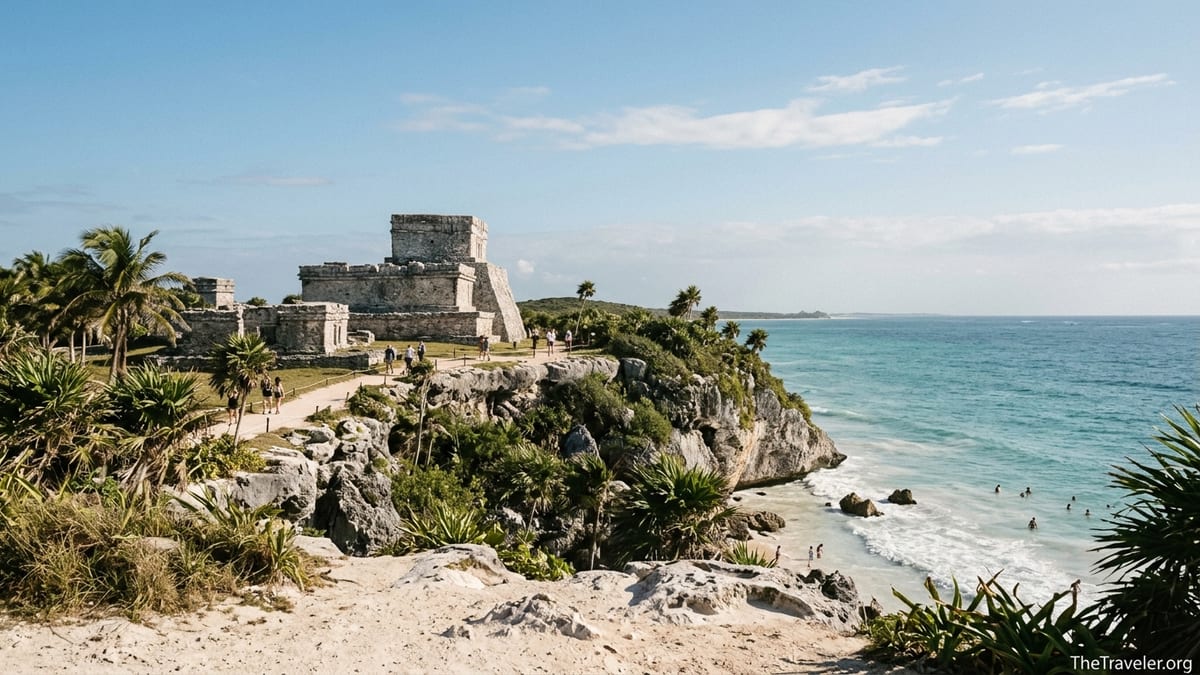
The Tulum ruins are famous for one thing above all: their setting above the turquoise Caribbean. The main temple, often photographed against the sea, is modest in scale compared with Chichén Itzá or Uxmal, but the cliff‑top location and breezes make this one of the most atmospheric sites in the region. The core visitable area is compact; many travelers walk the entire loop, stop for photos and sea views, and exit in about 90 minutes. For that reason, Tulum is sometimes underestimated, yet for visitors staying in the Tulum or Riviera Maya area who want a short, scenic taste of Mayan architecture, it can be ideal.
In recent years the entry system and fees around Tulum’s archaeological zone and the adjacent protected area have changed multiple times. As of mid‑2026, international visitors commonly pay a combination of a federal archaeology ticket, a national park or conservation fee and, depending on the access point, a Jaguar Park charge. In practice this means many foreign tourists experience a total somewhere in the range of a few hundred pesos per person. Some recent policies have aimed to soften the impact on Mexican nationals, residents and local identification holders, who may pay reduced or even zero access fees on certain days, especially Sundays. Because these rules are in flux, travelers should treat any specific peso amount they read online as approximate and be prepared for minor adjustments at the gate.
There are two broad strategies for visiting Tulum. The first is to enter via the main official access, pay the unified ticket and follow the shaded path toward the ruins with the majority of visitors. This route is straightforward, signed and includes shuttle options from the parking area. The second is to arrive via the beach side, typically starting near Playa Pescadores, and walk to the archaeology entrance from the sand. At times this secondary access has allowed visitors to pay only the federal ruins ticket, effectively reducing costs for those who are primarily interested in the site itself rather than the wider park. The details shift with local regulations, but speaking with your hotel concierge or a reputable local agency the day before your visit often yields the latest practical advice.
Because of Tulum’s exposed position, heat and sun are intense by late morning. An early entry between 8 and 9 am, or a late‑afternoon visit in the last two hours before closing, can be far more comfortable and photogenic. Many travelers staying in Tulum Pueblo use shared vans, known as colectivos, that run frequently along the main highway and drop passengers near the park entrance for just a few dozen pesos. From there, it is a 10 to 20 minute walk through vendors and shade to the ruins. This low‑cost, flexible approach is particularly appealing if you only plan a short visit and want to pair the ruins with a relaxed beach afternoon afterward.
Uxmal, Ek Balam and Mayapán: Quieter Sites With Character
Beyond the headline names, some of the most rewarding ruins on the Yucatán Peninsula are the mid‑sized sites that see far fewer tour buses. Uxmal, about an hour and a half south of Mérida, is widely regarded by archaeologists and repeat visitors as one of the most beautiful classic‑period Mayan cities. Its Pyramid of the Magician rises steeply above plazas decorated in the ornate Puuc style, with intricate stone mosaics of masks and geometric patterns. The site is large enough to feel like a real city, but the visitor numbers are moderate compared with Chichén Itzá, so you are more likely to find quiet corners to yourself.
Ek Balam, near Valladolid, offers a very different atmosphere: more compact, shaded by jungle and known for its well‑preserved stucco sculptures around the Acropolis. For years, one of its main draws was the ability to climb the main pyramid for expansive views over the forest canopy. Climbing policies have tightened across Mexico, and at some sites stair access has been partially or fully closed; travelers should check locally whether climbing is currently permitted at Ek Balam before planning their day around that experience. Even without climbing, the combination of manageable scale, green surroundings and nearby cenotes makes it a consistent favorite for those who find Chichén Itzá overwhelming.
Mayapán, southeast of Mérida, is often highlighted by locals as a “mini Chichén Itzá” with far fewer visitors. Here, the main pyramid and circular observatory echo the forms of larger sites, but paths between structures are quieter and less commercialized. Many travelers visit on day trips from Mérida by rental car, combining the ruins with a stop in a nearby village or cenote. Entry fees are typically lower than at the major international headline sites, and the lack of large souvenir markets inside the core zone contributes to a more contemplative experience. If your priority is to feel the scale of a Mayan city without heavy infrastructure or crowds, Mayapán belongs high on your list.
These three sites are also where a local guide can make a disproportionate difference, since interpretive signage is lighter than at Chichén Itzá or Tulum. On‑site guides, often quoting prices in the mid‑hundreds of pesos for a small group, can point out carvings and architectural motifs you might otherwise miss entirely. Travelers on a tighter budget sometimes choose to hire a guide at only one of these quieter sites, using that visit as a deep‑dive into Mayan cosmology and daily life, then apply what they learned as they walk through other ruins on their own.
Cobá and the Jungle Experience
Cobá sits in the forest inland from Tulum, historically known for its network of elevated stone causeways and its tallest pyramid, Nohoch Mul. In the past, visitors could climb Nohoch Mul for sweeping views above the tree canopy, but climbing has been prohibited since 2020 in the interest of preservation and safety. Even without climbing, Cobá remains appealing for those who enjoy a more adventurous, spread‑out experience compared with the compact sites on the coast. The core ruins are linked by broad paths through the jungle, and visitors can walk, rent simple bicycles or hire bicycle taxis driven by local operators.
For many travelers, the main charm of Cobá is this sense of movement through forest rather than the scale of any single structure. You might start at the cluster of buildings near the main entrance, ride or walk along a shaded path with occasional clearings, and then arrive at groups of stelae or the base of Nohoch Mul with birds calling overhead. On hot days, the ability to rent a bicycle for a modest fee is more than a novelty; it can transform the level of effort required. Families with younger children often opt for the bicycle taxis, which cost more but allow everyone to stay together and conserve energy.
Because Cobá lies between Tulum and Valladolid on a main road, it fits naturally into many itineraries. Some travelers base themselves in Tulum and visit Cobá as a half‑day trip, combining it with a swim in one of the cenotes near the ruins. Others traveling by rental car from the Caribbean coast to Chichén Itzá or Mérida plan a stop at Cobá en route, breaking up the drive and adding variety to a day already focused on archaeology. Entry fees are generally somewhat lower than at Chichén Itzá or Tulum, and the low‑rise jungle environment provides more shade, making midday visits slightly more tolerable.
Services immediately around Cobá are modest but adequate. Simple restaurants, small convenience stores and independent tour guides cluster near the entrance. While it is possible to visit entirely on your own, arriving early in the morning remains the most comfortable option in the humid months from May through September, when mid‑afternoon heat can feel oppressive even in the shade.
Heat, Crowds and Practical Timing
The Yucatán Peninsula sits firmly in the tropics, and visiting ruins here is as much an exercise in managing sun exposure and hydration as it is in cultural sightseeing. From roughly April through September, mid‑day temperatures often sit in the low to mid 30s Celsius, with high humidity. At open sites like Chichén Itzá and Mayapán, stone plazas reflect light and heat, and there is little shade away from the edges of the main plazas. At coastal Tulum, sea breezes offer some relief, but they can also make visitors underestimate how much sun they are receiving until they return to town noticeably burned.
The two most effective strategies are to schedule visits at the edges of the day and to treat sun protection as non‑negotiable. Arriving for site opening, typically at 8 am, not only allows for cooler temperatures and softer light for photography, it also positions you ahead of most group tours. Alternatively, some sites allow entry in the last two hours of the day, when heat has peaked and crowds have thinned. This pattern works especially well for travelers staying nearby in Valladolid, Mérida or Tulum who are not constrained by tour schedules. In all cases, a wide‑brimmed hat, sunglasses and frequent reapplication of reef‑safe sunscreen are more important than stylish outfits.
Hydration and snacks are another practical concern. While there are vendors near the entrances of all major ruins selling bottled water and basic food, prices tend to be higher than in town, and lines can develop at peak times. Carrying at least one liter of water per person for a half‑day visit is realistic, with more in the hotter months or if you plan to climb stairs where allowed. Light, salty snacks, such as packaged nuts or crackers from a supermarket in Mérida or Cancún, can help manage energy levels without requiring a sit‑down meal between structures.
Finally, consider crowds in your broader itinerary. If your first full day in the region is a Saturday in high season, and you are debating which ruin to see, Tulum and Chichén Itzá will feel most impacted by weekend and holiday traffic. In contrast, Uxmal, Mayapán and even Ek Balam often absorb visitors more gently, especially on weekdays. Many travelers report that pairing one large, famous site with one quieter site leads to a more balanced trip than chaining multiple crowded headliners back to back.
Which Ruins to Prioritize for Different Travelers
With limited days, you cannot see everything. Choosing which ruins to prioritize becomes a question of your interests, where you are staying and how much heat and bus time you can tolerate. For first‑time visitors based on the Caribbean coast with only one free day, Chichén Itzá is usually the top choice if you are willing to endure a long bus ride. It delivers the most iconic visuals and extensive structures in a single stop. Travelers who are less interested in a full‑day excursion and more drawn to scenery and photography might instead focus on Tulum ruins, combining them with a beach afternoon or cenote visit close to town.
If your trip anchors in Mérida or Valladolid, the equation shifts. Uxmal and Mayapán are far more convenient from Mérida than from Cancún or Playa del Carmen, and many visitors in that region describe Uxmal as their favorite site overall, ranking it above Chichén Itzá for atmosphere and detail. Those splitting time between the coast and inland towns often design a loop: Tulum or Cobá first, then north to Valladolid for Ek Balam and Chichén Itzá, and finally west to Mérida for Uxmal and Mayapán. This approach breaks up driving and showcases a wide range of architectural styles and settings in five or six days.
Families with younger children or multigenerational groups might emphasize shorter visits and easier logistics. Tulum, Cobá with bicycles and Ek Balam’s shaded paths all work well for visitors who cannot tolerate hours in full sun or long stair climbs. In contrast, travelers deeply interested in Mayan history, archaeology or photography may want to allocate more time per site, planning early‑morning and late‑afternoon sessions at places like Uxmal and Mayapán to capture changing light and study carvings without pressure.
Budget also plays a role. While none of the major ruins are expensive by global standards, entry fees plus transport and guiding can add up across multiple sites. Travelers watching costs might prioritize two larger sites and two smaller ones, mixing a group tour to Chichén Itzá with independent visits to Ek Balam and Mayapán by rental car or public bus. Those with more flexibility in their budget may choose private guides and smaller group tours that allow for custom timing, such as sunrise arrivals or lingering at less visited structures.
The Takeaway
Exploring Mayan ruins on the Yucatán Peninsula in 2026 remains one of the region’s great travel experiences, though it is no longer the low‑key, lightly visited adventure it once was at the most famous sites. With a bit of planning around tickets, fees, timing and heat, you can still carve out quiet, meaningful moments among ancient stones. Chichén Itzá rewards an early, guided visit; Tulum delivers unforgettable sea views in a compact package; Uxmal, Ek Balam and Mayapán showcase architecture and atmosphere away from the biggest crowds; and Cobá offers a more active, jungle‑framed day.
The key is to be realistic about the conditions you will face and the energy your group brings. Build early starts or late‑day visits into your schedule, keep your expectations flexible regarding evolving fee structures and consider mixing one or two marquee sights with lesser‑known ruins that many tour buses skip. In doing so, you give yourself a deeper, more balanced view of the Mayan world, from grand ceremonial plazas to quieter corners where birds call over weathered carvings and forest slowly reclaims once‑powerful cities.
FAQ
Q1. If I only have one day, should I choose Chichén Itzá or Tulum?
For most first‑time visitors, Chichén Itzá offers more extensive ruins and iconic structures in a single visit, but it requires a longer travel day and typically feels more crowded. Tulum is closer to Riviera Maya resorts, faster to visit and has spectacular sea views, making it better if you prefer a shorter outing with less time on a bus.
Q2. Do I need to book tickets to the ruins in advance?
At the main Yucatán sites, tickets are usually bought on arrival at the official entrance, and advance online sales are limited or nonexistent. During holiday periods and peak season, it is still worth arriving early to avoid queues, but most travelers do not need to prebook standard entry, only tours or transport.
Q3. Is a guided tour worth paying for at these ruins?
Guides add the most value at larger, historically complex sites such as Chichén Itzá and Uxmal, where context and interpretation greatly enhance what you see. If your budget allows only one guided visit, many travelers choose to hire a licensed guide at the gate at Chichén Itzá, then explore smaller sites like Cobá or Mayapán independently.
Q4. Can I still climb pyramids in the Yucatán?
Climbing has been restricted or banned at many major structures, including Nohoch Mul at Cobá and El Castillo at Chichén Itzá, primarily for preservation and safety reasons. Some smaller sites may still allow limited climbing on certain buildings, but policies change, so it is important to follow local instructions and signage rather than planning around climbing in advance.
Q5. How should I dress for visiting Mayan ruins?
Light, breathable clothing that covers your shoulders, a wide‑brimmed hat, comfortable walking shoes or sandals with good grip and sunglasses are practical choices. Because sun is intense even on cloudy days, many visitors also wear long sleeves or light trousers and carry a small backpack with water, sunscreen and a change of shirt.
Q6. Is it safe to visit these ruins independently without a tour?
For most travelers, visiting major archaeological zones independently in daylight hours is considered safe, as long as you use common sense, guard your belongings and follow park rules. If you are renting a car, stick to main roads, obey speed limits and avoid driving at night on unfamiliar rural highways.
Q7. How much cash should I bring for a day visiting ruins?
It is sensible to carry enough pesos to cover entry fees for your group, plus a margin for parking, snacks and an optional guide, even if you plan to use cards. For a couple visiting one major site with guiding and basic expenses, this might realistically mean bringing the equivalent of around 2,000 to 3,000 pesos in cash as a comfortable buffer.
Q8. What is the best time of year to visit Yucatán ruins?
The driest, most comfortable months are typically from November through March, when temperatures and humidity are lower and mosquitoes are less intense. This is also peak tourist season, so sites can be busier; in the hotter, wetter months, you will face more heat and occasional heavy showers but often slightly thinner crowds.
Q9. Can I visit multiple ruins in one day?
Yes, but it works best with combinations that are geographically close, such as Tulum and Cobá, or Ek Balam and Chichén Itzá. Trying to combine two major headline sites that are far apart in a single day can leave you rushed and exhausted, especially in the heat, so most travelers focus on one principal ruin plus a secondary stop like a cenote.
Q10. Are there facilities like bathrooms and food inside the ruins?
All major Yucatán sites have basic facilities near the entrance, such as restrooms, small restaurants or snack stands and souvenir stalls. Inside the archaeological zones themselves, services are limited, so it is wise to use bathrooms, buy water and adjust your sun protection before passing through the main gates and beginning your visit.