


More news on this day
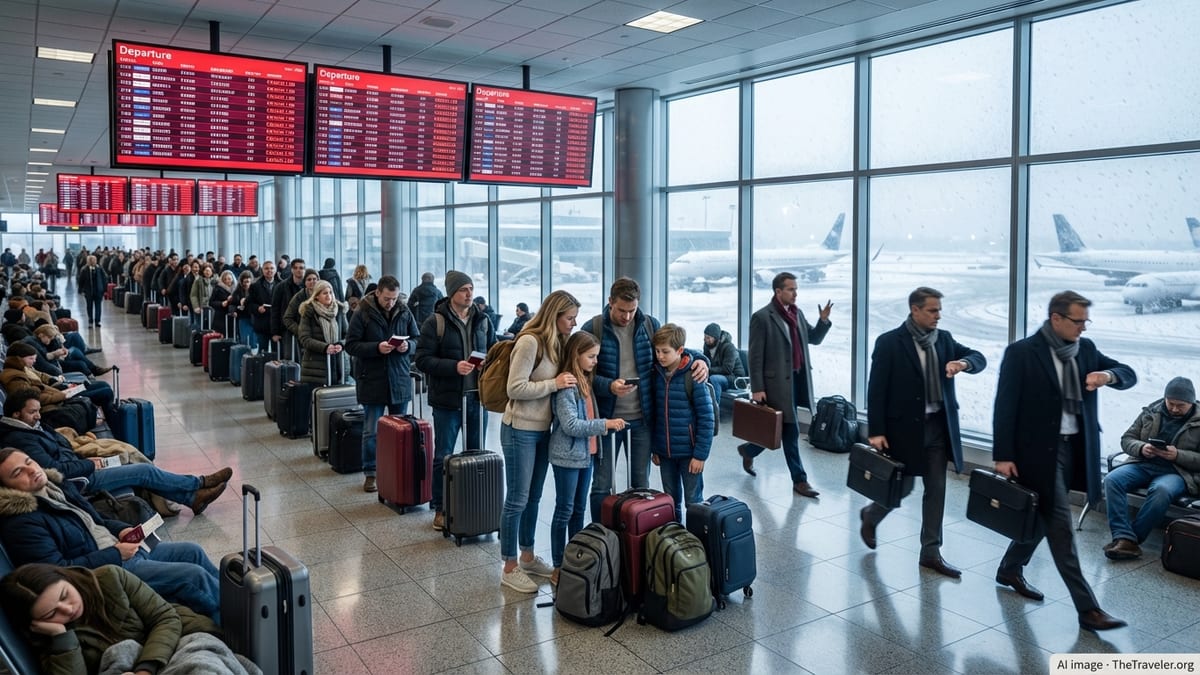
More than 330,000 air travelers have been caught in a fresh wave of mass flight cancellations across the United Kingdom, as a major air traffic control failure triggered scenes of overcrowded terminals, long queues and passengers sleeping on airport floors while airlines struggled to recover their schedules.
Get the latest news straight to your inbox!
Thousands of Flights Disrupted as Fault Hits UK Airspace
According to early estimates cited in published coverage, at least 330,000 passengers have been affected after a severe technical problem struck the system that manages flight plans in U.K.-controlled airspace. Industry reports indicate that more than a thousand flights were cancelled within the first 24 hours, with hundreds more heavily delayed as knock-on disruption rippled through major hubs including Heathrow, Gatwick, Manchester and Stansted.
The situation has drawn immediate comparisons with the air traffic control meltdown of 28 August 2023, when a failure in National Air Traffic Services’ flight planning system forced widespread ground stops and ultimately disrupted more than 700,000 passengers. An independent review by the UK Civil Aviation Authority later confirmed that around 300,000 people were affected specifically by cancellations during that episode, highlighting how quickly a single point of failure can cascade through the network.
In the latest incident, traffic management restrictions were imposed while the system was reset and checked, sharply reducing the number of flights that could safely depart or arrive. Data from aviation analytics cited in news reports shows that the combined effect was the cancellation of a significant portion of the day’s schedule, with long-haul and holiday routes among the hardest hit.
As the outage coincided with a busy travel period, many routes had limited spare capacity, leaving airlines with few options to rebook passengers on the same day. Carriers shifted to operating larger aircraft on selected services and added ad hoc “repatriation” flights where possible, but those measures only partially eased the backlog.
Passengers Stranded Overnight in Terminals
Social media images and passenger accounts collected in recent coverage show crowds stretched along terminal corridors, with families camped on the floor near check-in desks and departure gates after flights were cancelled late in the evening. Some travelers reported being kept on aircraft for extended periods before being told to disembark, search for their luggage and rejoin long queues to arrange new travel.
The experience echoes testimony gathered in research commissioned by the UK Civil Aviation Authority after the 2023 NATS outage. That study, conducted with passengers whose flights were delayed or cancelled during the August 2023 failure, described confusion over entitlements, difficulty getting information and a lack of suitable overnight accommodation at or near airports. The latest disruption appears to have revived many of those same concerns, with travelers again reporting uncertainty about where to sleep, how to secure meal vouchers and how to organize onward journeys.
At several airports, hotel capacity near terminals was quickly exhausted. Publicly available material from previous incidents suggests that when local rooms sell out, passengers are often given camp beds or blankets in gate areas, or left to organize their own accommodation and claim reimbursement later. Early accounts from the current disruption indicate that once again many resorted to sleeping on seats or bare floor space while they waited for rebooking options to open.
For those on complex itineraries involving connections outside the UK, the impact has been particularly severe. Travelers heading on long-haul trips have shared stories of missed onward flights, lost seat reservations and inbound segments that no longer match their revised plans, leaving them to negotiate new routings and, in some cases, downgraded cabins as airlines prioritize simply getting passengers moving again.
What Went Wrong in the Air Traffic System
While a full technical explanation of the latest failure has not yet been published, it comes against the backdrop of a detailed independent review into the August 2023 NATS outage, released in full by the Civil Aviation Authority in late 2024. That report concluded that a single anomalous but valid flight plan had triggered an automatic shutdown in the flight planning subsystem, forcing controllers to switch to manual back-up procedures and drastically reducing capacity.
The review highlighted a series of contributing issues, including the design of the software safeguards, the time taken for remote engineers to get on site and restart critical components, and gaps in contingency planning for such a large-scale system failure. It also noted that air traffic services had become increasingly reliant on complex automated tools, where rare edge cases in data processing can have disproportionate operational consequences.
News coverage of the latest disruption indicates that the technical fault again affected flight data processing rather than radar or radio communications. As in 2023, the priority for controllers was to maintain safe separation between aircraft, which meant limiting the number of flights that could be handled until normal automated functions were restored. Aviation experts quoted across multiple outlets have stressed that this conservative approach is expected when there is any doubt about system reliability.
Consumer groups and industry bodies have meanwhile questioned why, after multiple high-profile failures in recent years, core systems remain vulnerable to events capable of paralysing a substantial share of U.K. air traffic. Trade associations representing airlines have publicly called the situation “shocking” and “horrendous,” arguing that carriers and passengers are bearing the financial and emotional cost of infrastructure outside their control.
Compensation Rules and Passenger Rights
The disruption has once again drawn attention to the complex landscape of air passenger rights in the U.K. Under retained EU261 regulations, travelers whose flights are cancelled are generally entitled to a choice between a refund or rerouting, as well as care and assistance such as meals and accommodation. However, compensation payments for inconvenience depend on whether the cause of the disruption is deemed within the airline’s control.
In previous air traffic control incidents, airlines have frequently classified cancellations as the result of extraordinary circumstances, citing official airspace restrictions or technical failures at NATS. Publicly available accounts of compensation disputes show that claims are often rejected on this basis, leaving passengers frustrated when they perceive the disruption as a systemic failure rather than a weather event or strike.
The independent review into the 2023 outage acknowledged that many passengers waited weeks or even months to receive refunds and reimbursement for additional expenses, and that some never secured full payment. Following publication of that report, government statements signalled an intention to strengthen enforcement action against carriers that fail to provide timely redress, with talk of giving regulators enhanced powers to pursue non-compliance.
Consumer advocates are now using the latest wave of cancellations to renew calls for clearer communication at airports, standardized support packages across airlines and more robust automatic compensation where the root cause lies in national infrastructure rather than individual carriers. They argue that repeated large-scale breakdowns have eroded confidence in the system and left travelers unsure of their practical options when flights are suddenly scrapped.
Airlines and Regulators Face Growing Pressure
For the airline industry, the financial impact of a mass outage can be significant. The Civil Aviation Authority’s final assessment of the August 2023 system failure estimated combined costs to airlines, airports and passengers at between £75 million and £100 million, including extra staffing, aircraft repositioning, welfare for stranded travelers and lost revenue. Early analysis suggests that the latest disruption is likely to generate similar levels of expense, particularly if recovery operations extend over several days.
Carriers are also grappling with longer-term reputational damage. In an era when travelers can instantly share photos and accounts from crowded terminals, images of holidaymakers sleeping on hard floors and families left without clear information spread rapidly, amplifying pressure on both airlines and air traffic managers to demonstrate that lessons are being learned.
The Civil Aviation Authority has already outlined plans for continued oversight of NATS following its previous independent review, including recommendations on system resilience, incident communication and the pace at which detailed public findings are released after a failure. Observers expect fresh scrutiny of how quickly information was shared with airlines and airports during the latest outage, and whether additional contingency capacity or alternative routings could have reduced the scale of cancellations.
For passengers still queueing at ticket desks or trying to rearrange complex trips, those broader policy discussions offer little immediate relief. But with a growing body of official reporting on past failures and a renewed spotlight on the experience of ordinary travelers, pressure is mounting on all sides of the aviation system to ensure that a single technical fault no longer leaves hundreds of thousands of people facing an unexpected night on the airport floor.
UK Civil Aviation Authority: Independent review into August 2023 NATS flight planning system failure
CAA hub on NATS August 2023 failure and follow-up documents
The Guardian coverage of passenger protections after UK air traffic meltdown
Associated Press reporting on UK air traffic control problems and flight cancellations