


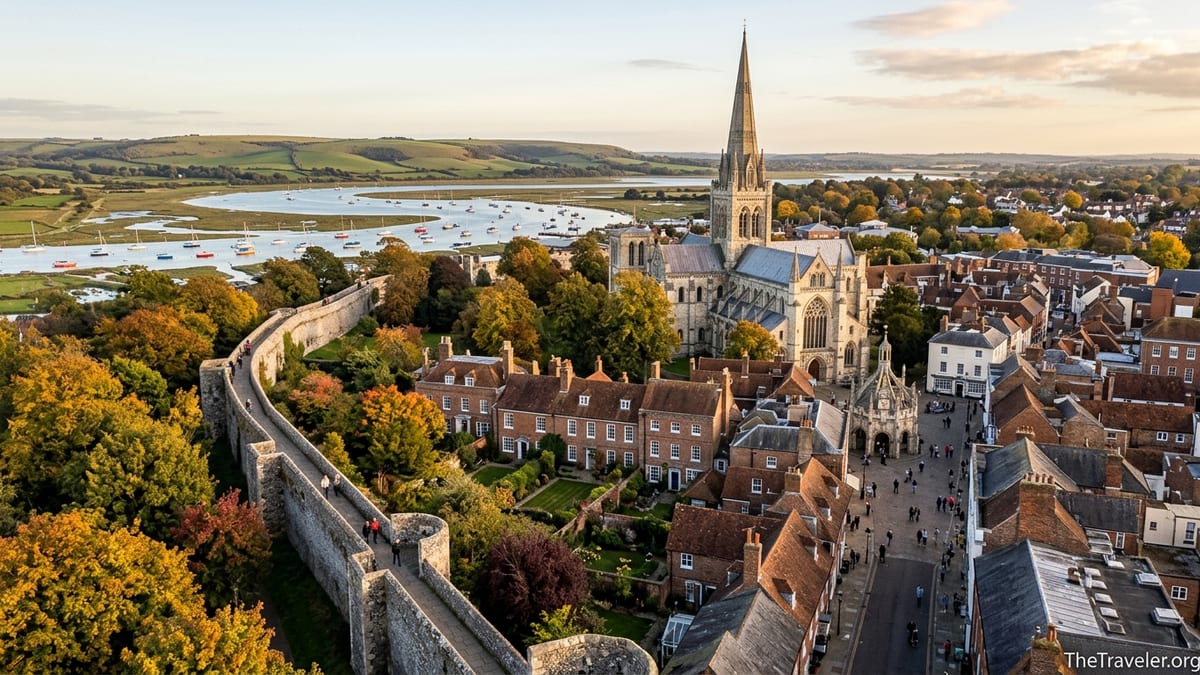
Compact, walkable and ringed by Roman walls, Chichester in West Sussex makes an excellent weekend base for exploring both the South Downs and the Sussex coast. With a striking medieval cathedral, serious art at Pallant House Gallery, a Roman palace a short hop away and beaches within easy reach, it offers a quieter, more historically layered alternative to larger southern cities.
Get the latest updates straight to your inbox!
Why Chichester Works as a Weekend Base
Chichester sits in West Sussex, roughly midway between Portsmouth and Brighton and a little inland from Chichester Harbour. Fast Southern Railway services from London Victoria take about 1 hour 30 minutes to 1 hour 45 minutes on weekends in late 2026, usually direct or with one easy change. Trains from Portsmouth and Southsea take about 25 to 30 minutes, while direct services from Brighton typically take around 1 hour 10 minutes. There is no direct mainline route from London Bridge; passengers usually change at East Croydon or Clapham Junction.
Compared with headline destinations such as Brighton or Portsmouth, Chichester feels smaller and more self-contained. The cathedral spire is visible from the station, the historic core is framed by walkable walls, and most key sights sit within a 10-minute radius on foot. You trade Brighton’s nightlife and Portsmouth’s big naval museums for a slower pace, historic streets and easy access to countryside and harbour villages.
For first-time visitors, an overnight stay offers better value than a rushed day trip. Many Londoners arrive late morning, and by the time you have explored the cathedral quarter, browsed the central streets and visited one major museum or gallery, the day can disappear. An extra night allows time for Fishbourne Roman Palace or a half-day out to Bosham or West Wittering Beach, and it gives flexibility if the weather turns on the coast.
Chichester also works well as a base for wider West Sussex. Rail and bus links radiate from the compact station and bus stands, so car-free visitors can reach harbour villages, nearby Downland walks and coastal resorts without navigating city traffic. Drivers, meanwhile, benefit from easier parking than in Brighton or Portsmouth, especially if they choose a hotel with on-site spaces.
Understanding the City: Roman Grid, Medieval Heart
Modern Chichester still follows the street grid set out when the Romans established Noviomagus Reginorum. North Street, East Street, South Street and West Street meet at the city’s Market Cross, giving today’s centre a clear, legible structure that is ideal for walking. The stone and flint circuit of city walls still encircles the core; in many stretches a raised path on the ramparts offers an easy, almost level loop of roughly 1.5 miles around gardens, back lanes and glimpses of the cathedral spire.
Chichester Cathedral, formally the Cathedral Church of the Holy Trinity, dominates the medieval quarter just off West Street. Although entry is by donation rather than a fixed ticket, the cathedral currently suggests around £7 per adult according to local visitor information checked in August 2026. The building’s mix of Norman origins, later Gothic work and modern art commissions tells the story of the city’s religious and civic importance over nearly 1,000 years.
Roman and medieval history is threaded through daily life rather than cordoned off in a single attraction. The Novium Museum is built directly over the excavated remains of a Roman bath house, while streets such as West Street and East Street sit on ancient lines. Walking the walls you look down into Georgian terraces, school playgrounds and modern gardens that all occupy former defensive ditches and ramparts.
This deep historical layering is part of what distinguishes Chichester from many resort towns on the south coast. It has its own theatre, a well-regarded modern art gallery and an active festival calendar, yet retains the feel of a cathedral city rather than a dedicated seaside destination. The sea and harbour are close, but they are day trips, not the whole story.
A Car-Free Day One: Cathedral, Walls and Galleries
Arriving at Chichester railway station around 10:00 on a Saturday, you step straight into a manageable, walkable centre. Most central hotels and guesthouses lie within a 5 to 10 minute walk. From the station, head along South Street to reach the Market Cross in roughly 6 minutes, passing cafes suitable for a quick coffee if you need to drop luggage first.
Begin at Chichester Cathedral, normally open to visitors from mid-morning. There is airport-style security at the main door and visitors are encouraged to give a donation rather than paying a compulsory fee. Allow 60 to 90 minutes for a self-guided visit, taking in the light-filled nave, the modern tapestries and sculptures and, time permitting, the cloisters and garden. Weekends sometimes host services or events that restrict access to certain chapels, so it is worth checking service times and any special events for your dates.
From the cathedral, walk up West Street for a few minutes and climb onto the city walls near the Westgate area. A relaxed clockwise loop along the ramparts and adjoining footpaths takes around 40 to 60 minutes at a gentle pace. The route is mostly level but includes a few short ramps and uneven historic surfaces. There are several stair and ramp access points, so it is easy to drop back into the centre if needed. You will pass close to Priory Park and its cricket ground, with views over the city rooftops to the South Downs.
For lunch, head back towards the Market Cross and on to Pallant House Gallery on North Pallant. The gallery opens Tuesday to Saturday from 10:00 to 17:00 and on Sundays and bank holidays from 10:00 to 16:00, remaining closed on Mondays. Adult admission in late 2026 is advertised at £17 including an optional £2 donation that enables Gift Aid claims, with free entry for under 18s and a reduced rate for visitors aged 18 to 25. The on-site Pallant Café serves seasonal dishes, coffee and cakes, making it a convenient place to break up your visit before touring the collection and temporary exhibitions.
Day One Afternoon and Evening: The Novium and Central Streets
After lunch, stroll back via the Market Cross to The Novium Museum on Tower Street, around 5 minutes on foot. The museum’s ground floor is built around the exposed remains of a Roman bath house, and upper levels explore the story of Chichester and the wider district. According to the museum’s own policy documents, general admission is free, with donations encouraged. The Novium is typically closed on Mondays; outside the main summer season it may also close on Sundays, so visitors should check the current timetable before planning an itinerary.
Allow 60 to 90 minutes for The Novium if you want to spend time at the Roman galleries as well as the later local history displays. Ticketed temporary exhibitions, when running, may have specific time slots. Accessibility is better than many historic sites, with lift access between floors, though some displays involve relatively low-lit areas to protect objects.
Late afternoon is ideal for unstructured time around the Market Cross and central streets. East Street and North Street carry a mix of high-street brands and independent shops, while nearby side streets host smaller boutiques, bookshops and cafes. The compact grid and pedestrianised sections make this easy to navigate, and it is straightforward to keep the cathedral spire or Market Cross as a reference point.
For dinner, visitors keen on local produce can look for modern British restaurants in the streets south of the Market Cross or traditional pubs near the cathedral precinct. Many feature Sussex beef, local cheeses and seasonal vegetables from surrounding farms. For a more casual option, there are several independent pizzerias and bistros within 10 minutes’ walk of the station, which is convenient if you plan an early start for coastal excursions the next day.
Day Two: Roman Palace or Harbour, Plus Practical Variations
On a second day without a car, you face a choice between focusing on Roman history at Fishbourne Roman Palace or heading out to coastal landscapes. Fishbourne lies about 2.5 miles west of Chichester. The site is operated by Sussex Past and preserves the remains of what is considered the largest known Roman residence north of the Alps, dating to around AD 75. Visitors can see extensive mosaic floors, reconstructed gardens and galleries interpreting the palace and its role in early Roman Britain.
In late 2026, Fishbourne Roman Palace’s own information notes varying opening hours across the year, with last admission one hour before closing. Visitors are advised to check specific seasonal times, as winter days are shorter and some weekday closures may apply outside school holidays. Standard adult admission is advertised in a mid-teens pound range, with concessions and family tickets; group rates apply for 10 or more. The site can be reached in several ways: a short train ride from Chichester to Fishbourne station followed by about a 10 to 15 minute walk, a local bus that stops within walking distance, or an off-road cycle route from the city using local lanes.
Those who prefer sea views can instead explore Chichester Harbour and the surrounding villages. Bosham lies on a tidal creek west of Chichester and can be reached by train to Bosham station or by bus on services heading towards Emsworth and Portsmouth. The village church, quay and waterfront lanes give a clear sense of how the harbour has shaped local life. Visitors must note the tidal road: cars parked too low on the shoreline have occasionally been caught by fast-rising tides, so it is essential to heed local signs and avoid driving or parking on flooded sections.
West Wittering Beach, at the mouth of Chichester Harbour, is one of the area’s most popular sandy beaches. It can be reached by Stagecoach buses from Chichester, including services that run to East and West Wittering according to the Chichester network map. On peak summer weekends, car parking at the private beach car park operates with pre-booking and capacity limits to manage crowds, so drivers should secure a space in advance. Swimmers and paddlers need to pay attention to lifeguard flags, posted notices and tidal currents, which can change quickly in the harbour mouth. For both Fishbourne and coastal villages, weather and tide forecasts are critical, particularly in winter, when winds across the open harbour can be strong and paths exposed.
Transport, Tickets and Getting Around Without a Car
Most visitors from London use direct Southern Railway trains from London Victoria, which serve Chichester several times each hour on Saturdays and Sundays in the current timetable period. Advance fares purchased through rail booking platforms can be significantly cheaper than walk-up tickets, particularly off-peak returns. At weekends, engineering works on the Brighton Main Line or Arun Valley route can mean diversions or replacement buses, especially on Sunday mornings, so it is advisable to check for planned works during the week before travel.
From Portsmouth and Southsea, regular Southern trains cover the short ride to Chichester in around 25 minutes, calling at intermediate stops such as Havant. From Brighton, Southern services cross West Sussex via Worthing and Littlehampton in just over an hour; some require a change, often at Littlehampton or Barnham. There is no need for a car to move between these coastal cities and Chichester unless you particularly want the flexibility of spontaneous detours.
Local bus services centre on Chichester Bus Station near the railway station. Stagecoach operates a network that includes the 51 to Selsey, routes 52 and 53 via Birdham to the Witterings, and the Coastliner 700 running east to Littlehampton and west to Portsmouth. The 51 serves Selsey West Sands and Selsey Seal Road, with regular daily departures from early morning until late evening. Buses are useful for reaching Selsey, Pagham Harbour, the Witterings and villages on the harbour fringes without the headache of coastal parking.
Cycling can work well for confident riders used to sharing narrow country lanes. There are some dedicated paths and quiet roads towards Fishbourne and the harbour, but not a fully segregated network. Bike hire is sometimes available through local shops or via hotel arrangements, though availability fluctuates season by season. Taxis are usually available at the station rank and can be booked ahead for evening returns from outlying pubs or after shows at the Chichester Festival Theatre.
When a Car Helps: Downs, Gardens and Goodwood
While Chichester itself and key nearby sites can be reached without driving, a car broadens your range considerably. Goodwood House, the surrounding estate, and the motor circuit and racecourse lie a few miles north of the city. There are occasional buses towards Goodwood, particularly on event days, but outside special services a car or taxi is often the easiest way to reach the house and its parkland. The Goodwood Festival of Speed and the Goodwood Revival motor circuit events, usually held in summer and early autumn, draw very large crowds; during these dates, hotel prices in and around Chichester tend to rise and local roads can be heavily congested at peak arrival and departure times.
To the north-west, West Dean Gardens near the village of West Dean showcase restored Victorian glasshouses, walled gardens and wooded walks set in a chalk valley. Reaching West Dean by public transport typically involves a bus along the A286 followed by a walk; a car allows you to combine West Dean with nearby viewpoints on the South Downs Way in a single day. Many visitors drive to a Downland car park such as those near the Trundle, north of Goodwood, to access circular walks with open views over Chichester and the coast.
Further afield, a car makes it easier to link coastal villages and beaches in a single loop, for example combining Pagham Harbour Nature Reserve, Selsey and East Wittering in one day, stopping at seafood shacks and harbour cafes along the way. However, parking at sensitive coastal sites is often limited or managed seasonally, and some lanes are narrow and shared with cyclists and walkers, so patient driving and careful planning are important.
By contrast, some attractions are less suitable for rushed half-day visits even with a car. Chichester Harbour’s boat excursions, for instance, run to timetables tied to tides and daylight; squeezing a harbour cruise into a tight schedule before driving back to London often leaves little margin for delays. Walking routes in the South Downs that include steep climbs or exposed ridges are also better done with generous time and appropriate footwear, rather than as quick stop-offs.
Where to Stay: City Centre, Station, Bosham and the Coast
Central Chichester offers the best balance of walkability and evening options. Hotels and guesthouses within the walls or just outside put the cathedral, Market Cross, Pallant House Gallery and many restaurants within easy reach. Mid-range hotels here typically fall in a broad band that might see weekend double rooms somewhere around the low to mid hundreds of pounds, depending on season and events, while independent B&Bs can be comparable or slightly lower. Parking is mixed; some properties include a small car park or arrange discounted spaces in nearby public car parks, while others rely entirely on paid on-street or council parking.
Near the railway station, chain hotels and modern apartment-style stays offer convenience for rail users and easier check-in and check-out when carrying luggage. These areas are less atmospheric than the historic streets but can be slightly better value outside peak times, particularly if booked in advance with flexible rates. They also make early departures for Fishbourne, Portsmouth or Brighton straightforward, as platforms are a short walk away.
Bosham, with its waterfront setting on Chichester Harbour, appeals to travellers who prioritise views and village charm. Small inns and guesthouses here can be more expensive on summer weekends and during sailing events. Parking is vital to check when booking because of the tidal road and limited spaces; some properties have secure off-road parking, while others rely on public bays. Rail connections are possible from Bosham station, but service frequency is lower than from Chichester.
Coastal villages such as West Wittering, East Wittering and Selsey suit visitors focused on beach time and water sports. Accommodation ranges from holiday parks and self-catering cottages to small B&Bs. During peak summer school holidays, weekly cottage rentals and holiday park stays often dominate; one- or two-night breaks can be harder to find or more expensive. For car-free travellers, these areas are best chosen only if you are comfortable relying on bus timetables for every outing, as evening buses can be less frequent, and taxis back to Chichester may add to costs.
Food, Drink, Culture and Seasonal Considerations
Chichester has more eating and drinking options than its compact size might suggest. Traditional pubs near the cathedral and along side streets off the main four arms of the cross offer local ales and classic pub dishes. Independent cafes cluster around the streets south of the Market Cross and near Pallant House Gallery, serving brunch plates, cakes and coffee that work well between museum visits. On the coast, seafood fans can seek out fish restaurants and informal kiosks in Selsey and the Witterings, where locally landed crab and fish appear on menus when in season.
Culturally, the Chichester Festival Theatre is a major draw, presenting a mix of new writing and revivals, especially from spring through early autumn. Performances often start around 19:30, and many visitors combine a pre-theatre supper in town with a short walk or taxi ride to the theatre complex north of the centre. Goodwood’s programme of race meetings, motoring events and horse racing also shapes the local calendar. During big fixtures, restaurants and pubs fill up quickly, and advance reservations become almost essential.
Weather and season play a significant role in planning. In spring, gardens at West Dean and the surrounding Downs begin to come into their own, and walking the city walls or harbour paths is generally pleasant, though showers are common. Summer brings the warmest beach conditions and the broadest choice of harbour boat excursions and water sports, but parking at West Wittering and traffic towards the coast can be difficult on hot weekends. Autumn suits walkers and museum-focused trips, with fewer crowds at Fishbourne and quieter city streets.
Winter can still be rewarding, particularly for those interested in history and culture rather than swimming. The Novium Museum and Pallant House Gallery provide indoor options, and the cathedral often hosts concerts and seasonal services. However, some attractions operate reduced winter hours, and harbour paths can become muddy or slippery. Short daylight hours mean early starts are advisable for any coastal or Downland walks, and checking both weather and tide times becomes even more important for safety.
Accessibility, Budgets and Example Itineraries
Much of Chichester’s centre is relatively flat, though the historic paving, kerbs and older shopfronts can present challenges for some visitors. The city walls feature a mix of stepped and ramped access points, so portions of the circuit may not suit wheelchairs or buggies. Inside the cathedral, main areas are broadly accessible, but some side chapels and galleries have steps. The Novium’s purpose-built design provides lift access between floors, and Pallant House Gallery offers accessibility information, including step-free entries to modern sections and accessible toilets.
Coastal paths and beaches require more care. The tidal nature of Chichester Harbour means that some quays and slipways become slippery with algae, and uneven surfaces are common. At West Wittering, boardwalks and marked paths help with access over dunes, but soft sand and shingle sections may still be difficult for some. Families should be particularly cautious with children near harbour edges and on groynes or breakwaters.
A car-free one-night weekend from London might look like this. Travel on a Saturday off-peak return ticket from London Victoria, staying in a central mid-range hotel. Afternoon and evening are spent visiting the cathedral, walking part of the walls and exploring Pallant House Gallery, punctuated by coffee at the gallery café and dinner in a local bistro near the Market Cross. Sunday morning is devoted to The Novium Museum and a final stroll through the streets before catching an afternoon train home. Travel costs will depend heavily on how far in advance rail tickets are purchased and whether any railcards are used, but admission to The Novium is free and cathedral entry is donation-based; the main fixed cultural cost is a Pallant House ticket.
A car-based two-night trip expands this pattern. Arrive Friday evening by car, stay in a hotel with parking just outside the walls, and spend Saturday exploring the city sights and perhaps catching a performance at Chichester Festival Theatre. On Sunday, drive to Fishbourne Roman Palace for the morning, continue to Bosham for lunch at a harbour pub, then loop back via West Dean Gardens and a short South Downs walk if daylight permits. Monday could be used for a relaxed coastal morning at West Wittering or Selsey before driving home. Fuel, parking charges, Fishbourne admission, garden entry fees and meals will add up, but careful planning, such as choosing one paid attraction each day and one free or donation-based site, can keep the total within a reasonable range for a cultural weekend.
How Chichester Compares: Winchester, Arundel and Brighton
For travellers choosing between Chichester and other southern English short-break options, a comparison helps set expectations. Winchester, another historic cathedral city, offers a larger collection of medieval buildings and a dramatic riverside setting, plus the Great Hall with its famed Round Table. However, Winchester lies further inland, so combining it with beaches or harbour villages requires more effort. Chichester is smaller and quieter, yet gives quicker access to both the South Downs and the coast.
Arundel, a short train ride east of Chichester, centres on its impressive castle and riverside walks. It works well as a focused day trip, but has fewer cultural institutions than Chichester and a smaller evening scene once day visitors leave. Chichester’s combination of cathedral, major gallery, museum and theatre provides more varied rainy-day and evening options, especially over a two- or three-night stay.
Brighton stands at the other end of the spectrum. It has a famous pier, nightlife, independent shopping in the Lanes and a broader range of restaurants and bars than Chichester, as well as the Royal Pavilion. Those looking primarily for clubbing, large seafront hotels and a busy urban beach will find Brighton a better fit. Yet many visitors find Chichester’s quieter streets and ready access to rural landscapes more restful, particularly for trips that prioritise walking, heritage and food rather than late-night entertainment.
In short, Chichester’s distinctive value lies in its blend of Roman archaeology, medieval fabric, modern culture and reach into West Sussex’s harbours and hills. For some, especially those expecting bustling nightlife and constant street buzz, it may feel quieter than anticipated after dark. For others, that calm is precisely the point, allowing a weekend that balances cathedral cloisters, gallery visits, harbourside strolls and South Downs vistas without ever straying far from a compact and welcoming base.