


If you hold two passports, planning a trip to the Schengen Area now involves more than simply choosing the booklet with the nicer cover. A traveler who holds citizenship of an EU member state has EU free-movement rights and should normally establish that EU citizenship when entering the EU. Presenting a non-EU passport instead can trigger visa, ETIAS and Entry/Exit System requirements that do not apply to you as an EU citizen, and may create mismatched border records if you later switch documents.
Get the latest updates straight to your inbox!
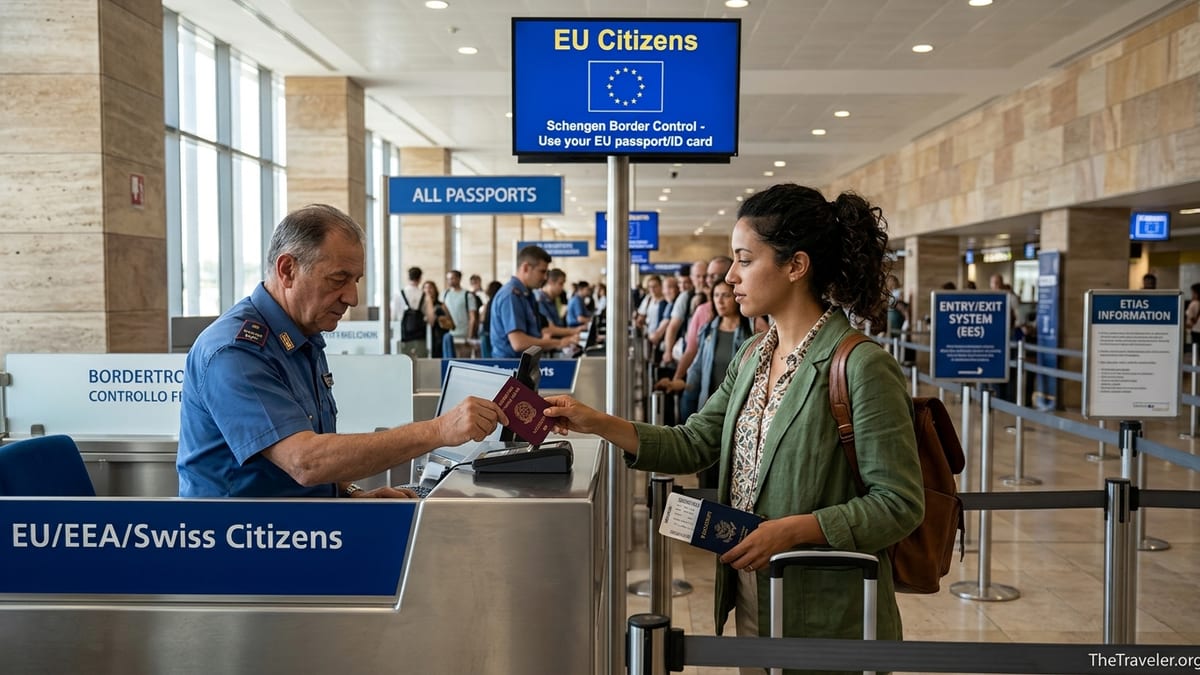
EU citizenship, free movement and why the “right” passport matters
Under EU law, a person who is a citizen of any EU country is also an EU citizen with the right to move and reside freely in other EU member states. That includes citizens of Ireland and of Schengen states such as Italy, Germany and France. When such a dual national arrives at an external Schengen border, border guards are supposed to treat them as an EU citizen if they can demonstrate that status, usually by presenting an EU passport or national ID card issued by an EU country.
At the same time, non-EU passports are subject to a different set of rules. Non-EU nationals coming for short stays can be visa-exempt or visa-required, and from 2025 onward many visa-exempt travelers to Schengen are being brought into the ETIAS travel authorisation system. Separately, the Entry/Exit System, fully operational at all external Schengen border crossing points since 10 April 2026, records biometric and travel document data for non-EU nationals entering and leaving the Schengen Area for short stays instead of relying on passport stamps. This system applies only to people who are not citizens of the EU or of associated countries such as Iceland, Norway, Liechtenstein and Switzerland.
For a dual national with one EU and one non-EU passport, this creates a clear practical rule: if you have EU citizenship, you normally want to enter and leave the Schengen Area as an EU citizen using your EU passport (or EU ID where accepted). Doing so keeps you outside the Entry/Exit System, avoids unnecessary ETIAS or visa requirements, and ensures border records match your legal status. If you instead present your non-EU passport at the Schengen border, the system will treat you as a third-country national, log you into EES, and may require an ETIAS authorisation that is not needed when you travel as an EU citizen.
None of this means you are forbidden to own or carry another passport. Many travelers quite reasonably use one passport to enter a region where they have full citizenship rights and the other to enter their second country of citizenship. What matters is understanding which document to present to which authority, and how that choice interacts with airline procedures and electronic border systems.
Legal rules vs airline procedures: two different conversations
Before looking at specific dual-national combinations, it helps to distinguish two moments where your passport matters: when you deal with the airline and when you deal with border control. These are separate processes, even if they happen within a few minutes of each other at the airport.
Airlines are required to check that you appear allowed to enter your destination before they board you. They do this by examining your travel documents at check in or online and often by consulting databases of entry rules. Carriers can face fines if they transport a traveler who is refused entry at the border, so they usually default to caution. In practice, that means an airline flying you from New York to Rome will want to see evidence that you are allowed into Italy: an Italian or other EU passport, or a non-EU passport that is visa-exempt for Schengen and, when ETIAS is in force, that has a valid ETIAS authorisation.
Border control is different. Immigration officers of the state you are entering or leaving apply that country’s laws, not airline policies. For example, U.S. law requires that U.S. citizens, including dual nationals, enter and depart the United States using a U.S. passport, subject to narrow exceptions in regulations. Official U.S. Department of State guidance likewise states that all U.S. citizens, even dual nationals, must use a U.S. passport to enter and depart the United States. By contrast, EU border authorities at Schengen external borders do not require EU citizens to use only their EU passport, but they can only apply EU free-movement rules if you present proof of EU citizenship. If you present only your non-EU passport, they must treat you as a non-EU traveler.
In practice this means you might show one passport to the airline and another to border control within the same airport, as long as you still comply with the legal obligation of each country. For instance, a U.S.–Italian dual national leaving the United States might show a U.S. passport at U.S. exit controls while handing their Italian passport to the airline agent to prove they can enter Italy. That sort of split is legally acceptable and quite common, though it can confuse staff unfamiliar with dual citizenship, so being ready to explain your situation calmly is useful.
Entry/Exit System and why switching passports mid-trip can cause problems
The new European Entry/Exit System significantly changes how non-EU travelers are recorded at Schengen borders. Since 10 April 2026, EES has been fully operational at all external Schengen border crossing points. For non-EU nationals making short stays, it stores travel document data, biometric data (such as facial image and fingerprints) and the dates and places of entry and exit. It also replaces routine passport stamping. The system is intended to track compliance with the 90-days-in-180-days rule and to strengthen border security.
EES is document-based. When you enter Schengen as a non-EU national, the border guard records your entry against the passport you present, and your biometrics are linked to that document’s details. When you later leave, the system expects to see an exit recorded for the same passport. If you enter using, for example, your Canadian passport and then try to leave using your Australian passport, the system will see an exit request but will find no matching entry in your Australian record and an apparent overstay in your Canadian record.
In most cases, border officers can sort this out by questioning you, examining both passports, and manually reconciling the records. However, it can mean extra interviews, missed connections and, in some cases, formal notes on your file. Over time, repeated unexplained mismatches might complicate future travel or applications for visas and residence permits. This is why official EU guidance for carriers notes that for travelers with dual citizenship, systems treat them as nationals of the state that issued the travel document they present and that dual citizens who hold a travel document from a European country using EES or requiring ETIAS should use that document. It aligns your legal status and your digital record.
For EU dual nationals, the implication is straightforward: enter and exit the Schengen Area using your EU passport, so you are not in EES as a third-country national at all. For travelers who hold two non-EU passports, the key point is consistency. Choose one passport to use for that entire Schengen trip, from first entry to final exit. You may choose a different passport for a different trip in the future, but switching documents halfway through a single stay is likely to confuse the system.
Real-world dual-national scenarios: US–Italian, British–Irish, Canadian–German, Australian–French and two non-EU passports
Consider a U.S.–Italian dual national flying New York to Rome and back. U.S. law requires this traveler to depart and re-enter the United States with a valid U.S. passport. At Italian border control, however, they want to be treated as an EU citizen. The practical pattern is: show the U.S. passport at airline check in so the U.S. carrier can record Advance Passenger Information, then show the Italian passport at Schengen entry in Rome. On the way back, they leave the Schengen Area by presenting the Italian passport to Italian authorities, then present the U.S. passport to U.S. border control on arrival. Many dual nationals also show their Italian passport to the airline when checking in for the New York–Rome leg so the carrier’s system recognizes them as EU nationals not subject to ETIAS; they still keep the U.S. passport handy for departure checks.
Now take a British–Irish dual national flying from London to Madrid and then onward to non-Schengen destinations. Since Ireland is an EU member state but not part of Schengen, while Spain is an EU and Schengen member, this traveler has several options. For entering Schengen in Spain, presenting the Irish passport clearly establishes EU citizenship and avoids EES. At airline check in, using the Irish passport as the travel document for boarding to Spain ensures the carrier does not incorrectly treat the traveler as a British citizen who may be subject to ETIAS and EES as a non-EU national. However, when entering or leaving the United Kingdom, they may use their British passport, since under UK law only British citizens have the automatic right of abode.
A Canadian–German dual national departing Toronto for Frankfurt can follow a similar pattern. German citizenship gives full EU rights, so it makes sense to enter and leave the Schengen Area with the German passport. Many airlines will accept seeing only the German passport, which demonstrates both the right to enter Germany and visa-free return to Canada. Others may ask to see the Canadian passport to satisfy carrier data requirements, but that does not change the fact that Schengen border control in Frankfurt will log the traveler as a German (and therefore as an EU citizen outside EES). On the return, they leave Schengen again as a German citizen and may present whichever passport Canada accepts for re-entry, noting that Canada requires proof of the right to enter, which is normally a Canadian passport for citizens.
For an Australian–French dual national flying Sydney to Paris, the French passport is the key at Schengen borders. Presenting the French passport means the traveler is treated as an EU citizen and stays outside EES. At airline check in in Sydney, the traveler can present the French passport to prove unrestricted right to enter France. On return, they exit Schengen with the French passport and present their Australian passport to Australian border control, since Australia, like many countries, expects its citizens to use an Australian passport to enter.
Finally, consider someone with two non-EU passports, such as a traveler who holds both Canadian and Brazilian nationality. Suppose Canadian citizens enjoy visa-free Schengen access subject to ETIAS, while Brazilian citizens may need a Schengen visa or have different permitted stay rules. This traveler should decide which passport to use for Schengen before booking. If they plan to travel visa-free as a Canadian, they should apply for ETIAS linked to their Canadian passport once that system is live and then consistently enter and exit Schengen using the Canadian passport so that all EES records line up. If they instead use the Brazilian passport for entry because, for instance, their Canadian passport is full or near expiry, they must be prepared to meet whatever visa requirements apply to Brazilian nationals and to use that same Brazilian passport at exit.
ETIAS, carrier checks and how dual nationals are treated
ETIAS, the European Travel Information and Authorisation System, is an electronic travel authorisation for visa-exempt non-EU nationals visiting the Schengen Area for short stays. It is not a visa, but airlines and carriers will be required to verify that passengers who need ETIAS have a valid authorisation before boarding. ETIAS is passport-specific. When you apply, the authorisation is electronically linked to one passport number and cannot be shifted to another document.
For dual nationals, the official ETIAS guidance notes that they are treated as nationals of the country that issued the travel document they present. Where a traveler holds both an EU and a visa-exempt non-EU passport, they will not need ETIAS if they use the EU passport for travel to Schengen, because EU citizens are not subject to ETIAS. If they instead choose to travel on the non-EU passport, they may need to apply for ETIAS and will be handled by border systems as nationals of that non-EU state for that journey.
Where a dual national holds two non-EU passports from visa-exempt countries, they can in principle choose which passport to use for ETIAS. For instance, a traveler with New Zealand and Canadian citizenship could apply for ETIAS using either passport if both are eligible. The authorisation will attach only to that passport. If they arrive at the Schengen border with the other passport, the system will not see a valid ETIAS and they may be refused boarding or entry. Carriers are instructed that when they query a third-country travel document for a dual citizen who should hold a visa or ETIAS but does not, they will receive a negative reply from the carrier interface and must treat the traveler accordingly.
Because of these links, dual nationals who rely on ETIAS should keep track of which passport pairs with which authorisation and avoid mixing documents. If you renew a passport, you may need to apply for a new ETIAS once the old one’s passport number no longer matches. By contrast, dual nationals who can travel entirely on an EU passport avoid ETIAS and EES for Schengen altogether, which is one reason many choose that option whenever possible.
Step-by-step: a New York to Rome round trip for a US–Italian dual citizen
Imagine Anna, a U.S.–Italian dual national living in New York, planning a two-week vacation in Italy with a flight from JFK to Rome Fiumicino. She holds valid U.S. and Italian passports, both with more than six months of validity. She buys a round-trip ticket on a major U.S. airline.
At online check in for the JFK to Rome flight, the airline’s website asks for passport details. Anna can enter her Italian passport, which proves she has the right to enter Italy without ETIAS, visa or stay limits, and the system will usually accept that. At the airport, before boarding, Transportation Security Administration staff handle security but do not check immigration status. When she reaches the gate or document-check desk, the airline agent may ask to see a passport. Anna shows her Italian passport, which the agent scans to confirm she is admissible to Italy. Some carriers and staff then also ask to see the U.S. passport because they know U.S. citizens must leave and reenter the United States on that document. Anna can briefly present the U.S. passport for them to confirm identity, but the key for boarding is that the system sees an EU travel document for arrival in Rome.
At JFK departure, U.S. exit immigration is usually automated via airline data rather than a full passport control line, but when U.S. officers do check documents, Anna must comply with the requirement that U.S. nationals use a U.S. passport to depart. She should therefore carry both passports and be prepared to present the U.S. one to any U.S. official who asks. On arrival in Rome, she proceeds to the EU/EEA/Swiss citizens lane and presents her Italian passport. Italian border police process her as an EU citizen, with no EES record because EES does not apply to EU nationals.
Two weeks later, Anna returns from Rome to New York. At Fiumicino, she heads to exit passport control and again uses the Italian passport. There is no EES exit record because she was never entered into EES. At airline check in, she shows the Italian passport to prove she can enter Schengen for any future legs, and may show the U.S. passport if asked specifically about her right to enter the United States. When she lands at JFK, she must present the U.S. passport to Customs and Border Protection. Officers will process her as a U.S. citizen, with no reference to Schengen stay limits because those never applied to her as an EU (Italian) national in Italy.
If Anna were instead a U.S.–Brazilian dual national with no EU citizenship, the picture would change. Flying New York to Rome on a U.S. passport as a visa-exempt visitor, she could be subject to ETIAS and her movements would be logged in EES as a third-country national when these systems are applied to U.S. citizens. She would need to use the same passport for both entry and exit to avoid mismatched records. Switching to the Brazilian passport at exit would likely trigger questions about why there is no corresponding entry on that document.
Changing passports between journeys, expired documents and inconsistent names
Dual nationals often ask whether they can change which passport they use for Europe between different trips. In general, yes. Each journey stands on its own. You might enter and exit Schengen using your Canadian passport on one holiday, then, after obtaining German citizenship and a German passport, use the German passport for your next trip, at which point you are no longer in EES or subject to ETIAS as a non-EU visitor. There is no requirement to use the same passport for all travel for life, only to keep each trip internally consistent at the border.
When one passport expires mid-year, you can typically switch to the other for future journeys as long as you meet that passport’s visa or ETIAS requirements. The main pitfall is any active travel authorisation linked to the old passport. An ETIAS, for instance, is tied to a specific passport number. If your Canadian passport expires and you get a new one, you cannot transfer the ETIAS; you may need to pay the relatively modest ETIAS fee again for the new document once the system is fully in operation. Likewise, active visas in an old passport do not automatically attach to your new passport unless a consulate endorses that connection.
Name inconsistencies can cause practical friction. Some dual nationals have slightly different name spellings on each passport, or one includes a middle name the other omits. Airline reservation systems and border databases work best when names and dates of birth match exactly. If you book a ticket as “Maria-Anna Rossi” but one passport reads “Maria A Rossi,” staff may ask more questions. Generally, consistent biographical data and carrying supporting documents such as marriage certificates or change-of-name orders reduces confusion. When applying for future passports, many travelers aim to harmonise their names across documents as far as each country’s law allows.
If an EES record does become mismatched because of a passport swap or a data error, Schengen states provide mechanisms to correct records. Travelers can usually address these issues by contacting the border authority of the country that created the record, often through national police or immigration services. Resolution might involve providing copies of all passports used, boarding passes, and any evidence of lawful exit, such as entry stamps into a non-Schengen country. Because formal procedures are evolving with the new system, travelers should expect case-by-case handling rather than an instant fix, but authorities are aware that dual nationality and document changes can generate complexities.
Documents to carry, passport validity and residence vs citizenship
In practice, dual nationals heading to the Schengen Area should travel with both valid passports whenever possible. A U.S.–Italian dual citizen should have both their U.S. passport, which U.S. law requires for U.S. border crossings, and their Italian passport, which proves EU citizenship at Schengen borders. Similarly, a British–Irish dual national should bring both, using the Irish passport for Schengen entry and the British one for UK immigration. Even when you expect to use only one document, carrying the other can help if airline systems flag your booking or if you need to prove the right to return to your country of residence.
Passport validity rules also matter. Many Schengen states require that non-EU passports used for short-stay visits be valid for at least three months beyond the intended departure date and have been issued within the past ten years. These rules do not apply in the same way to EU citizens, who cannot be refused entry to their own state for lacking such validity, but practical problems can still arise if your passport is about to expire and airline staff worry about your ability to return. To avoid arguments at the check in desk, dual nationals often ensure both passports meet common validity and blank-page expectations for international travel.
It is important to distinguish citizenship from residence. A long-term residence permit or visa in a Schengen country does not make you an EU citizen and does not exempt you from EES or ETIAS if you are otherwise a third-country national. For example, a Canadian citizen with a German residence card but no German citizenship is still a non-EU national for EES purposes when crossing the external border, though they may use separate lanes or simplified checks depending on local practice. By contrast, a German citizen living in Canada is an EU citizen regardless of residence and should travel on a German passport to be treated as such at Schengen entry.
Similarly, a U.S. green card does not alter your obligations as a citizen of another country. If that other country requires its citizens to enter and leave using its passport, you must follow that rule even if you also hold permanent residence elsewhere. Dual nationals must therefore juggle not only EU rules but also each of their countries’ rules about use of national passports, while remembering that airlines are primarily concerned with whether you appear admissible to the destination.
Frequently asked questions and concluding advice
Many dual nationals worry about passport stamps, boarding passes and whether using two passports is itself suspicious. Using two passports is not illegal in and of itself; what matters is that you meet each country’s legal requirements and that your story makes sense. A U.S.–Italian dual citizen leaving Schengen with an Italian passport and entering the United States with a U.S. passport will not get Schengen exit stamps but will have U.S. entry records, which is entirely normal for people traveling on citizenship rights. Airline boarding passes usually record only one travel document, often the one used to prove entry rights to the destination; they do not need to list every passport you hold.
When ETIAS and EES systems question a dual national, it is usually because the traveler mixed documents mid-trip or tried to use a passport with no corresponding authorisation. Answering border officers clearly, presenting all relevant passports, and explaining your citizenships almost always resolves the issue. In more complex cases, such as apparent EES overstays caused by an exit stamped in one passport after entry in another, travelers may need to work with national border authorities to correct records. Keeping copies of past boarding passes and itineraries can help prove movements if questions arise months later.
Looking ahead, the safest strategy for dual nationals is simple. If you have an EU passport, use it consistently at Schengen borders for both entry and exit so you are treated under EU free-movement rules and remain outside EES and ETIAS. Use your non-EU passport when entering and leaving that non-EU country if its laws require it, such as the United States’ requirement that U.S. citizens enter and depart on a U.S. passport. If you have two non-EU passports, pick one to use for the entire Schengen trip, ensure any ETIAS or visas are linked to that document, and stick with it for both entry and exit.
Above all, remember that border systems are powerful but not perfect, and that dual nationality is a recognised legal status, not a problem in itself. Traveling with both passports, understanding which one establishes your EU free-movement rights and which one satisfies your other country’s legal obligations, and keeping your documents valid and consistent will take most of the stress out of Schengen trips in the new EES and ETIAS era.
Last checked: 13 November 2026