


The transfer from Bali’s Ngurah Rai International Airport in Denpasar to Canggu is one of the island’s most in-demand routes, and in 2026 it is also one of the most traffic-prone. Distance on the map looks modest, but congestion through Kuta, Seminyak and Berawa regularly turns a 20-kilometre journey into a 90‑minute slog. This guide breaks down the best routes, realistic timings, and current options for private drivers, official taxis and Grab or Gojek, with concrete examples for different arrival times and budgets.
Get the latest updates straight to your inbox!
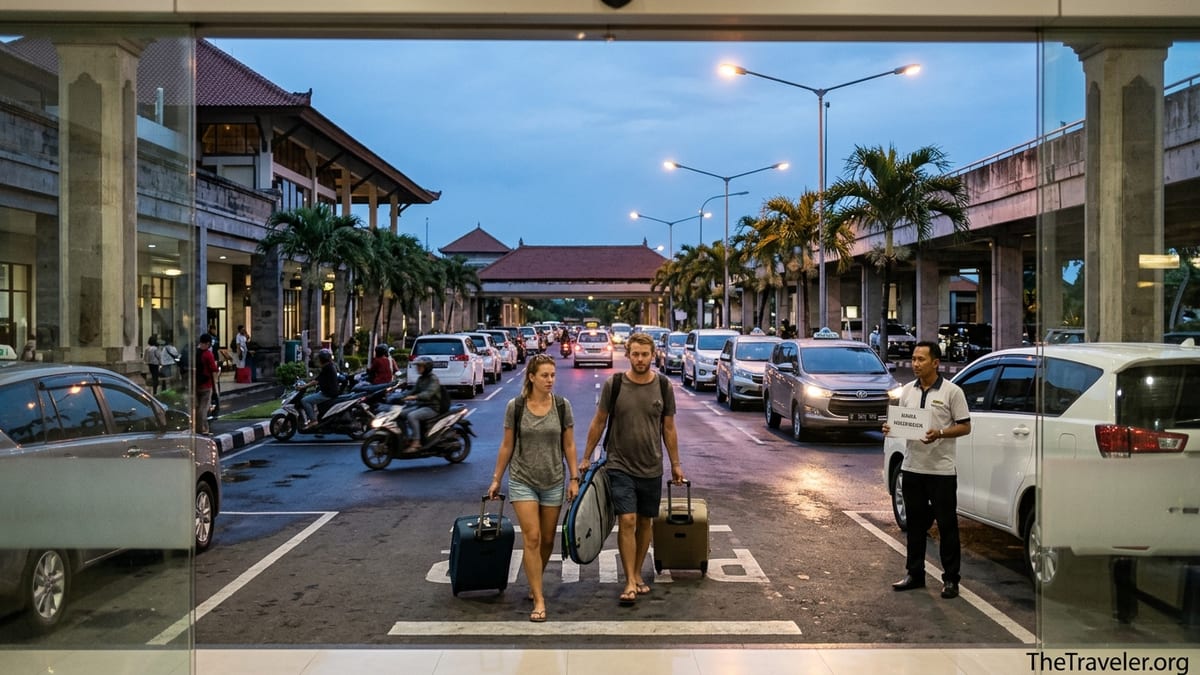
Understanding the Route: Distance, Areas and Why Traffic Is So Bad
Ngurah Rai International Airport (often called Denpasar or Bali Airport, code DPS) sits in Tuban, just south of Kuta. Canggu stretches along Bali’s southwest coast, with popular areas including Berawa, Batu Bolong, Echo Beach and Pererenan. On paper, most Canggu stays are only about 19 to 25 kilometres from the airport, depending on your villa’s location and the route your driver takes. In a city with fast-flowing roads this would be an easy 30-minute drive. In south Bali’s current traffic, that is rarely the case.
The core problem is that most airport-to-Canggu routes funnel through the same chronically congested corridors: Kuta, Sunset Road, Seminyak, Kerobokan and Berawa. These districts are packed with hotels, shops and restaurants, with narrow streets that were never designed for heavy car traffic. Canggu itself, especially Jalan Raya Canggu and the small roads feeding Batu Bolong and Berawa, is notoriously jammed in late afternoon and evening as locals commute and visitors head for sunset drinks.
As a result, travel time depends far more on when you land than how far you need to go. Travelers arriving around 2 pm on a weekday in high season often report 90 minutes door to door to central Batu Bolong, and up to two hours when a minor accident or ceremony creates a bottleneck. By contrast, people landing at 10 pm frequently reach Berawa in 40 to 50 minutes along clear roads. When planning, it is safer to assume the higher end of the range and be pleasantly surprised if traffic happens to be light.
It also matters exactly where in Canggu you are staying. A villa near Canggu Shortcut or the rice fields behind Batu Bolong can easily add 10 to 20 minutes as your driver navigates single-lane roads and scooters parked along the verge. If you are sharing your location with a driver from your phone, zoom in and warn them if your property sits inland on a tiny gang so they can choose the most logical access road from the main north–south artery.
Best Driving Routes From the Airport to Canggu
There are three broad route patterns most drivers use from Ngurah Rai Airport to Canggu. Which one is “best” on any given day depends on time, traffic and exactly where you are going. Private drivers often check navigation apps a few minutes before leaving the airport to decide which corridor is moving fastest.
The most common route runs north through Kuta and Seminyak, then into Kerobokan and finally Canggu. A typical pattern is airport to Kuta via Jalan Raya Kuta, then onto Sunset Road, then up through Seminyak and Kerobokan before turning toward Berawa or Batu Bolong. This is the most direct road mileage, and in light traffic it can be the fastest. Around school pickup time, weekday evenings or during big events, it can become a slow crawl, especially around the Sunset Road and Seminyak intersections.
A second pattern uses the coastal corridor via Jimbaran and Legian before joining the same northbound axis. Some drivers favour this in the late evening when the beachfront roads are relatively clear and traffic lights are better spaced. For example, a family landing at 11 pm may find their driver hugging the coast up past Legian before turning inland for Berawa, often making the trip in under an hour even with a short stop at a 24‑hour minimart.
A third option makes partial use of the Bali Mandara Toll Road before looping back inland. This toll bridge primarily connects the airport with Nusa Dua and Sanur, but in very heavy Kuta traffic some drivers briefly enter the toll network to bypass the most gridlocked stretches before exiting toward Denpasar and bringing you across to the Kerobokan and Canggu area. This is less common and can be more expensive because of toll fees, but on certain holiday weekends it can shave 15 to 20 minutes off a journey otherwise stuck behind tour buses and airport taxis.
Realistic Travel Times by Time of Day and Season
In 2026, the most accurate way to think about the Bali Airport to Canggu transfer is as a range rather than a fixed duration. In normal conditions with no major accidents or road closures, you can expect a typical travel time of 45 to 90 minutes. Where you fall in that window is largely dictated by the hour you leave the airport rather than the exact distance to your villa.
Arriving late at night remains the sweet spot. Travelers landing between 9 pm and 1 am often report reaching Berawa or Batu Bolong in about 40 to 55 minutes, even with a short luggage trolley delay and a brief air-conditioned pause at a minimart. With local workers off the road and sunset crowds already settled into bars, the main arteries flow more smoothly. For a couple arriving at 10 pm on an international flight, clearing immigration, grabbing checked bags and meeting a pre-booked driver by 11 pm, pulling into their Canggu guesthouse around midnight is a reasonable, realistic expectation.
Daytime and sunset arrivals are a different story. Between roughly 3 pm and 7 pm, roads into Canggu are at their most congested as surf schools wrap up, day-trippers leave beach clubs and office workers head home. It is common for the airport to Batu Bolong run to take 75 to 100 minutes during this period, with occasional journeys stretching past the two-hour mark when heavy rain or a ceremony causes temporary road closures. First-time visitors are often surprised that a 12 km stretch around Canggu itself can account for half the total transfer time.
Season also plays a role. July, August and late December are peak months when overall traffic volumes are highest. During these periods, mid-morning can also see heavier conditions as tours depart for Ubud and day trips to the Bukit Peninsula. If you land around 10 am in late July, a cautious estimate is 60 to 90 minutes to central Canggu. By contrast, shoulder months like May or early November tend to offer slightly smoother flows, although there are no guarantees. Whatever your arrival month, if you are connecting to a time-sensitive activity such as a wedding rehearsal or surf camp orientation, avoid planning anything important within three hours of your scheduled landing.
Private Drivers: Smoothest Option for Heavy Traffic
For most travelers heading straight to Canggu with luggage, a pre-booked private car is the least stressful choice, especially in heavy traffic or at peak hours. Private drivers wait in the arrivals area with a sign, track your flight, and typically factor realistic traffic patterns into their timing. In 2026, reliable companies and guesthouses commonly quote airport to Canggu transfers starting around 225,000 to 350,000 Indonesian rupiah for a standard car, rising to 450,000 rupiah or more for a large SUV or minivan suitable for surfboards or a family with multiple suitcases.
To picture how this plays out in real life, imagine a couple with two medium suitcases landing from Sydney at 3:30 pm in August. They pre-arrange a transfer for 300,000 rupiah through their Canggu villa. Their driver messages via WhatsApp as they taxi to the gate, meets them after customs with a name sign, and walks them directly to the car parked in the official lot. Traffic is heavy through Seminyak and Berawa, but they are already seated with air conditioning and water bottles, and the journey takes 80 minutes door to door. There are no negotiations, no last-minute price surprises and no app connectivity issues.
Private drivers are also more flexible when it comes to practical stops. If you need to pick up a local SIM card, baby supplies or a few groceries en route, most drivers are happy to pause at a minimart or small supermarket and wait for 10 to 15 minutes, sometimes with a modest extra fee if the stop is long. This can be invaluable if you are arriving late and your villa does not provide welcome supplies. For families, it is possible to request a child seat in advance, which is rarely an option with metered taxis or ride-hailing services.
On a heavily trafficked route such as the airport to Canggu, the main downside of private drivers is cost compared with the very cheapest app-based rides. However, when you factor in the wait time at the airport, the walk to the pickup zone, and the uncertainty of finding a large enough vehicle for multiple surf bags, the price difference often feels small. For solo backpackers arriving with just a carry-on, ride-hailing may still be more budget-friendly, but for most others, particularly late-night or peak-hour arrivals, the convenience of a pre-arranged driver is hard to beat.
Official Airport Taxis and On-the-Spot Negotiations
Ngurah Rai Airport has an official taxi cooperative with a counter near the arrivals exit. Here, staff quote fixed fares to major destinations, including Canggu. Current posted prices for Canggu are typically in the region of 120,000 to 160,000 rupiah for standard vehicles, though specific rates can vary depending on exact drop-off location and any recent tariff adjustments. You pay or receive a ticket at the counter, then are directed to a driver outside. This system is designed to avoid on-the-kerb haggling and gives first-timers a baseline sense of cost.
Outside the formal counter system, you will almost certainly encounter independent drivers in the public arrivals area offering transfers to Canggu. They often start with higher quotes, for example 300,000 to 400,000 rupiah or more for a regular car. Negotiating politely and firmly can sometimes bring this down, but after a long flight, many travelers accept a moderate premium in exchange for getting moving quickly. If you do negotiate on the spot, agree the full fare in rupiah before entering the car, specify whether the price includes tolls, and ensure you are heading to the correct “Canggu” area, as some drivers use the term loosely for anywhere north of Seminyak.
One advantage of taking an official taxi or negotiated car at the terminal is straightforward logistics. Unlike ride-hailing, you do not need local mobile data, an app account or an Indonesian phone number. Solo travelers landing in the early hours of the morning may feel more comfortable stepping straight into a waiting taxi than walking to a ride-hailing lounge. The trade-off is less control over car quality and limited ability to make multiple stops without renegotiating the fare on the fly.
For short-notice arrivals during extremely busy periods, the official taxi counter can also serve as a useful backup when ride-hailing apps show no cars available or continuously cancel. In late December evenings, when storms and demand spikes combine, some visitors report that the reliability of an old-fashioned taxi with a fixed airport fare outweighs any savings from trying to secure a cheaper app-based ride.
Grab and Gojek: How Airport Pickup Works in 2026
In 2026, both Grab and Gojek operate at Ngurah Rai Airport, but they cannot pick you up directly at the curb outside arrivals. Instead, the airport designates specific ride-hailing pickup areas and lounges. International and domestic terminals have signed pathways that guide you past the crowds of freelance drivers toward Grab and Gojek zones, where you can meet your assigned car. Expect at least a 5 to 10 minute walk with your luggage from the customs exit to these areas, depending on your terminal and walking pace.
For a typical app journey from the airport to Canggu, recent users report fares in the broad range of 120,000 to 200,000 rupiah for a small car on GrabCar or Gojek’s GoCar service, and higher for larger or premium vehicles. Prices fluctuate with demand and dynamic pricing, so landing at 11 pm in shoulder season might yield a 130,000 rupiah quote to Batu Bolong, while a stormy late afternoon in July could push instant-book quotes significantly higher. Payment by card or in-app wallet is widely supported, but it is still wise to carry enough cash in case your driver prefers that option or if a card transaction fails.
To make ride-hailing smooth, it helps to prepare before you fly. Install the Grab and Gojek apps on your phone ahead of time, register a payment method that works internationally, and download an offline map of Bali in case your mobile data is patchy when you land. If your home SIM includes roaming, you can usually order a car immediately on arrival. If you are buying a local SIM card at the airport, complete that step first, then open the app and set your pickup as the official Grab or Gojek zone rather than “Arrivals” generally.
One practical example: a solo traveler arriving from Singapore at 9 pm with just a backpack may decide to skip private drivers altogether. After clearing immigration by 9:40 pm and buying a tourist SIM, they follow the green and white signs toward the Grab and Gojek lounges, order a standard car to “Canggu, Batu Bolong,” and are quoted 150,000 rupiah. The driver messages via the app to confirm the zone, they meet at the designated bay, and with relatively light traffic they reach their guesthouse a little after 10:30 pm. This is one of the most cost-effective scenarios for app-based transfers.
Be aware that in heavy conditions, drivers can take some time to fight their way through airport traffic to the pickup area. It is not unusual to wait 10 to 20 minutes at peak times after confirming a booking. If you are very tired, carrying multiple bags or traveling with small children, weigh this waiting and walking time against the simplicity of a private driver who is already standing in the arrivals hall with your name on a sign.
Luggage, Surfboards and Villa Access Logistics
The Bali Airport to Canggu run is particularly popular with surfers and long-stay guests who travel with bulky luggage, from board bags to collapsible prams. This has a real impact on which transfer option makes sense. Small ride-hailing cars can struggle to accommodate more than two large suitcases plus passengers, and very few are configured to carry multiple longboards safely inside the cabin. If you are traveling with a 7‑foot surfboard or a large wheeled suitcase for each family member, it is worth booking a larger vehicle class or private van in advance.
When arranging a private transfer or requesting a driver through your accommodation, be specific about what you are carrying. Instead of saying “two bags,” mention “two checked suitcases and one 7‑foot surfboard” or “one large stroller and three medium suitcases.” This allows the coordinator to assign an appropriate car, such as a Toyota Innova or a minivan, which can handle both passengers and equipment comfortably. While the fare may be slightly higher than a compact sedan, it is far cheaper than discovering at 11 pm that your board does not fit and having to arrange a second vehicle at walk-up prices.
Villa access is another under-estimated factor. Many Canggu villas are tucked down narrow lanes that regular taxis and larger vans cannot enter. You may need to walk the last 50 to 150 metres along a rice field path or gang, sometimes in the dark. To avoid confusion, ask your host for a dropped pin and written access instructions in English, and share these with your driver as you depart the airport. It is common for drivers to call hosts a few minutes before arrival to double-check last turns, which can save 15 minutes circling in the maze of one-way streets behind Batu Bolong.
If you are arriving late at night or with heavy bags, consider asking your villa in advance whether staff can meet you at the lane entrance. Some properties, especially those with on-site security or 24‑hour reception, are happy to send someone to help carry luggage down the final stretch. If you are arriving in a downpour, having a flashlight or phone torch handy makes the last steps on wet tiles safer, particularly after a long journey and a stop-start drive through Bali traffic.
Families with infants or toddlers should also think about car seats. Indonesian law and local practice do not mirror common Western norms in this area, and taxis or ride-hailing vehicles almost never carry child seats. Private transfer companies serving Canggu are more likely to have at least a few child seats available. Requesting them at the time of booking, rather than on the day itself, increases your chances significantly. If traveling for an extended stay, some parents choose to bring a compact travel car seat from home specifically for the airport transfers and any longer drives during their trip.
Late Arrivals, Red-Eye Flights and Safety Considerations
Bali sees many late-night and red-eye arrivals, especially from East Asia and the Middle East. Landing in the late evening can be one of the most comfortable ways to approach the airport to Canggu journey, thanks to lighter traffic, but it does make planning your transfer more important. In the early hours of the morning, not all airport taxi desks are fully staffed, and ride-hailing availability can fluctuate, especially in shoulder season or bad weather. A pre-booked private driver is the most reliable option if your scheduled arrival time is between midnight and 5 am.
From a safety perspective, the airport to Canggu route is generally straightforward, but common-sense precautions still apply. Always use a licensed taxi, a vetted private driver or a reputable app, rather than accepting unsolicited offers from strangers to “follow me to my car” in unmarked areas of the parking lot. Once in the vehicle, stow handbags and small backpacks on the floor or under the seat rather than on your lap next to an open window, particularly in slow-moving traffic where you may be exposed to passing scooters.
Fatigue is another factor on late arrivals. It is easy to underestimate how draining a long international flight, immigration lines and humid air can be before you even reach the taxi rank. Build in time to rehydrate and use airport facilities before you begin the onward drive. If you know you are prone to motion sickness, sitting in the front passenger seat and asking the driver to open a window slightly through the more stop-start inner-city sections can help. For those landing around midnight with a long onward journey the next morning, some travelers choose to spend one night at an airport or Kuta hotel and continue to Canggu after breakfast, when they feel fresher and better able to enjoy the scenery.
One practical late-arrival scenario: a solo traveler from Europe lands at 11:30 pm, clears immigration by 12:15 am and meets a pre-booked driver at the arrivals gate. The car is already positioned near the exit, avoiding any need to walk to a ride-hailing lounge. With minimal traffic, they reach a Berawa guesthouse by 1 am, check in, and sleep immediately, rather than spending extra time negotiating prices or waiting for an app driver to arrive in an otherwise quiet terminal forecourt.
The Takeaway
The transfer from Ngurah Rai International Airport to Canggu is short in kilometres but long in unpredictability. South Bali’s road network and growing popularity mean that your landing time, luggage load and choice of transport all have a bigger impact on your experience than the precise route your driver takes. For most visitors, especially at busy hours or with bulky bags, a pre-booked private driver offers the best balance of simplicity, comfort and realistic timing.
Ride-hailing with Grab or Gojek can be an excellent value choice for app-savvy travelers arriving at reasonable hours with light luggage, provided you are comfortable walking to the designated pickup zones and potentially waiting during busy periods. Official airport taxis and on-the-spot negotiations remain a practical fallback for those without mobile data or advance bookings, though fares can be higher than app-based rides for the same distance.
Whichever you choose, plan with conservative time buffers, particularly in peak season and around sunset. Assume 60 to 90 minutes for the drive, be open to mild delays, and communicate clearly with your driver and accommodation about luggage, surfboards and final lane access. With realistic expectations and a transfer plan that matches your arrival time and travel style, the journey from Bali Airport to Canggu becomes less of a stress point and more of a straightforward final step toward your first sunset on the island.
FAQ
Q1. How long does it really take to get from Bali Airport to Canggu?
In normal conditions, expect 45 to 90 minutes door to door, with late-night transfers usually closer to 45 to 60 minutes and peak afternoon or sunset trips often taking 75 minutes or more.
Q2. What is a typical price for a private driver from Ngurah Rai Airport to Canggu?
Most reputable operators in 2026 quote roughly 225,000 to 350,000 rupiah for a standard car, and more for larger vehicles or vans that can carry multiple surfboards or large families.
Q3. Are Grab and Gojek allowed to pick up passengers at Bali Airport?
Yes, both operate at Ngurah Rai Airport but must use designated pickup areas or lounges. You cannot usually meet them directly at the curb outside the arrivals exit.
Q4. Is it safe to arrive late at night and go straight to Canggu?
Generally yes, provided you use a licensed taxi, vetted private driver or trusted ride-hailing service. Traffic is lighter at night, and many travelers prefer late transfers for this reason.
Q5. Should I book my airport transfer to Canggu in advance?
Advance booking is strongly recommended, especially in high season, if you arrive late at night, travel with children or carry bulky luggage such as surfboards or strollers.
Q6. Can I fit surfboards or very large bags in a regular taxi or Grab car?
Short boards and a couple of suitcases may fit in some sedans, but for longboards or several large bags it is safer to pre-book a larger vehicle such as a minivan or SUV.
Q7. Is it better to stay near the airport if my flight lands around midnight?
If you are very tired, traveling with young children or facing a very long journey behind you, one night near the airport or in Kuta can make sense before heading to Canggu the next day.
Q8. How do I avoid getting overcharged by taxis at Bali Airport?
Using the official airport taxi counter, booking a driver through your hotel or comparing several ride quotes in Grab or Gojek before committing are the easiest ways to keep fares reasonable.
Q9. What if my flight is delayed and I have a pre-booked driver?
Most established drivers and transfer companies track flight numbers and adjust pickup times, though there may be waiting limits. Inform them by message as soon as you have Wi‑Fi or mobile data.
Q10. Are there any public buses or cheap shared shuttles from the airport to Canggu?
As of 2026 there is no straightforward public bus or regular shared shuttle directly from the airport to Canggu, so most travelers use private drivers, taxis or ride-hailing services.