


The Bay of Kotor in Montenegro is one of Europe’s most dramatic coastal landscapes, a fjord-like inlet ringed by limestone peaks and dotted with stone villages and island churches. Whether you arrive by cruise ship, rental car or local bus, you will find a compact region where medieval towns, calm swimming spots and big Adriatic views are all within an hour of each other. This guide focuses on the main bases around the bay, how to see it from the water and the road, and where to find the best viewpoints and places to stay.
Get the latest updates straight to your inbox!
Getting Oriented Around the Bay of Kotor
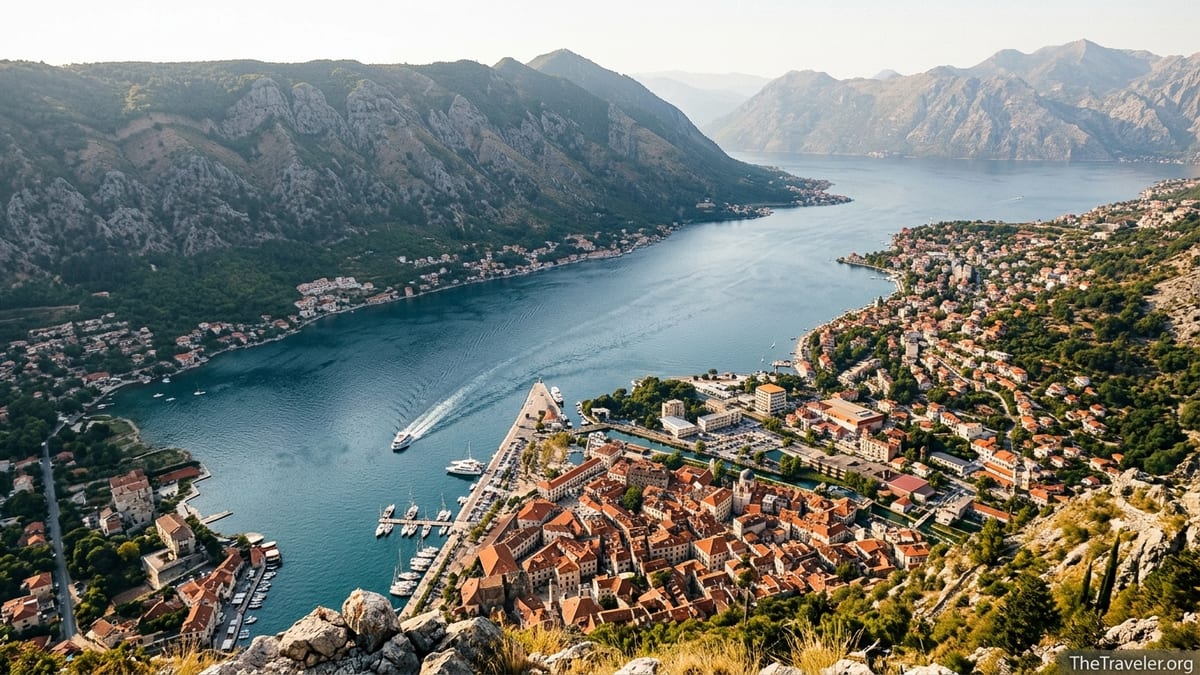
The Bay of Kotor, often called Boka Bay, sits on Montenegro’s northern coast close to the border with Croatia. It is shaped like a series of linked basins that cut deeply into the mountains, with narrow straits connecting each section. The innermost part of the bay is where you find Kotor itself, backed by steep limestone cliffs. Moving outward toward the Adriatic, the road and shoreline pass smaller towns such as Dobrota, Perast, Risan, Morinj, Bijela, Tivat and finally Herceg Novi near the bay entrance.
For a first visit, it helps to think of the bay in simple sections. The inner bay is Kotor and its immediate neighbors, ideal if you want historic streets and easy access to tours. The mid-bay is centered on Perast and Risan, quieter and more romantic, with some of the best open-water views. The outer bay runs from Morinj and Bijela around to Herceg Novi and the Luštica Peninsula, where the scenery opens up towards the Adriatic and swimming options become broader and more beach-like.
Distances are short but travel can be slow, especially in high season from June to September when traffic builds up on the narrow coastal road. Kotor to Perast is only about 12 kilometers, usually 20 minutes by car outside peak times, while Kotor to Herceg Novi takes roughly an hour by road if you follow the northern shore the whole way. A small car ferry links Lepetane and Kamenari across the narrow Verige Strait, saving 30 to 40 minutes of driving when you are connecting Tivat or Kotor with Herceg Novi or the Croatian border.
First-time visitors often underestimate how much they can see here without a car. Regular local buses connect Kotor, Perast and Herceg Novi, and group boat tours stitch many of the same towns together by water. Still, if you want to mix in high viewpoints, side trips to Lovćen National Park, or a full loop drive around the bay, a rental car from Tivat Airport or Podgorica Airport gives the most flexibility.
Kotor: Medieval Heart of the Bay
Kotor is the visual and practical heart of the bay. Enclosed by stone walls and overlooked by a zigzagging mountain path, the Old Town is a compact grid of alleys, small squares and churches that rewards slow exploration in the early morning or evening once cruise crowds thin out. The main gate is only a 5 to 10 minute walk from the cruise pier and intercity bus station, which makes it the natural starting point for most visitors.
The most famous viewpoint above Kotor is the San Giovanni Fortress, reached via roughly 1,300 stone steps from the Old Town. The climb fee is around 8 euros in high season and the ascent takes 30 to 45 minutes for reasonably fit travelers. Mornings before 9 am or late afternoons after 5 pm are the most comfortable in summer, with softer light and less heat. From the top ramparts you get a sweeping view down into Kotor, across the inner bay and out toward Dobrota and the narrower channel beyond.
Within the town itself, key sights include the twin-towered Cathedral of Saint Tryphon and the Church of Saint Luke, both reminders of Kotor’s Venetian and medieval trading past. Cafes line the small squares, and you can still find reasonably priced espresso and a pastry for under 3 euros if you step a street or two away from the main gate. Accommodation inside the walls is mostly apartment-style rooms in old stone buildings, often without lifts, while just outside the walls modern hotels and guesthouses provide easier access to parking and slightly quieter nights.
Kotor is also the main departure point for boat tours around the bay. On the waterfront in front of the old town you will see small kiosks advertising half-day and full-day trips, with group departures in season typically priced from about 25 to 40 euros per person for a 3 to 6 hour tour, depending on route and inclusions. Many travelers use Kotor as a base for three or four nights, combining a fortress climb and Old Town wander with at least one boat day and a scenic road or minibus trip into the surrounding mountains.
Perast and Our Lady of the Rocks: Baroque Gem of the Bay
Perast sits about 20 minutes’ drive north of Kotor along the waterfront road through Dobrota and Ljuta. Unlike Kotor, Perast is essentially one long waterfront street backed by steep slopes and baroque stone houses. It has no sprawling new town, no large supermarkets and very limited car access in summer. Drivers park in lots at either end of the village and walk in, which keeps traffic low and preserves the old-world atmosphere along the promenade.
The twin islets just offshore are what define Perast’s skyline. One, known as Our Lady of the Rocks, is an artificial island built up over centuries and topped by a church and small museum. The other, Saint George, is a natural island that remains a monastery and is not open to visitors. Short boat shuttles leave constantly from Perast’s waterfront, taking around five minutes to reach Our Lady of the Rocks. Expect to pay just a few euros per person for a simple return hop, and plan about 30 to 45 minutes on the island to wander the church interior and enjoy the view back toward the village.
Perast itself is peaceful for much of the day, especially before mid-morning and later in the evening once day-trippers leave. Several waterfront restaurants set tables right by the water, serving grilled fish, risotto and Montenegrin wines. Prices are higher than everyday local spots in the hinterland but still reasonable by broader European standards. A plate of grilled squid with a side salad may run 15 to 20 euros in 2026, and a glass of local white wine from the coast or Lake Skadar region often costs 4 to 6 euros.
Swimming in Perast is focused on small stone jetties and ladders rather than sandy beaches. Locals and visitors alike climb down from the waterfront wall or use designated platforms; the water is deep and usually very clear, which suits confident swimmers more than small children. Those who want a wider arc of shoreline and more family-friendly beach clubs often base themselves in Dobrota, Orahovac or the Tivat area and come to Perast for a day visit and sunset dinner rather than for a full week’s stay.
Tivat and Porto Montenegro: Modern, Convenient Base
Tivat occupies a strategic position on a flatter stretch of coast between the inner and outer sections of the bay. It is home to Tivat Airport, which handles many of the seasonal flights bringing visitors to the Montenegrin coast. Just a few minutes’ walk from the town center lies Porto Montenegro, a smart marina development lined with yachts, restaurants, cafes and high-end apartments. The area feels contemporary and international, a contrast with the medieval stone of Kotor and Perast.
For travelers, Tivat works well as a comfortable and convenient base, especially for families or those arriving on late flights who do not want to drive narrow roads on their first night. Accommodation ranges from modern waterfront hotels with pools to functional apartments a few streets inland. Prices for midrange hotels in high summer can sit in the 120 to 200 euro per night range for a double room, though shoulder seasons in May, June and late September are often significantly cheaper.
While the shoreline in Tivat itself is more urban, the wider municipality has access to several good swimming areas. One of the best known is Plavi Horizonti beach on the Luštica Peninsula, about a 20 to 30 minute drive away depending on traffic. It offers a curved sandy bay and clear water that is shallower than the drop-offs along the Kotor waterfront, making it attractive for children and less confident swimmers. In summer you can expect to pay a modest fee if you want a sunbed and umbrella, while the basic access to the beach remains free.
Boat tours also operate from Tivat, although not as densely as in Kotor. Some full-bay and Blue Cave trips pick up passengers at Porto Montenegro or nearby jetties, which can be handy if you are staying nearby and do not want to drive to Kotor just to join a tour. Many visitors combine Tivat and Kotor by bus, taxi or rental car, treating Tivat as either a gentler base with easy airport access or as a final night stop before an early flight home.
Herceg Novi and the Outer Bay
Herceg Novi sits near the entrance to the Bay of Kotor, close to the border with Croatia. Compared with Kotor, it feels more like a lived-in coastal town than a purely historic showcase, with residential neighborhoods, multiple beach areas and a long seaside promenade that runs for several kilometers through neighboring villages. Stepped streets connect the old center uphill with the waterfront below, so be prepared for lots of stairs when you explore here on foot.
The town makes a good base for visitors who want more beach time and a slightly less touristic feel. Along the shore you will find a mix of small pebble beaches, concrete swimming platforms and informal coves. Many waterfront sections offer sunbeds and umbrellas for daily rental, typically for 5 to 15 euros for two beds and a shade in peak season, though you can also find unserviced stretches where you simply lay a towel on the concrete or pebbles and swim for free. The water around the outer bay is often a fraction cooler and more open-feeling than the inner basins.
Herceg Novi is also a launch point for boat trips toward the Blue Cave, Žanjic Beach and the open Adriatic. Speedboat tours commonly include a circuit that skirts the Mamula fortress island, visits the Blue Cave for a short swim stop and then relaxes at one of the beach restaurants near Žanjic or Mirište before returning. Prices vary with group size and duration, but half-day group trips from Herceg Novi in recent seasons have typically fallen somewhere in the 30 to 50 euro per person range.
For travelers linking Montenegro and Croatia, Herceg Novi is often the last or first stop, with buses running to Dubrovnik and other points along the Dalmatian coast. It pairs especially well with a stay in Kotor or Perast, giving you a chance to experience both the enclosed, dramatic inner bay and the more open seafront at the bay’s mouth within a single trip of five to seven days.
Boat Tours, Viewpoints and a Scenic Driving Loop
Seeing the Bay of Kotor from the water is almost essential, whether you choose a shared boat tour or hire a small boat with a skipper. Standard half-day tours from Kotor usually link Perast, Our Lady of the Rocks, parts of the outer bay and at least one swimming stop. Many extend as far as the Blue Cave near the Luštica Peninsula, particularly in calm summer weather. Tour desks on the Kotor promenade typically quote around 30 to 40 euros per person in 2026 for a four to six hour itinerary that includes the island church, time in Perast and swimming opportunities.
Private speedboat charters are widely available from the Kotor waterfront, Porto Montenegro in Tivat and various jetties around the bay. These suit families or small groups who want to customize their route and timetable. Expect to pay a flat hourly rate for the vessel and skipper, and note that fuel is often an additional line item for longer runs. Travelers commonly report rates starting from roughly 80 to 120 euros per hour for a small speedboat, scaling up with boat size and comfort. If you want to swim at the Blue Cave before it gets busy, aim for an early departure around 8 am.
On land, several viewpoints give expansive perspectives over the bay. The climb to the San Giovanni Fortress above Kotor is the best known, but you can also drive or join an organized excursion up the serpentine road towards the village of Njeguši and Lovćen National Park. As the road rises, successive hairpins reveal wider and wider views back over the bay and its basins. Many guided tours stop at official lay-bys and small cafes where you can photograph the full sweep of Boka Bay, usually combining these stops with a tasting of local smoked ham and cheese in Njeguši.
If you are comfortable driving, a full loop around the bay makes a satisfying day out. A typical clockwise circuit from Kotor might run through Dobrota, Perast and Risan to Morinj and Bijela, then on to Herceg Novi for a lunch and swim stop. From there you continue along the outer shore to Kamenari, take the short Lepetane ferry across to the Tivat side, and then return to Kotor via Tivat and the low ridge behind the town. The full loop covers around 120 to 140 kilometers depending on detours and usually takes a full day with stops. Parking in Kotor and Perast can be tight in July and August, so starting early in the morning is wise.
Swimming Spots and Waterfront Life
Unlike some Mediterranean destinations, the Bay of Kotor is not dominated by long sandy beaches. Instead, most swimming happens from stone jetties, concrete platforms and small pebble coves. In Kotor and Dobrota, accommodation often sits directly across a narrow lane from the waterfront, with ladders and tiny terraces where guests dip into the bay before breakfast or in the evening. Many of these spots are effectively public, though some guesthouses also maintain small private platforms for their guests only.
Dobrota, stretching northwest from Kotor along the inner bay, offers some of the best low-key waterfront life. Here you will find a sequence of stone villas, small churches and shaded terraces where locals swim in the early morning, followed by visitors later in the day. A number of informal bars and restaurants open directly onto the water, with people swimming between courses in high summer. Sunbed rentals are less structured than on big resort beaches; in many places it is simply a matter of finding a free edge and laying a towel on the warm stone.
Beyond Dobrota and Perast, several pockets around the bay draw swimmers and sunseekers. Orahovac, a short drive past Perast, has a small but pleasant stretch of shoreline that feels more village-like and often a little quieter than Perast itself. Around Tivat, small town beaches and beach clubs provide more conventional facilities like changing cabins, showers and on-site cafes. Plavi Horizonti, mentioned earlier, is the closest thing in the area to a classic sandy resort beach, with gently shelving sand and pine trees backing the shore.
Water quality in the bay is generally good, especially away from the busiest harbor corners. Still, locals often prefer to swim earlier or later in the day in the height of summer, both to avoid the midday heat and to sidestep occasional congestion at popular platforms. Footwear that can handle pebbles and the odd sea urchin is helpful if you plan to explore rocky coves or scramble in and out where there are no ladders. As always, be cautious of boat traffic and give way to any vessels using established channels near marinas or jetties.
Where to Stay Around the Bay
Choosing where to stay around the Bay of Kotor depends largely on whether you value nightlife and conveniences, or quiet waterfront views and slower evenings. Kotor Old Town is the obvious choice for first-time visitors who want atmosphere and easy access to tours. Staying inside or just outside the walls places you within a short walk of most restaurants, the fortress trailhead and the main boat tour piers. It is busy, and in peak season the narrow streets can feel crowded during cruise ship hours, but late evenings and early mornings retain a surprisingly local feel.
Just along the shore, Dobrota is often recommended as the best all-rounder. It puts you close enough to Kotor to walk or take a short taxi ride, yet the waterfront is more relaxed and residential. Many guesthouses here offer direct access to the water, breakfast terraces facing the bay and on-site parking. Prices vary widely but you can often find midrange rooms in the 80 to 150 euro per night bracket in mid-summer, with better deals outside July and August.
Perast appeals to travelers who value romance and quiet over nightlife. The car-restricted waterfront, stone palaces converted into boutique hotels, and open views across the bay create a distinct atmosphere. Accommodation stock is smaller and prices reflect the limited supply, especially for rooms with balconies overlooking the water. Many visitors therefore choose to stay in Kotor or Dobrota and treat Perast as a special day or evening trip, perhaps returning by taxi boat after dinner for a memorable ride under the stars if conditions allow.
Farther out, Herceg Novi and the villages along the outer bay offer better value and more space, especially for longer stays. Apartments a short stroll from the promenade can be significantly cheaper than equivalent properties around Kotor, and the area suits travelers who want to blend beach days with occasional forays into the inner bay by bus, boat or rental car. Tivat, meanwhile, is ideal for those who want modern accommodation, easy airport transfers and a quick hop to both Kotor and the Luštica Peninsula. Splitting a week between two bases, such as three nights in Kotor or Dobrota and four nights in Herceg Novi or Tivat, gives a well-rounded sense of the bay.
The Takeaway
The Bay of Kotor rewards both short visits and longer stays. Cruise passengers who see only a few hours of Kotor and a quick boat ride will glimpse the drama of the setting, but those who linger for three to seven nights unlock a slower rhythm of swimming before breakfast, quiet backstreets at dusk and drives or hikes to mountain viewpoints that reveal the bay as a whole. With compact distances, a growing range of accommodations and a strong network of local tours, it is relatively easy to shape a trip around your own appetite for history, scenery or simple waterfront relaxation.
For many travelers, the ideal approach is to combine perspectives: at least one good boat day linking Perast, Our Lady of the Rocks and the Blue Cave if conditions are right; a climb or drive to a high viewpoint; and a loose day or two spent just walking the promenade, swimming from jetties and lingering over long lunches by the water. Whether you base yourself in Kotor’s medieval core, on a shaded terrace in Dobrota, in a baroque palace in Perast or near the beaches of Herceg Novi, the constant thread is the bay itself, changing color with every passing hour and anchoring one of the Adriatic’s most memorable coastal journeys.
FAQ
Q1. How many days do I need to see the Bay of Kotor properly?
Most travelers find that three full days is the minimum to experience Kotor’s Old Town, take a boat tour and visit at least one other town such as Perast. With five to seven days you can add Herceg Novi, a full driving loop, mountain viewpoints and slower days at the water’s edge.
Q2. Is it better to stay in Kotor or Perast?
Kotor is more practical, with more accommodation, restaurants, transport connections and tour options, which suits first-time visitors and those without a car. Perast is quieter and more romantic, ideal for couples or repeat visitors who are happy with fewer services in exchange for open views and a slower pace.
Q3. Do I need a car to explore the Bay of Kotor?
No, you can see a lot without a car by combining local buses, taxis and boat tours, especially between Kotor, Perast, Tivat and Herceg Novi. A rental car becomes more useful if you want to drive the full bay loop, visit mountain viewpoints around Lovćen or combine the bay with day trips to places like Budva or Lake Skadar.
Q4. When is the best time of year to visit the Bay of Kotor?
Late May, June, September and early October usually offer the best balance of warm weather, swimmable water and lighter crowds. July and August have the hottest temperatures and liveliest atmosphere but also the heaviest traffic and highest accommodation prices.
Q5. Can I swim everywhere in the bay, or only at beaches?
You can swim from many parts of the waterfront, especially where there are stone jetties or ladders, as well as at designated beaches and platforms. Always check local signs, be aware of boat traffic near marinas and use common sense regarding water depth and your own swimming ability.
Q6. What should I expect to pay for a standard boat tour?
Group half-day boat tours from Kotor, Tivat or Herceg Novi that include Perast and Our Lady of the Rocks typically cost from about 25 to 40 euros per person, depending on duration and route. Private charters cost more but can be economical for small groups who want to customize timing and stops.
Q7. How challenging is the hike to the Kotor fortress viewpoint?
The climb to the San Giovanni Fortress involves roughly 1,300 stone steps and steady uphill walking, but no technical sections. Most reasonably fit visitors complete the ascent in 30 to 45 minutes, taking breaks as needed. Good footwear, water and avoiding the midday heat make it much more comfortable.
Q8. Are there sandy beaches near the Bay of Kotor?
The bay itself is dominated by stone and pebble shorelines, but sandy options exist a short drive away. Plavi Horizonti on the Luštica Peninsula is one of the best-known sandy beaches within an easy reach, and the broader Montenegrin coast around Budva has several more classic sandy stretches.
Q9. Is the Bay of Kotor suitable for families with young children?
Yes, provided you choose your base carefully and prioritize gentle entry points to the water. Tivat, parts of Dobrota and areas near sandy beaches like Plavi Horizonti work well for families, while the deeper drop-offs and stone ladders in places like Perast can be better suited to older children and confident swimmers.
Q10. How busy does Kotor get on cruise ship days?
On days when large cruise ships call, Kotor’s Old Town can feel very crowded between late morning and mid-afternoon, especially around the main squares and fortress entrance. Early mornings, lunchtimes when many passengers return to the ship and evenings after departure are much quieter, so planning your main sightseeing around those windows helps significantly.