


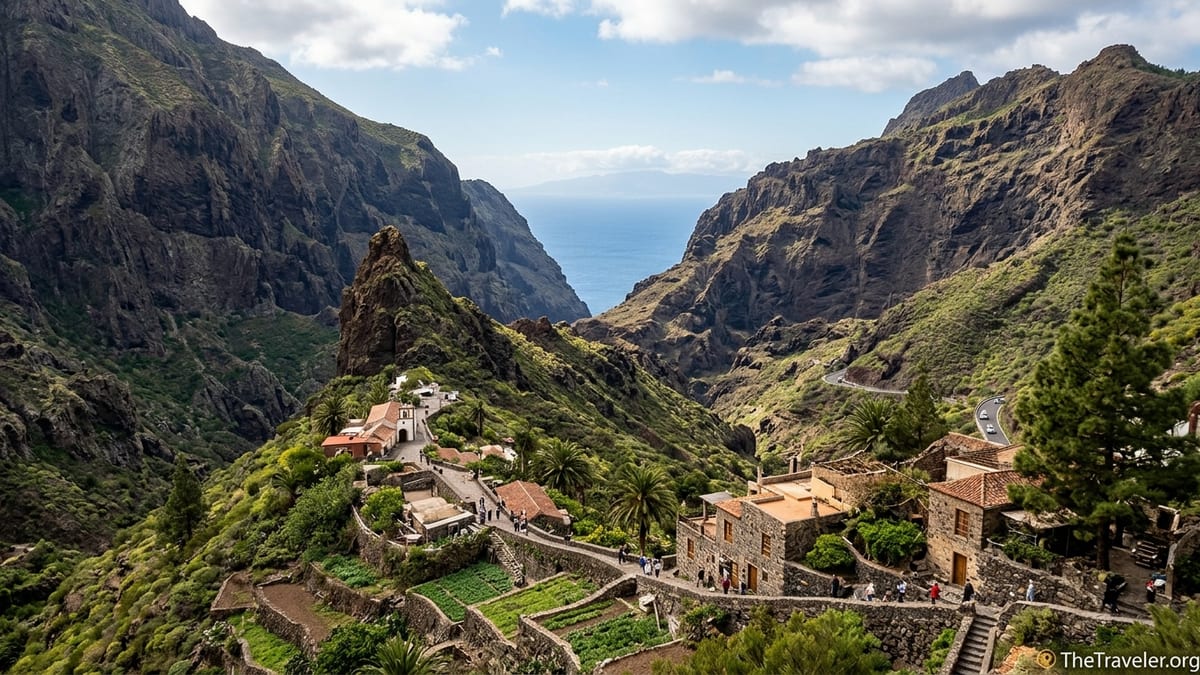
Masca has become one of Tenerife’s most recognisable images: a tiny hamlet perched on a ridge in the Teno massif, framed by cliffs that fall toward the Atlantic. In 2026 it remains both a dramatic viewpoint and the gateway to one of the island’s most tightly regulated hikes. Understanding the difference between visiting the village by road and entering the Masca Gorge is essential if you want to experience this landscape safely and legally.
Get the latest updates straight to your inbox!
Masca in the Teno massif: geography and first impressions
Masca is a small mountain settlement in the Teno Rural Park in northwestern Tenerife. It sits on a narrow saddle at around 600 to 750 metres above sea level, with steep ravines dropping on both sides and distant views to the ocean. Administratively it belongs to Buenavista del Norte, but many visitors approach from the south via Santiago del Teide, treating Masca as a day trip from coastal bases such as Los Gigantes, Puerto de Santiago or Costa Adeje.
The hamlet itself is compact: a cluster of stone houses, a small church square and a handful of bars and souvenir shops threaded along lanes and stepped paths. The attraction here is not an extensive village centre but the combination of traditional architecture, terraced slopes and cliff walls that enclose the site. The surrounding Teno massif is rugged and deeply incised, so every short stroll around the village yields new vantage points over gullies and ridges.
Masca lies on the TF-436, the narrow mountain road that links Buenavista del Norte on the north coast with Santiago del Teide inland. This route is scenic but slow, with continuous curves, steep drops and few overtaking opportunities. It is part of the appeal for many visitors, yet it also creates bottlenecks and requires cautious, patient driving, especially in peak holiday periods and on weekends when excursion traffic is heavy.
Because the settlement is so small and the terrain so confined, Masca cannot absorb large numbers of vehicles or tour groups at once. Even if you only plan to look at the village and take photographs, it is important to arrive with realistic expectations: there are limited services, virtually no flat open space and a constant flow of people trying to enjoy viewpoints and terraces.
Visiting Masca village: roads, parking and viewpoints
Visiting Masca village itself remains straightforward in 2026. You do not need a permit, ticket or reservation merely to enter the hamlet, walk its lanes or enjoy the viewpoints. Access is free, but practical constraints shape the experience. The TF-436 is narrow, with tight bends and sections protected by barriers that run close to the carriageway. Drivers must be comfortable with mountain roads, frequent passing manoeuvres with buses and vans, and the possibility of slow convoys when traffic is dense.
Parking is the main limiting factor. Public spaces in and around the village are few and often full by mid morning. Recent measures by the island authorities have aimed to reduce congestion and improve safety on the TF-436, including encouraging the use of public transport and controlled access periods during high fire risk. You should be prepared for the possibility of having to park some distance from the square, or of being turned back if controls are in place on the day of your visit.
Within the village, short walks connect several natural terraces and balconies that serve as viewpoints. From these you can see the upper reaches of the Masca Gorge, the zigzag road and, on clear days, the outline of La Gomera offshore. These viewpoints require only modest effort, though they involve steps and uneven stone paths rather than smooth pavements. For many visitors who do not wish to attempt the demanding gorge hike, time spent moving between these terraces, stopping for refreshments and absorbing the scenery is the main goal of the trip.
If you prefer not to drive, you can reach Masca by public bus from Buenavista del Norte or Santiago del Teide when services operate, by taxi arranged from nearby towns, or on an organised excursion. Using shared or public transport reduces pressure on the road and parking and is increasingly encouraged by local authorities. However, bus routes and frequencies are adjusted periodically, so travellers should always check the current island transport information shortly before travel instead of relying on older timetables.
The Masca Gorge hike in 2026: opening status and permits
The descent through the Masca Gorge from the village to the sea is a different proposition from a casual visit to the hamlet. After several years of closure and phased reopening, the trail in 2026 is open to the public but strictly regulated. The island council has put in place a visitor management system with advance online booking, mandatory safety equipment and a capped daily capacity to protect both hikers and the fragile canyon environment.
Access to the gorge requires an individual reservation made through the official booking platform. Places are limited and allocated to specific start times during the day, typically from the morning into early afternoon, so it is not possible to simply turn up in Masca and expect to walk. The system has been refined since its initial launch, and recent official documents confirm that the managed access model introduced in 2021 has been strengthened, with the operation of the pier at the mouth of the gorge and coordinated transport helping to reduce traffic on the TF-436.
There is a fee per person to enter the gorge, functioning as an environmental and management charge. The amount varies by visitor category, and residents of Tenerife or the wider Canary Islands may benefit from reduced or zero charges under the ecotax scheme, while non resident visitors pay a higher rate. As figures and categories can change with new decisions by the island government, writers preparing material for publication should always verify the current fee table directly on the official booking portal rather than quoting outdated amounts.
Reservations normally require basic personal details such as names and identification numbers, agreement to the safety rules and acceptance of data protection terms. You receive a dated ticket with a specified entry time, and you must present it at the control point in Masca together with identification documents for all members of the party, including children. Policies on how far in advance slots open, which payment methods are accepted and how cancellations or changes work are periodically updated, so they should be confirmed against the latest information on the official portal immediately before publication.
Trail characteristics, safety rules and required equipment
The Masca Gorge hike is classified by the operator as a demanding route. From the edge of the village, the trail descends through the ravine to sea level over a distance of roughly 4.5 kilometres one way. The vertical drop is in the order of 700 metres, concentrated into a sequence of steep sections, rocky steps and boulder fields that require steady footing, good balance and confidence on uneven ground. For a reasonably fit hiker following the regulated route, the descent typically takes several hours, with exact times varying according to conditions and the pace of the group.
The terrain is natural and rugged. The path alternates between narrow ledges, stone stairs, dry stream beds and shaded gullies. Parts of the gorge can feel enclosed, with high rock walls close on either side, while other stretches open out to wider bends. In good weather the lower section can be hot and humid, especially on days with little wind, and the amount of direct sun varies with the season and time of day. After rain, the risk of slippery surfaces and falling debris increases, and the authorities may close the trail temporarily if conditions are unsafe.
Safety rules set by the island government and the trail operator are detailed and binding. Current guidance specifies that hikers must wear closed hiking boots with a treaded sole and bring a minimum amount of water per person, typically at least 1.5 litres, along with food and a fully charged mobile phone. Helmets are mandatory and are provided at the start of the route, to be worn throughout the descent and returned at the end of the visit. Without the required equipment, entry can be refused at the control point even if you hold a valid reservation.
Other regulations address conduct inside the gorge. Bathing in pools or the stream is forbidden, as are fires, smoking, camping and recreational drone use. Hikers must remain on the marked trail and respect instructions from staff, who monitor the flow of visitors and conditions in the canyon. Eligibility rules typically exclude very young children, with a minimum age set for safety reasons, and older children must be accompanied by a responsible adult. Because specific thresholds and lists of mandatory gear may be revised, authors should always cross check the current rule set on the official Masca Gorge information pages shortly before describing them as definitive.
Route format, boats from the sea and current operating days
The way the route is structured has evolved over time. Historically, walkers would descend from Masca to the coast, then leave by boat along the cliffs to a harbour such as Los Gigantes. More recently, official information describes a system in which the gorge operates on set days of the week, with bookable start slots that run through the late morning and early afternoon and an organised maritime connection handling most exits from the mouth of the ravine.
Current guidance indicates that the standard experience in 2026 still involves descending from the village to the sea level exit and then taking an authorised boat service to a harbour on the west coast, typically Los Gigantes. Some descriptions refer to the boat as a compulsory part of the route, while at the same time emphasising that the exact operating days and departure times depend on maritime conditions and operator schedules. Given this, it is essential to verify on both the official gorge information and with the boat operator which harbour is being used and whether a boat ticket is indeed mandatory at the time of your visit.
One important consideration is weather and sea state. Strong swell or adverse forecasts can lead to the suspension of boat services at short notice, even when the trail itself is technically open. Recent local guidance stresses that if the boat cannot run, hikers must be physically and logistically prepared for the possibility of having to climb back up the same path to Masca under supervision, or to accept alternative instructions from the authorities on the day. That makes fitness, daylight planning and conservative decision making crucial elements of any gorge trip.
Because the gorge is operated under a dynamic safety framework, regulations on whether the hike is strictly one way, whether return by the same path is routinely forbidden and whether the boat is always compulsory are subject to review. Before stating these points firmly, writers and travellers alike should examine the latest notices published by the island council and the official Masca Gorge booking pages, which explain the precise format valid for the current season.
Getting to and from Masca for village visits and gorge hikes
Reaching Masca efficiently and safely is as important as securing a gorge reservation. Drivers coming from the south usually follow the TF-1 motorway to the Santiago del Teide junction and then take the TF-436 over the crest into the Teno massif. From the north, the TF-436 climbs from Buenavista del Norte. In both directions, journey times can be significantly longer than the raw distance suggests because of the winding alignment and speed restrictions. Recent fire risk episodes have shown that the island government can place temporary controls on access to Masca, sometimes excluding private tourist vehicles, which makes it essential to check daily status updates before setting off.
Parking in or near the hamlet is scarce and cannot be guaranteed. During busy periods some visitors choose to park in Santiago del Teide or Buenavista del Norte and continue by bus or taxi, which reduces pressure on the road section that passes directly through Masca. This approach is particularly useful for those with timed gorge slots, as it decouples arrival from the uncertainties of village level parking.
Public transport plays a growing role in access management. A key service is a bus route linking Buenavista del Norte, El Palmar, Las Portelas, El Carrizal, Masca and Santiago del Teide, often referenced as line 355 when this designation is in use. Timetables show departures in both directions on all days of the week, with certain journeys continuing directly to or from Masca and others requiring a change. Importantly, some buses prioritise boarding for passengers who present a valid Masca Gorge trail ticket. Since route numbers, times and seasonal patterns can change, travellers should always confirm the latest details on the official island bus information rather than relying on historic data.
After completing the gorge hike, most visitors return to their accommodation by combining the boat from the canyon mouth to a west coast harbour with a bus or taxi back to their starting point. This can involve travelling from Los Gigantes to Santiago del Teide or to major resort areas by public bus, then connecting onwards. Given the number of moving parts in this chain, it is sensible to build in time buffers, especially in the afternoon, and to have a fallback plan such as a pre arranged taxi booking in case of missed connections or disruptions.
Alternatives to the gorge hike and options for limited mobility
Not everyone can or should attempt the Masca Gorge descent. The physical demands, equipment requirements and exposure to heat or rockfall risks mean that some visitors will prefer safer, less strenuous options. Fortunately, the wider Teno area offers many ways to appreciate the landscape without entering the regulated canyon. Around Masca itself, you can explore short paths that lead to viewpoints above the gorge, walk between hamlets along the TF-436 corridor or simply spend more time at roadside miradores that look into the ravines.
Elsewhere in the Teno massif, signed hiking routes traverse ridges and upland valleys, offering wide views over Masca and the surrounding gorges without the same level of technical difficulty. Paths above Santiago del Teide and in the direction of the Chinyero volcanic area provide medium length walks through pine and broom with regular vantage points over the western slopes. These alternatives vary in length and gradient, but many are less committing than the gorge itself while still delivering a strong sense of the island’s dramatic relief.
For visitors with limited mobility or those travelling with small children, the TF-436 between Santiago del Teide and Buenavista del Norte is a viewpoint in its own right. Several official miradores along the roadside, some with parking bays and basic facilities, allow you to step out briefly and look into the canyons without walking far. In good weather the contrasts between the green ravines and the blue ocean, especially toward Punta de Teno and the cliffs near Los Gigantes, can be appreciated from these accessible stops.
Local walking guides and organised excursions based in Santiago del Teide or the south coast resorts also offer half day trips that skirt the top of the gorge or visit other parts of the Teno Rural Park. These guided experiences can be a good compromise for travellers who want structured hiking with safety oversight but prefer routes that are graded as moderate rather than demanding. As always, it is wise to confirm in advance which trails are included and whether any permits or temporary closure dates affect them.
Planning checklist and best times to visit safely
Successful trips to Masca in 2026 begin with clear priorities. If your main goal is to walk the gorge, the first task is to secure a reservation for the desired date and time through the official booking portal and to purchase any associated boat or transport tickets that are required under the current system. These bookings should be made before you arrange secondary elements such as car hire or accommodation, because gorge places are limited and popular dates can book out well in advance.
Next, build a habit of checking for operational updates as your visit approaches. Important variables include the status of the TF-436 road, any temporary access controls imposed because of fire risk, the current operation of bus routes that serve Masca and Santiago del Teide, and maritime advisories that might affect boat departures along the cliffs. Weather alerts and high wind or heat warnings issued by the island authorities are also relevant, since they can influence both the gorge’s opening decision and the comfort and safety of ordinary village visits.
When it comes to timing your day, arriving early or later in the afternoon generally reduces congestion in the village compared with the late morning peak, though exact crowd patterns vary by season, school holidays and the broader tourism cycle. For gorge hikers, the assigned entry slot and expected walking time, plus boat departures and onward connections, will largely determine the structure of the day. That makes it important to carry a printed or offline copy of your tickets, allow for delays, and avoid planning tight onward commitments immediately after the hike.
Finally, pack and behave with mountain respect. Even though Masca is highly photographed and relatively close to resort areas, the gorge itself is a serious hike in a protected rural park. Appropriate footwear, sun protection, adequate water, food, navigation awareness and a readiness to follow staff instructions all contribute to a safe experience. For those who find that reservations are unavailable, conditions unsuitable or rules too restrictive, the Teno massif still offers rewarding viewpoints and alternative walks. With flexible planning and up to date information, you can adapt on the day and still enjoy one of Tenerife’s most impressive landscapes.